We’d like to remind Forumites to please avoid political debate on the Forum.
This is to keep it a safe and useful space for MoneySaving discussions. Threads that are – or become – political in nature may be removed in line with the Forum’s rules. Thank you for your understanding.
📨 Have you signed up to the Forum's new Email Digest yet? Get a selection of trending threads sent straight to your inbox daily, weekly or monthly!
The Forum now has a brand new text editor, adding a bunch of handy features to use when creating posts. Read more in our how-to guide
RTS
Comments
-
CSI_Yorkshire said:
I wonder how long before the "my supplier is discriminating against me because they won't give me a smart meter tariff for my mechanical meter" complaints start?[Deleted User] said:
These tariffs require a smart meter.shellfish61 said:I keep getting emails from Octopus advising my meter needs replacing and to get a smart meter, ignored. I've now had an email saying RTS will be switched off in March 2024 and that I should get a smart meter. I don't particularly want one, is there an alternative?
What's wrong with someone doing just that? No one here can have a smart meter, me included. Same goes for a few other villages locally, and probably in a fair few other rural communities. We tried to get a smart meter from SSE. To be fair to them they installed it, then came back two or three times to do modifications, like replacing the comms unit, but had to give up and replace it with another dumb meter. Interestingly the fitter that came around to fit the dumb meter had local knowledge and was disparaging about his head office thinking a smart meter would work here. I think there is a universal belief that everyone can have one. I think the reality is that around 10% of homes won't be able to have one.
1 -
That's a reason to improve the comms backend, not to permanently maintain the dumb meter arrangement.JSHarris said:CSI_Yorkshire said:
I wonder how long before the "my supplier is discriminating against me because they won't give me a smart meter tariff for my mechanical meter" complaints start?[Deleted User] said:
These tariffs require a smart meter.shellfish61 said:I keep getting emails from Octopus advising my meter needs replacing and to get a smart meter, ignored. I've now had an email saying RTS will be switched off in March 2024 and that I should get a smart meter. I don't particularly want one, is there an alternative?
What's wrong with someone doing just that? No one here can have a smart meter, me included. Same goes for a few other villages locally, and probably in a fair few other rural communities. We tried to get a smart meter from SSE. To be fair to them they installed it, then came back two or three times to do modifications, like replacing the comms unit, but had to give up and replace it with another dumb meter. Interestingly the fitter that came around to fit the dumb meter had local knowledge and was disparaging about his head office thinking a smart meter would work here. I think there is a universal belief that everyone can have one. I think the reality is that around 10% of homes won't be able to have one.
And it certainly isn't a reason to let dumb meter users onto a smart meter tariff.2 -
CSI_Yorkshire said:
That's a reason to improve the comms backend, not to permanently maintain the dumb meter arrangement.JSHarris said:CSI_Yorkshire said:
I wonder how long before the "my supplier is discriminating against me because they won't give me a smart meter tariff for my mechanical meter" complaints start?Dolor said:
These tariffs require a smart meter.shellfish61 said:I keep getting emails from Octopus advising my meter needs replacing and to get a smart meter, ignored. I've now had an email saying RTS will be switched off in March 2024 and that I should get a smart meter. I don't particularly want one, is there an alternative?
What's wrong with someone doing just that? No one here can have a smart meter, me included. Same goes for a few other villages locally, and probably in a fair few other rural communities. We tried to get a smart meter from SSE. To be fair to them they installed it, then came back two or three times to do modifications, like replacing the comms unit, but had to give up and replace it with another dumb meter. Interestingly the fitter that came around to fit the dumb meter had local knowledge and was disparaging about his head office thinking a smart meter would work here. I think there is a universal belief that everyone can have one. I think the reality is that around 10% of homes won't be able to have one.
And it certainly isn't a reason to let dumb meter users onto a smart meter tariff.No amount of improvement is going to get one to connect here - there is no detectable signal. Same goes for around 10% of UK homes, either they are in a "not spot", like us, or they are homes like my late in-laws, where the hefty stone work blocked the signal. Some blocks of flats are also a problem, as often meter and service rooms are in the centre of the building, often in a basement.Things have improved a fair bit, with one or two meters having an external comms box option, connected via a trailing lead back to the meter. The final attempt SSE made was to try one of these external comms units, but with no signal available even that didn't work.I can't see any valid reason for creating/worsening a two tier system that pushes costs up further for all those living in homes with no signal. We already have to live without public transport here, which increases the cost of living here. I don't see why we should be forced to pay very high electricity tariffs simply because the mobile network providers refuse to put a mast up here.1 -
The DCC can designate an area for MESH rather than WAN. Provided a meter can MESH with a meter that has a WAN connection with the DCC network then the meter will operate in smart mode without a direct connection. Suppliers are also rolling out Alt-HAN for difficult installations.JSHarris said:CSI_Yorkshire said:
That's a reason to improve the comms backend, not to permanently maintain the dumb meter arrangement.JSHarris said:CSI_Yorkshire said:
I wonder how long before the "my supplier is discriminating against me because they won't give me a smart meter tariff for my mechanical meter" complaints start?[Deleted User] said:
These tariffs require a smart meter.shellfish61 said:I keep getting emails from Octopus advising my meter needs replacing and to get a smart meter, ignored. I've now had an email saying RTS will be switched off in March 2024 and that I should get a smart meter. I don't particularly want one, is there an alternative?
What's wrong with someone doing just that? No one here can have a smart meter, me included. Same goes for a few other villages locally, and probably in a fair few other rural communities. We tried to get a smart meter from SSE. To be fair to them they installed it, then came back two or three times to do modifications, like replacing the comms unit, but had to give up and replace it with another dumb meter. Interestingly the fitter that came around to fit the dumb meter had local knowledge and was disparaging about his head office thinking a smart meter would work here. I think there is a universal belief that everyone can have one. I think the reality is that around 10% of homes won't be able to have one.
And it certainly isn't a reason to let dumb meter users onto a smart meter tariff.No amount of improvement is going to get one to connect here - there is no detectable signal. same goes for around 10% of UK homes, either they are in a "not spot", like us, or they are homes like my late in-laws, where the hefty stone work blocked the signal. Some blocks of flats are also a problem, as often meter and service rooms are in the centre of the building, often in a basement.Things have improved a fair bit, with one or two meters having an external comms box option, connected via a trailing lead back to the meter. The final attempt SSE made was to try one of these external comms units, but with no signal available even that didn't work.1 -
If they decided to use PLC to solve the niche no-signal areas, or mesh where that works, then there would be no problem. They could even bridge off your home WiFi or the telephone network if they chose.JSHarris said:CSI_Yorkshire said:
That's a reason to improve the comms backend, not to permanently maintain the dumb meter arrangement.JSHarris said:CSI_Yorkshire said:
I wonder how long before the "my supplier is discriminating against me because they won't give me a smart meter tariff for my mechanical meter" complaints start?Dolor said:
These tariffs require a smart meter.shellfish61 said:I keep getting emails from Octopus advising my meter needs replacing and to get a smart meter, ignored. I've now had an email saying RTS will be switched off in March 2024 and that I should get a smart meter. I don't particularly want one, is there an alternative?
What's wrong with someone doing just that? No one here can have a smart meter, me included. Same goes for a few other villages locally, and probably in a fair few other rural communities. We tried to get a smart meter from SSE. To be fair to them they installed it, then came back two or three times to do modifications, like replacing the comms unit, but had to give up and replace it with another dumb meter. Interestingly the fitter that came around to fit the dumb meter had local knowledge and was disparaging about his head office thinking a smart meter would work here. I think there is a universal belief that everyone can have one. I think the reality is that around 10% of homes won't be able to have one.
And it certainly isn't a reason to let dumb meter users onto a smart meter tariff.No amount of improvement is going to get one to connect here - there is no detectable signal. Same goes for around 10% of UK homes, either they are in a "not spot", like us, or they are homes like my late in-laws, where the hefty stone work blocked the signal. Some blocks of flats are also a problem, as often meter and service rooms are in the centre of the building, often in a basement.Things have improved a fair bit, with one or two meters having an external comms box option, connected via a trailing lead back to the meter. The final attempt SSE made was to try one of these external comms units, but with no signal available even that didn't work.I can't see any valid reason for creating/worsening a two tier system that pushes costs up further for all those living in homes with no signal. We already have to live without public transport here, which increases the cost of living here. I don't see why we should be forced to pay very high electricity tariffs simply because the mobile network providers refuse to put a mast up here.
You would be 'forced' into that tariff arrangement because of where you choose to live. Just like for hundreds of other things. This is normal, and part of being an adult. I'm 'forced' into not using the tube to get to work because the nearest tube station to my office and home is 170 miles away.0 -
CSI_Yorkshire said:
If they decided to use PLC to solve the niche no-signal areas, or mesh where that works, then there would be no problem. They could even bridge off your home WiFi or the telephone network if they chose.JSHarris said:CSI_Yorkshire said:
That's a reason to improve the comms backend, not to permanently maintain the dumb meter arrangement.JSHarris said:CSI_Yorkshire said:
I wonder how long before the "my supplier is discriminating against me because they won't give me a smart meter tariff for my mechanical meter" complaints start?Dolor said:
These tariffs require a smart meter.shellfish61 said:I keep getting emails from Octopus advising my meter needs replacing and to get a smart meter, ignored. I've now had an email saying RTS will be switched off in March 2024 and that I should get a smart meter. I don't particularly want one, is there an alternative?
What's wrong with someone doing just that? No one here can have a smart meter, me included. Same goes for a few other villages locally, and probably in a fair few other rural communities. We tried to get a smart meter from SSE. To be fair to them they installed it, then came back two or three times to do modifications, like replacing the comms unit, but had to give up and replace it with another dumb meter. Interestingly the fitter that came around to fit the dumb meter had local knowledge and was disparaging about his head office thinking a smart meter would work here. I think there is a universal belief that everyone can have one. I think the reality is that around 10% of homes won't be able to have one.
And it certainly isn't a reason to let dumb meter users onto a smart meter tariff.No amount of improvement is going to get one to connect here - there is no detectable signal. Same goes for around 10% of UK homes, either they are in a "not spot", like us, or they are homes like my late in-laws, where the hefty stone work blocked the signal. Some blocks of flats are also a problem, as often meter and service rooms are in the centre of the building, often in a basement.Things have improved a fair bit, with one or two meters having an external comms box option, connected via a trailing lead back to the meter. The final attempt SSE made was to try one of these external comms units, but with no signal available even that didn't work.I can't see any valid reason for creating/worsening a two tier system that pushes costs up further for all those living in homes with no signal. We already have to live without public transport here, which increases the cost of living here. I don't see why we should be forced to pay very high electricity tariffs simply because the mobile network providers refuse to put a mast up here.
You would be 'forced' into that tariff arrangement because of where you choose to live. Just like for hundreds of other things. This is normal, and part of being an adult. I'm 'forced' into not using the tube to get to work because the nearest tube station to my office and home is 170 miles away.The mesh works for houses that are close together, but not for houses that aren't. One option the SSE chap looked at was whether our meter could mesh with others until it piggy-backed up closer to the top of the hill behind to connect to the mobile network. Unfortunately the spec chosen for the mesh system isn't good enough to make this work.Best option would have been to use the Arqiva system for all areas. 433MHz is a bit better at penetrating valleys and building materials than 800MHz. They've provided the Arquiva option for rural areas in the north of England and Scotland, so why not rural areas everywhere?I don't accept that having an affordable tariff taken away and replaced with one that is much higher, for no other reason than the inability of network providers to provide adequate coverage, is part and parcel of being an adult. For the same reason I don't see why the exact same issue means that we shall be unable to call the emergency services from home in a few years time. At the moment it looks like we may have to buy a satellite phone if we need to call an ambulance, the police or fire service in future. I know a lot of people locally that wouldn't have the funds to do that.1 -
It's not being taken away though, because people without smart meters already don't have access to smart tariffs. [Except a few legacy members on Octopus' Tracker, which I don't think really counts as systematic denial of a cheaper tariff for those without smart meters because it was in the T&Cs when we signed up.]JSHarris said:CSI_Yorkshire said:
If they decided to use PLC to solve the niche no-signal areas, or mesh where that works, then there would be no problem. They could even bridge off your home WiFi or the telephone network if they chose.JSHarris said:CSI_Yorkshire said:
That's a reason to improve the comms backend, not to permanently maintain the dumb meter arrangement.JSHarris said:CSI_Yorkshire said:
I wonder how long before the "my supplier is discriminating against me because they won't give me a smart meter tariff for my mechanical meter" complaints start?Dolor said:
These tariffs require a smart meter.shellfish61 said:I keep getting emails from Octopus advising my meter needs replacing and to get a smart meter, ignored. I've now had an email saying RTS will be switched off in March 2024 and that I should get a smart meter. I don't particularly want one, is there an alternative?
What's wrong with someone doing just that? No one here can have a smart meter, me included. Same goes for a few other villages locally, and probably in a fair few other rural communities. We tried to get a smart meter from SSE. To be fair to them they installed it, then came back two or three times to do modifications, like replacing the comms unit, but had to give up and replace it with another dumb meter. Interestingly the fitter that came around to fit the dumb meter had local knowledge and was disparaging about his head office thinking a smart meter would work here. I think there is a universal belief that everyone can have one. I think the reality is that around 10% of homes won't be able to have one.
And it certainly isn't a reason to let dumb meter users onto a smart meter tariff.No amount of improvement is going to get one to connect here - there is no detectable signal. Same goes for around 10% of UK homes, either they are in a "not spot", like us, or they are homes like my late in-laws, where the hefty stone work blocked the signal. Some blocks of flats are also a problem, as often meter and service rooms are in the centre of the building, often in a basement.Things have improved a fair bit, with one or two meters having an external comms box option, connected via a trailing lead back to the meter. The final attempt SSE made was to try one of these external comms units, but with no signal available even that didn't work.I can't see any valid reason for creating/worsening a two tier system that pushes costs up further for all those living in homes with no signal. We already have to live without public transport here, which increases the cost of living here. I don't see why we should be forced to pay very high electricity tariffs simply because the mobile network providers refuse to put a mast up here.
You would be 'forced' into that tariff arrangement because of where you choose to live. Just like for hundreds of other things. This is normal, and part of being an adult. I'm 'forced' into not using the tube to get to work because the nearest tube station to my office and home is 170 miles away.I don't accept that having an affordable tariff taken away and replaced with one that is much higher, for no other reason than the inability of network providers to provide adequate coverage, is part and parcel of being an adult. For the same reason I don't see why the exact same issue means that we shall be unable to call the emergency services from home in a few years time. At the moment it looks like we may have to buy a satellite phone if we need to call an ambulance, the police or fire service in future. I know a lot of people locally that wouldn't have the funds to do that.
I do empathise with the challenges of rural living, we've been fortunate to not be completely left behind where we live* (although I don't yet know if a smart meter will work - we'll be finding out soon enough if we want to try and stay on Tracker) but I do hope that some consideration is made in future for those who for whatever reason simply cannot have working smart meters, it would be unfair to actively punish them with higher tariffs than standard. Either that or make the necessary improvements to ensure everyone can have one so the only people who don't have chosen to hold out … I don't know which of those is least likely.
*Technologically anyway. We have no public transport either.
(Also completely understand and agree with the concern about landline changeover, but that's outwith the remit of the energy board.)3 -
Leaving to one side the smart meter/dumb meter debate, and looking solely at the pattern of UK energy use, very simple time switched tariffs, like E7, are every bit as sensible today as they were 50 years ago.Energy demand is very predictable. We have a clear pattern, where night time demand is far less than day time demand. A look at Gridwatch demonstrates this. This is demand over the past week:
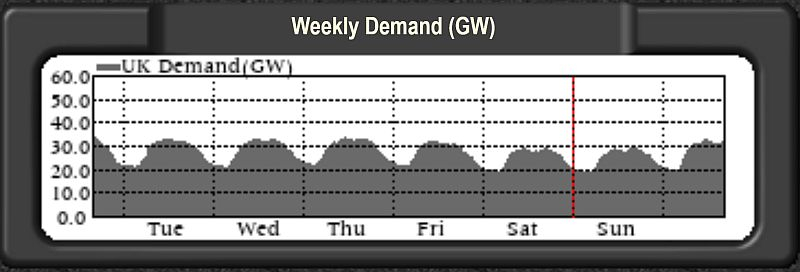 This isn't untypical. Demand has followed the same diurnal pattern for decades. Overnight demand is always around 2/3rd of day time demand. There is no need for any sort of complex control systems to try and move energy consumption to the low demand period. I time switch is every bit as good as anything else.If we had the sort of ill-defined demand curves seen in places like California, then the argument for smart control is more compelling. We don't though, and there is no sign that the easily predictable demand curve shown above isn't going to remain much the same for a few decades yet.0
 -
Which is the completely backwards way to look at it.JSHarris said:Leaving to one side the smart meter/dumb meter debate, and looking solely at the pattern of UK energy use, very simple time switched tariffs, like E7, are every bit as sensible today as they were 50 years ago.Energy demand is very predictable. We have a clear pattern, where night time demand is far less than day time demand. A look at Gridwatch demonstrates this. This is demand over the past week:This isn't untypical. Demand has followed the same diurnal pattern for decades. Overnight demand is always around 2/3rd of day time demand. There is no need for any sort of complex control systems to try and move energy consumption to the low demand period. I time switch is every bit as good as anything else.If we had the sort of ill-defined demand curves seen in places like California, then the argument for smart control is more compelling. We don't though, and there is no sign that the easily predictable demand curve shown above isn't going to remain much the same for a few decades yet.
We used to have dispatchable generation, so could turn generators up and down to follow that curve. Making it flatter made it cheaper, so that was kind of nice.
We no longer have anywhere near the same amount of dispatchable generation (we could, but we seem to have decided that we shouldn't) and it's getting worse. Now we just get whatever generation is pushed in, so the best way to balance the system is with the demand side. A coarse and simplistic E7-type tariff doesn't allow that.
I expected a better argument than "well it worked in the 1970s".0 -
CSI_Yorkshire said:
Which is the completely backwards way to look at it.JSHarris said:Leaving to one side the smart meter/dumb meter debate, and looking solely at the pattern of UK energy use, very simple time switched tariffs, like E7, are every bit as sensible today as they were 50 years ago.Energy demand is very predictable. We have a clear pattern, where night time demand is far less than day time demand. A look at Gridwatch demonstrates this. This is demand over the past week:This isn't untypical. Demand has followed the same diurnal pattern for decades. Overnight demand is always around 2/3rd of day time demand. There is no need for any sort of complex control systems to try and move energy consumption to the low demand period. I time switch is every bit as good as anything else.If we had the sort of ill-defined demand curves seen in places like California, then the argument for smart control is more compelling. We don't though, and there is no sign that the easily predictable demand curve shown above isn't going to remain much the same for a few decades yet.
We used to have dispatchable generation, so could turn generators up and down to follow that curve. Making it flatter made it cheaper, so that was kind of nice.
We no longer have anywhere near the same amount of dispatchable generation (we could, but we seem to have decided that we shouldn't) and it's getting worse. Now we just get whatever generation is pushed in, so the best way to balance the system is with the demand side. A coarse and simplistic E7-type tariff doesn't allow that.
I expected a better argument than "well it worked in the 1970s".Generators are now far more flexible than they used to be. We've lost a lot of inflexible generation over the years (mostly coal and nuclear). We've replaced that with a lot of very flexible generation, generation that can be wound up and down very rapidly (wind, for example, together with solar and, more recently, battery storage.The days when we had massive amounts of spinning reserve in order to maintain frequency stability are coming to an end. We are moving into an era when generators are far, far more flexible than has ever been the case in the past. This is all a red herring when it comes to demand, though. Demand is driven by usage patterns. We've lost a great deal of 24/7 demand due to de-industrialisation in part (the loss of heavy industries like steel). We've gained a lot of daytime only commercial demand, as we've switched to becoming a service economy.The evidence proves that there is a strong, and very predictable, diurnal variation in demand. I can predict now when demand will drop this evening, and how low that demand will get. Generators will track it easily, and will maintain grid frequency within limits, almost certainly without needing to call upon FFR. The fact that FFR exists, and has existed for years, illustrates just how flexible generators now are.0









Confirm your email address to Create Threads and Reply

Categories
- All Categories
- 354.2K Banking & Borrowing
- 254.3K Reduce Debt & Boost Income
- 455.3K Spending & Discounts
- 247.1K Work, Benefits & Business
- 603.8K Mortgages, Homes & Bills
- 178.4K Life & Family
- 261.3K Travel & Transport
- 1.5M Hobbies & Leisure
- 16.1K Discuss & Feedback
- 37.7K Read-Only Boards