We’d like to remind Forumites to please avoid political debate on the Forum.
This is to keep it a safe and useful space for MoneySaving discussions. Threads that are – or become – political in nature may be removed in line with the Forum’s rules. Thank you for your understanding.
📨 Have you signed up to the Forum's new Email Digest yet? Get a selection of trending threads sent straight to your inbox daily, weekly or monthly!
The Forum now has a brand new text editor, adding a bunch of handy features to use when creating posts. Read more in our how-to guide
Energy suppliers limited to 2% profit
Comments
-
Suppliers failed because global energy prices went through the roof due to Russia invading Ukraine, combined with the price cap. No business is going to plan financially on the basis that the regulator in their industry will force them to sell their product less than 50% of cost for more than a year. No amount of financial oversight would have resolved that because even the best regulated industry will not be required to hold 50%+ of annual turnover as cash reserves.We cannot attribute all the supplier failures to high wholesale prices. The Ukraine War has only been going for 12 months and suppliers were falling off the cliff months before that. Ofgem repeatedly said that it had no role in checking whether people were fit persons to run an energy company, and it said that financial scrutiny was not in its remit. Ofgem was dragged ‘kicking and screaming’ into taking a more pro-active regulatory stance.
Suppliers like Avro failed because they took a punt on the market and didn’t hedge as they should have done. This in my view was a failure of regulation. Let me give you an extreme example of why a lack of regulation has consequences. Each year millions of people fly around the World. Each aircraft has two or more engines and each engine has two separate fire extinguishers. The probably of anybody experiencing an engine fire is minuscule. Do we allow the owner of GetRichQuick Airlines to make a judgement that is perfectly acceptable to fly with one or no serviceable fire extinguishers because there is little chance of a fire? No - the Regulator insists that both extinguishers are serviceable before each departure. If they didn’t, a simple fire which could easily be extinguished becomes a disaster. As far as domestic energy is concerned, Ofgem didn’t regulate and changing market conditions revealed that many suppliers were operating on a ‘wing and a prayer’: they went under as a result.If you recall, the Ofgem Cap was brought in under political pressure. It was the politicians way of protecting reluctant switchers from high SVTs. It was aligned to a proposal that there should be enforced switching to cheaper fixed tariffs. For the reasons you describe, the Cap then became a floor and a ceiling which it was never designed to be. It follows that the greater the profit that Ofgem allows suppliers to glean from the Cap, the less incentive there is for true competition to return to the market.
Quote: Ofgem CEO Dermot Nolan has said that finding a replacement for the price cap introduced at the start of the year in order to protect vulnerable customers is an absolute priority for the regulator over the next two to three years. He was speaking to the Commons Public Accounts Committee during an evidence session held on Monday 20 May. He described the price cap as having positive effects in the short-term but is capable of being gamed and limits innovation and efficiency in the long-term. Nolan also said that there needs to be some form of intervention in the long-term to help vulnerable customers, “perhaps some form of switching service”. He said Ofgem would consult on a possible replacement system for the cap and would publish its findings by the end of 2019. (Cornwall Insight, Daily Bulletin, May 21, 2019) Unquote
In my view, the Cap has served its purpose and it should be abolished. Ofgem as of a few days ago thinks otherwise: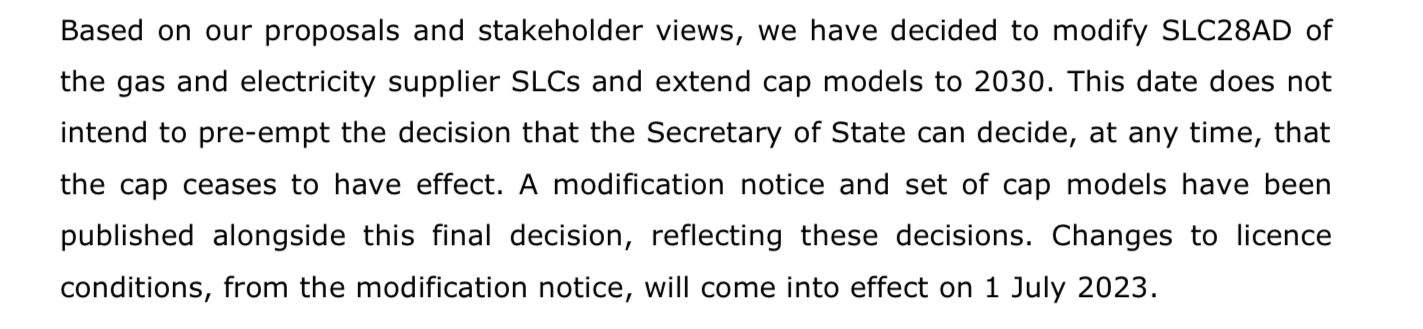 1
1 -
I don't believe Ofgem actually limits the suppliers' profits, what it does is limit their selling prices to a level where they believe a competent supplier should be able to make 1.9% (or 2.4%) profit.2
-
Straight from this weeks price cap press release - the only thing that you might have missed is that the use the accounting term EBIT - Earnings Before Interest and Tax - not profitCovers both existing 1.9% - and the consultation to raise it to 2.4% from Oct"We anticipate seeing an increase of the allowance to a level equivalent to 2.4% of EBIT in Q4 2023 (in comparison to the 1.9% in the current allowance)"Not that wording "allowance" - it's not a strict level is how I interpret it - merely a component within the total price cap.If a supplier can save elsewhere - say operating costs - then they can make more.2
-
Correct, it's exactly that. In the same way as they'll make more if they have a better hedging strategy or spend less money chasing bad debt.Scot_39 said:Straight from this weeks price cap press release - the only thing that you might have missed is that the use the accounting term EBIT - Earnings Before Interest and Tax - not profitCovers both existing 1.9% - and the consultation to raise it to 2.4% from Oct"We anticipate seeing an increase of the allowance to a level equivalent to 2.4% of EBIT in Q4 2023 (in comparison to the 1.9% in the current allowance)"Not that wording "allowance" - it's not a strict level is how I interpret it - merely a component within the total price cap.If a supplier can save elsewhere - say operating costs - then they can make more.1
![[Deleted User]](https://us-noi.v-cdn.net/6031891/uploads/defaultavatar/nFA7H6UNOO0N5.jpg)



Confirm your email address to Create Threads and Reply

Categories
- All Categories
- 354.6K Banking & Borrowing
- 254.5K Reduce Debt & Boost Income
- 455.5K Spending & Discounts
- 247.5K Work, Benefits & Business
- 604.3K Mortgages, Homes & Bills
- 178.5K Life & Family
- 261.8K Travel & Transport
- 1.5M Hobbies & Leisure
- 16.1K Discuss & Feedback
- 37.7K Read-Only Boards