We’d like to remind Forumites to please avoid political debate on the Forum.
This is to keep it a safe and useful space for MoneySaving discussions. Threads that are – or become – political in nature may be removed in line with the Forum’s rules. Thank you for your understanding.
📨 Have you signed up to the Forum's new Email Digest yet? Get a selection of trending threads sent straight to your inbox daily, weekly or monthly!
The Forum now has a brand new text editor, adding a bunch of handy features to use when creating posts. Read more in our how-to guide
Standing charge on energy bills
Comments
-
It goes back to consumers wanting the cheapest prices.agentcain said:
We've been through this a number of times.matt_drummer said:
Really? All those customers would have lost their money, it would have been a nightmare for many people.agentcain said:
The increase of standing charges is unfair because it mainly includes so many other things that are not related to the actual network maintenance, the worst one being the credit cover for failed suppliers.
This should never have happened. The regulator should have forced the companies to ringfence those credits and no one would have lost anything. I realise this is hindsight but lacking that (which is more obvious than not, I can't believe how anyone wanting to call themselves a regulator missed it), individual assets should have been liquidated, i.e. we don't care if CEOs and directors of those supplies lose everything, its their fault. There is an argument about limited liability etc, but it goes back to proper regulation.
That is what we are like in this country, we want the best for the lowest cost. It is not like this in other European countries that I know really well.
What the ceo's and directors may have got is peanuts.
I have never and would never have gone with any of these companies as a matter of principle, they were always a problem in my view.
But, millions did, and for a small cost to the rest of us, they are protected from what could have been a massive problem for them.
I have no problem with paying my share, it could have been my well established supplier that got into trouble.
Hopefully it will never happen again, but that means the end of ultra low fixes for the foreseeable future.
1 -
The Regulator has just reviewed the whole issue and concluded the following:agentcain said:
We've been through this a number of times.matt_drummer said:
Really? All those customers would have lost their money, it would have been a nightmare for many people.agentcain said:
The increase of standing charges is unfair because it mainly includes so many other things that are not related to the actual network maintenance, the worst one being the credit cover for failed suppliers.
This should never have happened. The regulator should have forced the companies to ringfence those credits and no one would have lost anything. I realise this is hindsight but lacking that (which is more obvious than not, I can't believe how anyone wanting to call themselves a regulator missed it), individual assets should have been liquidated, i.e. we don't care if CEOs and directors of those supplies lose everything, its their fault. There is an argument about limited liability etc, but it goes back to proper regulation.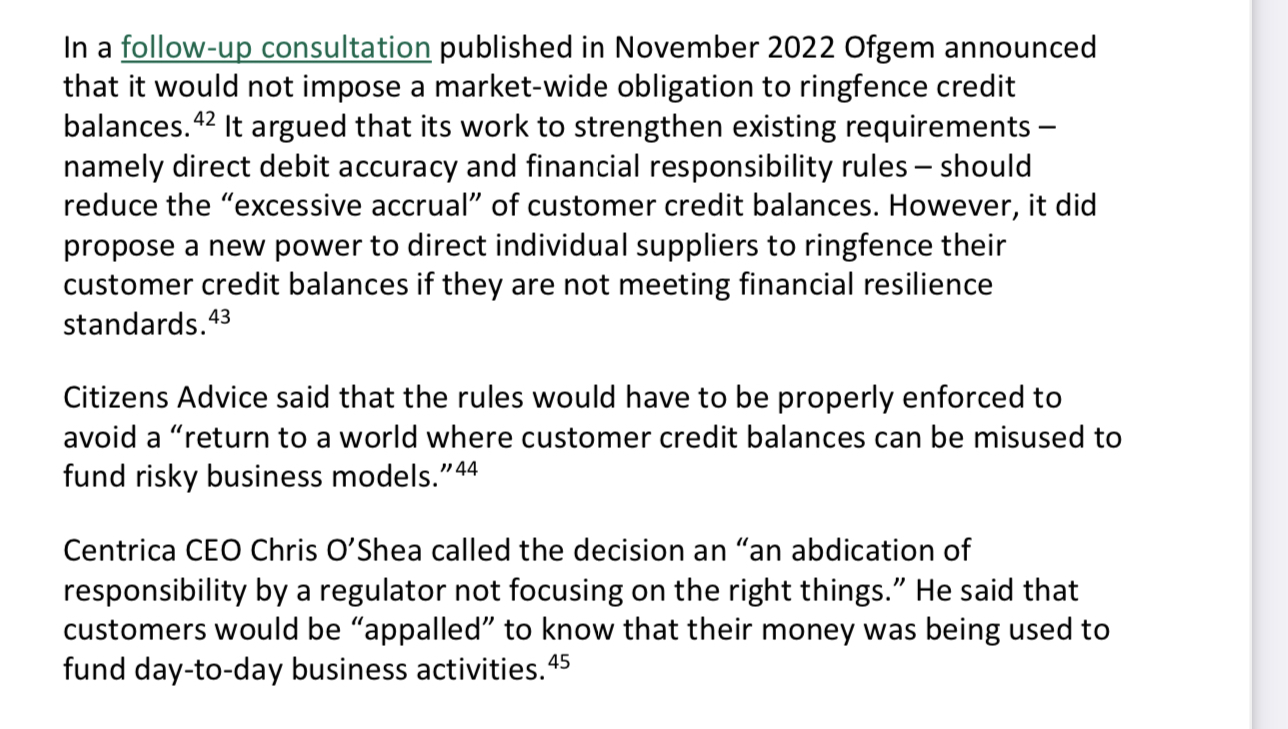 What could possibility go wrong? If it did, then Ofgem can go down the SoLR route and get its friends to pick up the bill for all the lost deposits.2
 -
I was one of those consumers. And I don't think it's unique to the UK as I personally am a foreigner and I see this happening elsewhere too. There are things you can pay for better quality, but energy will always be energy. You might argue that you can pay more for "greener" energy, but even that is not guaranteed. I consider the inclination of consumers towards lower prices natural and it is what competition is supposed to be doing.matt_drummer said:
It goes back to consumers wanting the cheapest prices.agentcain said:
We've been through this a number of times.matt_drummer said:
Really? All those customers would have lost their money, it would have been a nightmare for many people.agentcain said:
The increase of standing charges is unfair because it mainly includes so many other things that are not related to the actual network maintenance, the worst one being the credit cover for failed suppliers.
This should never have happened. The regulator should have forced the companies to ringfence those credits and no one would have lost anything. I realise this is hindsight but lacking that (which is more obvious than not, I can't believe how anyone wanting to call themselves a regulator missed it), individual assets should have been liquidated, i.e. we don't care if CEOs and directors of those supplies lose everything, its their fault. There is an argument about limited liability etc, but it goes back to proper regulation.
That is what we are like in this country, we want the best for the lowest cost. It is not like this in other European countries that I know really well.
What the ceo's and directors may have got is peanuts.
I have never and would never have gone with any of these companies as a matter of principle, they were always a problem in my view.
But, millions did, and for a small cost to the rest of us, they are protected from what could have been a massive problem for them.
I have no problem with paying my share, it could have been my well established supplier that got into trouble.
Hopefully it will never happen again, but that means the end of ultra low fixes for the foreseeable future.
I do have a problem with paying more to fund risky investments. When I pay my bills, I do not pay them with promises that may or may not materialize; the funds are leaving my bank account, funds that could have been used to buy food, clothes, holidays etc. I expected them to act accordingly. I did not share part of their profit, I shouldn't share any part of their shortcomings. No one should.1 -
Sums up that £14 per month on average is a small price to pay to be connected to the grid for a vital service.agentcain said:
Not comparable. A shop sells a number of things, some of which are more vital than others. There's a greater variety of shops too. Energy is about survival. Even if a particular vital item is fixed in price, e.g. a bottle of water, and there's an increasing probability of theft for that item, its price should never increase because of that as it is vital. Instead, the costs are covered from other item sales and further measures are taken to avoid it in the future. Which is something most suppliers were not doing, because they're not generators.powerful_Rogue said:I don't shoplift, so should my groceries be cheaper as I shouldn't have to pay for those that do and the additional security shops have to employ.I think the SC is a small price to pay to be connected to the grid. Average of £14 per month. A telephone landline costs around £20+ per month.
3 -
Well, I missed the part where we're supposed to trust Ofgem's ability to handle the matter, so I can't say I back this decision any more than any decision it takes.[Deleted User] said:
The Regulator has just reviewed the whole issue and concluded the following:agentcain said:
We've been through this a number of times.matt_drummer said:
Really? All those customers would have lost their money, it would have been a nightmare for many people.agentcain said:
The increase of standing charges is unfair because it mainly includes so many other things that are not related to the actual network maintenance, the worst one being the credit cover for failed suppliers.
This should never have happened. The regulator should have forced the companies to ringfence those credits and no one would have lost anything. I realise this is hindsight but lacking that (which is more obvious than not, I can't believe how anyone wanting to call themselves a regulator missed it), individual assets should have been liquidated, i.e. we don't care if CEOs and directors of those supplies lose everything, its their fault. There is an argument about limited liability etc, but it goes back to proper regulation.What could possibility go wrong? If it did, then Ofgem can go down the SoLR route and get its friends to pick up the bill for all the lost deposits.
I find Centrica CEO's comment expected though; a large supplier/generator would appreciate anything that puts at risk the business model of those small suppliers that tried to disturb the market in the wrong way.0 -
Again.powerful_Rogue said:
Sums up that £14 per month on average is a small price to pay to be connected to the grid for a vital service.agentcain said:
Not comparable. A shop sells a number of things, some of which are more vital than others. There's a greater variety of shops too. Energy is about survival. Even if a particular vital item is fixed in price, e.g. a bottle of water, and there's an increasing probability of theft for that item, its price should never increase because of that as it is vital. Instead, the costs are covered from other item sales and further measures are taken to avoid it in the future. Which is something most suppliers were not doing, because they're not generators.powerful_Rogue said:I don't shoplift, so should my groceries be cheaper as I shouldn't have to pay for those that do and the additional security shops have to employ.I think the SC is a small price to pay to be connected to the grid. Average of £14 per month. A telephone landline costs around £20+ per month.
Not an issue paying for maintenance and operation of the grid.
Big issue with paying for everything else hidden inside it.1 -
They were cheap because they were not doing it properly and got caught out. They did not hedge the risks, all to provide a lower price.agentcain said:
I was one of those consumers. And I don't think it's unique to the UK as I personally am a foreigner and I see this happening elsewhere too. There are things you can pay for better quality, but energy will always be energy. You might argue that you can pay more for "greener" energy, but even that is not guaranteed. I consider the inclination of consumers towards lower prices natural and it is what competition is supposed to be doing.matt_drummer said:
I do have a problem with paying more to fund risky investments. When I pay my bills, I do not pay them with promises that may or may not materialize; the funds are leaving my bank account, funds that could have been used to buy food, clothes, holidays etc. I expected them to act accordingly. I did not share part of their profit, I shouldn't share any part of their shortcomings. No one should.
I work in a sector as an accountant where it is all about price, its the first and only thing that customers are interested in. They expect the highest quality and want to pay the cheapest price, and they complain like you wouldn't believe when the product doesn't last.
I have worked extensively in Scandanavia and the Baltic States and they have a different attitude.0 -
Well, yes indeed. I am aware of this and don't disagree. At the end of the day, its an optimization exercise. If however quality is guaranteed, like in the case of energy, you favour cost minimization.matt_drummer said:
They were cheap because they were not doing it properly and got caught out. They did not hedge the risks, all to provide a lower price.agentcain said:
I was one of those consumers. And I don't think it's unique to the UK as I personally am a foreigner and I see this happening elsewhere too. There are things you can pay for better quality, but energy will always be energy. You might argue that you can pay more for "greener" energy, but even that is not guaranteed. I consider the inclination of consumers towards lower prices natural and it is what competition is supposed to be doing.matt_drummer said:
I do have a problem with paying more to fund risky investments. When I pay my bills, I do not pay them with promises that may or may not materialize; the funds are leaving my bank account, funds that could have been used to buy food, clothes, holidays etc. I expected them to act accordingly. I did not share part of their profit, I shouldn't share any part of their shortcomings. No one should.
I work in a sector as an accountant where it is all about price, its the first and only thing that customers are interested in. They expect the highest quality and want to pay the cheapest price, and they complain like you wouldn't believe when the product doesn't last.
I have worked extensively in Scandanavia and the Baltic States and they have a different attitude.
All this doesn't change anything though and certainly shouldn't prevent us from finally start to push for accountability. The consumer is the last person to be blamed for anything when it comes to energy supply. Other heads have to roll first, lets not forget that.1 -
Maybe the cost minimilisation should come with a warning, much like other things, that your capital is at risk.agentcain said:
Well, yes indeed. I am aware of this and don't disagree. At the end of the day, its an optimization exercise. If however quality is guaranteed, like in the case of energy, you favour cost minimization.
All this doesn't change anything though and certainly shouldn't prevent us from finally start to push for accountability. The consumer is the last person to be blamed for anything when it comes to energy supply. Other heads have to roll first, lets not forget that.
If you want to gamble on the low prices, be prepared to lose your deposit, investment or credit balance, however you want to put it.
Maybe it's not right to take advantage of the rock bottom prices and expect other consumers to bail you out if it goes wrong?1 -
No to your first question.sandyides said:Anyone else like me appalled by the escalation of the daily standing charges being applied to energy bills? So even if you don't use any energy at all, you'll still have an increasing bill.
There was a time, not so long ago, when there were no standing charges. Can we revert to that please?
Is it worth a petition?
No to the second question as they hid the charge and it meant heavier uses unfairly paid more.
No to the third question when you realise why they have gone up.
I am an Independent Financial Adviser (IFA). The comments I make are just my opinion and are for discussion purposes only. They are not financial advice and you should not treat them as such. If you feel an area discussed may be relevant to you, then please seek advice from an Independent Financial Adviser local to you.1








Confirm your email address to Create Threads and Reply

Categories
- All Categories
- 354K Banking & Borrowing
- 254.3K Reduce Debt & Boost Income
- 455.2K Spending & Discounts
- 247K Work, Benefits & Business
- 603.6K Mortgages, Homes & Bills
- 178.3K Life & Family
- 261.1K Travel & Transport
- 1.5M Hobbies & Leisure
- 16.1K Discuss & Feedback
- 37.7K Read-Only Boards