We’d like to remind Forumites to please avoid political debate on the Forum.
This is to keep it a safe and useful space for MoneySaving discussions. Threads that are – or become – political in nature may be removed in line with the Forum’s rules. Thank you for your understanding.
📨 Have you signed up to the Forum's new Email Digest yet? Get a selection of trending threads sent straight to your inbox daily, weekly or monthly!
The Forum now has a brand new text editor, adding a bunch of handy features to use when creating posts. Read more in our how-to guide
Plug socket lost power.
Comments
-
The socket behind the appliance isn't fused but of course all plugs are. It would be a PITA to have to pull a washing machine out to replace a fuse in the plug top (first step in fault finding) hence making them accessible via these sort of grid panels.grumbler said:Mutton_Geoff said:
... It's quite common to still run the fused output to a 13A socket behind the appliance to make it easy to remove it for repair/service.grumbler said:Can anybody explain why spurs are fused here? Was it just to use thinner cables?What's the point in a fused spur in this case?What you wouldn't want is a washing machine to fault and go live or overheat without being able to access some form of isolation quickly.That's what accessible switches are for.Signature on holiday for two weeks0 -
I understand, but it's ether a plug with a fuse or hard-wiring with an accessible fuse, not both. You can't have two fuses in sequence. Well, you can - if it's 13A fuse in the plug and, say, 5A the accessible one. Too complicated for normal people and 5A isn't enough for many appliances.Mutton_Geoff said:
The socket behind the appliance isn't fused but of course all plugs are. It would be a PITA to have to pull a washing machine out to replace a fuse in the plug top (first step in fault finding) hence making them accessible via these sort of grid panels.grumbler said:Mutton_Geoff said:
... It's quite common to still run the fused output to a 13A socket behind the appliance to make it easy to remove it for repair/service.grumbler said:Can anybody explain why spurs are fused here? Was it just to use thinner cables?What's the point in a fused spur in this case?What you wouldn't want is a washing machine to fault and go live or overheat without being able to access some form of isolation quickly.That's what accessible switches are for.
ETA: I see 10A fuses, less common, available as well.
0 -
Maybe wasn't making myself clear. All you need is RCD/MCD feeding that fused switched plate then off to the appliance.
Hard wiring into a junction box behind the appliance wouldn't need another fuse, but you'd be forced to have one if you used a convenient connector like the common 13A plug. I'd probably leave a 13A fuse in the plug but protect the cable/appliance with correctly rated fuse in the grid plate so that it would be that one that blew first. A serious fault could of course pop both in one go in which case, you're pulling the appliance out anyway.Signature on holiday for two weeks0 -
tony3619 said:
I find it baffling that turning the trip switch on and off would make it work again even though it didn't trip in the first place.Without knowing the make and type of device this is a guess... but my guess would be this device has a mid-position the 'toggle' should (/is supposed to) go to when it trips, which is not the same as the 'off' position.Devices like this usually have to be reset by cycling them through one or more other positions before they can be switched back on. (e.g. moved to 'off' before being moved to 'on').If you post a picture of the device which trips then someone may be able to comment more specifically about its correct operation.0 -
This is the fuse box. The one labelled "kitchen ring" is the one i turned off and back on again. It's strange that there is a separate "fridge" breaker.
Are the appliances that are connected to the fuse plate still part of the main ring but also have there own trip switch?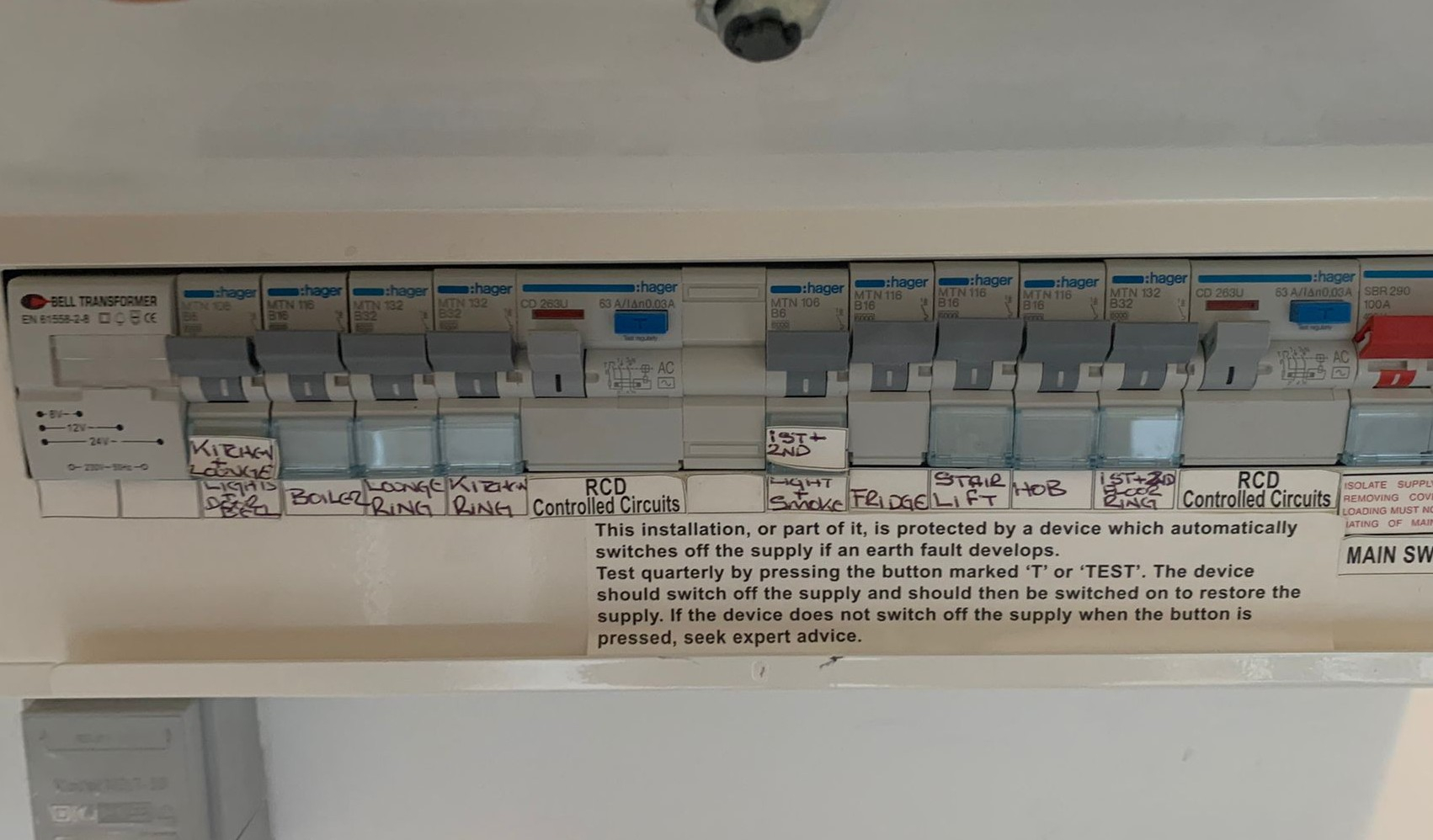
0 -
tony3619 said:
Are the appliances that are connected to the fuse plate still part of the main ring but also have there own trip switch?Each ring is controlled by its own MCB. You can easily check which MCB controls the fused grid switches and corresponding appliances.Several circuits are controlled by one common RCD.
0 -
Is it possible for the fridge socket that failed to be controlled by both the "kitchen ring" and "fridge" MCB?grumbler said:tony3619 said:
Are the appliances that are connected to the fuse plate still part of the main ring but also have there own trip switch?Each ring is controlled by its own MCB. You can easily check which MCB controls the fused grid switches and corresponding appliances.Several circuits are controlled by one common RCD.0 -
No, certainly not both. But yes, theoretically it's possible that these four appliances can be not on the same ring. Or it can be a dedicated radial circuit for the fridge.
0 -
So if resetting the "kitchen ring" affected the fridge it must be connected to that MCB? Maybe the fridge is labelled on a mcb but that MCB isn't active? I am way so cannot test itgrumbler said:No, certainly not both. But yes, theoretically it's possible that these four appliances can be not on the same ring. Or it can be a dedicated radial circuit for the fridge.0 -
Rather weird to run separate radial circuits for a kitchen just to put a fridge/freezer and hob on it? Is this a very large kitchen with lots of 13A sockets installed?
By contrast, the entire 1st and 2nd floors are on a single ring circuit...No free lunch, and no free laptop 0
0











Confirm your email address to Create Threads and Reply

Categories
- All Categories
- 353.5K Banking & Borrowing
- 254.1K Reduce Debt & Boost Income
- 455K Spending & Discounts
- 246.5K Work, Benefits & Business
- 602.9K Mortgages, Homes & Bills
- 178K Life & Family
- 260.5K Travel & Transport
- 1.5M Hobbies & Leisure
- 16K Discuss & Feedback
- 37.7K Read-Only Boards