We’d like to remind Forumites to please avoid political debate on the Forum.
This is to keep it a safe and useful space for MoneySaving discussions. Threads that are – or become – political in nature may be removed in line with the Forum’s rules. Thank you for your understanding.
PLEASE READ BEFORE POSTING: Hello Forumites! In order to help keep the Forum a useful, safe and friendly place for our users, discussions around non-MoneySaving matters are not permitted per the Forum rules. While we understand that mentioning house prices may sometimes be relevant to a user's specific MoneySaving situation, we ask that you please avoid veering into broad, general debates about the market, the economy and politics, as these can unfortunately lead to abusive or hateful behaviour. Threads that are found to have derailed into wider discussions may be removed. Users who repeatedly disregard this may have their Forum account banned. Please also avoid posting personally identifiable information, including links to your own online property listing which may reveal your address. Thank you for your understanding.
📨 Have you signed up to the Forum's new Email Digest yet? Get a selection of trending threads sent straight to your inbox daily, weekly or monthly!
The Forum now has a brand new text editor, adding a bunch of handy features to use when creating posts. Read more in our how-to guide
Chimney breasts and lounge wall removed without plan/docs
Comments
-
Easier said than done when 95% of the houses on the market are unfit (for me) for one reason or another and you don't want to lose the train (years pass and eligibility falls).lincroft1710 said:
Because building regulations change frequently (especially regarding electrics) the vast majority of properties will not and probably never will comply with current regs.pieroabcd said:After talking to several structural engineers (that confirmed that the situation can be regularised) I've decided to go on with the searches and fix whatever needs fixing after the purchase.
Yet I can't avoid to think that it's insane that sellers are allowed to sell houses that are non compliant with the regulations.
In most countries in Europe a house in that condition just *can't* be sold, as is fair.
The burden should be on the sellers, not on the buyers that are at the mercy of solicitors and totally unaware of regulations.
It's paradoxical that sellers make a mess and buyers must fix it.
There is a very simple solution if you find a non compliant property and are not not happy with it - don't buy it!
After 2 years of searching and literally hundreds of viewings I really can't have anymore.
0 -
Which European country forbids properties to be sold unless they meet current building regulations (and is also inhabited by sellers who understand those regulations)?2
-
user1977 said: Which European country forbids properties to be sold unless they meet current building regulations (and is also inhabited by sellers who understand those regulations)?
For example France, Spain, Italy. There the sales are managed by notaries that represent both sellers, buyers and the State. They are public officers, so they keep compliance in check.0 -
pieroabcd said:
user1977 said:
Which European country forbids properties to be sold unless they meet current building regulations (and is also inhabited by sellers who understand those regulations)?
For example France, Spain, Italy. There the sales are managed by notaries that represent both sellers, buyers and the State. They are public officers, so they keep compliance in check. Hmmm .... not sure I agree with you - the house I bought in France was definitely NOT up to the latest regs - in fact all the ones I look at weren't!
MarkWe’ve had to remove your signature. Please check the Forum Rules if you’re unsure why it’s been removed and, if still unsure, email forumteam@moneysavingexpert.com0 -
pieroabcd said:
user1977 said:
Which European country forbids properties to be sold unless they meet current building regulations (and is also inhabited by sellers who understand those regulations)?
For example France, Spain, Italy. There the sales are managed by notaries that represent both sellers, buyers and the State. They are public officers, so they keep compliance in check. And how does the notary know whether or not the property is compliant with current building regulations?0 -
Although it might be nice if there was more disincentive for people to ride roughshod over the building control process, any legislation which prevented the sale of properties which didn't meet regulations would need to be carefully crafted to avoid the situation where a defective property was owned by someone who didn't have the capital to bring it up to the required standard, but was barred by law from selling it.The current system in England (for all its faults) does at least allow properties (including those in dereliction) to be sold to people with the capital to put them back into order and allow them to become a decent home for someone.Although legislation could provide for a 'buyer of last resort' (i.e you could always sell to the local authority or to an 'approved' business buyer) great care would need to taken to ensure this system wasn't unfair - it would be easy for desperate/vulnerable home owners to be taken advantage of in a system which prevents them selling their property at a fair market value achieved through an open market sale.0
-
iàll repond here because the quoting seems to be broken.
As in my case, a mismatch between the floorplan registerd with the land registry and the current floorplan would evidence immediately that the chimney brests were removed and a check to search the approval would fail. Same story for any other alteration.
And yes, the land registry does have the floorplan.0 -
Hi,
the solicitor has come back suggesting that part of the sewer seems to be under the perimeter of the house, as in the picture attached. Why would anyone want to do that?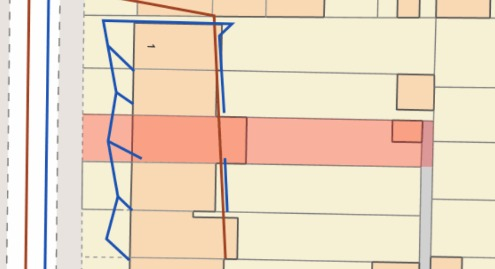
The sewer is in blue and the house is red.
Does it mean that if the water company needs to do some intervention on the sewer they'll need to dig under the house or even break the lounge walls?0 -
The “why?” Is answered as because they want an extension. They should have had a build over agreement with the water board, consenting to do that. You may find a manhole cover under the flooring of the extension. Some people put up with the risk. If the water board did need to dig up, chances are they would avoid digging through the house, if they could access from either side.pieroabcd said:Hi,
the solicitor has come back suggesting that part of the sewer seems to be under the perimeter of the house, as in the picture attached. Why would anyone want to do that?
The sewer is in blue and the house is red.
Does it mean that if the water company needs to do some intervention on the sewer they'll need to dig under the house or even break the lounge walls?I'm a Forum Ambassador on the housing, mortgages & student money saving boards. I volunteer to help get your forum questions answered and keep the forum running smoothly. Forum Ambassadors are not moderators and don't read every post. If you spot an illegal or inappropriate post then please report it to forumteam@moneysavingexpert.com (it's not part of my role to deal with this). Any views are mine and not the official line of MoneySavingExpert.com.0












Confirm your email address to Create Threads and Reply

Categories
- All Categories
- 354.4K Banking & Borrowing
- 254.4K Reduce Debt & Boost Income
- 455.4K Spending & Discounts
- 247.3K Work, Benefits & Business
- 604K Mortgages, Homes & Bills
- 178.4K Life & Family
- 261.5K Travel & Transport
- 1.5M Hobbies & Leisure
- 16K Discuss & Feedback
- 37.7K Read-Only Boards