We’d like to remind Forumites to please avoid political debate on the Forum.
This is to keep it a safe and useful space for MoneySaving discussions. Threads that are – or become – political in nature may be removed in line with the Forum’s rules. Thank you for your understanding.
📨 Have you signed up to the Forum's new Email Digest yet? Get a selection of trending threads sent straight to your inbox daily, weekly or monthly!
The Forum now has a brand new text editor, adding a bunch of handy features to use when creating posts. Read more in our how-to guide
New Energy Price Guarantee - a fair measure for all or a slightly unfair redistribution?
Comments
-
But those with multiple homes only occupying one at once (and I don't just mean the rich - couples that both currently have their own place fit in here) benefit more. People with very large family properties housing 6+ people are much worse off than those in smaller properties... there's arguments against any system.Deleted_User said:I would have just given every household £1,000. So high energy users typically better off people with large homes are not given more off their bill in cash terms and due to standing charges in percentage terms. And would call it a cost of living payment to help not just with energy but also things like food, rent.As the energy cap rises in January, April I would have made further payments.Keeping the energy bills high would also encourage people to reduce energy use and invest in insulation, new boilers, solar panel systems.0 -
michaels said:Cost of the freeze is of order £150bm
Eventually that means 150bn more tax needs to be paid - probably easiest to think of it as 4p on the basic rate of tax for 10 years.
So the question is, which would you rather, 4% higher tax rate for 10 years or to have to pay the full cost of the utility price increase over the next 2 years.
This makes the winners and losers pretty clear - high energy users who are low earners win, middle users, average income break even, high earners pay for it.But the government is planning on cutting the taxes of higher earners and companies.The government plans to pay for the energy price guarantee through borrowing, to be paid back out of general taxation increases from economic growth. Economic growth is the working masses making more goods and services and buying more goods and services. Income tax and VAT on the worker/consumers.It maybe wishful thinking by the government but it is their plan.0 -
Yes, charity had sprung to mind., I agree that’s an excellent idea.Mstty said:
Well you can always calculate your usage at the official Ofgem cap rates and donate it to charities that help people that cannot afford to live.lisyloo said:As someone who doesn’t need the help, I don’t think it’s been fairly targeted.
however unilateral action is not a replacement for a fair scheme as many will not do that for a whole host of reasons.
0 -
deano2099 said:
But those with multiple homes only occupying one at once (and I don't just mean the rich - couples that both currently have their own place fit in here) benefit more. People with very large family properties housing 6+ people are much worse off than those in smaller properties... there's arguments against any system.Deleted_User said:I would have just given every household £1,000. So high energy users typically better off people with large homes are not given more off their bill in cash terms and due to standing charges in percentage terms. And would call it a cost of living payment to help not just with energy but also things like food, rent.As the energy cap rises in January, April I would have made further payments.Keeping the energy bills high would also encourage people to reduce energy use and invest in insulation, new boilers, solar panel systems.A household as in the economic unit in the benefits and tax system.Not household as in house.A household can typically share energy costs because they can cook a family meal and sit together in the same room eating it watching TV.0 -
The UK has one of the worst inequality in the western world, our top 50% are currently under taxed and bottom 10% over taxed. I think this is a lot down to our wealthiest massively resisting tax increases more than they do in Germany, France etc. We have too much regressive and not enough progressive taxes. Truss has took us backwards sadly, we badly needed the corp tax rise, and the NI changes she made are regressive.MattMattMattUK said:
It falls disproportionately on the young in general, as well as higher earners. Those who do not make a net contribution will not be repaying it at all. It appears it will be added to the national debt, which is serviced from general taxation, so again the burden falls on net contributors.lisyloo said:I’d like to question this idea that we’re all equally liable to repay.
I'm going to retire in a few years a lower my tax and NI contributions.
sweeping generalisation of course but doesn’t this burden fall disproportionately on the young or in more general terms future tax payers.
I guess the devil may be in the detail of exactly how it’s going to be collected.
It is insane that Truss is proposing tax cuts when we are still borrowing to cover day to day expenditure, that's even before she adds £150-200 billion with this scheme, even more so when the bottom two thirds of taxpayers have the lowest effective rate of income taxation in the EU (ok, I know we unfortunately left. Also the top third have the fifth highest).
I do agree with the decision to put it on general taxation instead of future energy bills, putting the SOLR costs on the SC was a horrific decision.1 -
I agree that there should have been a cap on the amount of "support" and it should have been done in a way that doesn't reward excessive usage. IF somebody wants a hot tub or swimming pool they should not have a taxpayer subsidy to pay for the privilege. At least that way every household would get support from this latest initiative and hopefully there would be incentive to use less energy.Deleted_User said:I would have just given every household £1,000. So high energy users typically better off people with large homes are not given more off their bill in cash terms and due to standing charges in percentage terms. And would call it a cost of living payment to help not just with energy but also things like food, rent.As the energy cap rises in January, April I would have made further payments.Keeping the energy bills high would also encourage people to reduce energy use and invest in insulation, new boilers, solar panel systems.1 -
But I think we need to look at the marginal impact. Whatever else happens in the economy at some point £150bn more tax (plus interest on borrower) will need to be paid than would have been the case without the intervention.Deleted_User said:michaels said:Cost of the freeze is of order £150bm
Eventually that means 150bn more tax needs to be paid - probably easiest to think of it as 4p on the basic rate of tax for 10 years.
So the question is, which would you rather, 4% higher tax rate for 10 years or to have to pay the full cost of the utility price increase over the next 2 years.
This makes the winners and losers pretty clear - high energy users who are low earners win, middle users, average income break even, high earners pay for it.But the government is planning on cutting the taxes of higher earners and companies.The government plans to pay for the energy price guarantee through borrowing, to be paid back out of general taxation increases from economic growth. Economic growth is the working masses making more goods and services and buying more goods and services. Income tax and VAT on the worker/consumers.It maybe wishful thinking by the government but it is their plan.
Do you feel you have got value for money for that spend?
It could instead have bought an awful lot of Doctors and hospitals which would also have boosted the economy as the latest employment figures suggest that ill health is increasingly reducing the working population. Instead I guess boosted demand for pool boys as Rishi Sunak will no longer need to think about cutting back on his pool usage due to heating costs.I think....1 -
I must admit, that does have a certain appeal to it - I do believe that we've become far too "comfortable" with our relatively high energy usage and when you think about how previous generations managed (actually, maybe not even previous, thinking back to my own childhood... that's a scary thought), there may be value in using high prices to force people to use less (maybe going back to the principles of the supply-demand model). The reality, of course, is that such a move would inevitably result in some (or rather many) people suffering because they're simply not able to afford even those minimum levels of energy use, which we might think of as reasonable. Good job I'm not in charge, either, eh?Mstty said:
I would have done nothing except the £400 til January if in charge.theoretica said:It would be -one kind of- exactly fair to take everyone who is on one off fixed tariffs, whether they fixed high or low, and put every single account onto the same rate. That would - as the current proposal does - remove the anticipated advantage from those currently on low fixes. The current proposal still leaves the potential for people on low fixes to benefit, just maybe not as much as they hoped at one time.
My reasoning is that the current price freeze is not enough to make people really reduce energy and think about what it all costs. This measure and all the other payouts mean some are paying close to last winters prices or lower.
I believe we all needed a shock then a saviour package to come in January.
Probably good I'm not in charge lol
I think I'm probably going to just use the same logic in our own house and see if I can do my bit - not from a personal financial perspective but as a collective effort, to try and reduce our overall demand, in the hope that this results in a small dent in wholesale markets.
0 -
You can frame an argument any way you like.
The £150bn could also reduce the worry for middle earners who will now go out and buy other things that help keep the economy turning, cars, white goods, clothes, even going out for a meal would likely have been cut back and its knock on effect on the economy, its state aid via the back door.
There is also the cost to the NHS and other services had people been unable to pay their bills and sat in the cold or gone without food, so again the £150bn offsets some of these costs elsewhere, and its not just the vulnerable here as these costs were starting to drag middle earners into the mix, people who could afford to heat their homes get nervous trying to cut back but it can end up being detrimental to their health.2 -
The cost of £150B for this intervention is notional, based on the market prices of gas at the time of the announcement. The UK Govt. is actually taking a huge 'short' position on wholesale gas prices, which have been dropping quite rapidly on the futures market.
If, and it's a big if, gas prices do stabilise at a lower level over the next 24 months then the cost to the taxpayer of subsidising domestic bills may be quite moderate.
Obs. the Govt. can itself manipulate the market by announcing that fracking will be allowed etc. which would serve to depress gas prices. The Govt. may also ramp up munition supplies to Ukraine; a comprehensive defeat for Russia could trigger a regime change and a new leader who re-starts gas supplies before the Russian economy is wrecked from sanctions.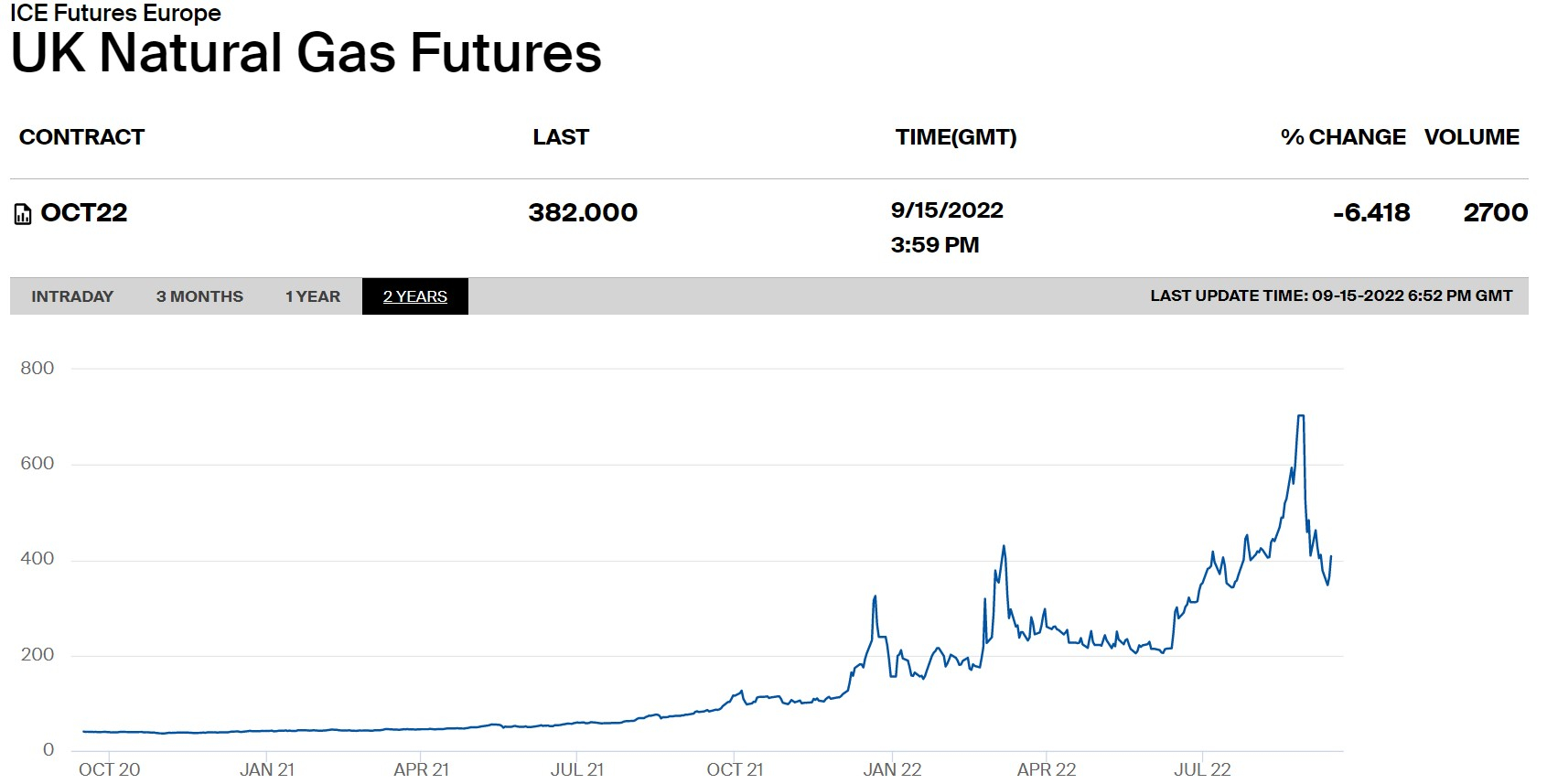
0














Confirm your email address to Create Threads and Reply

Categories
- All Categories
- 354.6K Banking & Borrowing
- 254.5K Reduce Debt & Boost Income
- 455.5K Spending & Discounts
- 247.5K Work, Benefits & Business
- 604.4K Mortgages, Homes & Bills
- 178.6K Life & Family
- 261.9K Travel & Transport
- 1.5M Hobbies & Leisure
- 16.1K Discuss & Feedback
- 37.7K Read-Only Boards