We’d like to remind Forumites to please avoid political debate on the Forum.
This is to keep it a safe and useful space for MoneySaving discussions. Threads that are – or become – political in nature may be removed in line with the Forum’s rules. Thank you for your understanding.
📨 Have you signed up to the Forum's new Email Digest yet? Get a selection of trending threads sent straight to your inbox daily, weekly or monthly!
The Forum now has a brand new text editor, adding a bunch of handy features to use when creating posts. Read more in our how-to guide
Electricity-only homes not covered by Energy Price Cap?
Comments
-
No, I'm not asking for a higher assumed usage of electricity.Dolor said:If I am reading your concern properly, you are suggesting that there needs to be a higher assumed usage for electricity only homes. If units above the assumed usage figure were charged at a higher unit cost, you would probably have a case - but they are not.
The methodology adopted hasn’t been changed since the Cap was introduced. Electricity only homes have historically been more expensive to heat than those heated by gas.
My total energy usage is 9914kWh - much lower than the 14900 of gas and electricity the government/BBC considers 'average'.
I'm concerned that I'll be penalised because I'll be over the threshold for electricity, even though I use no gas at all and my total is below average.
The phrase 'If you use more gas or electricity than that, you will pay more.
Those of you that think I've misunderstood, can you provide some evidence of how you think it works, rather than just stating your own interpretation? So far, nobody has managed that.0 -
The values (12,000 & 2,900) are for an average household (3 bed?).steveholc said:No, I'm not asking for a higher assumed usage of electricity.
My total energy usage is 9914kWh - much lower than the 14900 of gas and electricity the government/BBC considers 'average'.
I'm concerned that I'll be penalised because I'll be over the threshold for electricity, even though I use no gas at all and my total is below average.
The phrase 'If you use more gas or electricity than that, you will pay more.
Those of you that think I've misunderstood, can you provide some evidence of how you think it works, rather than just stating your own interpretation? So far, nobody has managed that.
Whether you use 2,500 or 250,000 units of electricity the price per unit is still the same as per your fix or SVR provider values3 -
We don't think you've misunderstood - you have.
This is how the price cap works. There is a 'typical' user, who uses 2900kWh of electricity and 12000 kWh of gas. Someone decides how much this should cost annually. From 1 Oct, it was decided that this will be £2500.
Some maths then happens to split the £2500 into electricity standing charge (about £165), gas standing charge (about £100), electricity cost (about £1000) and gas cost (about £1250).
You then take the two costs, and work out what unit rate it would be to make 2900kWh of electricity cost "about £1000" and to make 12000kWh of gas cost "about £1250". This turns out to be about 34p per kWh for electricity and about 10.3p per kWh for gas.
Those unit rates are then used for every person on a standard tariff, no matter how much they use. The price doesn't suddenly change if you use more.6 -
steveholc said:Those of you that think I've misunderstood, can you provide some evidence of how you think it works, rather than just stating your own interpretation? So far, nobody has managed that.This is not our interpretation, it is how it works, you just don't seem to believe us....The headline figure you see quoted are based on an assumed dual-fuel customer using 2900 kWh electric 12,000 kWh gas paying by DD and they show the average across the regions to give you a single number, but the reality is there is not just one cap, there are many oft hem for each region, payment method, fuel type and metering profile.The only one you care about is electricity, and that will average 35p/kWh across all the regions for those paying by DD, regardless of how much you use.If the press mention the £2,500 figure they have to make it clear that it assuming specific usage so if you use more than that amount you will pay more, doesn't alter the fact that the kWh rate is what is capped, not the total bill...1
-
Just the median user on dual-fuel single-rate when OFGEM applies exclusions for vacant and second homes. Doesn't actually relate to a particular family size, house size, or anything else. Purely mathematical.1 -
There is no "threshold". The price per unit of energy has been capped, but you still pay for what you use. Let's give a much simplified example - let's pretend the price is £1 per unit. If you use 100 units, you'll pay £100. If you use 10,000 units, you'll pay £10,000.steveholc said:
No, I'm not asking for a higher assumed usage of electricity.Dolor said:If I am reading your concern properly, you are suggesting that there needs to be a higher assumed usage for electricity only homes. If units above the assumed usage figure were charged at a higher unit cost, you would probably have a case - but they are not.
The methodology adopted hasn’t been changed since the Cap was introduced. Electricity only homes have historically been more expensive to heat than those heated by gas.
My total energy usage is 9914kWh - much lower than the 14900 of gas and electricity the government/BBC considers 'average'.
I'm concerned that I'll be penalised because I'll be over the threshold for electricity, even though I use no gas at all and my total is below average.
The phrase 'If you use more gas or electricity than that, you will pay more.
Those of you that think I've misunderstood, can you provide some evidence of how you think it works, rather than just stating your own interpretation? So far, nobody has managed that.That's what this bit is referring to: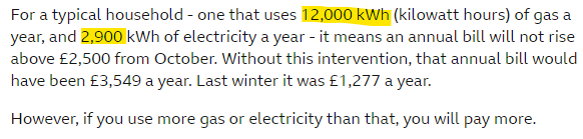
So this is just an example, based upon a fictitious but broadly typical usage pattern. If you use 2,900 units of electricity and 12,000 units of gas, your total bill will be £2500. So the cost per unit of electricity is capped, and the cost per unit of gas is capped. If your house uses only electricity, you'll likely use more units of electricity, but the cost per unit still has the same cap applied. Whether you use 100 units a year or a million units a year, you'll still pay a maximum of <price per unit> multiplied by <units used>. You're not being penalised for using only electricity.
0 -
@steveholc, this assumes you are on a flat rate standard variable tariff.
To put it simply all your electricity usage will now be capped at a UNIT RATE of around 34p for the next two years from 1st October and your 9914 kWh will cost you roughly £3559 a year including standing charges.
Had the government not intervened then from 1st October the unit rate would have been 51p meaning YOUR annual bill would have been £5238 with further adjustments every 3 months.
Your are getting support to the tune of 9914 x 17p = £1685 per year
Edit : You'll also get a further £400 of government money over six months from October.
4 -
Oh dear, I hope you have not been needlessly alarming these people and maybe it’s not too late to tell the MP to ignore your e mail due to you having totally misunderstood how billing and unit caps will work.steveholc said:If, as the BBC website stated, the Energy Price Guarantee is based on thresholds of 2900kWh of Electricity, and 12000 kWh of gas, then what about those houses that only use electricity and are not connected to mains gas?
I used 9914 kWh of Electricity last year, which is well under the 14900kWh (2900+12000) that the government considers an average, but it seems the price I pay will NOT BE CAPPED for the 7000kWh over the threshold that I will use. How is this fair?
My 84 year-old mother in law is int he same situation, along with her 54 neighbouring flats in a development full of elderly people. None of these pensioners, many living on benefits, will have their energy prices capped or guaranteed.
How, and to whom, can I report this loophole? I have already emailed my MP, but that was on the day the queen died, and apparently the government doesn't have to do any work for the forseeable future.0 -
It is reasonable to say that a consumer that uses 20000kWh/year will get more financial support than a consumer that uses 2000kWh/year: that is, the financial saving in £s will be greater for higher consumers even though the percentage unit price saving is the same. Is this fair?
It is probably just as fair as offering £400 to all electricity consumers. The ‘challenge’ being that no one is ever going to invent a system that treats every energy user in an equitable way. It would just be too complicated and time-consuming to administrate.0 -
Almost impossible to distinguish between those who need to be a high user and those who choose to be a high user without being overly intrusive into people's lifestyles. Obvious cases are just that - obvious - but the grey areas are large and ominous.[Deleted User] said:It is reasonable to say that a consumer that uses 20000kWh/year will get more financial support than a consumer that uses 2000kWh/year: that is, the financial saving in £s will be greater for higher consumers even though the percentage unit price saving is the same. Is this fair?
It is probably just as fair as offering £400 to all electricity consumers. The ‘challenge’ being that no one is ever going to invent a system that treats every energy user in an equitable way. It would just be too complicated and time-consuming to administrate.1












Confirm your email address to Create Threads and Reply

Categories
- All Categories
- 354.6K Banking & Borrowing
- 254.5K Reduce Debt & Boost Income
- 455.5K Spending & Discounts
- 247.5K Work, Benefits & Business
- 604.3K Mortgages, Homes & Bills
- 178.6K Life & Family
- 261.9K Travel & Transport
- 1.5M Hobbies & Leisure
- 16.1K Discuss & Feedback
- 37.7K Read-Only Boards