We’d like to remind Forumites to please avoid political debate on the Forum.
This is to keep it a safe and useful space for MoneySaving discussions. Threads that are – or become – political in nature may be removed in line with the Forum’s rules. Thank you for your understanding.
📨 Have you signed up to the Forum's new Email Digest yet? Get a selection of trending threads sent straight to your inbox daily, weekly or monthly!
The Forum now has a brand new text editor, adding a bunch of handy features to use when creating posts. Read more in our how-to guide
Future distribution yield of bond funds

aroominyork
Posts: 3,887 Forumite



Does the stated distribution yield of a bond fund accurately reflect the income from its underlying holdings assuming they do not default? For example, Vanguard's global aggregate bond fund shows a distribution yield of 1.79%. Putting aside fund movements due to changes in interests rates or other demand-driven factors, is that a reliable indicator? And if so, given that cash pays c.3% for a one year fix, what is the attraction of such a fund if you are not predicting that a capital gain will be made?
0
Comments
-
Yes, it's explained in the tool-tip:
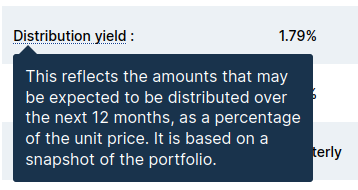 As the fund is currency hedged (so there is no local currency gain to be made from the pound continuing to devalue), the only way the return could beat a 1 year fix (currently 3.5%) is a dramatic reversal of interest rate policy.I suppose if you want to keep things simple and are investing in a S&S ISA or SIPP, you'd face a low double digit loss of spending power whichever option you picked, and normal savings accounts are beyond reasonable reach.1
 -
What do you mean by "normal savings accounts are beyond reasonable reach"?Our funds are mostly in SIPPs and ISAs, 70% equities and 30% fixed interest. I am about to receive an inheritance which will take a few years to feed into tax-wrapped accounts. My plan - before thinking about this bond vs. cash issue - was to use a trading account and structure it to minimise dividend, income and capital gains tax.If I want cash instead of bond funds, I could (in rough terms) hold equities in the tax wrappers, not bother with a trading account, and open a few cash accounts for one year (or other) savings. I will be a basic rate taxpayer so 3.5% becomes 2.8%.Are many people taking their route of replacing bonds with cash?0
-
cash pays c.3% for a one year fix, what is the attraction of such a (bond) fund (yielding 1.7%) if you are not predicting that a capital gain will be made?...........Are many people taking their route of replacing bonds with cash?It wasn't clear if the money for this discussion was new money, or swapping from bonds to cash. They're pretty different.If you have a well thought out investment strategy I don’t think it’s worth up-ending it by moving from bonds to cash because of short term ‘aberrations’ in valuations. Market timing isn’t easy if it’s to improve returns, and I think one needs evidence one has done it enough times to justify trying it. Changing your investments because your personal circumstances changed relevantly is a different kettle of fish.
But if you’re talking about cash ?> term deposit or bond fund, then if you’re a short term speculator you might choose the higher yielding term deposit. But if you’re a long term investor, then you might choose the bond fund because its duration (many years) more closely matches your drawdown horizon than a term deposit with a duration of less than 1 year. It’s horses for courses, and generally the best returns come from duration matching the investment with the needs; and the longer the term of investing the higher the returns are expected to be.0 -
aroominyork said:What do you mean by "normal savings accounts are beyond reasonable reach"?If your capital is currently within a S&S ISA or a SIPP, pulling it out to place into the retail savings market is going to present some challenges or at least some undesirable consequences. ISA money could lose its tax status, or you might be stuck trying to partially transfer into a cash ISA with poorer rates than the conventional savings market. Some providers will only allow you to transfer out your whole ISA. Someone with a SIPP is not going to be able to remove money until age 55, and if they do there may be income tax consequences.
New money is different, and what you are really asking is 'should I wait before investing it because I don't like the outlook for my investment of choice vs cash'. I'm sure you are not considering staying in cash for the long term, nor considering investing money you intend to spend in the short term.aroominyork said:I am about to receive an inheritance which will take a few years to feed into tax-wrapped accounts. My plan - before thinking about this bond vs. cash issue - was to use a trading account and structure it to minimise dividend, income and capital gains tax.If I want cash instead of bond funds, I could (in rough terms) hold equities in the tax wrappers, not bother with a trading account, and open a few cash accounts for one year (or other) savings. I will be a basic rate taxpayer so 3.5% becomes 2.8%.Earning 3.5% net of basic rate tax is still a little better than using a cash ISA where you'd get no more than 2.6% at current rates. Presumably not all of it would be taxed. But what happens after that first year? Is that your investment horizon? Probably not. Even if it were, I don't think you are considering all of the options. For example, TN24 would give you a return approaching 4% risk free, mostly as a tax exempt capital gain. I know individual gilts are a pain to transact through a fund supermarket, but it's probably worth the effort if the inheritance is large enough.
I've been using a ladder of fixed term savings accounts plus a little gold as a bond proxy for a couple of years now (alongside WP funds). I'm poised to start replacing that with bonds as it has largely served its purpose in preventing me from suffering a ~20% loss of capital from my bonds component.aroominyork said:Are many people taking their route of replacing bonds with cash?I prefer bonds (when they are not ridiculously priced) for their usual negative correlation with equities.2 -
From my personal understanding of bonds (which is not 100% complete) I don't think the answers given so far give the complete picture here
The yield is a bit of a misleading short term statistic with bonds, what is more relevant is the Yield to Maturity. This is a surprisingly tricky stat to find, but it's listed here:
https://www.vanguard.co.uk/professional/product/etf/bond/9685/global-aggregate-bond-ucits-etf-gbp-hedged-accumulating
Basically, if you hold the VAGP/S bond fund for the long term, the yield you'll receive p.a. is the YTM, which is near 4%. If you hold it for the long term, this is what you will get, regardless of fluctuations in the short term (as if the price of the bond fund decreases, the yield increases to compensate and reach your YTM)
I probably have not explained this brilliantly and I suggest you look it up. Occam investing has a few great articles.
Here's one other definition which i think reflects what I'm saying:
"Yield to maturity (YTM) is the overall interest rate earned by an investor who buys a bond at the market price and holds it until maturity. Mathematically, it is the discount rate at which the sum of all future cash flows (from coupons and principal repayment) equals the price of the bond. YTM is often quoted in terms of an annual rate and may differ from the bond’s coupon rate."0 -
Frequentlyhere said:From my personal understanding of bonds (which is not 100% complete) I don't think the answers given so far give the complete picture here
The yield is a bit of a misleading short term statistic with bonds, what is more relevant is the Yield to Maturity. This is a surprisingly tricky stat to find, but it's listed here:
https://www.vanguard.co.uk/professional/product/etf/bond/9685/global-aggregate-bond-ucits-etf-gbp-hedged-accumulating
Basically, if you hold the VAGP/S bond fund for the long term, the yield you'll receive p.a. is the YTM, which is near 4%. If you hold it for the long term, this is what you will get, regardless of fluctuations in the short term (as if the price of the bond fund decreases, the yield increases to compensate and reach your YTM)
I probably have not explained this brilliantly and I suggest you look it up. Occam investing has a few great articles Here's one other definition which i think reflects what I'm saying:
"Yield to maturity (YTM) is the overall interest rate earned by an investor who buys a bond at the market price and holds it until maturity. Mathematically, it is the discount rate at which the sum of all future cash flows (from coupons and principal repayment) equals the price of the bond. YTM is often quoted in terms of an annual rate and may differ from the bond’s coupon rate."That's an answer to a different question than the one that was posed. ARIY was looking to the return over the next 12 months, with a view to potentially jumping in thereafter. If the cash flows are such that this avoids a period of low returns, then based on the stated assumption that "you are not predicting that a capital gain will be made", then the projected return over those first 12 months is going to be nowhere near the YTM. It is worth doing an analysis of the durations of the bonds within the fund. Vanguard's data shows 1.3% have a maturity of <12 months, so the gain within the fund from bonds maturing with a capital gain will be fairly insignificant, with the bulk of the bonds held having maturities spread over 10 years, with a long tail. Of course, if the 40% of bonds with maturity 1-5 years includes 10% with maturity 1-2 years, then these might start tending towards their face value a bit, but I don't think this effect will be very significant, especially as interest rates seem to have further to rise in the short term and they stand to fall further in price. Therefore, the effect of those future cashflows will not be felt in the first year. This is all assuming interest rate expectations do not materially shift, as this would pull forward or push back the cashflows and lead to capital gains or losses.It's also worth bearing in mind that YTM in the context of a bond fund is only a rough guide, and only if the holding period >> average maturity of bonds in the fund (in this case just shy of 9 years). This is due to the continual reinvestment into new bonds, which means you can never hold until all of the bonds have matured. Your return will approximate the average YTM over your entire holding period, and the YTM will change over time. If your holding period ended now, then the 12% loss the fund suffered YTD is going to cause a significant deviation from the YTM you invested at, say in 2012. Compare to someone investing in 2011-2021 who would have got in at a similar YTM, but had a very different total return.0 -
Fair points @masonic, though OP does ask "what is the attraction of such a fund if you are not predicting that a capital gain will be made?" ref comparing an apparent low yield to a better rate available on a 1 year cash fix, and so I thought it reasonable to point out that that isn't the full story.
Also despite comparing it to a 1 year fix, OP doesn't state what sort of time period they're looking to hold the fund for. I don't think most people aim to hold bond funds for a single year typically. Or it seems a bit unusual to me if in this case they are. I'm certainly not sure it'd be wise given the risk of ongoing volatility.
But yes it very much depends on what OP is looking to achieve. If ARIY is really only concerned with the first year, then welcome to disregard my ramblings.
1 -
It absolutely isn't wise to hold a bond fund for just a year. It should be 3-5 years minimum. Given the 12% drop in the bond fund in question, it's going to take a few years for those investing last year to break even.Frequentlyhere said:Also despite comparing it to a 1 year fix, OP doesn't state what sort of time period they're looking to hold the fund for. I don't think most people aim to hold bond funds for a single year typically. Or it seems a bit unusual to me if in this case they are. I'm certainly not sure it'd be wise given the risk of ongoing volatility.
1 -
......hmmm, but does TN24 not mature in 16 months rather than 12?.......which means the OP might still be better off with the cash account(s).masonic said:Even if it were, I don't think you are considering all of the options. For example, TN24 would give you a return approaching 4% risk free, mostly as a tax exempt capital gain. I know individual gilts are a pain to transact through a fund supermarket, but it's probably worth the effort if the inheritance is large enough.
0 -
The reference to taking "a few years to feed into tax-wrapped accounts" suggested to me that maturity in September/October 2023 vs January 2024 is unlikely to be material. There may be other options, I just looked at the one closest to the end of the 2023/24 tax year with a favourable profile. It would obviously need re-evaluation when the inheritance is actually received.MK62 said:
......hmmm, but does TN24 not mature in 16 months rather than 12?.......which means the OP might still be better off with the cash account(s).masonic said:Even if it were, I don't think you are considering all of the options. For example, TN24 would give you a return approaching 4% risk free, mostly as a tax exempt capital gain. I know individual gilts are a pain to transact through a fund supermarket, but it's probably worth the effort if the inheritance is large enough.
0





Confirm your email address to Create Threads and Reply

Categories
- All Categories
- 354.4K Banking & Borrowing
- 254.4K Reduce Debt & Boost Income
- 455.4K Spending & Discounts
- 247.3K Work, Benefits & Business
- 604K Mortgages, Homes & Bills
- 178.4K Life & Family
- 261.5K Travel & Transport
- 1.5M Hobbies & Leisure
- 16K Discuss & Feedback
- 37.7K Read-Only Boards