We’d like to remind Forumites to please avoid political debate on the Forum.
This is to keep it a safe and useful space for MoneySaving discussions. Threads that are – or become – political in nature may be removed in line with the Forum’s rules. Thank you for your understanding.
📨 Have you signed up to the Forum's new Email Digest yet? Get a selection of trending threads sent straight to your inbox daily, weekly or monthly!
The Forum now has a brand new text editor, adding a bunch of handy features to use when creating posts. Read more in our how-to guide
Why are the stock markets so stable right now?
Comments
-
The fact that the markets hardly twitched after the Bof E announcements, tells the story. The markets were not surprised and had priced in a recession over the last few months. In any case UK is only 4% of the global financial markets, and they are as much influenced as to what happens globally than locally.2
-
Stockmarkets look a year ahead. So, the 2022 recession selloff began as early as May 2021. The 2023 recovery buyin (for now) looks to have begun in May 2022.0
-
If the BoE can predict a very large recession, surely other people in the investment world can also predict it.Booge said:True, we have been talking about a recession for some months. But we are now talking about a recession bigger than in 2008 and inflation that is the worst since the 1970s. The scale of the predictions are increasing. Yet to look at these indexes you would think everything is fine in the world.
In fact the BoE may not want to cause panic, so their predictions will be downplayed and late.
When we have 11.8% RPI inflation, a stable stock market, is not keeping pace with inflation.0 -
Not in my experience, perhaps six months if you're lucky. It depends on how obvious something is. Look at 2020: they didn't anticipate the lockdowns etc stemming from the Covid-19 outbreak in China at all. In 2008 it was only when the banks began to pop that the market really reacted even though it has been clear they had been up to lots of very silly things for a long time.Millyonare said:Stockmarkets look a year ahead. So, the 2022 recession selloff began as early as May 2021. The 2023 recovery buyin (for now) looks to have begun in May 2022.
The S&P500 hit its most recent peak at the very end of December 2021 and genuine recession fears began sometime after and accelerated following the invasion of Ukraine.
What we've seen this last month could just be a bear market rally, only time and more economic data will tell.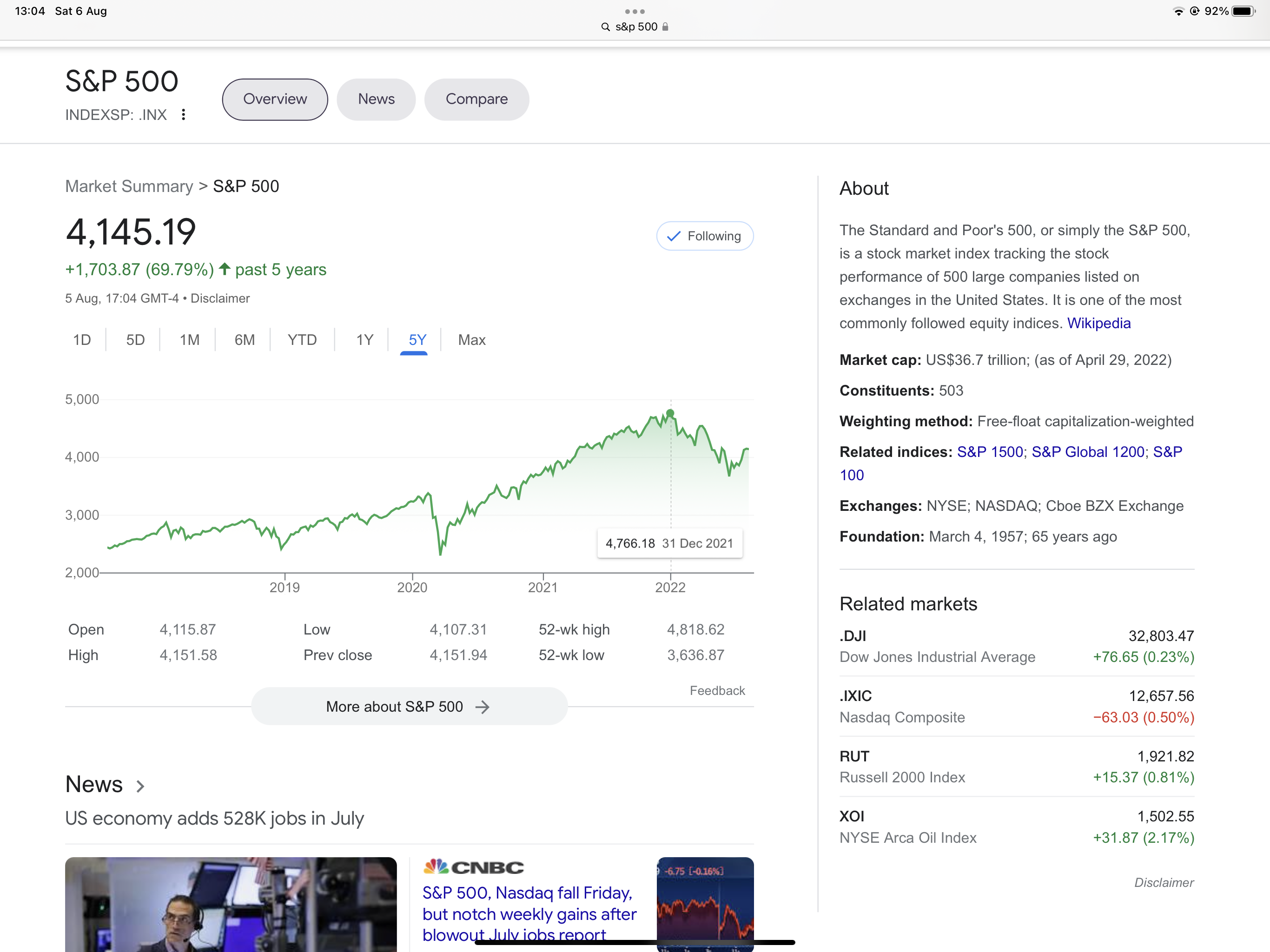
1 -
I wonder if the BoE can predict anything? They seem to be reactive rather than proactive and rates should have gone up a long long time ago. Having rates so low for so long was unsustainable, creating bubbles along the way.sevenhills said:
If the BoE can predict a very large recession, surely other people in the investment world can also predict it.Booge said:True, we have been talking about a recession for some months. But we are now talking about a recession bigger than in 2008 and inflation that is the worst since the 1970s. The scale of the predictions are increasing. Yet to look at these indexes you would think everything is fine in the world.
In fact the BoE may not want to cause panic, so their predictions will be downplayed and late.
When we have 11.8% RPI inflation, a stable stock market, is not keeping pace with inflation.
Now, all that will have to be unwound, or at least go through a correction of sorts.0 -
I wonder if the BoE can predict anything? They seem to be reactive rather than proactive and rates should have gone up a long long time ago. Having rates so low for so long was unsustainable, creating bubbles along the way.And the worst thing hit by that is gilts. A gilts crash is classed as 5%. Gilts are down as much as 25% on the expectation that interest rates will go to 3% in the coming years. That gives you an indication of the scale of that bubble unwinding.
Now, all that will have to be unwound, or at least go through a correction of sorts.
I am an Independent Financial Adviser (IFA). The comments I make are just my opinion and are for discussion purposes only. They are not financial advice and you should not treat them as such. If you feel an area discussed may be relevant to you, then please seek advice from an Independent Financial Adviser local to you.4 -
It depends on how closely one follows the data. A large chunk of the S&P500 stocks had already started to decline as early as May 2021 last year and 2022 recession chatter on investor forums was already rife back then. Similarly, the chatter today about economic recovery and US rate cuts for 2023 has already been going on for 3+ months. The broader overall indexes, like the S&P500, are a bigger ship, and can often take months to catchup with the underlying and emerging sentiment. What investors are doing doesn't always show up immediately in the top-level stats.wmb194 said:
Not in my experience, perhaps six months if you're lucky. It depends on how obvious something is. Look at 2020: they didn't anticipate the lockdowns etc stemming from the Covid-19 outbreak in China at all. In 2008 it was only when the banks began to pop that the market really reacted even though it has been clear they had been up to lots of very silly things for a long time.Millyonare said:Stockmarkets look a year ahead. So, the 2022 recession selloff began as early as May 2021. The 2023 recovery buyin (for now) looks to have begun in May 2022.
The S&P500 hit its most recent peak at the very end of December 2021 and genuine recession fears began sometime after and accelerated following the invasion of Ukraine.
What we've seen this last month could just be a bear market rally, only time and more economic data will tell.0 -
The BoE today is a shadow of its former self and its recent forecasting track record is woeful.GSP said:
I wonder if the BoE can predict anything? They seem to be reactive rather than proactive and rates should have gone up a long long time ago. Having rates so low for so long was unsustainable, creating bubbles along the way.sevenhills said:
If the BoE can predict a very large recession, surely other people in the investment world can also predict it.Booge said:True, we have been talking about a recession for some months. But we are now talking about a recession bigger than in 2008 and inflation that is the worst since the 1970s. The scale of the predictions are increasing. Yet to look at these indexes you would think everything is fine in the world.
In fact the BoE may not want to cause panic, so their predictions will be downplayed and late.
When we have 11.8% RPI inflation, a stable stock market, is not keeping pace with inflation.
Now, all that will have to be unwound, or at least go through a correction of sorts.
It said Britain would crash after Brexit in 2016 -- it didn't. It said inflation was transitory in 2021 -- it wasn't. It now wants to talk down Britain and says there will be a mega recession in 2023 -- many bet there won't be.
1 -
Well, the market as a whole didn't and you'll always find bull and bear chatter no matter what. It's what makes a market.Millyonare said:
It depends on how closely one follows the data. A large chunk of the S&P500 stocks had already started to decline as early as May 2021 last year and 2022 recession chatter on investor forums was already rife back then. Similarly, the chatter today about economic recovery and US rate cuts for 2023 has already been going on for 3+ months. The broader overall indexes, like the S&P500, are a bigger ship, and can often take months to catchup with the underlying and emerging sentiment. What investors are doing doesn't always show up immediately in the top-level stats.wmb194 said:
Not in my experience, perhaps six months if you're lucky. It depends on how obvious something is. Look at 2020: they didn't anticipate the lockdowns etc stemming from the Covid-19 outbreak in China at all. In 2008 it was only when the banks began to pop that the market really reacted even though it has been clear they had been up to lots of very silly things for a long time.Millyonare said:Stockmarkets look a year ahead. So, the 2022 recession selloff began as early as May 2021. The 2023 recovery buyin (for now) looks to have begun in May 2022.
The S&P500 hit its most recent peak at the very end of December 2021 and genuine recession fears began sometime after and accelerated following the invasion of Ukraine.
What we've seen this last month could just be a bear market rally, only time and more economic data will tell.0 -
Well it is weekend. The market is closed so the price is stable as there is no movement at all.
 0
0










Confirm your email address to Create Threads and Reply

Categories
- All Categories
- 354.5K Banking & Borrowing
- 254.4K Reduce Debt & Boost Income
- 455.4K Spending & Discounts
- 247.4K Work, Benefits & Business
- 604.2K Mortgages, Homes & Bills
- 178.5K Life & Family
- 261.7K Travel & Transport
- 1.5M Hobbies & Leisure
- 16.1K Discuss & Feedback
- 37.7K Read-Only Boards