We’d like to remind Forumites to please avoid political debate on the Forum.
This is to keep it a safe and useful space for MoneySaving discussions. Threads that are – or become – political in nature may be removed in line with the Forum’s rules. Thank you for your understanding.
To overpay mortgage or to increase savings?
Comments
-
Thank you.george4064 said:A property worth approx 230k with a 80k mortgage equates to a LTV ratio of c. 35%. The best rates are unlocked at 40% LTV so there isn't a better LTV band you can move to (as you're in the best one) where you can get a better rate.
To answer your question:
Scenario 1. 100k house with 90k mortgage = 90% LTV. Very risky from bank's point of view and the borrower should look to reduce that LTV over time as soon as possible. As a result, someone in this situation can't afford to take as much risk as they're highly mortgaged on their property.
Scenario 2. 1m house with 90k mortgage = 9% LTV. Very comfortable situation, bank will offer you their lowest rates (relative to higher LTVs) and borrower can afford to take a lot of risk as their home is as close to mortgage free without actually being mortgage free.
So if I get it right then what you're saying is you constantly (or at least come mortgage renewal time) need to find out what your house is worth? A bit like eBay. You need to say this box of junk you found in the shed is worth £50, but you don't know. You stick it on eBay & it could sell for £500 just the same as it could sell for £5.
Point being, you mention the rates being unlocked at 40%. So say my mortgage is what it is & just stick a number on my house but it puts me at 41%. Once I realise that, again if I've understood you correctly, then any sane person would just drop their valuation a few grand and hey presto they're now at 39%. Yes/no?🤐🤐🤐
0 -
I think if you look in to it you'll find that not all workplace pension providers provide what you call alternative choices. So no, they don't all offer alternative choices where approach to risk is concerned. Some are invested as the provider decides and you can't change that
I know that choice can be quite limited at some providers ( mainly the newer auto enrolment ones) , but I was not aware of any DC pension providers with no choice at all of investments. Out of interest can you name the provider(s) you found with this restriction?
2 -
This ^^^^^Albermarle said:I think if you look in to it you'll find that not all workplace pension providers provide what you call alternative choices. So no, they don't all offer alternative choices where approach to risk is concerned. Some are invested as the provider decides and you can't change thatI know that choice can be quite limited at some providers ( mainly the newer auto enrolment ones) , but I was not aware of any DC pension providers with no choice at all of investments. Out of interest can you name the provider(s) you found with this restriction?
What you (op) seem to be suggesting is that someone working for your employer has to have the same pension investment option whether they have 50 years left till retirement or 50 days.
That seems extremely unusual and a recipe for disaster for one or the other 😳.If I want to change HOW the workplace pension is invested at all then I need to quit my job & go elsewhere, assuming elsewhere uses a different provider1 -
Which investment provider is your workplace pension with?B0bbyEwing said:Albermarle said:
Regarding your workplace pension, for most people this is the backbone of their retirement plans, not something in the background. You seem to think that where your money is invested in your workplace pension is out of your control, when it almost certainly is not . You should normally have online direct access to your workplace pension, where you can see exactly how it is invested, and what the alternative choices are. As you say it may be a good idea to change how it is invested to suit you.As mentioned by MX5Huggy, it can be advantageous to add extra contributions to your workplace pension by increased monthly contributions rather than starting up a new SIPP etc
So I think you need to spend some time looking into your workplace pension, despite the fact you do not like your employer.
I think if you look in to it you'll find that not all workplace pension providers provide what you call alternative choices.
I personally have experienced 3 different providers and they all offer something different. One offered you additional payments in the form of a percentage but that was all for example. You couldn't say that I want it invested more or less risky. Another provider would allow that change in risk but didn't provide the option to add additional contributions in percentage form, but you could do it in flat fee form.
So no, they don't all offer alternative choices where approach to risk is concerned. Some are invested as the provider decides and you can't change that.
In my situation at least, there is no rather than starting up a new SIPP. It's already been started. I simply add money to it or not.
My situation is my 5% goes to my workplace pension. Employer pays 3%.
Now let's say on top of this I can afford to put an extra £250/month towards retirement. This is my situation:
* I can either put that £250 in to my workplace pension, invested however it is invested (safe I imagine - the provider isn't very clear) and my employer keeps paying that same 3% they were paying before I even thought about £250.
* Or I can put it in to the SIPP I have, invested at a more adventurous angle based on my age and attitude.
I have spent plenty of time looking in to my workplace pension before I opened my SIPP. I initially did contribute more before deciding to put that extra in a SIPP instead for reasons mentioned. As far as the workplace pension goes, I have a number of options:
* pay in as I am doing. Anything above 5% going to the SIPP
* stop paying in to the SIPP and put that same £250 (or % equivalent) to the workplace pension, albeit in a less risky approach
* stop paying altogether
* If I want to change HOW the workplace pension is invested at all then I need to quit my job & go elsewhere, assuming elsewhere uses a different provider.
As said above rare that they would not allow you to change how your pension is invested?
Would suggest finding out what your workplace pension is invested in, and the fees you are paying as a priority.
0 -
That's correct. In other words, someone with a 43% LTV that is close to remortgaging, it would be worthwhile to overpay the mortgage a bit to bring the LTV to 40% or lower. That would make the lower 40% LTV rates available to you, which over a 5year fix or longer could save you thousands.B0bbyEwing said:
Thank you.george4064 said:A property worth approx 230k with a 80k mortgage equates to a LTV ratio of c. 35%. The best rates are unlocked at 40% LTV so there isn't a better LTV band you can move to (as you're in the best one) where you can get a better rate.
To answer your question:
Scenario 1. 100k house with 90k mortgage = 90% LTV. Very risky from bank's point of view and the borrower should look to reduce that LTV over time as soon as possible. As a result, someone in this situation can't afford to take as much risk as they're highly mortgaged on their property.
Scenario 2. 1m house with 90k mortgage = 9% LTV. Very comfortable situation, bank will offer you their lowest rates (relative to higher LTVs) and borrower can afford to take a lot of risk as their home is as close to mortgage free without actually being mortgage free.
So if I get it right then what you're saying is you constantly (or at least come mortgage renewal time) need to find out what your house is worth? A bit like eBay. You need to say this box of junk you found in the shed is worth £50, but you don't know. You stick it on eBay & it could sell for £500 just the same as it could sell for £5.
Point being, you mention the rates being unlocked at 40%. So say my mortgage is what it is & just stick a number on my house but it puts me at 41%. Once I realise that, again if I've understood you correctly, then any sane person would just drop their valuation a few grand and hey presto they're now at 39%. Yes/no?"If you aren’t willing to own a stock for ten years, don’t even think about owning it for ten minutes” Warren Buffett
Save £12k in 2025 - #024 £1,450 / £15,000 (9%)1 -
Not exactly. In my experience when remortgaging, first of all you don't get to do your own valuation, you have to pay for it to be done professionally (sometimes the lender offers to pay for it) or they use some kind of electronic data bases to come up with a value (lower in my experience). Second, you want the highest possible valuation in order to make your loan proportionally smaller, therefore a lower LTV, lower than 40% is best (or if you make your loan smaller, if you can, will have the same effect)B0bbyEwing said:
Thank you.george4064 said:A property worth approx 230k with a 80k mortgage equates to a LTV ratio of c. 35%. The best rates are unlocked at 40% LTV so there isn't a better LTV band you can move to (as you're in the best one) where you can get a better rate.
To answer your question:
Scenario 1. 100k house with 90k mortgage = 90% LTV. Very risky from bank's point of view and the borrower should look to reduce that LTV over time as soon as possible. As a result, someone in this situation can't afford to take as much risk as they're highly mortgaged on their property.
Scenario 2. 1m house with 90k mortgage = 9% LTV. Very comfortable situation, bank will offer you their lowest rates (relative to higher LTVs) and borrower can afford to take a lot of risk as their home is as close to mortgage free without actually being mortgage free.
So if I get it right then what you're saying is you constantly (or at least come mortgage renewal time) need to find out what your house is worth? A bit like eBay. You need to say this box of junk you found in the shed is worth £50, but you don't know. You stick it on eBay & it could sell for £500 just the same as it could sell for £5.
Point being, you mention the rates being unlocked at 40%. So say my mortgage is what it is & just stick a number on my house but it puts me at 41%. Once I realise that, again if I've understood you correctly, then any sane person would just drop their valuation a few grand and hey presto they're now at 39%. Yes/no?1 -
Ah, you say that's correct but you then go on to say something that has a significant difference to what I said, so I'm wondering which one is accurate if you don't mind -george4064 said:
That's correct. In other words, someone with a 43% LTV that is close to remortgaging, it would be worthwhile to overpay the mortgage a bit to bring the LTV to 40% or lower. That would make the lower 40% LTV rates available to you, which over a 5year fix or longer could save you thousands.
In the post I made, I said that the person would simply change their valuation. So for easy maths, say my mortgage is 41k, I value my house at 100k, I'm at 41% so these super-duper deals are not unlocked to me as I'm above the 40% threshold you mentioned.
What I then said was, as it seems I need to stick a valuation on my house (which clearly changes over time) rather than go off what I bought the house for, I would then simply just say well now the house is worth say £103k. Just like that I'm under 40% and hey presto these great deals are unlocked. 3k difference is close enough to what I would've valued the house at without raising alarm bells such as if i valued the house at 900k.
However what you said was that the person would overpay to actually bring it under the 40% mark. That suggests there is a universally agreed number that the house will be valued at that can't be disputed one way or another, but then you'd only get close to that surely if you actually paid for someone to value the house, which I doubt anyone does come renewal time. So overpaying brings you under 40%, but who decides the number? You? What if the next person disagrees and goes a fair bit above or below you? What makes you right?
Not trying to cause offence here. When I say what makes you right, I don't mean you george, I mean the individual, any individual in the above example.🤐🤐🤐
0 -
Expotter said:
See this is why I went to an IFA last time as I didn't have a clue. I also wonder whether we're talking about the same thing here?Not exactly. In my experience when remortgaging, first of all you don't get to do your own valuation, you have to pay for it to be done professionally (sometimes the lender offers to pay for it) or they use some kind of electronic data bases to come up with a value (lower in my experience). Second, you want the highest possible valuation in order to make your loan proportionally smaller, therefore a lower LTV, lower than 40% is best (or if you make your loan smaller, if you can, will have the same effect)
The reason I say that is you mention that you don't get to do your own valuation & you need to pay for a professional.
So let's say all of us reading this now is on a 5 year fixed deal which ends next year like mine does. We'll then tick over on to our banks/building societies default deal unless we do something about it - either shifting to a different deal with the same bank/building society or going to a different one.
Let's say we all then want to shift to a new 5 year fixed deal because we expect rates to go up & up.
You're saying that all 20 of us then need to book in someone to come & value our houses before we do that?
I find that hard to believe so either I've misunderstood you, you've misunderstood me, we're talking about different things through some kind of misunderstanding or I don't know what. I say this because when I was in that very situation 4 years ago, I didn't book anyone in to come & value the house. I just went to the IFA, said my deal is ending & I want to lock in on a new 5 year deal & we did it there & then. Nobody coming out to value my house at all, nor did I have to jump on Rightmove or Zoopla and find out what houses in the area were selling for.🤐🤐🤐
0 -
No offence taken at all.B0bbyEwing said:
Ah, you say that's correct but you then go on to say something that has a significant difference to what I said, so I'm wondering which one is accurate if you don't mind -george4064 said:
That's correct. In other words, someone with a 43% LTV that is close to remortgaging, it would be worthwhile to overpay the mortgage a bit to bring the LTV to 40% or lower. That would make the lower 40% LTV rates available to you, which over a 5year fix or longer could save you thousands.
In the post I made, I said that the person would simply change their valuation. So for easy maths, say my mortgage is 41k, I value my house at 100k, I'm at 41% so these super-duper deals are not unlocked to me as I'm above the 40% threshold you mentioned.
What I then said was, as it seems I need to stick a valuation on my house (which clearly changes over time) rather than go off what I bought the house for, I would then simply just say well now the house is worth say £103k. Just like that I'm under 40% and hey presto these great deals are unlocked. 3k difference is close enough to what I would've valued the house at without raising alarm bells such as if i valued the house at 900k.
However what you said was that the person would overpay to actually bring it under the 40% mark. That suggests there is a universally agreed number that the house will be valued at that can't be disputed one way or another, but then you'd only get close to that surely if you actually paid for someone to value the house, which I doubt anyone does come renewal time. So overpaying brings you under 40%, but who decides the number? You? What if the next person disagrees and goes a fair bit above or below you? What makes you right?
Not trying to cause offence here. When I say what makes you right, I don't mean you george, I mean the individual, any individual in the above example.
You don't value your own home, by default your lender will using property index data or you can get a surveyor to value it and persuade the lender to use that.
This link is to a website that explains the remortgaging process, you might find it helpful: https://www.remortgage.com/guides/ltv-explained.php"If you aren’t willing to own a stock for ten years, don’t even think about owning it for ten minutes” Warren Buffett
Save £12k in 2025 - #024 £1,450 / £15,000 (9%)1 -
@Albermarle
@Dazed_and_C0nfused
@grumiofoundation
Firstly Albermarle touched on something which may be why you seem to be suggesting I've got it wrong here when I know I haven't - auto enrolment.
Now I don't know what the experience of workplace pensions is you guys have and I'm no expert but I've seen enough to know that they're not all created equal, so I don't assume that mine is a fair representations of the next persons, likewise theirs isn't necessarily going to be the same as the person after them and so on. I personally accept that there's differences between providers.
Now whether this lack of faith in me being correct comes down to you're thinking about a workplace pension that isn't auto-enrolment and maybe auto-enrolment is different, I honestly don't know. I don't knwo whether auto enrolment is or is not different to other workplace pensions.
I'll show you 3 examples: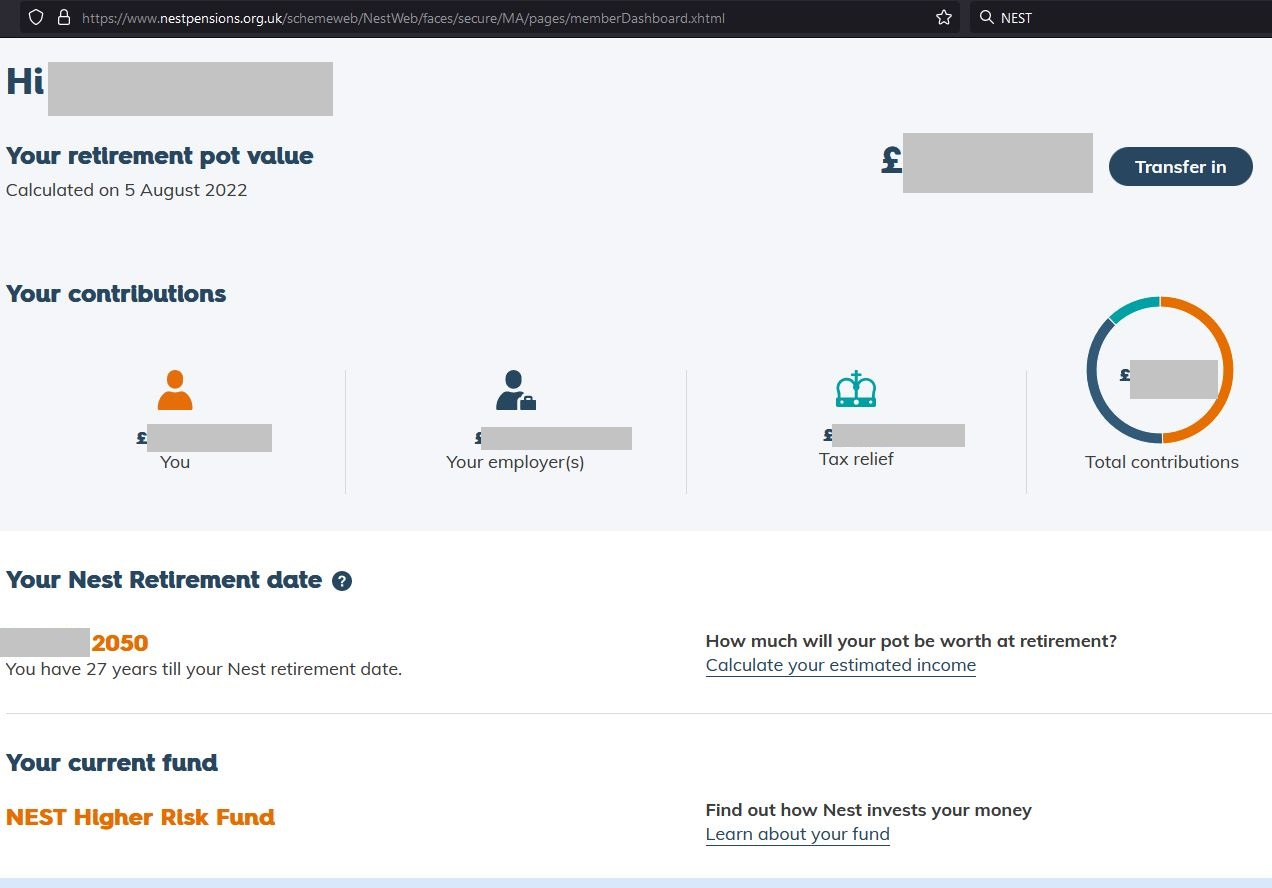

As you can see, this person with nest has selected to be invested in the higher risk fund. There's other options such as ethical, sharia, lower growth etc. If I remember right then once you keep clicking through you can actually see a breakdown of how it's invested. In this example the umbrella could be called higher risk but underneath this it shows how this is broken down.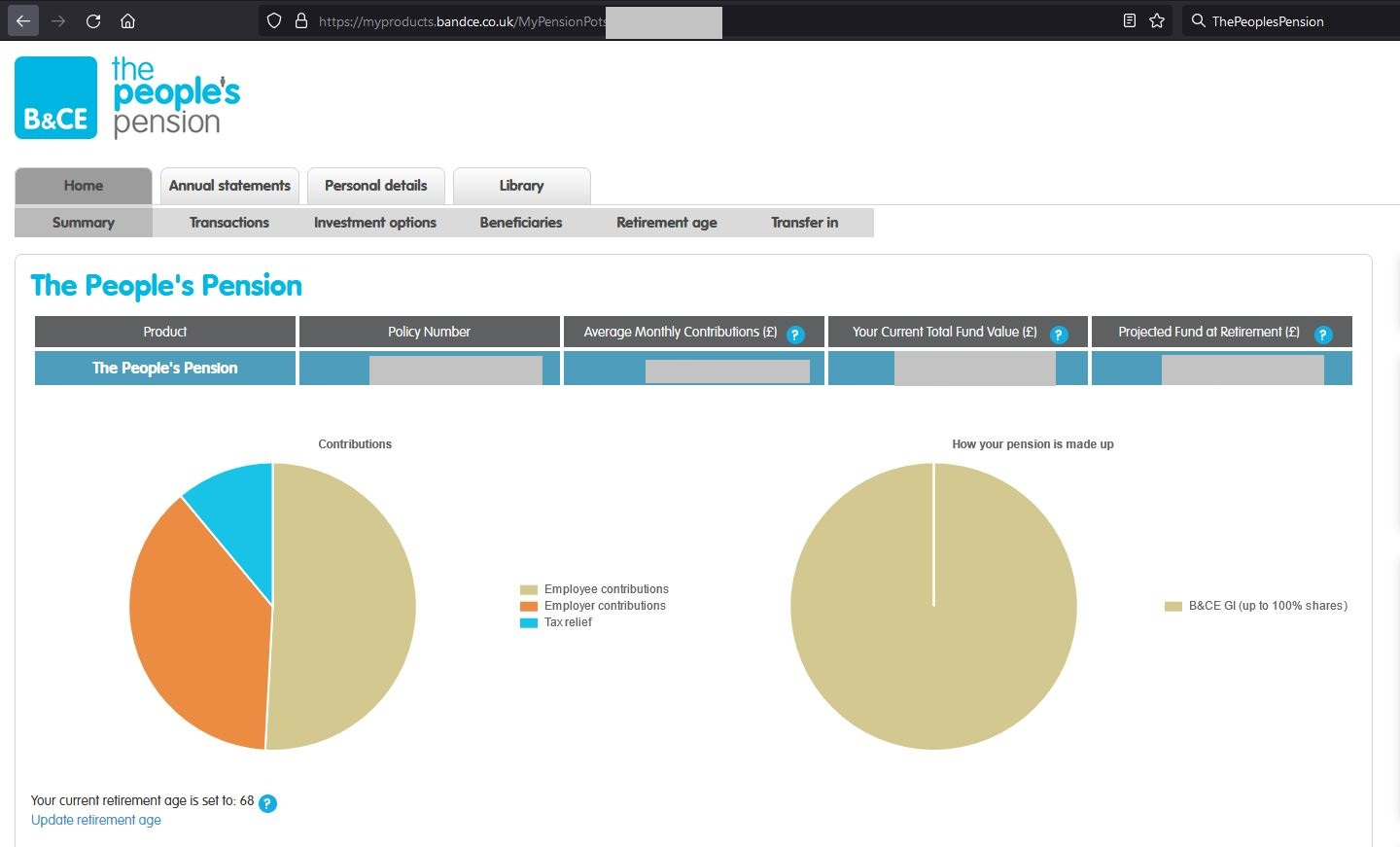
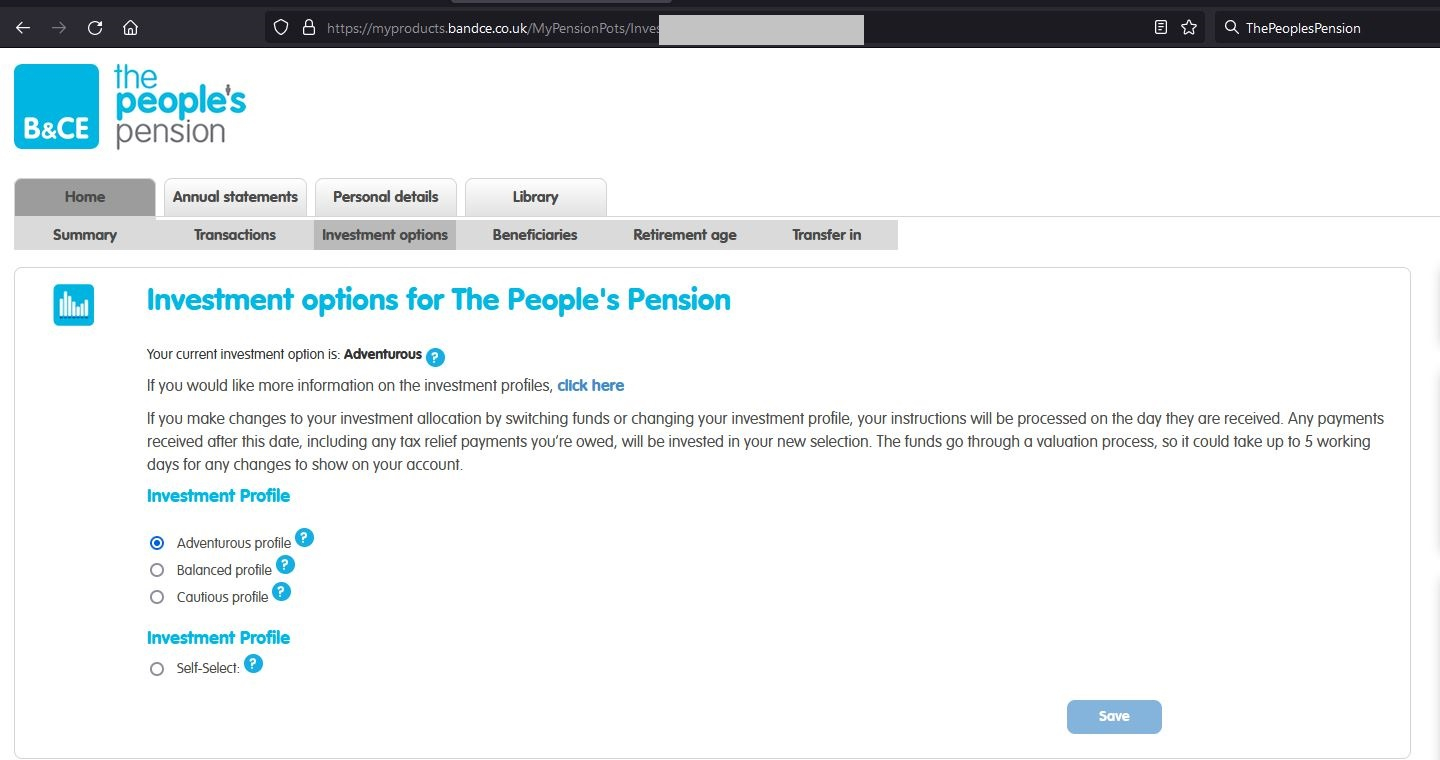
Something a little similar with the peoples pension. They get options of adventurous, balanced, cautious - so there's choice there. They can do other things like selecting beneficiaries, setting their retirement age, they can easily transfer in from within their online portal.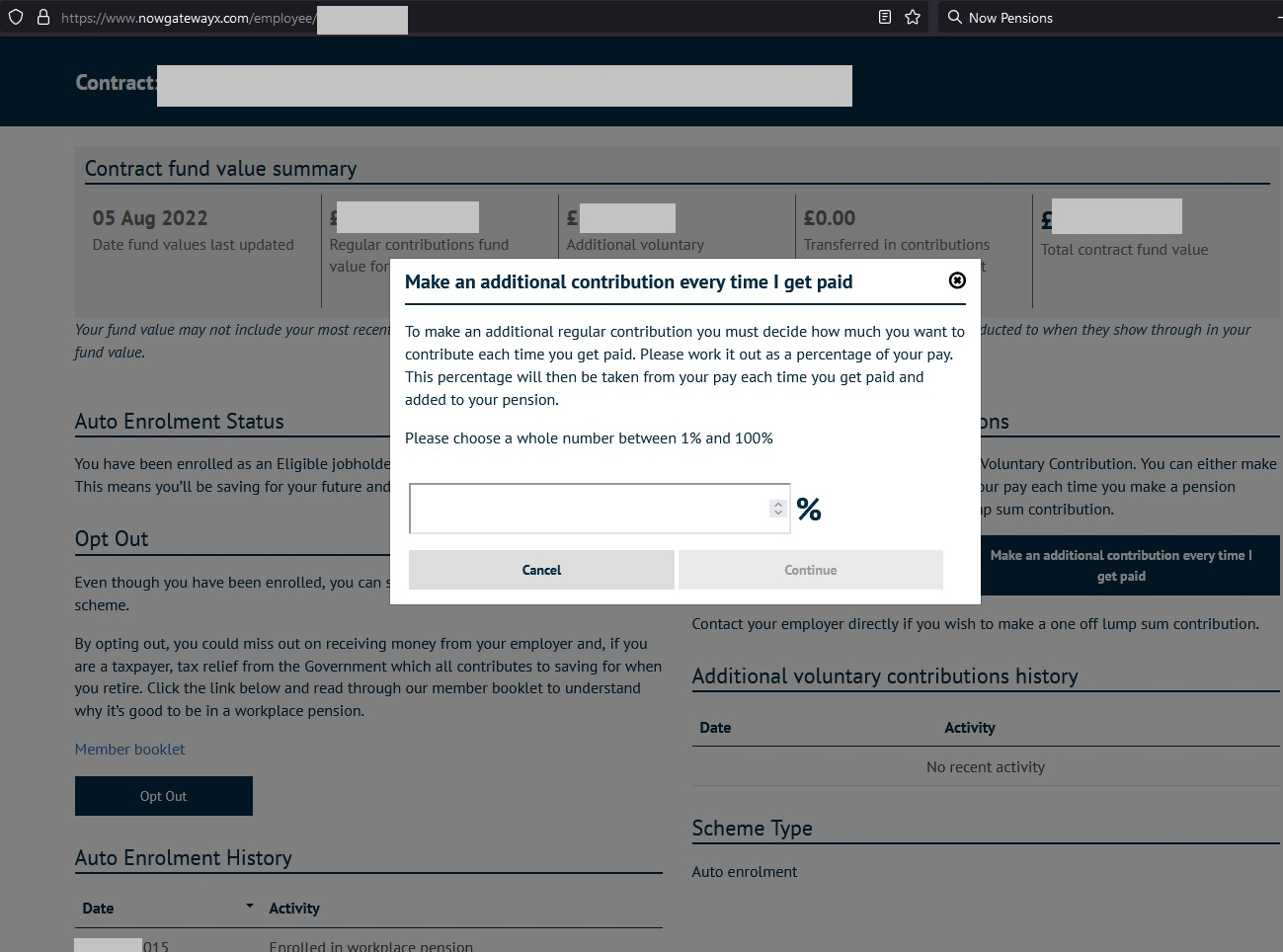
Then there's now pensions which gives you almost nothing. The only change you can make is an additional contribution in the form of a percentage.
You cannot really do any of the above with the other 2 providers from within your now portal.
If you go on to the now site and dig deep you can find a wishy-washy answer as to how they invest but there is no input from you. Your money goes in, they decide what happens with it and that is final.
It sounds quite similar to Vanguards Target Retirement approach. Speaking of which, I'm not even sure that you can set your retirement age with Now. Maybe you can, but what you can't do which you guys appear to be suggesting must be able to be done, is you can't tell them hey I want to invest more aggressively or more cautiously.
If you want to do that then you need to quit your job & go work for someone who uses a different provider.
Or pay in to a SIPP.🤐🤐🤐
0








Confirm your email address to Create Threads and Reply

Categories
- All Categories
- 355.2K Banking & Borrowing
- 254.7K Reduce Debt & Boost Income
- 455.8K Spending & Discounts
- 247.9K Work, Benefits & Business
- 605K Mortgages, Homes & Bills
- 178.8K Life & Family
- 262.8K Travel & Transport
- 1.5M Hobbies & Leisure
- 16.1K Discuss & Feedback
- 37.7K Read-Only Boards