We’d like to remind Forumites to please avoid political debate on the Forum.
This is to keep it a safe and useful space for MoneySaving discussions. Threads that are – or become – political in nature may be removed in line with the Forum’s rules. Thank you for your understanding.
Berkshire Hathaway - thoughts?
Comments
-
Its partly because over longer periods slow and steady companies which are able to grow their profits have outperformed the more speculative areas of the markets. So in the 70s and 80s Berkshire was invested in insurance companies, textile companies, food producers and finance. Not exactly high speed growth.Steve182 said:
Yes, that's how it is now, but in 70's, 80's and 90's its phenomenal growth was not achieved through investment in slow burners.Prism said:
I wouldn't say that BH has ever been in the market for new growth companies. It outperforms by investing in reliable quality companies - more slow burners.Steve182 said:BH is now just too big to find enough opportunities to invest the vast sums required in new growth companies to make a difference and significantly outperform the market...
Edited to say (ask) -
If the above statement is wrong, why can they now no longer find the quality, reliable slow burners that achieved such phenomenal growth in these past decades?
Over the last 10 years we have to say that technology has done amazingly well, both in shareprice and company performance. Berkshire has typically stayed away from tech. Maybe they were a bit late in eventually investing in Apple
Anyway, over 5, 10 and 20+ years Berkshire has outperformed the S&P 500 so it doesn't seem to have harmed them too much.1 -
BH bought Coca Cola in 1988 @ <$3. A sound investment for the first 10 years, then a poorer investment for the next decade, after which shares in all good US companies flourished.Thrugelmir said:
WB bought a 10% stake in Coca Cola (that he still holds to this day). Reliable well managed moated company that churns out cash whathever the weather. Simple business model that's easy to understand. Coca Cola itself dates back to 1892.Steve182 said:
Yes, that's how it is now, but in 70's, 80's and 90's its phenomenal growth was not achieved through investment in slow burners.Prism said:
I wouldn't say that BH has ever been in the market for new growth companies. It outperforms by investing in reliable quality companies - more slow burners.Steve182 said:BH is now just too big to find enough opportunities to invest the vast sums required in new growth companies to make a difference and significantly outperform the market...
To re-phrase my original comment, rather than saying "new growth companies" perhaps I should have said "growth opportunities"
“Like a bunch of cod fishermen after all the cod’s been overfished, they don’t catch a lot of cod, but they keep on fishing in the same waters. That’s what’s happened to all these value investors. Maybe they should move to where the fish are.” Charlie Munger, vice chairman, Berkshire Hathaway2 -
When you the set the chart to 50 years or ALL it's not plain sailing. No idea but maybe some new share issues along the way to distort the picture ? " Growth opportunities " got to agree it's all about timing . Did they not buy Tesco and then sell it ? I can remember TSCO trading on a lofty P/E of 20 when supermarkets normally traded around 10 . The growth story was over and the share was dumped as usual. Keep saying it if you buy single shares you need to understand this . Forward earnings and growth are vital.Steve182 said:
BH bought Coca Cola in 1988 @ <$3. A sound investment for the first 10 years, then a poorer investment for the next decade, after which shares in all good US companies flourished.Thrugelmir said:
WB bought a 10% stake in Coca Cola (that he still holds to this day). Reliable well managed moated company that churns out cash whathever the weather. Simple business model that's easy to understand. Coca Cola itself dates back to 1892.Steve182 said:
Yes, that's how it is now, but in 70's, 80's and 90's its phenomenal growth was not achieved through investment in slow burners.Prism said:
I wouldn't say that BH has ever been in the market for new growth companies. It outperforms by investing in reliable quality companies - more slow burners.Steve182 said:BH is now just too big to find enough opportunities to invest the vast sums required in new growth companies to make a difference and significantly outperform the market...
To re-phrase my original comment, rather than saying "new growth companies" perhaps I should have said "growth opportunities"
Coca-Cola | KO - Stock Price | Live Quote | Historical Chart (tradingeconomics.com)
At random I've picked AZN in the UK and again set to 25 yrs or ALL.
AstraZeneca | AZN - Stock Price | Live Quote | Historical Chart (tradingeconomics.com)
Here's Unilever ULVR and set to 10 years. Growth story not so good and the share falls against the market. So anybody thinking they can just buy a share because it's a quality company think again. You could be waiting years for results. Forward earnings and growth key.
Unilever | ULVR - Stock Price | Live Quote | Historical Chart (tradingeconomics.com)
3 -
adindas said:aroominyork said:
'Back to normal' is not low inflation and growth powering ahead of value. That is an aberration of the last decade+ caused by, mostly, QE and cheap money. The 'normal' of the coming decade could look very different. (I may be wrong but for once Thrugelmir might agree with me.)adindas said:In the last few month since December last year value beat growth stock. But wait until the situation is back to normal, inflation is under control, no more uncertainty...When I said back to normal, it does not mean people life back to normal, but the stock market is back to normal e,g bull market (the default of the stock market), less FUD, less volatility, the war in Ukraine is over, controllable inflation and interest rate.My point exactly. You think that 'normal' is a turbo-charged, growth led stock market with low inflation and close-to-zero interest rates. History will probably record the last decade was an exception, not the rule.
And this is where you are confused. QE did not begin with the pandemic; it began after the GFC with central banks buying gilts/govt bonds so banks would loan to companies at cheap rates. The pandemic, it seems to me, was just the trigger to start the reversal; if it had not been the pandemic it would have been something else in the short/medium term. (Happy to be corrected on this; macroeconomics is not my field but I think this is about right.)adindas said:I do not know whether you are aware or not, QE happen during the COVID-19 pandemic lock down, not since decades ago. where they were a lot of money printed to buy assets and distribute pay cheque to people. These is what has caused the high inflation which in turn trigger the high interest rate. If they did not do QE during the COVID-19 pandemic lock down many of the companies which does not earn revenue at that time would go bankrupt.3 -
aroominyork said:And this is where you are confused. QE did not begin with the pandemic; it began after the GFC with central banks buying gilts/govt bonds so banks would loan to companies at cheap rates. The pandemic, it seems to me, was just the trigger to start the reversal; if it had not been the pandemic it would have been something else in the short/medium term. (Happy to be corrected on this; macroeconomics is not my field but I think this is about right.)I do not get confused, but you might get confused to what I wrote.I never said QE (Quantitative easing ) is only for COVID-19 or during COVID and I am talking about the US stock market, not the UK.But it is during the COVID-19 lockdown where they started printing money aggressively to allow the V-shape recovery. Those excessive money supplies, liquidity do the job for V-Shape recovery, but now they will need deal with other consequences e.g high inflation, high interest rate that now they want to combat.This illustrative picture below that you could easily find online illustrate what Jerome Powell did during the US COVID-19 Lockdown.
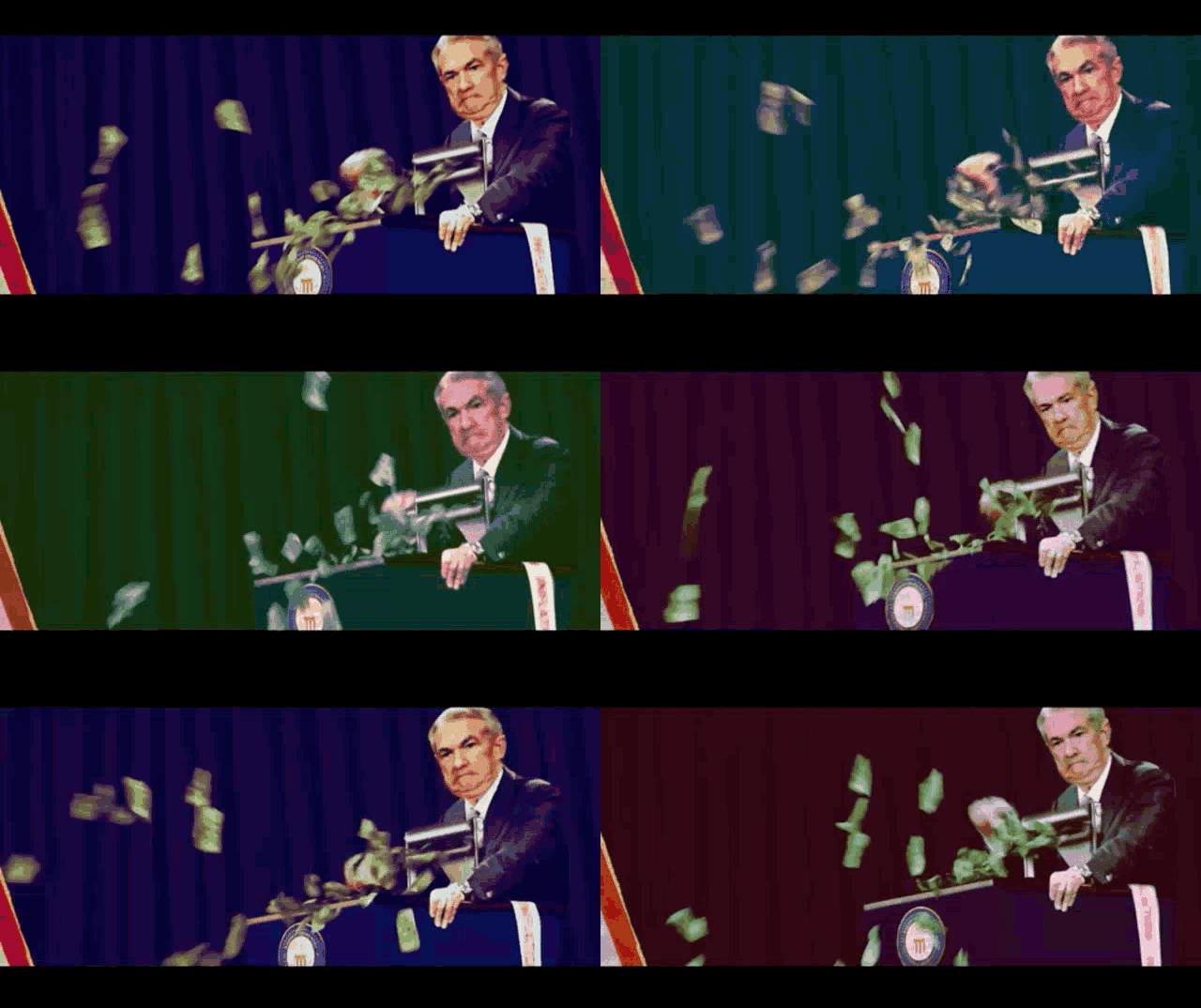 Do you have any idea how much money was pumped into the US economy during the lockdown and compare in other period? Do you have any idea what they have done now to combat inflation??.I do not know about you but I do have understanding the current stock market and I could say that confidently as I have been following closely. I have posts regarding the stock market, market crashed, interest rate, bear market, etc. on other threads and I have not seen your contribution regarding these topics.
0 -
Firstly it's BRK.A, and that's only if you have enough money lying around to afford a house, otherwise it's BRK.B.adindas said:Comparison of BARK-A, SMT.L, S&P500 how they perform and and draw your conclusion. Warren Buffet beat the market a few decades ago before many high growth stocks emerge.In the last few month since December last year value beat growth stock. But wait until the situation is back to normal, inflation is under control, no more uncertainty I very much doubt if BARK-A could ever beat the market in the next decade.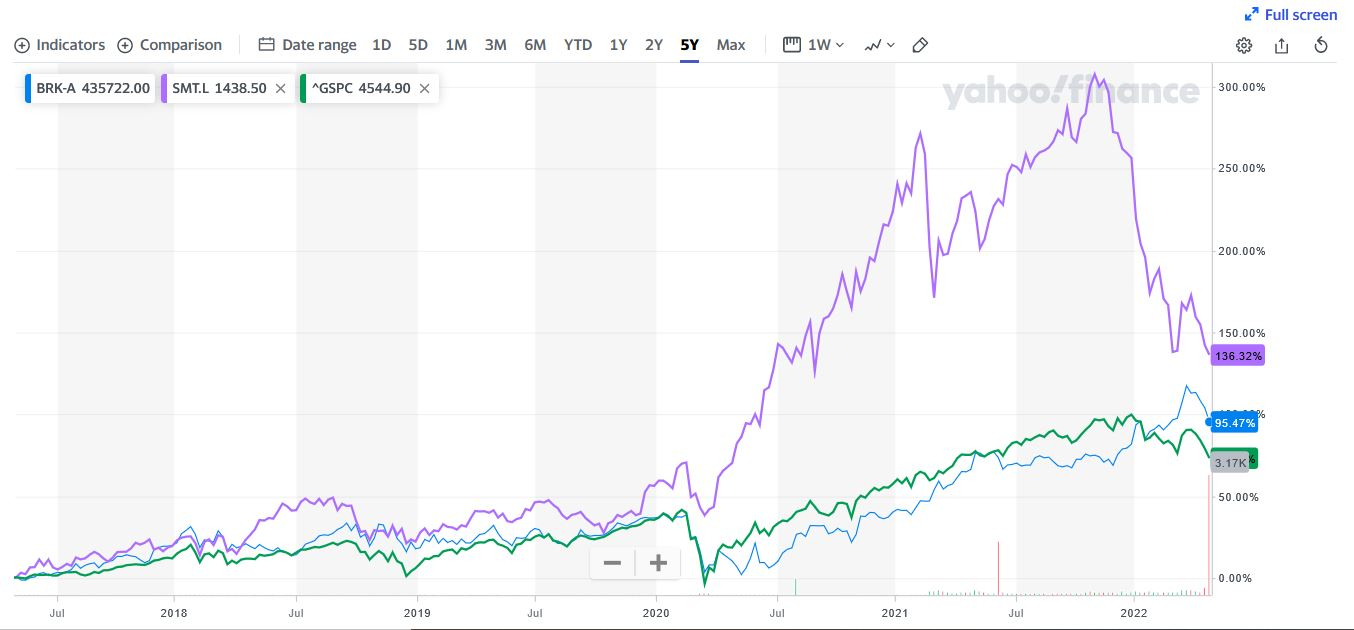
What normal?
Berkshire has been around in its current form since 1965, what conclusions are you drawing from a 5-year snapshot of its history compared with what has done well with the benefit of hindsight?
When has there ever been no uncertainty?
When was it normal for "growth" to beat the index over sustained periods? - it simply doesn't.
There have always been "growth" stocks, growth didn't emerge out of the internet, before the FAANGs there were other growth stocks.
2 -
Have a read of the "Intelligent Investor". Text maybe dated by the principles are as valid today as there were all those decades ago.Steve182 said:
BH bought Coca Cola in 1988 @ <$3. A sound investment for the first 10 years, then a poorer investment for the next decade, after which shares in all good US companies flourished.Thrugelmir said:
WB bought a 10% stake in Coca Cola (that he still holds to this day). Reliable well managed moated company that churns out cash whathever the weather. Simple business model that's easy to understand. Coca Cola itself dates back to 1892.Steve182 said:
Yes, that's how it is now, but in 70's, 80's and 90's its phenomenal growth was not achieved through investment in slow burners.Prism said:
I wouldn't say that BH has ever been in the market for new growth companies. It outperforms by investing in reliable quality companies - more slow burners.Steve182 said:BH is now just too big to find enough opportunities to invest the vast sums required in new growth companies to make a difference and significantly outperform the market...
To re-phrase my original comment, rather than saying "new growth companies" perhaps I should have said "growth opportunities"
All companies aim to grow. How much they do so is another matter.0 -
Thrugelmir said:
Have a read of the "Intelligent Investor". Text maybe dated by the principles are as valid today as there were all those decades ago.Steve182 said:
BH bought Coca Cola in 1988 @ <$3. A sound investment for the first 10 years, then a poorer investment for the next decade, after which shares in all good US companies flourished.Thrugelmir said:
WB bought a 10% stake in Coca Cola (that he still holds to this day). Reliable well managed moated company that churns out cash whathever the weather. Simple business model that's easy to understand. Coca Cola itself dates back to 1892.Steve182 said:
Yes, that's how it is now, but in 70's, 80's and 90's its phenomenal growth was not achieved through investment in slow burners.Prism said:
I wouldn't say that BH has ever been in the market for new growth companies. It outperforms by investing in reliable quality companies - more slow burners.Steve182 said:BH is now just too big to find enough opportunities to invest the vast sums required in new growth companies to make a difference and significantly outperform the market...
To re-phrase my original comment, rather than saying "new growth companies" perhaps I should have said "growth opportunities"
All companies aim to grow. How much they do so is another matter.It is a natural law that everything has "a limit to grow". Those good high growth companies will settle to become value company and limit their growth at the end, if they do not innovate and keep reinventing innovative products that will compete in the market. Some will collapse.A good example of growth company but keep innovating is APPL (Apple). It is entirely a different story if you compare it such as Blackberry or Dyno-sour hi-tech such as AT&T, IBM.Why growth matter because significant growth in revenue will improve their valuation from time to time and in turn will reduce their P/E ratio significantly.In the meanwhile these growth companies are very sensitive to earning. If they miss earning at the earning season even at the slightest the market will punish them. It is not uncommon you see high growth stock down -20% in just one day due to missing the earning exception. Let alone if they provide a weak guidance.0 -
That's simply stating the obvious. My comment remains valid. Given that the average lifespan of a listed company is now only 15 years .adindas said:Thrugelmir said:
Have a read of the "Intelligent Investor". Text maybe dated by the principles are as valid today as there were all those decades ago.Steve182 said:
BH bought Coca Cola in 1988 @ <$3. A sound investment for the first 10 years, then a poorer investment for the next decade, after which shares in all good US companies flourished.Thrugelmir said:
WB bought a 10% stake in Coca Cola (that he still holds to this day). Reliable well managed moated company that churns out cash whathever the weather. Simple business model that's easy to understand. Coca Cola itself dates back to 1892.Steve182 said:
Yes, that's how it is now, but in 70's, 80's and 90's its phenomenal growth was not achieved through investment in slow burners.Prism said:
I wouldn't say that BH has ever been in the market for new growth companies. It outperforms by investing in reliable quality companies - more slow burners.Steve182 said:BH is now just too big to find enough opportunities to invest the vast sums required in new growth companies to make a difference and significantly outperform the market...
To re-phrase my original comment, rather than saying "new growth companies" perhaps I should have said "growth opportunities"
All companies aim to grow. How much they do so is another matter.It is a natural law that everything has "a limit to growth". Those high growth companies will settle to become value company and limit their growth at the end if they do not innovate and keep reinventing innovative products that will compete in the market.A good example of growth companies but keep innovating is APPL (Apple). It is entirely a different story if you compare it such as Blackberry or Dyno-sour hi-tech such as AT&T, IBM.Why growth matter because significant growth in revenue will improve their valuation and in turn will reduce their P/E ratio significantly.In the meanwhile these growth companies are very sensitive to earning. If they miss earning even at the slightest the market will punish it.1 -
tebbins said:
Firstly it's BRK.A, and that's only if you have enough money lying around to afford a house, otherwise it's BRK.B.adindas said:Comparison of BARK-A, SMT.L, S&P500 how they perform and and draw your conclusion. Warren Buffet beat the market a few decades ago before many high growth stocks emerge.In the last few month since December last year value beat growth stock. But wait until the situation is back to normal, inflation is under control, no more uncertainty I very much doubt if BARK-A could ever beat the market in the next decade.
What normal?It is sometimes astonishing me that some people talking a lot about the stock markets and still do not know that you do not need money lying around to afford a house, to get BRK.A. This is what happen you do not keep updating your knowledge.
Also that BRK.A literally has similar holding with BRK.B, it is only that share price is different, but could be converted, So their performance in percentage will be the same. So whatever you plot if you plot together with S&P500, SMT.L you will get similar result with the above plot as they are in percentage.
Here I print that again with BRK-B? Are they different ?
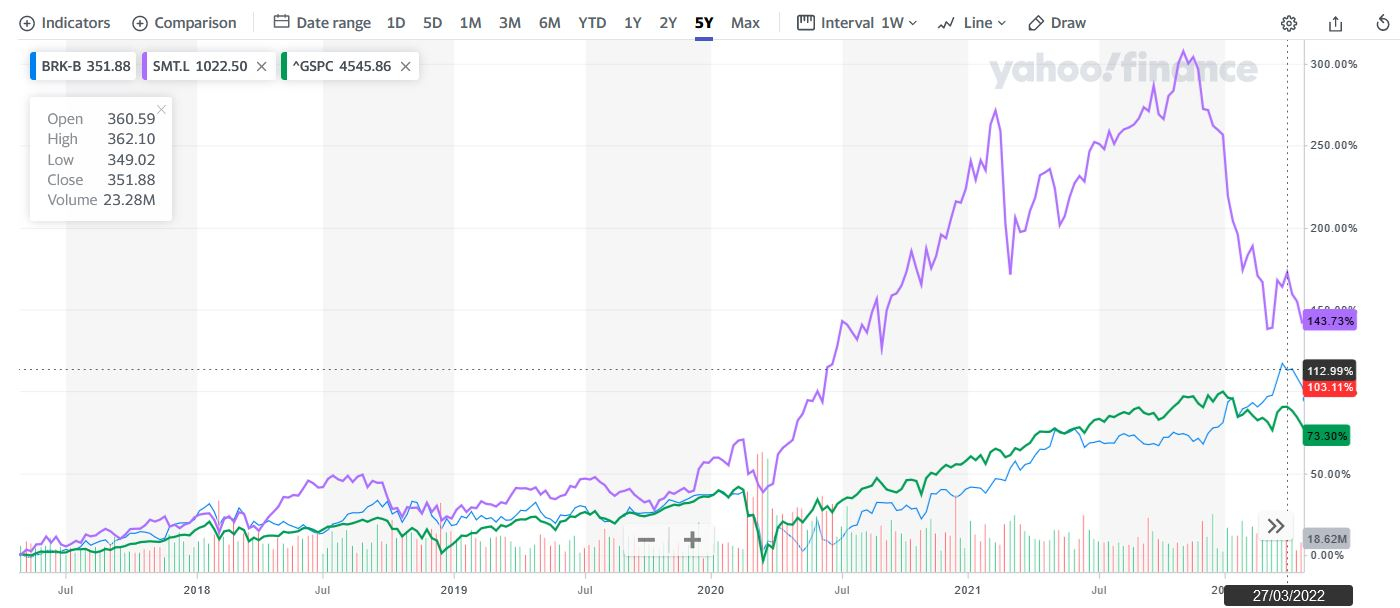
The discussion about Value vs Growth has been going on for years and and there a lot of experts on their fields outthere have been discussion it. So certainly we do not want to start another debate as this will become never ending debate. We believe want we want to believe.tebbins said:Berkshire has been around in its current form since 1965, what conclusions are you drawing from a 5-year snapshot of its history compared with what has done well with the benefit of hindsight?
When has there ever been no uncertainty?
When was it normal for "growth" to beat the index over sustained periods? - it simply doesn't.
There have always been "growth" stocks, growth didn't emerge out of the internet, before the FAANGs there were other growth stocks.
0










Confirm your email address to Create Threads and Reply

Categories
- All Categories
- 353.9K Banking & Borrowing
- 254.3K Reduce Debt & Boost Income
- 455.2K Spending & Discounts
- 247K Work, Benefits & Business
- 603.6K Mortgages, Homes & Bills
- 178.3K Life & Family
- 261.1K Travel & Transport
- 1.5M Hobbies & Leisure
- 16.1K Discuss & Feedback
- 37.7K Read-Only Boards