We’d like to remind Forumites to please avoid political debate on the Forum.
This is to keep it a safe and useful space for MoneySaving discussions. Threads that are – or become – political in nature may be removed in line with the Forum’s rules. Thank you for your understanding.
📨 Have you signed up to the Forum's new Email Digest yet? Get a selection of trending threads sent straight to your inbox daily, weekly or monthly!
The Forum now has a brand new text editor, adding a bunch of handy features to use when creating posts. Read more in our how-to guide
Looks like that time of the year! (to empty septic tank...)
Comments
-
Sounds like episode from "Better Call Saul", really looking forward to new season.in_my_wellies said:
Sorry, off topic but this reminded me that a vet can treat a human but a doctor can't treat an animal. At least in USA, my husband had a fall and his uncle took him to the local vet - saved claiming on insuranceAs an ex farmer, I wonder if some farmers would still do such a job? It's amusing that they are allowed to spread animal waste on their fields ... but not human. 🤷♂️Play with the expectation of winning not the fear of failure. S.Clarke0
 -
It's worth greasing the frames as well. The capacity is probably around 1000 gallons, but it's only a guesstimate.
A crust will form on the top of the first chamber, with other solids at the bottom. Liquids will go into the second one before going into the soakaway.
2 -
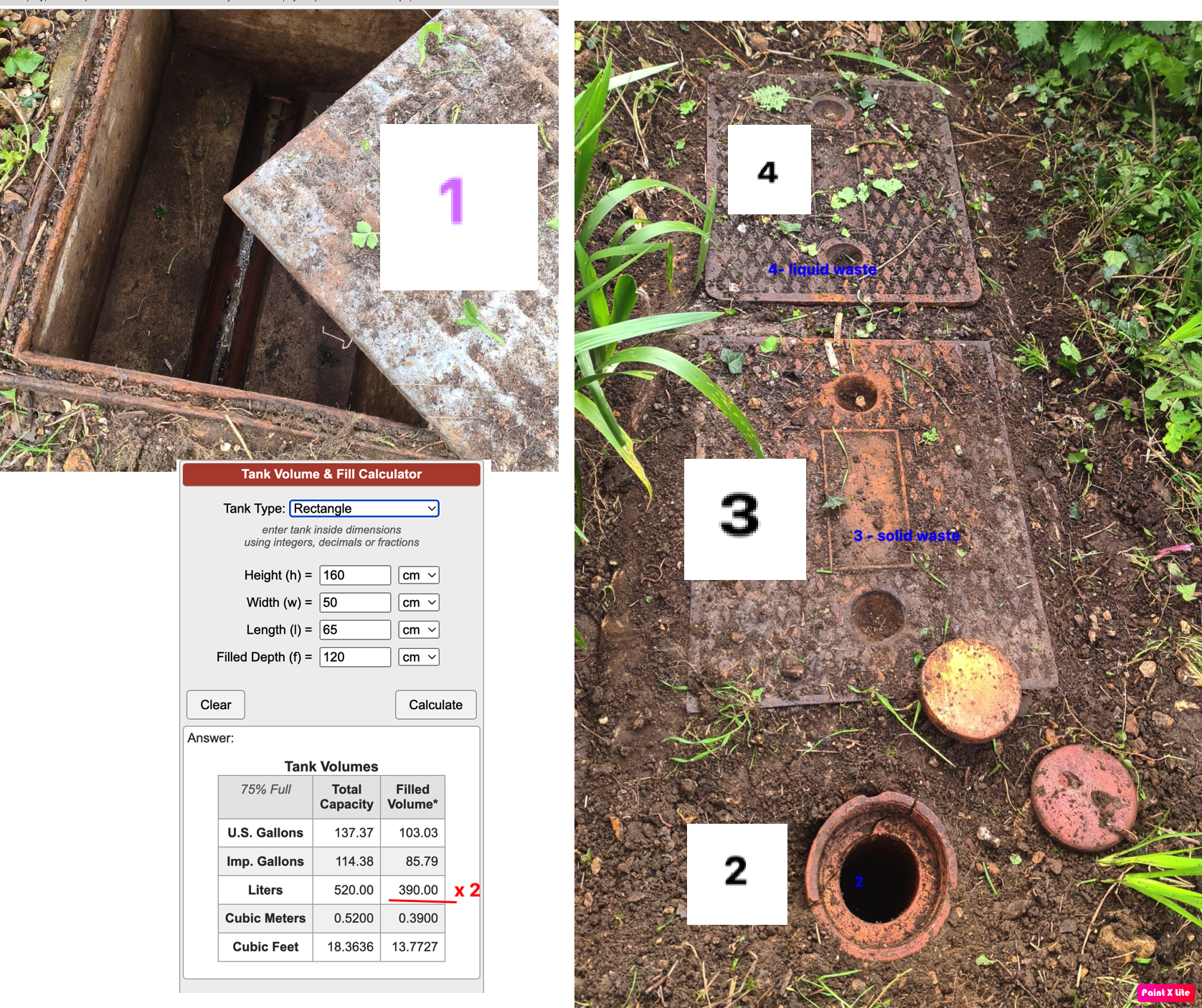
sujsuj said:After clearing all the weed around the lids I have following findings..
1. There are 4 lids/chambers for this septic tank system (not 3!)
2. First lid seems to be an inspection chamber sort as shown in first Image below. Water just flows via this.I can't see any difficulty in water flow, I suppose thats a good sign..?
3. Between chamber 2 above and actual septic tank there is small round hole may be 15cm diameter. see 2nd Image below. This is made of red brick (clay) material. I measured depth using stick into this only. I can say no smell I could get when I opened this chamber and can see some water down.
4. 3 & 4 lids covers side by side equal sized chambers paved with bricks. chamber 3 got solid waste and still didn't smell anything!! I didn't had courage to put a stick in this
5. Chamber 4 is same size as 3 but this got cloudy water in it, no solid waste
6. Both above chambers are 60% filled I think
7. when emptying waste is that done on solid chamber waste only..? or liquid chamber as well?
8. Solid chamber volume seems to be as shown in last image, but its not in 1000's of gallon as the companies were asking me..? Is this volume calculation wrong?I'd expect the first chamber to just be one for inspection, and to enable rodding of the drain leading to the septic tank.The second (small round one) is likely to be a "dip pipe extension". The dip pipe is a 'T' shaped fitting on the entry pipe which directs the incoming flow down and stops the incoming pipe getting blocked by 'crust' on the top of the tank contents. This can be a source of blockages - so the extension pipe provides a means of access to the vertical part of the 'T' (the horizontal part can be rodded from chamber 1)The third and fourth covers are very close together - I suspect what you have underneath them is a single large chamber with a 'baffle' between them. Covers 3 and 4 give access to the two halves of the chamber.Ideally they should start by emptying from 3 - because that's where the solids and sludge ought to be. While they are doing that cover 4 ought to be off as well so they can observe the water level dropping as they pump out. If the level doesn't drop then it may indicate a blockage - if so, they should alternate pumping between 3 and 4 so the level difference doesn't get too much (otherwise differential pressure could cause the baffle to fail).The calculations you've done look like they are based on the size of the manhole cover, not the size of the chamber - which usually is much larger below ground level. It is possible you can't see the true size of the tank because the water level is above the underside of the 'cover slab' - when that happens the only thing you'll see is the rectangular brick shaft between the cover slab and ground level.If you've no idea of the total volume of the tank then the best thing is to tell the company you want it emptied completely (say up to 1000 gallons). The operative will be able to tell you how much they have actually pumped out so you'll know for next time. Whether they will charge you for the full 1000 gallons, or just the amount pumped, will depend on the company. They want to know in advance primarily to schedule jobs in the most efficient way - e.g. whether they can fit one, two or three jobs into the tanker before going back to the depot or STW.When the tank is empty you will be able to get a much better idea of the size to verify what the operative says they have pumped out.1 -
daivid said:
As I understand human waste has far more harmful bacteria in it than the animal waste typically spread by farmers.It's amusing that they are allowed to spread animal waste on their fields ... but not human. 🤷♂️One of the main issues is the chemical cocktail flushed/poured into 'human' drainage systems in modern times.Back in the day a septic tank would contain very little other than organic material - which would quickly decompose when spread on land. Now you'd expect to find a variety of plastics, detergents, cleaning products etc etc, which either don't decompose, or delay the decomposition of other material. There's also very little control of the different chemical composition (e.g. nitrogen and phosphorus content) and potentially toxic elements (PTE).As stuart45 says, it is now illegal to spread raw human sewage, but it is possible to spread treated sludge - albeit the process is tightly controlled with the sludge having to be analysed/monitored for chemical composition and PTE content, and the land it is spread on has to meet certain criteria (e.g. proposed use, existing PTE levels etc)The economics have shifted from a cheap and informal way for householders to get their tanks pumped out, to a far more industrialised process.2 -
Section62
Thanks for the detailed reply..
After further investigations I can confirm..
1 - is tank inlet and flushed tank and saw water coming out flowing without any blocks, so tank still have capacity.
2 - Still not cleat what is this and use of it, I managed pull out tissue from there and depth wise its same as septic tank but nothing solid in this
3- Solid tank, I managed to put stick there and measure depth more accurately to 120cm filled with 40cm empty
4. Liquid waste same size as (3)
Updated volume calculation looks to be around 800 L (solid + liquid). If completely liquid emptied from tank any issues with soak away?- "dip pipe extension" >> this got same depth as septic tank and have liquid filled to same level as well. is that what expected..?
- Ideally they should start by emptying from 3 >> so the expectation is once solid removed since chambers 3 &4 are connected water from chamber 4 also will be sucked. Is it expected to completely empty both tanks ? if so any water will flow back from soak away??
- The calculations you've done look like they are based on the size of the manhole cover, not the size of the chamber T->> As far as I can see manhole cover size is the same as chamber size. I will inspect this again.
- If you've no idea of the total volume of the tank then the best thing is to tell the company you want it emptied completely (say up to 1000 gallons). >> This is what confuses me, now we are talking in gallons as per my calculations solid & liquid together is 800L ( see calculation after my dip stick test in solid chamber)
0 -
Here's a rough sketch of what I think you've got.1 is the inspection chamber.2 is where the Dip Pipe extends up to the surface.3 is above the primary side (solids)4 is above the secondary side (liquid)
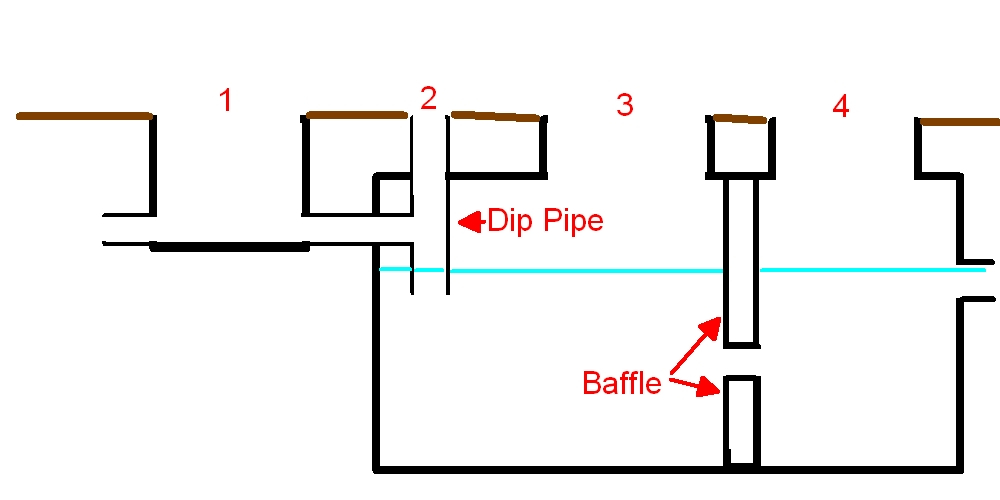 You can see that the water level and measured depth will be the same in 2, 3 and 4, because they are effectively all measurements of the same larger tank.If this is the first time the tank has been emptied in your ownership I would aim to have it completely emptied so you can see the whole thing. You will get some backflow from the drainage field (soakaway), which isn't a bad thing, especially if it washes and sludge back into the tank.The way I've drawn it is with the water level well below the cover slab level - if yours was like this then you'd see the manholes opening out into a larger space below. It is possible the cover slab level is below the water level, meaning you can't (currently) see inside the larger chamber.Normally the size of the tank would be a lot larger than the manhole covers (i.e. something like the way I've drawn it) - which I think is why your calculations are coming up with a volume much smaller than what you'd normally expect a septic tank to contain.Getting the tank pumped out should solve the mystery. (hopefully)2
 -
As Section62 says, 800 litres would be a really small tank. 800 gallons is quite a small tank.2








Confirm your email address to Create Threads and Reply

Categories
- All Categories
- 354.6K Banking & Borrowing
- 254.5K Reduce Debt & Boost Income
- 455.5K Spending & Discounts
- 247.5K Work, Benefits & Business
- 604.3K Mortgages, Homes & Bills
- 178.6K Life & Family
- 261.9K Travel & Transport
- 1.5M Hobbies & Leisure
- 16.1K Discuss & Feedback
- 37.7K Read-Only Boards