We’d like to remind Forumites to please avoid political debate on the Forum.
This is to keep it a safe and useful space for MoneySaving discussions. Threads that are – or become – political in nature may be removed in line with the Forum’s rules. Thank you for your understanding.
📨 Have you signed up to the Forum's new Email Digest yet? Get a selection of trending threads sent straight to your inbox daily, weekly or monthly!
Using Fund Search Tools / Screeners

Tommohawk
Posts: 49 Forumite




Hi all. Folks have been so helpful with my previous posts I'm going to push my luck and try another!
Lets say I have about 200k to invest, and leave aside all issues about my personal situation and tax and CGT etc.
If I'm looking for a fund which is primarily safe, ie low risk, and offers a modest return, can I depend on using search tools to locate my ideal fund?
In other words I have no knowledge, I'm just using the ratings to make the call. And more generally how reliable is it to use search tools/indeces/ratings in this way?
As an example if I use FT tools to search for a fund with the following criteria:
Sharpe Ratio >1, Standard deviation <10, Morningstar rating 5*, Lipper Expenses Return and Preservation all 5*, and BestInvest Rating 5*.
I get only 1 return: Trojan Fund X income.
So is this the ideal fund? I haven't made any selection of Fund type, Sector, Region, Class etc. Can I assume that because I've asked for something that performs well and is low risk, I will get the desired result? Does the risk mean relative risk for that type of fund, or is on an absolute scale? Pretty sure this approach cant work, but I'd like to know how folk approach this.
Lets say I have about 200k to invest, and leave aside all issues about my personal situation and tax and CGT etc.
If I'm looking for a fund which is primarily safe, ie low risk, and offers a modest return, can I depend on using search tools to locate my ideal fund?
In other words I have no knowledge, I'm just using the ratings to make the call. And more generally how reliable is it to use search tools/indeces/ratings in this way?
As an example if I use FT tools to search for a fund with the following criteria:
Sharpe Ratio >1, Standard deviation <10, Morningstar rating 5*, Lipper Expenses Return and Preservation all 5*, and BestInvest Rating 5*.
I get only 1 return: Trojan Fund X income.
So is this the ideal fund? I haven't made any selection of Fund type, Sector, Region, Class etc. Can I assume that because I've asked for something that performs well and is low risk, I will get the desired result? Does the risk mean relative risk for that type of fund, or is on an absolute scale? Pretty sure this approach cant work, but I'd like to know how folk approach this.
0
Comments
-
No, because that tells you nothing about the fund. You're thinking about investing backwards based on other people's opinions and how it has behaved. Start with thinking what you want, ie "Safe" and "modest return", over what timescale, what is the maximum drawdown (fall) you would like to see, would you be happy just to keep up with inflation or do you really want a return of inflation plus a few % ideally. Troy Trojan is global 60/40 equity/bonds portfolio marketed as a total return fund - it tries to make sure that if you hold for at least 3 years you'll have a positive return. Since 2011 VLS60, the closest index-based comparator I could think of (plenty others available: https://monevator.com/passive-fund-of-funds-the-rivals/) has outperformed Troy Trojan, but with more volatility. Troy Trojan has looked very good for minimising drawdown, so perhaps it has a place in your portfolio, however using it as your only holding may not be sensible, especially if you need this money to last for retirement and want for it to grow a fair bit over that timeframe.Tommohawk said:Hi all. Folks have been so helpful with my previous posts I'm going to push my luck and try another!
Lets say I have about 200k to invest, and leave aside all issues about my personal situation and tax and CGT etc.
If I'm looking for a fund which is primarily safe, ie low risk, and offers a modest return, can I depend on using search tools to locate my ideal fund?
No
In other words I have no knowledge, I'm just using the ratings to make the call. And more generally how reliable is it to use search tools/indeces/ratings in this way?
About as reliable as a weather forecast a month in advance.
As an example if I use FT tools to search for a fund with the following criteria:
Sharpe Ratio >1, Standard deviation <10, Morningstar rating 5*, Lipper Expenses Return and Preservation all 5*, and BestInvest Rating 5*.
I get only 1 return: Trojan Fund X income.
So is this the ideal fund? I haven't made any selection of Fund type, Sector, Region, Class etc. Can I assume that because I've asked for something that performs well and is low risk, I will get the desired result? Does the risk mean relative risk for that type of fund, or is on an absolute scale? Pretty sure this approach cant work, but I'd like to know how folk approach this.
But who knows what the future holds...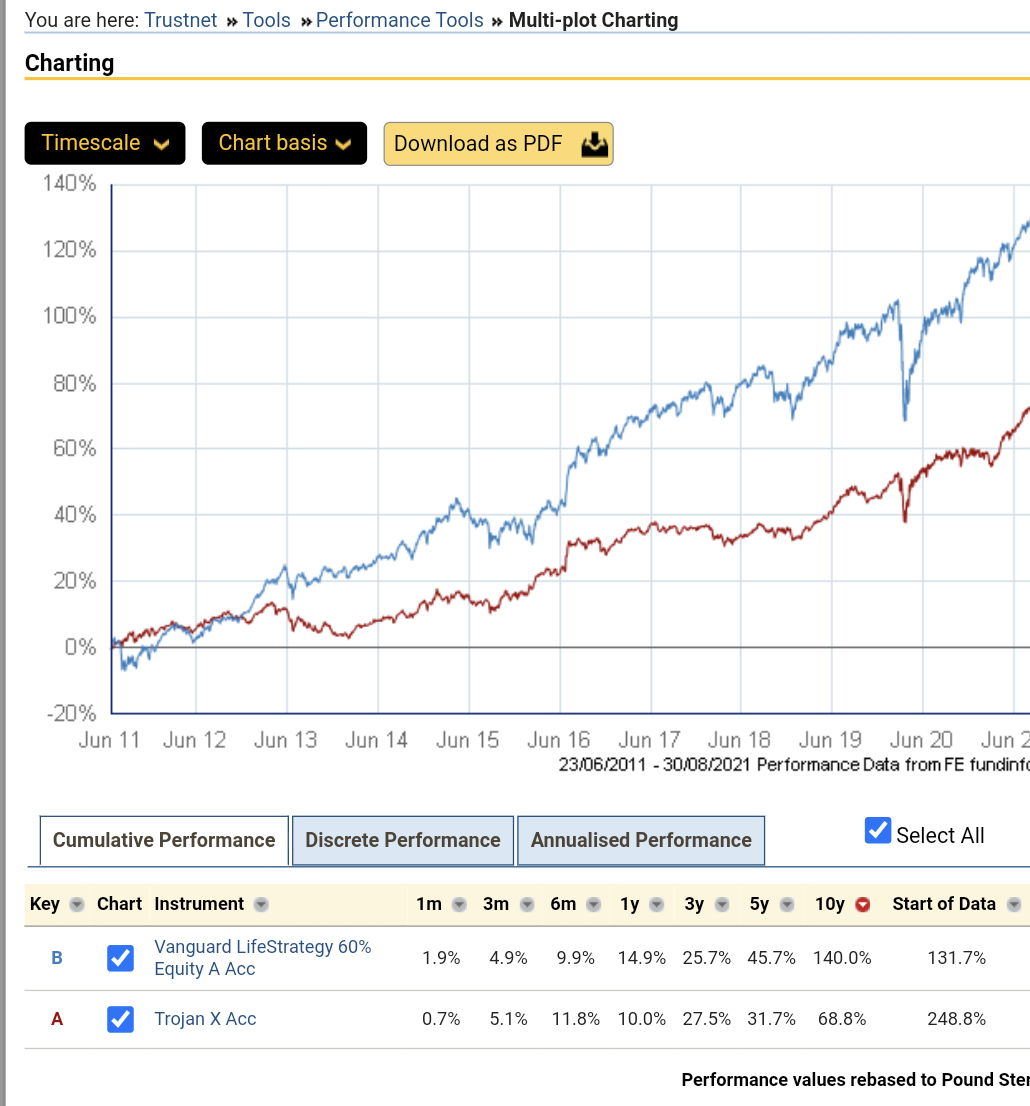
1 -
If you took Autocar, WhatCar and Parker's ratings of a Porsche Cayman as the basis of buying a car, you would think it was a great car, but try to get three people in it and suddenly you realise that it's not that good for that purpose.
If you need a globally diversified Growth fund, even a highly rated European-focused Income fund isn't going to be much good to you.
The comments I post are my personal opinion. While I try to check everything is correct before posting, I can and do make mistakes, so always try to check official information sources before relying on my posts.1 -
Thanks guys and whilst I take your points which are well made, it still leaves me wondering if I can use fund screeners / tools to find my ideal fund or fund mix (or fund of funds)
Thing is, like most folk I understand terms like risk and return - although there are going to be different ways of expressing these values. But I don't really understand all the other terminology - fund type, investment style, class etc etc. I'm reading up and learning all the while but I think I'll always be well off the pace on this.
So it strikes me that using the data and other more knowledgeable folks skills, it ought to be possible to search based on the outcome that you want rather than the technical asset type or whatever.
To borrow the motoring analogy: I want to drive from home to work every day with no passengers, with the best MPG I can get, and with the least devaluation on the vehicle. I don't care if the vehicle is a "sports car" or a "SUV" or a "hot hatch" (showing my age there!)
Does that make sense?
From a practical point of view, thinking of risk in particular, this could be expressed in relative or absolute terms. So the risk rating might be the risk for that class/type of asset rather than absolute risk. Therefore the search engine might locate a fund which has good stats and is low risk for its type, but that risk could be much higher than average.
0 -
Quick follow on: I've just noticed that if I look at a specific fund, eg Troy Trojan mentioned above, and go to the risk tab on FT, this shows the spread of other funds "in this category"
Not surprisingly, Troy Trojan is fairly well "top left" ie lower risk, higher return". What would be useful to see on this chart is all funds - would get pretty crowded I guess.
And of course I realise that risk and return aren't the only factors - I'm just using these to make the point about the use of search tools generally.0 -
I was faced with the same problem a few years ago when trying to construct a retirement drawdown portfolio. I had to make two fundamental decisions as part of selecting the funds to purchase:
1) did I want to purchase assets that would grow in value (so I could sell them to povide my income) or did I want assets that paid an income directly?
2) did I want to purchase a small number of multi-asset funds that had the asset allocation I wanted or did I want to puchase funds containing specific assets that I would then purchase different quantities of in order to get the asset allocation I wanted?
With my decisions made, I could then start searching for the funds available. I found I had to look at each of the three fund structures in turn to find what was available and what appeared to be good: Open-ended funds (sometimes called Mutual Funds), closed funds (usually called Investment Trusts) and Exchange Traded funds.
None of the search tools currently available do a good job of comparing alternatives across the different structures. e.g. comparing a Mutual Fund to an Investment Trust, but they do allow you to eliminate the sorts of funds that were not going to be suitable for acheiving a particular asset allocation. (e.g. a global fund is never going to be a selection in a portfolio that is attemption to build a specific asset allocation, unless you are looking to hold the fund as a 'core' holding and tweak the asset allocation by purchasing other specialised funds to do so).
I used the Trustnet ratings (both the Crowns and the risk rating) but was quite open minded about these. I hold some funds that have no FE Crowns. My sense is that most of these ratings are looking back at the behaviour of the fund and the fund managers, so they are not much better than looking at the historical performance of the fund. I think the Crowns ratings do give you a quick way of understanding what attention the fund manager is paying to ESG (Environmental, Social and Governane) concepts. While I think the jury is still out on whether paying attention to ESG is a good thing, I would rather invest in companies that do pay attention to such matters even if it doesn't improve the performance of the investments.
One thing I did decide was that I wanted to use my investments to learn more about investing, so I was not hesitant about investing in a range of funds and planned to consolidate my portfolio as and when the long term performance of the funds became apparent.
One thing to realise is that when you are investing in a "high risk" fund from a UK Investment House, say Baillie Gifford Global Discovery B ACC which has a Trustnet Risk Rating of 150 and is rated in the KIID as a 6, this is not a high risk investment in the same way that investing in art, or wiskey or bit coin is high risk. It is an order of magnitude lower. This is not to say that you cannot lose a lot of money, but by carefully selecting funds from the UK investment universe, you reduce your risk significantly. Another thing to consider is "capitalisation". If you only buy funds that have a capitalisation of over £1bn, you are very much following a herd of investors and you can have some confidence that the fund is well regarded by others.
I hope this helps - I do sympathise with you when trying to use the search tools.The comments I post are my personal opinion. While I try to check everything is correct before posting, I can and do make mistakes, so always try to check official information sources before relying on my posts.2 -
Yes thats very helpful not least because it reassures me that I'm on the right lines.
I need to explore these resources more fully and try and figure some kind of composite which covers all the various relevent markers0 -
Looking further at FT risks, it seems the risks are given an absolute value rather than a value within their own sector market. For example, if I select a cash fund the risks are predictably low - something less than 8, and this is comparable with other cash funds. No surprise there.
If I deliberately select a fund which looks risker (by using a low Sharpe value and high SD) I find funds with a risk value of around 30. This might imply that their "risk factor" means risk within all sectors/classes. But maybe not?
Interestingly Trustnet also make a point about absolute and relative risk although there take on it is a bit different. They point out that risk factor can change according to market conditions, so that for example most funds likely become riskier with the onset of the COVID pandemic.
0 -
You need knowledge to use the tools productively. If you don't know what you are doing, you could end up, for example, putting a large proportion of your savings into some small, obscure fund just because it comes through your screen. With £200k, I would suggest that you spread it between a few funds. There's no magic number but it should not all go into one fund.Tommohawk said:
I have no knowledge, I'm just using the ratings to make the call. And more generally how reliable is it to use search tools/indeces/ratings in this way?1 -
If I had to pick the sectors that I think you should be looking at, they would be (in no particular order):
- Flexible Investment
- Mixed Investment xx%-xx% Shares
- Volatility Managed
"If you aren’t willing to own a stock for ten years, don’t even think about owning it for ten minutes” Warren Buffett
Save £12k in 2025 - #024 £1,450 / £15,000 (9%)2 -
We know that when the markets are doing well (like right now), your money will do okay in any fund that is diversified across sectors/countries and/or invested in global trackers like the recommended books and Mr Buffett tell us.
The tricky bit is where to invest for the bad times which I think is where @Tommohawk is coming from. Many people are predicting a big market correction/crash but nobody knows when this will come. If you're investing long term, then I don't think it really matters. Just stick with a high percentage equity plan. I've been investing in pensions since the early 90s. I was oblivious to the dot com crash and the 08 banking crisis. I just left everything as it was. This is mainly because I didn't even know where my money was being invested and I only got an annual paper statement. Had I had the knowledge and online tools I do now, I may well have panicked and moved things around. That would have been wrong.
Maybe the answer is always keeping enough cash to ride out a couple of years of bad market returns. Also there are wealth preservation funds which "should" not fall too much in market downturn conditions. Trojan is one such fund. Capital Gearing is another. Maybe invest enough in one of these to give you 3-5 years of income when you need it? Keep the rest in globally diversified index tracker funds and bonds in a ratio split you feel matches your risk profile.
Just my thoughts as someone who's been contributing to pensions for 30 years but understanding what they actually are for 6 months. ;-)2







Confirm your email address to Create Threads and Reply

Categories
- All Categories
- 354.8K Banking & Borrowing
- 254.5K Reduce Debt & Boost Income
- 455.6K Spending & Discounts
- 247.6K Work, Benefits & Business
- 604.6K Mortgages, Homes & Bills
- 178.6K Life & Family
- 262.2K Travel & Transport
- 1.5M Hobbies & Leisure
- 16.1K Discuss & Feedback
- 37.7K Read-Only Boards