We’d like to remind Forumites to please avoid political debate on the Forum.
This is to keep it a safe and useful space for MoneySaving discussions. Threads that are – or become – political in nature may be removed in line with the Forum’s rules. Thank you for your understanding.
PLEASE READ BEFORE POSTING: Hello Forumites! In order to help keep the Forum a useful, safe and friendly place for our users, discussions around non-MoneySaving matters are not permitted per the Forum rules. While we understand that mentioning house prices may sometimes be relevant to a user's specific MoneySaving situation, we ask that you please avoid veering into broad, general debates about the market, the economy and politics, as these can unfortunately lead to abusive or hateful behaviour. Threads that are found to have derailed into wider discussions may be removed. Users who repeatedly disregard this may have their Forum account banned. Please also avoid posting personally identifiable information, including links to your own online property listing which may reveal your address. Thank you for your understanding.
📨 Have you signed up to the Forum's new Email Digest yet? Get a selection of trending threads sent straight to your inbox daily, weekly or monthly!
What to do if the surveyor failed to pick up issues?
Comments
-
The damp surveyor may have some liability, but it is unlikely.He used a so-called 'damp meter' on the walls which showed no damp (and which I believe are indeed not damp).He used CCTV to access some below floor areas, but this would have been restricted to where he could gain access. If you read his report carefully, I'm sure you'll find some phrase like "so far as we were able to investigate" or "we limited in what areas we could access, but these areas showed no signs....".As said earlier:You have to remember they are surveying someone else's property, they can start drilling holes, ripping up tiles.Clearly a misprint- should read "can't"!But if the reprt clearly states that a full investigation took place, and that no damp was found, and there are no caveats or eclusion clauses, then you might have a case against the damp surveyor.You would need a second surveyor to write a report to support any legal claim.
1 -
Thanks for your advice. After removing more plaster boards today, I think the damp issues can be easily fixed now.greatcrested said:The damp surveyor may have some liability, but it is unlikely.He used a so-called 'damp meter' on the walls which showed no damp (and which I believe are indeed not damp).He used CCTV to access some below floor areas, but this would have been restricted to where he could gain access. If you read his report carefully, I'm sure you'll find some phrase like "so far as we were able to investigate" or "we limited in what areas we could access, but these areas showed no signs....".As said earlier:You have to remember they are surveying someone else's property, they can start drilling holes, ripping up tiles.Clearly a misprint- should read "can't"!But if the reprt clearly states that a full investigation took place, and that no damp was found, and there are no caveats or eclusion clauses, then you might have a case against the damp surveyor.You would need a second surveyor to write a report to support any legal claim.Probably it’s not worth to spend money to blame the damp surveyor now. But I want to share my experience to other buyers.1 -
Like buying a used car privately. Vendors are rarely honest about everything.917700 said:greatcrested said:The damp surveyor may have some liability, but it is unlikely.He used a so-called 'damp meter' on the walls which showed no damp (and which I believe are indeed not damp).He used CCTV to access some below floor areas, but this would have been restricted to where he could gain access. If you read his report carefully, I'm sure you'll find some phrase like "so far as we were able to investigate" or "we limited in what areas we could access, but these areas showed no signs....".As said earlier:You have to remember they are surveying someone else's property, they can start drilling holes, ripping up tiles.Clearly a misprint- should read "can't"!But if the reprt clearly states that a full investigation took place, and that no damp was found, and there are no caveats or eclusion clauses, then you might have a case against the damp surveyor.You would need a second surveyor to write a report to support any legal claim.Probably it’s not worth to spend money to blame the damp surveyor now. But I want to share my experience to other buyers.0 -
917700 said:
Thanks for your advice. After removing more plaster boards today, I think the damp issues can be easily fixed now.greatcrested said:The damp surveyor may have some liability, but it is unlikely.He used a so-called 'damp meter' on the walls which showed no damp (and which I believe are indeed not damp).He used CCTV to access some below floor areas, but this would have been restricted to where he could gain access. If you read his report carefully, I'm sure you'll find some phrase like "so far as we were able to investigate" or "we limited in what areas we could access, but these areas showed no signs....".As said earlier:You have to remember they are surveying someone else's property, they can start drilling holes, ripping up tiles.Clearly a misprint- should read "can't"!But if the reprt clearly states that a full investigation took place, and that no damp was found, and there are no caveats or eclusion clauses, then you might have a case against the damp surveyor.You would need a second surveyor to write a report to support any legal claim.Probably it’s not worth to spend money to blame the damp surveyor now. But I want to share my experience to other buyers.
It would be interesting to know what you found to be the cause.917700 said:
Thanks for your advice. After removing more plaster boards today, I think the damp issues can be easily fixed now.greatcrested said:The damp surveyor may have some liability, but it is unlikely.He used a so-called 'damp meter' on the walls which showed no damp (and which I believe are indeed not damp).He used CCTV to access some below floor areas, but this would have been restricted to where he could gain access. If you read his report carefully, I'm sure you'll find some phrase like "so far as we were able to investigate" or "we limited in what areas we could access, but these areas showed no signs....".As said earlier:You have to remember they are surveying someone else's property, they can start drilling holes, ripping up tiles.Clearly a misprint- should read "can't"!But if the reprt clearly states that a full investigation took place, and that no damp was found, and there are no caveats or eclusion clauses, then you might have a case against the damp surveyor.You would need a second surveyor to write a report to support any legal claim.
0 -
This is true, especially when buying an ex rental property.Thrugelmir said:
Like buying a used car privately. Vendors are rarely honest about everything.917700 said:greatcrested said:The damp surveyor may have some liability, but it is unlikely.He used a so-called 'damp meter' on the walls which showed no damp (and which I believe are indeed not damp).He used CCTV to access some below floor areas, but this would have been restricted to where he could gain access. If you read his report carefully, I'm sure you'll find some phrase like "so far as we were able to investigate" or "we limited in what areas we could access, but these areas showed no signs....".As said earlier:You have to remember they are surveying someone else's property, they can start drilling holes, ripping up tiles.Clearly a misprint- should read "can't"!But if the reprt clearly states that a full investigation took place, and that no damp was found, and there are no caveats or eclusion clauses, then you might have a case against the damp surveyor.You would need a second surveyor to write a report to support any legal claim.Probably it’s not worth to spend money to blame the damp surveyor now. But I want to share my experience to other buyers.The vendor provide a satisfied electric certificate to my solicitor. However, I had another electric test last week, the overall condition is unsatisfied and the electrician suggested a full rewire.I believe the previous owner lied on many things. I would not be surprised if more issues come up during the renovation0 -
I posted another picture. The kitchen layout was probably changed in the past and there are some pipes behind the stud wall.greatcrested said:917700 said:
Thanks for your advice. After removing more plaster boards today, I think the damp issues can be easily fixed now.greatcrested said:The damp surveyor may have some liability, but it is unlikely.He used a so-called 'damp meter' on the walls which showed no damp (and which I believe are indeed not damp).He used CCTV to access some below floor areas, but this would have been restricted to where he could gain access. If you read his report carefully, I'm sure you'll find some phrase like "so far as we were able to investigate" or "we limited in what areas we could access, but these areas showed no signs....".As said earlier:You have to remember they are surveying someone else's property, they can start drilling holes, ripping up tiles.Clearly a misprint- should read "can't"!But if the reprt clearly states that a full investigation took place, and that no damp was found, and there are no caveats or eclusion clauses, then you might have a case against the damp surveyor.You would need a second surveyor to write a report to support any legal claim.Probably it’s not worth to spend money to blame the damp surveyor now. But I want to share my experience to other buyers.
It would be interesting to know what you found to be the cause.917700 said:
Thanks for your advice. After removing more plaster boards today, I think the damp issues can be easily fixed now.greatcrested said:The damp surveyor may have some liability, but it is unlikely.He used a so-called 'damp meter' on the walls which showed no damp (and which I believe are indeed not damp).He used CCTV to access some below floor areas, but this would have been restricted to where he could gain access. If you read his report carefully, I'm sure you'll find some phrase like "so far as we were able to investigate" or "we limited in what areas we could access, but these areas showed no signs....".As said earlier:You have to remember they are surveying someone else's property, they can start drilling holes, ripping up tiles.Clearly a misprint- should read "can't"!But if the reprt clearly states that a full investigation took place, and that no damp was found, and there are no caveats or eclusion clauses, then you might have a case against the damp surveyor.You would need a second surveyor to write a report to support any legal claim.As you can see the most wet timber stud area is below the end of the pipe.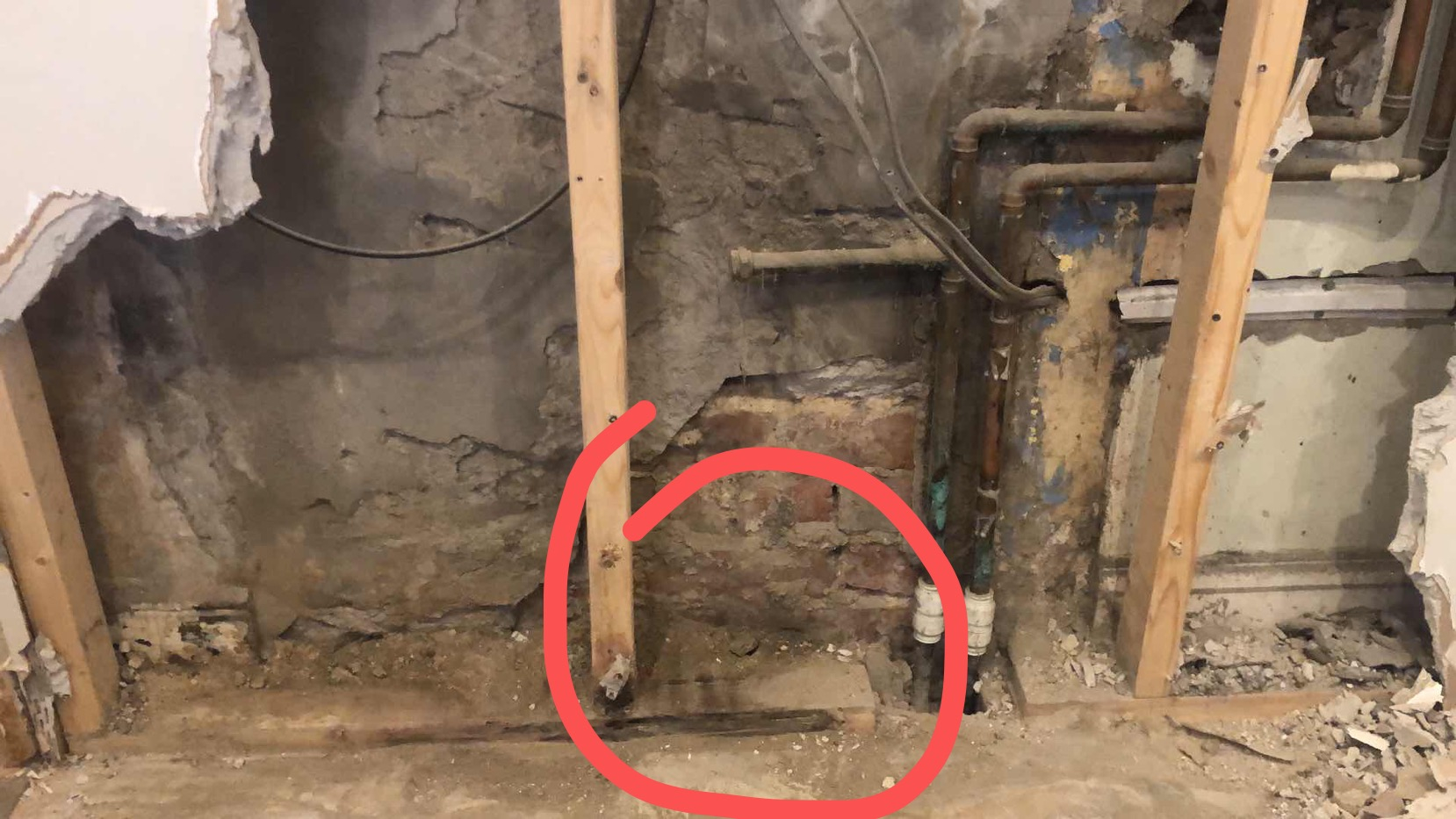 1
1







Confirm your email address to Create Threads and Reply

Categories
- All Categories
- 355K Banking & Borrowing
- 254.6K Reduce Debt & Boost Income
- 455.8K Spending & Discounts
- 247.8K Work, Benefits & Business
- 604.9K Mortgages, Homes & Bills
- 178.7K Life & Family
- 262.5K Travel & Transport
- 1.5M Hobbies & Leisure
- 16.1K Discuss & Feedback
- 37.7K Read-Only Boards