We’d like to remind Forumites to please avoid political debate on the Forum.
This is to keep it a safe and useful space for MoneySaving discussions. Threads that are – or become – political in nature may be removed in line with the Forum’s rules. Thank you for your understanding.
📨 Have you signed up to the Forum's new Email Digest yet? Get a selection of trending threads sent straight to your inbox daily, weekly or monthly!
Filling gaps in brickwork around pipes
Comments
-
If you are concerned about fire resistance, use cement board instead of plywood. A little more difficult to work with - Any cutting & drilling, wear a dust mask. You don't want to be breathing the stuff.
Any language construct that forces such insanity in this case should be abandoned without regrets. –
Erik Aronesty, 2014
Treasure the moments that you have. Savour them for as long as you can for they will never come back again.1 -
You can't cement around a cooper pipe, it's a corrosion risk, it will eat through the pipe sooner or later.
As already been said it should have been sleeved and sealed at one end in this case the internal end. Did you see the gas safe licence? It's a cowboy who left it like that and possibly not even registered to make a mistake like that.0 -
Is the 'making good' part of this job - sleeving and filling in that hole with a suitable material - a requirement for a 'benchmarked' boiler installation? Or can it just be left as it is, with nothing actually in contact with the pipes and a good clearance?I ask 'cos I don't know.N-G, do you have the installation booklet? At the back should be a tick list of all the actions carried out to make it a conforming install. Is there anything on there about 'sleeving' or 'pipes through walls' or similar?0
-
I've just been out to measure the pipes through the wall and all 3 are 28mm (and I know that the gas main is 22mm because we had to have the whole pipe upgraded from the meter to the boilers new location). I could also see that they are sleeved, I couldn't see it clearly on the original photos but here's another.
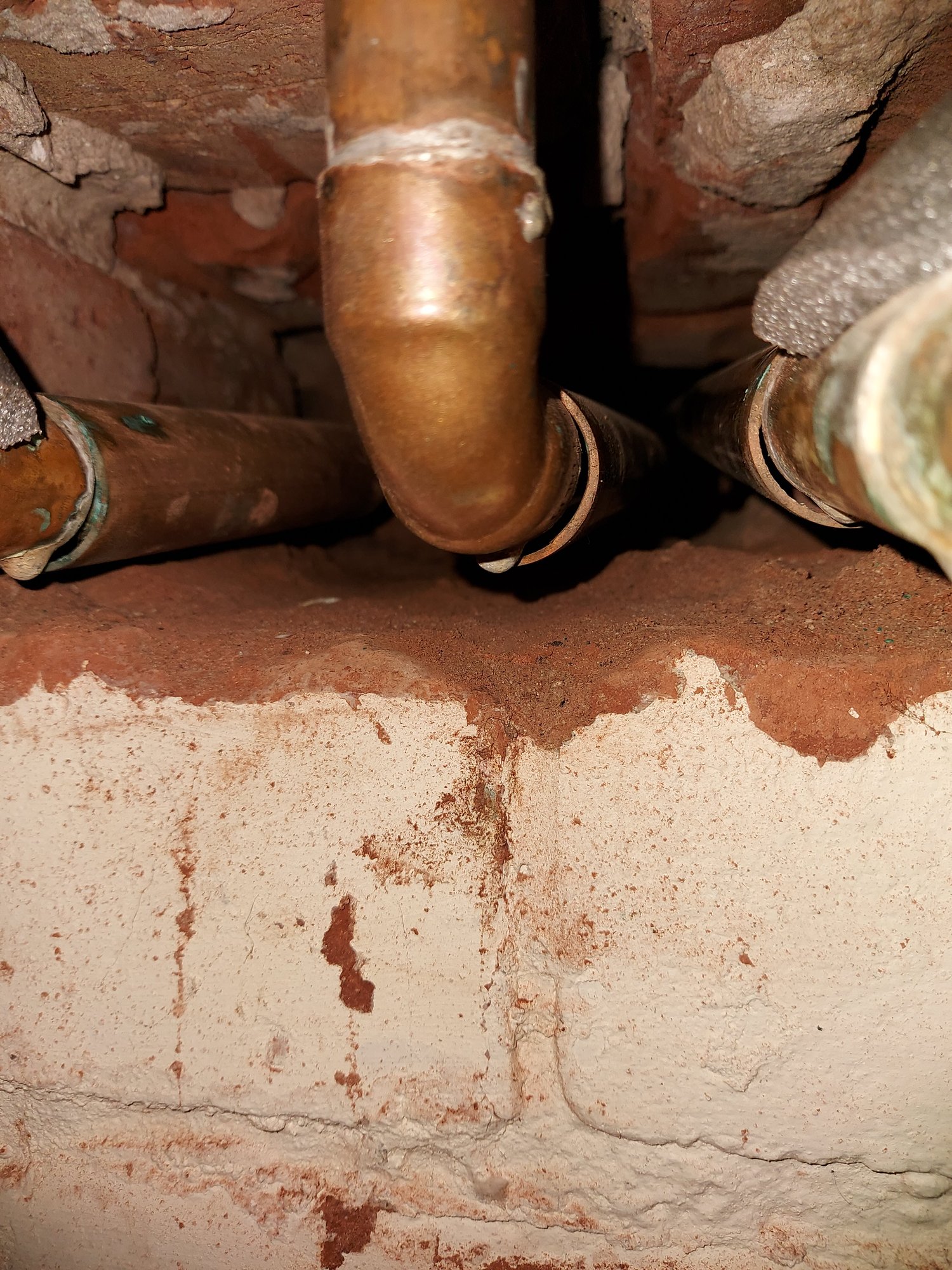
I've got the installation booklet which doesn't go into specifics of sleeving but is ticked to say building regs all complied with. I've since received a gas safe building regs compliance certificate when the boiler warranty confirmation was sent out.
So hopefully that means we're all ok in this aspect? And can start thinking about blocking up the hole around them?
1 -
That sounds ideal, NG, and I'm not too surprised that the GasSafe doesn't carry a bucket of mortar around with them. It would have been 'nice', tho', if they'd pointed this out before or even during the job.What filling method are you going with?!0
-
Yep, would have been nice! But I'm quickly learning that I need to have more than half a clue about what needs doing and then be very specific when they come round to quote/do the work! This house has been a steep learning curve and we're only 7 months inJeepers_Creepers said:That sounds ideal, NG, and I'm not too surprised that the GasSafe doesn't carry a bucket of mortar around with them. It would have been 'nice', tho', if they'd pointed this out before or even during the job.What filling method are you going with?!
I'm still thinking pipe lagging and then insulation (I'm assuming the same stuff that's in my loft? There's a couple of big rolls going spare up there) and then covering the outside with something. FreeBear has mentioned wood or cement board - I reckon I could do wood but I've no experience with cement board so I'll have to look into that. I think I've seen some kind of rodent mesh somewhere before as well, but it might be quite tricky to do around the lagged pipes.0 -
Since the pipe has seemingly been sleeved and is therefore 'conforming', what you add a round it is of less importance.Certainly pipe lagging over the two water pipes would make sense - and that can be the foam tubular stuff used already on these pipes (if you are going 'mortar') - but then it's whatever you want. If you have loft insulation, then stuff it in there - job done.Any finishing board should do on the house side - even easy-to-cut hardboard - and hopefully you won't have meece trying to work their way through (it would then become obvious if they did...). If you think there's a significant risk of mice, then get some wire mesh sheet - even the stuff they use for car body repairs - and fit this neatly over the outhouse side. Regs say that the area should be ventilated so if there's a gas leak in that 1-foot wide space, it cannot build up and cause 'issues'.1
-
Thanks again everyone for your help, much appreciated1
-
The hole is too big to fill with mortar alone. You need to use cut up small pieces of brickwork set in mortar. Make the mortar fairly dry (what is sometimes called earth dry) or it will slump as you build it up.
0












Confirm your email address to Create Threads and Reply

Categories
- All Categories
- 354.9K Banking & Borrowing
- 254.6K Reduce Debt & Boost Income
- 455.7K Spending & Discounts
- 247.7K Work, Benefits & Business
- 604.7K Mortgages, Homes & Bills
- 178.7K Life & Family
- 262.3K Travel & Transport
- 1.5M Hobbies & Leisure
- 16.1K Discuss & Feedback
- 37.7K Read-Only Boards