We’d like to remind Forumites to please avoid political debate on the Forum.
This is to keep it a safe and useful space for MoneySaving discussions. Threads that are – or become – political in nature may be removed in line with the Forum’s rules. Thank you for your understanding.
📨 Have you signed up to the Forum's new Email Digest yet? Get a selection of trending threads sent straight to your inbox daily, weekly or monthly!
The Forum now has a brand new text editor, adding a bunch of handy features to use when creating posts. Read more in our how-to guide
AJBell fund advice
Comments
-
I think you are right , it is often underestimated how little understanding of financial matters most people have .BritishInvestor said:
I think you are underestimating your knowledge, in absolute terms and also relative to the typical private investor. I also think you are underestimating the time taken to build that knowledge.Deleted_User said:You need to have an appropriate asset allocation for the overall portfolio. Do you know what it should be? Given your timeline, volatility is your enemy. The simplest solution is a multi-asset fund with at least 40% fixed income. There are a few options available, eg from Vanguard and HSBC. The former has stable allocations, more home bias and more diversification.To make your portfolio any more complicated than this, you would need to read up, study the funds and understand each option. Managing your own portfolio is very easy these days but you do need to have a little education on the subject. Lots of great books available, from the sources that are far better than an average IFA.Ongoing advice from an IFA is expensive. Its thousands of pounds every year. And you incur it even if the IFA managed portfolio loses your money. This cost is only ever justified if the IFA is good and you are ignorant. If you are certain that both of these conditions have been met, and you are not prepared to invest a bit of time in learning, then let the IFA manage everything. Even then you should learn enough to at least understand what the IFA is advising and why.Returns of 4 to 6% are achievable (net of costs). Balanced portfolio owners have had higher returns for quite some time and the future might be the same. But I wouldn’t rely on it.0 -
In the olden days investing was tough. Buying and selling stocks via brokers was a pain. Fund managers were extremely inconsistent. Funds lied in the advertising materials. Information on company profits was incredibly misleading. It was a jungle. You had to have a complex portfolio multiple stocks or funds to have a reasonable degree of diversification. Costs of trading and owning was very high.BritishInvestor said:
I think you are underestimating your knowledge, in absolute terms and also relative to the typical private investor. I also think you are underestimating the time taken to build that knowledge.Deleted_User said:You need to have an appropriate asset allocation for the overall portfolio. Do you know what it should be? Given your timeline, volatility is your enemy. The simplest solution is a multi-asset fund with at least 40% fixed income. There are a few options available, eg from Vanguard and HSBC. The former has stable allocations, more home bias and more diversification.To make your portfolio any more complicated than this, you would need to read up, study the funds and understand each option. Managing your own portfolio is very easy these days but you do need to have a little education on the subject. Lots of great books available, from the sources that are far better than an average IFA.Ongoing advice from an IFA is expensive. Its thousands of pounds every year. And you incur it even if the IFA managed portfolio loses your money. This cost is only ever justified if the IFA is good and you are ignorant. If you are certain that both of these conditions have been met, and you are not prepared to invest a bit of time in learning, then let the IFA manage everything. Even then you should learn enough to at least understand what the IFA is advising and why.Returns of 4 to 6% are achievable (net of costs). Balanced portfolio owners have had higher returns for quite some time and the future might be the same. But I wouldn’t rely on it.
Today fund managers are all educated on the same principles. Much stricter rules. Less misleading information. Costs can be managed to be very low (although care has to be taken). All the rebalancing work can be taken care of if you pick the right instrument. And its easy anyway.And enough information can be picked by reading a very basic book, like the one by Edwards. The rest is detail.0 -
Yep, investing is so much easier these days, but I bet you that if there were 2 offerings available:Deleted_User said:
In the olden days investing was tough. Buying and selling stocks via brokers was a pain. Fund managers were extremely inconsistent. Funds lied in the advertising materials. Information on company profits was incredibly misleading. It was a jungle. You had to have a complex portfolio multiple stocks or funds to have a reasonable degree of diversification. Costs of trading and owning was very high.BritishInvestor said:
I think you are underestimating your knowledge, in absolute terms and also relative to the typical private investor. I also think you are underestimating the time taken to build that knowledge.Deleted_User said:You need to have an appropriate asset allocation for the overall portfolio. Do you know what it should be? Given your timeline, volatility is your enemy. The simplest solution is a multi-asset fund with at least 40% fixed income. There are a few options available, eg from Vanguard and HSBC. The former has stable allocations, more home bias and more diversification.To make your portfolio any more complicated than this, you would need to read up, study the funds and understand each option. Managing your own portfolio is very easy these days but you do need to have a little education on the subject. Lots of great books available, from the sources that are far better than an average IFA.Ongoing advice from an IFA is expensive. Its thousands of pounds every year. And you incur it even if the IFA managed portfolio loses your money. This cost is only ever justified if the IFA is good and you are ignorant. If you are certain that both of these conditions have been met, and you are not prepared to invest a bit of time in learning, then let the IFA manage everything. Even then you should learn enough to at least understand what the IFA is advising and why.Returns of 4 to 6% are achievable (net of costs). Balanced portfolio owners have had higher returns for quite some time and the future might be the same. But I wouldn’t rely on it.
Today fund managers are all educated on the same principles. Much stricter rules. Less misleading information. Costs can be managed to be very low (although care has to be taken). All the rebalancing work can be taken care of if you pick the right instrument. And its easy anyway.And enough information can be picked by reading a very basic book, like the one by Edwards. The rest is detail.
1. A basket of tech stocks that has shown great historical returns (over the last decade) with huge concentration, style and sector risk, peddled by someone with a great story.
2. A dull, plodding, low cost, diversified multi-asset portfolio.
99/100 of the general public would rush for #1, despite it being completely inappropriate for their objectives, and will probably sell when the market unwinds, vowing never to invest again.
I haven't read the Edwards book but what we need is an offering that looks at the suboptimal outcomes rather than just what we "should" be doing.3 -
Just put it into VLS60.Scallypud said:Can anyone advise me on which funds i should invest my 245K pension pot. I currently have the cash sitting in SIPP cash at AJBell.
I'm looking to set up a portfolio that could generate 4/6% per year.
Can anyone advise what percentage of cash i should put into each fund.
Also i would like to thank everyone for their advice over the years. It has been very much appreciated.
Price 21,695
There isn't a fund more middle of the road and since the price of VLS60 is contiguous with the other VLS numbered funds, you are effectively buying them all.
When? Asap if the alternative is cash.2 -
Love this. Simple but informativecfw1994 said:Curious.
My magic spreaddie suggest that you should be fine, even if you only average 2% to last until you are 100.
Maybe I have misread the numbers. If so, let me know!
Sample below - assuming you want 18k at todays money, rising at 2% (3rd column - note it says 'inflation, but today inflation is under 1% !!).
If you would like a copy to play with numbers, let me know - it is pretty basic really.
If you get 3%, happy days, all good: the last column shows how much the two pots you describe end up each year, after taking the income in the "£ Amount Required" column: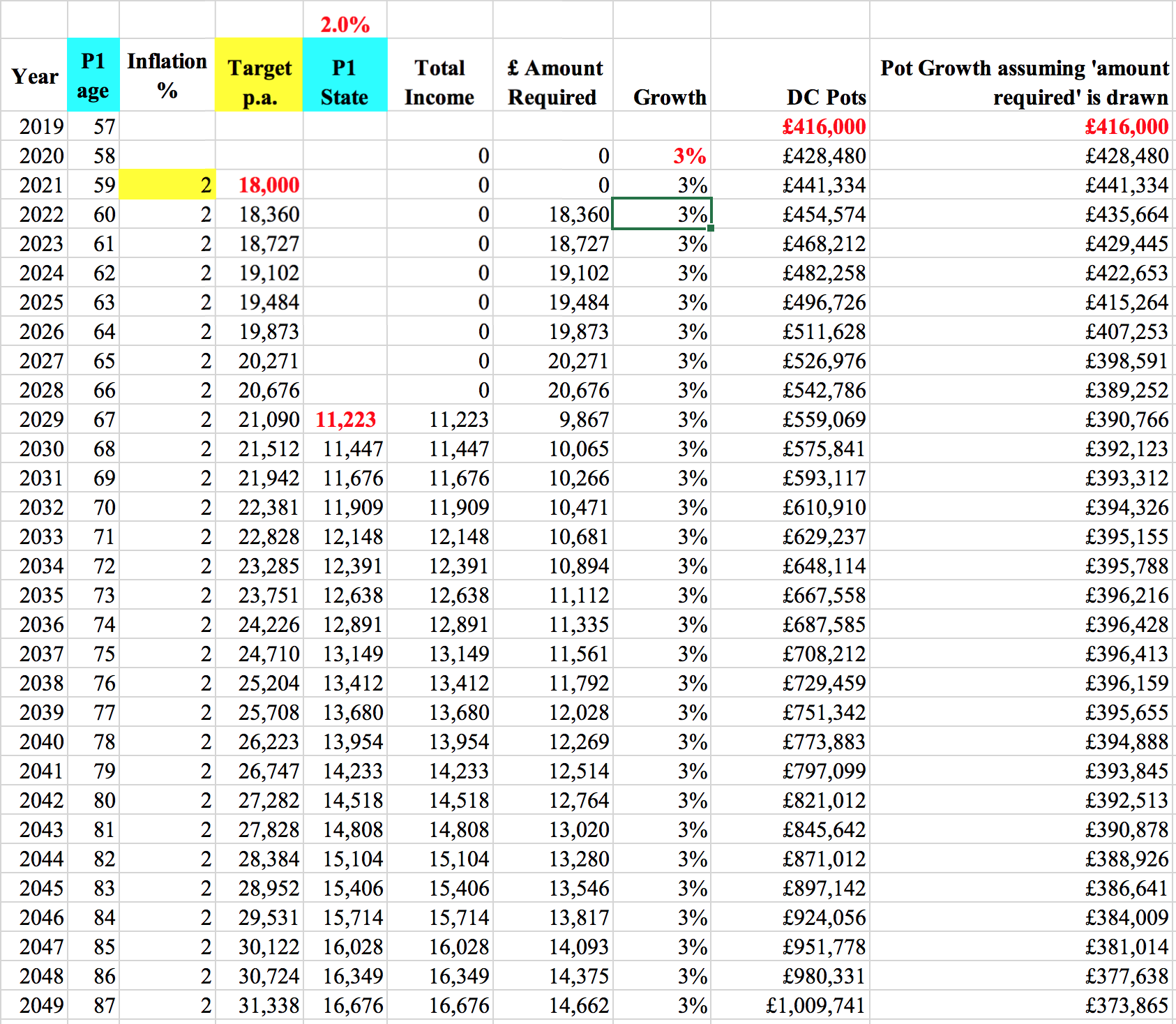
If I have misunderstood some of the numbers, let me know.
I have put the State pension as if it gets a 2% rise each year - slightly lower than how things stand today - remember, as things stand, there is a "triple lock" protection that guarantees the state pension would increase by the greatest of the following three measures:- Average earnings
- Prices, as measured by the Consumer Prices Index (CPI)
- 2.5 per cent
Of course the "Growth" column will vary from year to year, perhaps wildly, so it is wise to play with it and drop some negative years in, particularly early on, but if you can keep some cash funds (ours are in Premium Bonds), and have the ability to "pause" the drawdown, then you can help mitigate downturns.
In terms of "advising you where to invest" - you will NOT get that here: advice comes with the need for regulations and training, and although there are one or two such advisors here, they would not give you a simple answer given the little information we all read here - plus, that would rather take away the mystery of finance
If I were unsure of things, I would probably pop it all in a Vanguard LifeStrategy 80, or perhaps LS60, to capture the essence of "invest in the world".
YES, there is a lot more information , as dunstonh & others outlined, that would be needed to get to the bottom of what the best thing for YOU is, but who knows what tomorrow can bring!
But that is just my personal suggestion, just an invisible individual on the internet!1 -
Edwards provides a model portfolio with 50% equities which is perfectly fine.BritishInvestor said:
Yep, investing is so much easier these days, but I bet you that if there were 2 offerings available:Deleted_User said:
In the olden days investing was tough. Buying and selling stocks via brokers was a pain. Fund managers were extremely inconsistent. Funds lied in the advertising materials. Information on company profits was incredibly misleading. It was a jungle. You had to have a complex portfolio multiple stocks or funds to have a reasonable degree of diversification. Costs of trading and owning was very high.BritishInvestor said:
I think you are underestimating your knowledge, in absolute terms and also relative to the typical private investor. I also think you are underestimating the time taken to build that knowledge.Deleted_User said:You need to have an appropriate asset allocation for the overall portfolio. Do you know what it should be? Given your timeline, volatility is your enemy. The simplest solution is a multi-asset fund with at least 40% fixed income. There are a few options available, eg from Vanguard and HSBC. The former has stable allocations, more home bias and more diversification.To make your portfolio any more complicated than this, you would need to read up, study the funds and understand each option. Managing your own portfolio is very easy these days but you do need to have a little education on the subject. Lots of great books available, from the sources that are far better than an average IFA.Ongoing advice from an IFA is expensive. Its thousands of pounds every year. And you incur it even if the IFA managed portfolio loses your money. This cost is only ever justified if the IFA is good and you are ignorant. If you are certain that both of these conditions have been met, and you are not prepared to invest a bit of time in learning, then let the IFA manage everything. Even then you should learn enough to at least understand what the IFA is advising and why.Returns of 4 to 6% are achievable (net of costs). Balanced portfolio owners have had higher returns for quite some time and the future might be the same. But I wouldn’t rely on it.
Today fund managers are all educated on the same principles. Much stricter rules. Less misleading information. Costs can be managed to be very low (although care has to be taken). All the rebalancing work can be taken care of if you pick the right instrument. And its easy anyway.And enough information can be picked by reading a very basic book, like the one by Edwards. The rest is detail.
1. A basket of tech stocks that has shown great historical returns (over the last decade) with huge concentration, style and sector risk, peddled by someone with a great story.
2. A dull, plodding, low cost, diversified multi-asset portfolio.
99/100 of the general public would rush for #1, despite it being completely inappropriate for their objectives, and will probably sell when the market unwinds, vowing never to invest again.
I haven't read the Edwards book but what we need is an offering that looks at the suboptimal outcomes rather than just what we "should" be doing.I agree that its good to read about asset allocation and risks, about historic crashes, about behavioural problems, but if you spend a couple of hours reading Edwards and just follow his direction, you’ll be ok.0 -
I don't disagree that if someone read Edwards, or similar, they might make better choices. But going back to my point, what % of the general population would know that this type of book existed, and which one(s) to read.Deleted_User said:
Edwards provides a model portfolio with 50% equities which is perfectly fine.BritishInvestor said:
Yep, investing is so much easier these days, but I bet you that if there were 2 offerings available:Deleted_User said:
In the olden days investing was tough. Buying and selling stocks via brokers was a pain. Fund managers were extremely inconsistent. Funds lied in the advertising materials. Information on company profits was incredibly misleading. It was a jungle. You had to have a complex portfolio multiple stocks or funds to have a reasonable degree of diversification. Costs of trading and owning was very high.BritishInvestor said:
I think you are underestimating your knowledge, in absolute terms and also relative to the typical private investor. I also think you are underestimating the time taken to build that knowledge.Deleted_User said:You need to have an appropriate asset allocation for the overall portfolio. Do you know what it should be? Given your timeline, volatility is your enemy. The simplest solution is a multi-asset fund with at least 40% fixed income. There are a few options available, eg from Vanguard and HSBC. The former has stable allocations, more home bias and more diversification.To make your portfolio any more complicated than this, you would need to read up, study the funds and understand each option. Managing your own portfolio is very easy these days but you do need to have a little education on the subject. Lots of great books available, from the sources that are far better than an average IFA.Ongoing advice from an IFA is expensive. Its thousands of pounds every year. And you incur it even if the IFA managed portfolio loses your money. This cost is only ever justified if the IFA is good and you are ignorant. If you are certain that both of these conditions have been met, and you are not prepared to invest a bit of time in learning, then let the IFA manage everything. Even then you should learn enough to at least understand what the IFA is advising and why.Returns of 4 to 6% are achievable (net of costs). Balanced portfolio owners have had higher returns for quite some time and the future might be the same. But I wouldn’t rely on it.
Today fund managers are all educated on the same principles. Much stricter rules. Less misleading information. Costs can be managed to be very low (although care has to be taken). All the rebalancing work can be taken care of if you pick the right instrument. And its easy anyway.And enough information can be picked by reading a very basic book, like the one by Edwards. The rest is detail.
1. A basket of tech stocks that has shown great historical returns (over the last decade) with huge concentration, style and sector risk, peddled by someone with a great story.
2. A dull, plodding, low cost, diversified multi-asset portfolio.
99/100 of the general public would rush for #1, despite it being completely inappropriate for their objectives, and will probably sell when the market unwinds, vowing never to invest again.
I haven't read the Edwards book but what we need is an offering that looks at the suboptimal outcomes rather than just what we "should" be doing.I agree that its good to read about asset allocation and risks, about historic crashes, about behavioural problems, but if you spend a couple of hours reading Edwards and just follow his direction, you’ll be ok.0 -
I don't disagree for Scallypud or anyone on a glidepath for a comfortable retirement.
But the opportunity cost of following Edwards' book rather than tech stocks over the last four years - that's something you will never claw back.0 -
You sure about that?ZingPowZing said:
But the opportunity cost of following Edwards' book rather than tech stocks over the last four years - that's something you will never claw back.
"Between 1995 and its peak in March 2000, the Nasdaq Composite stock market index rose 400%, only to fall 78% from its peak by October 2002, giving up all its gains during the bubble. "1 -
Scallypad has enough to cover his needs. He won the game. His priority is preservation rather than the “opportunity” of becoming a billionaire.ZingPowZing said:I don't disagree for Scallypud or anyone on a glidepath for a comfortable retirement.
But the opportunity cost of following Edwards' book rather than tech stocks over the last four years - that's something you will never claw back.2










Confirm your email address to Create Threads and Reply

Categories
- All Categories
- 354.2K Banking & Borrowing
- 254.3K Reduce Debt & Boost Income
- 455.3K Spending & Discounts
- 247.2K Work, Benefits & Business
- 603.8K Mortgages, Homes & Bills
- 178.4K Life & Family
- 261.3K Travel & Transport
- 1.5M Hobbies & Leisure
- 16.1K Discuss & Feedback
- 37.7K Read-Only Boards