We’d like to remind Forumites to please avoid political debate on the Forum.
This is to keep it a safe and useful space for MoneySaving discussions. Threads that are – or become – political in nature may be removed in line with the Forum’s rules. Thank you for your understanding.
Civil enforcement LTD Pre action letter
Comments
-
That looks like a part defence and part witness statement. A defence is a series of legal and technical arguments such as poor signage, no landowner authority etc, like your paragraph 5, whereas most of the rest of your defence is more like a WS in that is is a narrative (a story) of what happened on the day and subsequently. You will get the chance later to submit your WS. For now go to the NEWBIE sticky post # 2 and follow the links to the 16 pre-written defences and see what a standard defence looks like (the Bargepole one is a good start point) and adapt it to suit your case.
NEWBIE post # 2 here: -
https://forums.moneysavingexpert.com/discussion/comment/64350585#Comment_64350585
You could also search for defences that other posters have used.
Also you should delete your paragraphs 1 & 2 as they are old arguments and not used nowadays.
Your paragraph 3 should be moved to near the end of your defence and it should use the arguments to be found in this link: -0 -
Thank you so much for your help, please see below my new defence with changes, I really appreciate any help.
IN THE COUNTY COURT BUSINESS CENTRE (CCBC)
CLAIM NUMBER: XXXXXXXX
CIVIL ENFORCEMENT LTD V XXXXXXXX
STATEMENT OF DEFENCE
The Defendant denies any liability to the Claimant for all of the following reasons, any one of which is fatal to the Claimant’s case:
1/The allegation appears to be that the 'vehicle was not authorised to use the car park' based on images by their ANPR camera at the entrance and exit to the site. This is merely an image of the vehicle in transit and is no evidence of 'No Authorisation' or not being a patron of the facility.
2/ This case can be distinguished from ParkingEye v Beavis [2015] UKSC 67 (the ‘Beavis’ case) which was dependent upon an undenied contract, formed by unusually prominent signage forming a clear offer and which turned on unique facts regarding the location and the interests of the landowner. Strict compliance with the BPA Code of Practice (CoP) was paramount and Mr Beavis was the driver who saw the signs and entered into a contract to pay £85 after exceeding a licence to park free. None of this applies in this material case.
3/ This is a penalty and is not saved by the Beavis case. This car park is free and there is no provision for the purchasing of a ticket or any other means for paying for parking. There was no damage nor obstruction caused, so there can be no loss arising from this event. The charge is an unenforceable penalty, neither based upon a genuine pre-estimate of loss nor any commercial justification. We put the claimant to strict proof for any loss.
4/ The Defendant further asserts that the Claimant has ignored the Government’s clear intention as expressed in the Department for Transport Guidance on the Recovery of Parking Charges:
“Charges for breaking a parking contract must be reasonable and a genuine pre-estimate of loss. This means charges must compensate the landholder only for the loss they are likely to suffer because the parking contract has been broken. For example, to cover the unpaid charges and the administrative costs associated with issuing the ticket to recover the charges. Charges may not be set at higher levels than necessary to recover business losses and the intention should not be to penalise the driver”.
5/ The charge is an unenforceable penalty, neither based upon a genuine pre-estimate of loss nor any commercial justification. The Beavis case confirmed that the penalty rule is certainly engaged in any case of a private parking charge and was only disengaged due to the unique circumstances of that case, which do not resemble this claim. The signage states “If you park without obtaining a valid permit, you agree to pay £100”. There is thus no free period, and parking for one minute without a permit would incur a £100 charge. This clearly has no basis on estimates of loss or any commercial justification.
6/ In the Beavis case the £85 was deemed the 'quid pro quo' for the licence granted to park free for two hours and there was no quantified loss. Not so in this case where where there is no grace or free period.
7/Costs on the claim - disproportionate and disingenuous
- CPR 44.3 (2) states: ''Where the amount of costs is to be assessed on the standard basis, the court will
(a) only allow costs which are proportionate to the matters in issue. Costs which are disproportionate in amount may be disallowed or reduced even if they were reasonably or necessarily incurred; and
(b) resolve any doubt which it may have as to whether costs were reasonably and proportionately incurred or were reasonable and proportionate in amount in favour of the paying party.
8/ Whilst quantified costs can be considered on a standard basis, this Claimant's purported costs are wholly disproportionate and do not stand up to scrutiny. In fact it is averred that the Claimant has not paid or incurred such damages/costs or 'legal fees' at all. Any debt collection letters were a standard feature of a low cost business model and are already counted within the parking charge itself.
9/The Defendant asserts that the Claimant was not acting in “good faith” and that the charges are unlawful, as they are in breach of the Consumer Rights Act 2015, specifically regulation 62(4).
a) The Defendant believes that the charges added Legal Representative (£50) are fake and were not incurred by the Claimant and therefore cannot be recovered in Court as part of this claim.
b) Even if the Legal representative’s cost of £50 is genuine, it cannot be recovered in Court as this does not comply with Civil Procedure Rule 27.14
c) If the £50 legal cost to prepare the claim was not incurred, the statement of truth must be false.
d) The Claimant is put to strict proof that it paid any debt recovery agency or legal representative in escalating the matter. If incurred – the Defendant believes this consists of the administration staff of the Claimant performing their normal duties. The Defendant believes this is another example of the Claimant artificially inflating the amount of the claim.
e)The Protection of Freedoms Act 2012, Schedule 4 ('the POFA') at paras 4(5) and 4(6) makes it clear that the will of Parliament regarding parking on private land is that the only sum potentially able to be recovered is the sum in any compliant 'Notice to Keeper'
Inadequate signage incapable of binding the driver
10/ It is believed that the signage present was unclear, sporadic and not visible at the time. Terms are only imported into a contract if they are clear and prominent that the party ‘must’ have known about and agreed to. Therefore, no contract was formed.
11/ According to the sparse signs in this car park, it now transpires that to avoid a Parking Charge and despite there being no Pay & Display machines or similar, visitors were expected to know to input their Vehicle Registration Number (VRN). This was far from clearly signed and the purported keypad was nowhere to be seen.
12/The entrance to the car park shows only a sign marked ‘Permit Holders Only’. It shows no terms and conditions, nor the basis upon permits are obtained and merely directs visitors to the signage inside the car park. There is no reference to charges on the entry sign, to the use of ANPR technology nor how any data collected will be used. The driver therefore only becomes aware of the permit conditions by entering the car park. At that point in time the ANPR system will have recorded the vehicle details. Therefore drivers are unaware that ANPR tracking will engage on entering the car park and are unaware of the conditions that apply. There is clearly no opportunity to view the terms and conditions before driving into the car park, there is no valid offer made prior to entering and no valid consent.
13/ No promise was made by the driver that could constitute consideration because there was no offer known nor accepted. No consideration flowed from the Claimant. Absent the elements of a contract, there can be no breach of contract.
The Claimant has no standing to make contracts with drivers
14/ This distinguishes this case from the Beavis case. The proper claimant is the landowner. Strict proof is required that there is a chain of contracts leading from the landowner to Civil Enforcement Ltd. The Claimant does not own the car park and nor does he have any other interest in it and therefore lacks capacity to offer parking. Nor did the claimant provide any service to the defendant.
15/ The claimant has no BPA-compliant landowner contract containing wording specifically assigning them any rights to form contracts with drivers in their own name, nor to pursue these charges in their own name in the Courts. We put Civil Enforcement Ltd to strict proof of the above in the form of their unredacted contract.
16/ The contract must be with the landowner – not a managing agent nor retailer nor any facility on site which is not the landholder – and the contract must comply with paragraph 7 of the BPA CoP. Such a contract must show that this contravention can result in this charge at this car park and that CEL can form contracts with drivers in their own right and have the assignment of rights to enforce the matter in court in their name.
17/This event occurred at a GP surgery where the driver was authorised to park, due to attendance of an appointment.
a)The Defendant has obtained written proof from the surgery of the confirmation of appointment/times and also stating that there was a legitimate reason for the patient's car to be parked in the patient car park.
b) This removes any excuse the Claimant may have had, to try to paint a 'legitimate interest' picture to justify their extortionate charge. The GP surgery do not support the charge.
c) Further, the charging regime offends against the Government Policy set out in the NHS Car Parking Memorandum sent to all NHS Trusts over two years ago, which made it clear that genuine patients, staff and visitors were not to be unfairly penalised and that the NHS Trusts remained fully liable and responsible for the actions of their agents, and could not allow regimes where a third party is incentivised and/or makes their money from penalties only (exactly the regime operating at this site).
18/This distinguishes case from the Beavis case. The signage at the entrance to the car does not set out any terms save to state that it is ‘Permit Holders Only’ which is a breach of the BPA CoP.
19/ In addition, there can be no cause of action in a parking charge case without a 'relevant obligation' and/or 'relevant contract' (the Protection of Freedoms Act 2012, Schedule 4 refers). Expecting a driver to somehow realise they need to input their VRN into an unseen keypad, in what the consumer is confident is an unrestricted free car park for patrons with no visible machines of any description, is indisputably a 'concealed pitfall' and cannot be described as a 'relevant obligation'.
20/This Claimant uses ANPR camera systems to process data but fails to comply with the Information Commissioner's 'Data Protection Code of Practice for Surveillance Cameras and Personal Information' (the ICO Code). This is both a specific Data Protection and BPA Code of Practice breach. The Supreme Court Judges in Beavis held that a Code of Practice is effectively 'regulation' for this blatantly rogue industry, full compliance with which is both mandatory and binding upon any parking operator.
21/The ICO Code applies to all ANPR systems, and states that the private sector is required to follow it, in order to meet its legal obligations as a data processor. Members of the BPA are required to comply fully with the Data Protection Act (DPA) and all ICO rules and guidelines, as a pre-requisite of being able to use the DVLA KADOE system and in order to enforce parking charges on private land. At this location, the Claimant has failed on all counts and the data gathered about patrons of the site is unconscionable and excessive, given the lack of transparency about the risk of a charge for failing to do something that the driver never knew was a requirement.
22/There are no clear instructions or signs, neither mutual advice of personnel inside the surgery of how to proceed the car registration. Given registration number to a member of staff patients believe that the staff responsible to make sure that the car is registered. If this is not the case patients must be advised and explained of the process
23/ The Claimant have cancelled Defendant rights to appeal to POPLA , Claimant refused to give another code.
a) The Claimant refusal to issue a POPLA code breaches the BPA Code of Practice, and this renders theirs liable to prosecution under the Consumer Protection from Unfair Trading Practices 2008 (the specific offence being that you have failed to comply with a code of conduct to which you have committed).
b)The Claimant are not following the British Parking Association Ltd Code of Practice by providing access to an appeals procedure. They are also ignoring the guidelines that were issued to BPA Ltd members in January 2014 which advises that failing to issue a correct and / or valid POPLA Code within the Rejection letter correspondence will be considered as a Code breach.
The vague Particulars of Claim disclose no clear cause of action. The Court is invited to strike out the claim of its own volition as having no merit and no reasonable prospects of success.
The Defendant invites the Court to use its discretion to make such an order, if not striking out this claim.
0 -
That defence is so old it needs binning, there is so much wrong with it!
When you came back here and read loads of threads (we hope) before posting here again, you missed this one:
https://forums.moneysavingexpert.com/discussion/comment/76880595
PRIVATE 'PCN'? DON'T PAY BUT DON'T IGNORE IT (except N.Ireland).
CLICK at the top or bottom of any page where it says:
Home»Motoring»Parking Tickets Fines & Parking - read the NEWBIES THREAD1 -
Thank you Coupon -mad .
I went through all the topics and all threads on Newbie . picked everything what can be used for my situation and created my own defence.
0 -
Thank you so much for your help, please can you confirm if my new defence good to go?
1. The Defendant denies that the Claimant is entitled to relief in the sum claimed, or at all. It is denied that the driver of the vehicle entered into any contractual agreement, whether express, implied, or by conduct, to pay a ‘parking charge’ to the Claimant.
2. In relation to parking on private land, it is settled law from the Supreme Court, that a parking charge must be set at a level which includes recovery of the costs of operating a scheme. However, this Claimant is claiming a global sum of 192.52£. This figure is a penalty, far exceeding the £85 parking charge in the ParkingEye Ltd v Beaviscase.
3. The global sum claimed is unconscionable and it was not shown in large lettering on any consumer signs, and it is averred that the charge offends against Schedule 2 of the Consumer Rights Act 2015 (‘the CRA’), where s71(2) creates a duty on the Court to consider the fairness of a consumer contract. The court’s attention is drawn (but not limited to) parts 6, 10, 14 and 18 of the list of terms that are likely to be unfair.
4. Even if the Claimant had shown the global sum claimed in the largest font on clear and prominent signs - which is denied - they are attempting double recovery of costs. The sum exceeds the maximum amount which can be recovered from a registered keeper, as prescribed in Schedule 4, Section 4(5) of the Protection of Freedoms Act 2012 (‘the POFA’). It is worth noting that in the Beavis case where the driver was known, the Supreme Court considered and referred more than once to the POFA.
5. Claims pleaded on this basis by multiple parking firms have routinely been struck out ab initio in various County Court areas in England and Wales since 2019. Recent examples are appended to this defence; a February 2020 Order from District Judge Fay Wright, sitting at Skipton County Court (Appendix A) and a similar Order from Deputy District Judge Josephs, sitting at Warwick County Court (Appendix B ).
6. Applications by AOS member parking firms to try to reach the usually low threshold to set aside multiple strike-out orders have been reviewed by more than one area Circuit Judge, including His Honour Iain Hughes QC, occasioning District Judge Grand at Southampton to hear submissions from a barrister on 11th November 2019. The court refused to set aside the Orders and, tellingly, no appeal was made.
7. The Judge found that the claims - both trying to claim 160£ with some ten or more similar cases stayed - represented an abuse of process that ‘tainted’ each claim. It was held to be not in the public interest for a court to let such claims proceed and merely disallow £60 in a case-by-case basis, thus restricting and reserving the proper application of the relevant consumer rights legislation only for those relatively few consumers who reach hearing stage. That Judgment is appended (Appendix C).
8. The CCBC and/or the allocated Court Judge is invited to read the Appendices at the earliest opportunity. The Defendant avers that parking firm claims which add a duplicitous ‘costs’ sum to the parking charge are now easily identified to be unlawful. Such claims are against the public interest, requiring no further assessment, and listing such cases for trial should be avoided. The Court is invited to exercise its case management powers pursuant to CPR 3.4 to strike out this claim, which is entirely tainted by abuse of process and breaches of the CRA.
9. Should this claim continue, the Claimant will no doubt try to mislead the court by pointing to their Trade Association ‘ATA’ Code of Practice (‘CoP’) that now includes a hastily-added clause 'allowing' added costs/damages. The Defendant points out that the CoP is a self-serving document, written in the parking firms’ interests. Further, the ‘admin fee’ model was reportedly invented by a member of the British Parking Association Board, Gary Osner, whose previous firm, Roxburghe (UK) Limited, folded after being declared ‘unfit’ by the Office of Fair Trading who refused to renew their consumer credit licence due to ‘unfair and misleading’ business practices. Mr Osner states in an article that has been in the public domain since 2018: ''I created the model of ‘admin fees’ for debt recovery because ticket value was so low that nobody would make any money. Parking is business and business is about money, after all.''
10. The two competing ‘race to the bottom’ ATAs have engineered a veil of legitimacy to protect this industry for too long. They are not regulators and have failed consumers so badly, that Parliament is currently working on replacing them with a new CoP overseen by the Secretary of State, following the enactment of the Parking (Code of Practice) Act 2019. Many courts have now recognised that a predatory parking firm Claimant using unfair and predatory business practices and inflating their claims with false ‘admin fees’, is not the ‘innocent party’ in a dispute. In stark contrast to the BPA Board member’s mindset, the will of Parliament as set out in the new 2019 Act is very much consumer-focussed, aiming for: ''good practice...in the operation or management of private parking facilities as appears to the Secretary of State to be desirable having regard to the interests of persons using such facilities.''
11. In the alternative, the defence is prejudiced and the court is invited to note that, contrary to the Pre-Action Protocol for Debt Claims, the Letter Before Claim omitted evidence of any breach and failed to append the wording of the sign or consumer notice. Further, the Particulars of Claim are embarrassing and incoherent, lacking specificity re the location of the event and status of the contracting parties and failing to detail any conduct or liability that could give rise to a cause of action. There is insufficient detail to ascertain the nature, basis and facts of the case but the sum claimed includes unrecoverable costs/damages and is clearly an abuse of process.
12. The court is invited to note that the Beavis case would not have passed had it been pleaded in damages by ParkingEye, and the penalty rule applies to charges that are penal or unconscionable in their construction. The Supreme Court held at [14] ‘‘where a contract contains an obligation on one party to perform an act, and also provides that, if he does not perform it, he will pay the other party a specified sum of money, the obligation to pay the specified sum is a secondary obligation which is capable of being a penalty.’’ And at [99] ‘‘the penalty rule is plainly engaged.’’
13. Unlike in this case, ParkingEye demonstrated a commercial justification for their £85 parking charge which included all operational costs and was constructed in such a way and offered on such ‘brief and clear’ signs with terms set in the interests of the landowner, that they were able to overcome the real possibility of the charge being struck out as penal and unrecoverable. The unintended consequence is that, rather than persuade courts considering other cases that all parking charges are automatically justified, the Beavis case facts and pleadings set a high bar that other claims fail to reach. Unusually for this industry, it is worth noting that ParkingEye do not add false ‘debt letter costs/damages’ to their parking charges and as a consequence, their own claims have escaped any reports of being summarily struck out.
14. This Claimant has failed to plead their case, or to set out their terms or construct their contractual charges in the same way as in Beavis and the penalty rule remains firmly engaged. Paraphrasing from the Supreme Court, deterrence is likely to be penal if there is a lack of an overriding legitimate interest in performance extending beyond the prospect of compensation flowing directly from the alleged breach. The intention cannot be to punish drivers nor to present a motorist with concealed pitfalls or traps, nor to claim an unconscionable total sum.
15. Should this poorly pleaded claim not be summarily struck out for any/all of the reasons stated above, the Defendant sets out this defence as clearly as possible in the circumstances, insofar as the facts below are known.
16/This car park is free and there is no provision for the purchasing of a ticket or any other means for paying for parking. According to the sparse signs in this car park, it now transpires that to avoid a Parking Charge and despite there being no Pay & Display machines or similar, visitors were expected to know to input their Vehicle Registration Number (VRN). This was far from clearly signed and the purported keypad was nowhere to be seen.
17/This event occurred at a GP surgery where the driver was authorised to park, due to attendance of an appointment.
The Defendant has obtained written proof from the surgery of the confirmation of appointment/times and also stating that there was a legitimate reason for the patient's car to be parked in the patient car park.
This removes any excuse the Claimant may have had, to try to paint a 'legitimate interest' picture to justify their extortionate charge. The GP surgery do not support the charge.
Further, the charging regime offends against the Government Policy set out in the NHS Car Parking Memorandum sent to all NHS Trusts over two years ago, which made it clear that genuine patients, staff and visitors were not to be unfairly penalised and that the NHS Trusts remained fully liable and responsible for the actions of their agents, and could not allow regimes where a third party is incentivised and/or makes their money from penalties only (exactly the regime operating at this site).
18. The Claimant’s signs have vague/hidden terms and a mix of small font, such that they would be considered incapable of binding any person reading them under common contract law, and would also be considered void pursuant to Schedule 2 of the CRA. Consequently, it is the Defendant’s position that no contract to pay an onerous penalty was entered into with the Claimant, whether express, implied, or by conduct.
19. The Beavis case is fully distinguished and a more relevant list of binding Court of Appeal authorities which are on all fours with a case involving unclear terms and a lack of ‘adequate notice’ of an onerous parking charge, would include:
(i) Spurling v Bradshaw [1956] 1 WLR 461 and (ii) Thornton v Shoe Lane Parking Ltd [1970] EWCA Civ 2, both leading examples of the ‘red hand’ rule - i.e. that an unseen/hidden clause cannot be incorporated after a contract has been concluded; and
(iii) Vine v London Borough of Waltham Forest: CA 5 Apr 2000, where the Court of Appeal held that it was unsurprising that the appellant did not see the sign ''in view of the absence of any notice on the wall opposite the southern parking space''.
20. Further and in the alternative, the Claimant is put to strict proof that it has sufficient proprietary interest in the land, or the necessary landowner authorisation to issue PCNs under these circumstances and to pursue keepers by means of civil litigation.
It is not accepted that the Claimant has adhered to the landholder's definitions, exemptions, grace period, other terms (or instructions to cancel charges due to a surge of complaints) and there is no evidence that the freeholder authorises this particular Claimant 05645677 .Any purported landowner 'contract' which fails to properly identify the two contracting parties and/or which is in any way redacted (including the signatories, which in some parking claims have been revealed not to be that of the landowner) should be disregarded, along with any undated and/or unsubstantiated records, documents, boundary maps or aerial views, or photos which are capable of manipulation.
21. For any or all of the reasons stated above, the Court is invited to dismiss this claim.
22. In the matter of costs. If the claim is not struck out, the Defendant seeks:
(a) standard witness costs for attendance at Court, pursuant to CPR 27.14, and
(b) the Court to reserve, assess and award the Defendant’s Summary Costs Assessment, to be filed and served at Witness Statement stage in anticipation of a typical late Notice of Discontinuance (‘NoD’) from this Claimant.
23. At NoD stage, or at a hearing if the case proceeds that far, the Court will be taken to facts to support a finding of wholly unreasonable conduct by this Claimant. Pursuant to CPR 46.5, whilst indemnity costs cannot exceed two thirds of the applicable rate if using legal representation, the Defendant notes that LiP costs are not necessarily capped at £19 ph. The Defendant will ask for a fairly assessed rate for the hours spent on this case, referencing Spencer & anor v Paul Jones Financial Services Ltd.
24. In summary, the Claimant's Particulars disclose no legal basis for the sum claimed. This Claimant knew, or should have known, that an exaggerated ‘parking charge’ claim where the alleged ‘debt’ exceeds the £100 ATA CoP ceiling is disallowed under the CPRs, the Beavis case, the POFA and the CRA, The Judge in the instant case is taken to the Appendices, demonstrating that several court areas continue to summarily strike out private parking cases that include an extravagant and unlawful costs sum.
0 -
However, this Claimant is claiming a global sum of 271.52£.
No - NOT THE FULL CLAIM SUM.
The template tells you what must be shown there. Is it not clear, what do I need to do to make this clearer please?
https://forums.moneysavingexpert.com/discussion/comment/76896184#Comment_76896184
Fed up with stopping people putting the wrong figure in. What can I do to assist in making it clear in my template?
Very good apart from that little blip, and this (below) is great as your 'facts' bit:16/This car park is free and there is no provision for the purchasing of a ticket or any other means for paying for parking. According to the sparse signs in this car park, it now transpires that to avoid a Parking Charge and despite there being no Pay & Display machines or similar, visitors were expected to know to input their Vehicle Registration Number (VRN). This was far from clearly signed and the purported keypad was nowhere to be seen.
17/This event occurred at a GP surgery where the driver was authorised to park, due to attendance of an appointment.
The Defendant has obtained written proof from the surgery of the confirmation of appointment/times and also stating that there was a legitimate reason for the patient's car to be parked in the patient car park.
This removes any excuse the Claimant may have had, to try to paint a 'legitimate interest' picture to justify their extortionate charge. The GP surgery do not support the charge.
Further, the charging regime offends against the Government Policy set out in the NHS Car Parking Memorandum sent to all NHS Trusts over two years ago, which made it clear that genuine patients, staff and visitors were not to be unfairly penalised and that the NHS Trusts remained fully liable and responsible for the actions of their agents, and could not allow regimes where a third party is incentivised and/or makes their money from penalties only (exactly the regime operating at this site).
PRIVATE 'PCN'? DON'T PAY BUT DON'T IGNORE IT (except N.Ireland).
CLICK at the top or bottom of any page where it says:
Home»Motoring»Parking Tickets Fines & Parking - read the NEWBIES THREAD1 -
Thank you , I have updated.1
-
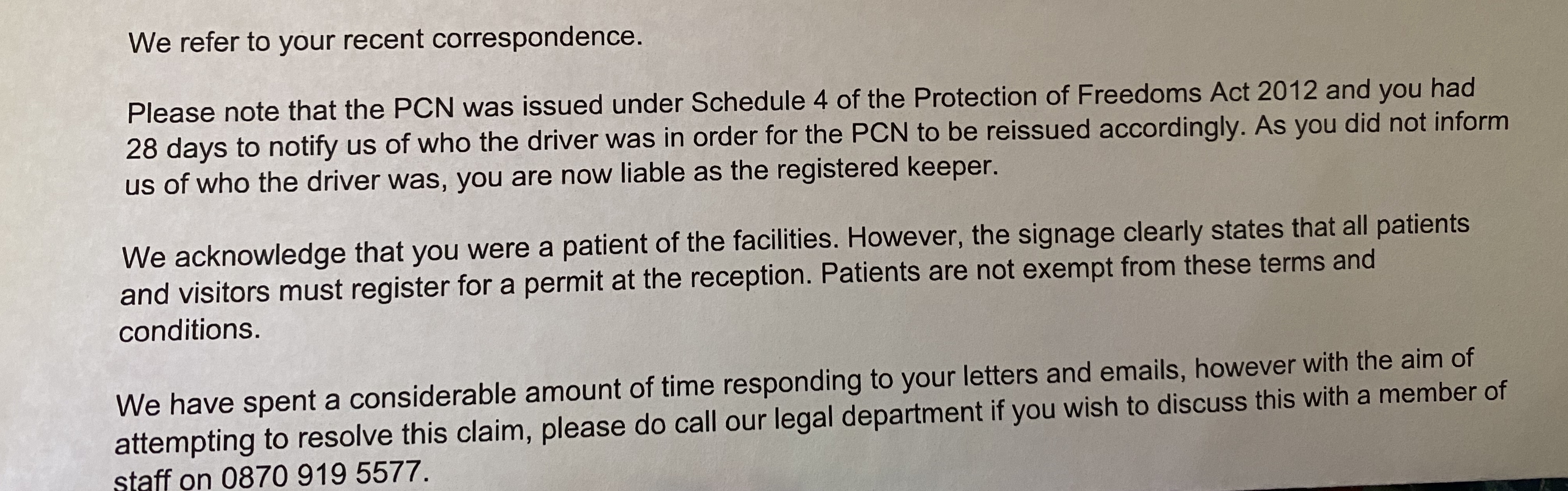
Hello, I have received a letter from CEL, please see bellow, do I need to reply ?
 0
0 -
Looks like a new tactic, a desperate attempt to handle the new template defence, by getting victims to ring up and pay them some money to 'resolve the dispute out of court'.
Don't. I predict that CEL will discontinue in the end.
I assume the communication they are talking about is them seeing the defence from the CCBC that you emailed to the CCBC with the Appendix C Southampton judgment?PRIVATE 'PCN'? DON'T PAY BUT DON'T IGNORE IT (except N.Ireland).
CLICK at the top or bottom of any page where it says:
Home»Motoring»Parking Tickets Fines & Parking - read the NEWBIES THREAD0 -
Notice that costly 0870 number at the bottom. So lets say that the OP did call them to "discuss the matter", they would be making money on the call before even talking. They are very cunning, and deceptive.
@OP, I hope you win in court.1










Confirm your email address to Create Threads and Reply

Categories
- All Categories
- 354.2K Banking & Borrowing
- 254.3K Reduce Debt & Boost Income
- 455.3K Spending & Discounts
- 247.2K Work, Benefits & Business
- 603.8K Mortgages, Homes & Bills
- 178.4K Life & Family
- 261.3K Travel & Transport
- 1.5M Hobbies & Leisure
- 16.1K Discuss & Feedback
- 37.7K Read-Only Boards