We’d like to remind Forumites to please avoid political debate on the Forum.
This is to keep it a safe and useful space for MoneySaving discussions. Threads that are – or become – political in nature may be removed in line with the Forum’s rules. Thank you for your understanding.
📨 Have you signed up to the Forum's new Email Digest yet? Get a selection of trending threads sent straight to your inbox daily, weekly or monthly!
The Alternative Green Energy Thread
Comments
-
Magnitio said:
China’s plans to cut emissions too weak to stave off global catastrophe, say experts
China’s plans are to cut emissions by between 7% and 10% of their peak by 2035 – a long way from the 30% cut that experts said was feasible and necessary.
But experts said China was failing to show leadership in its climate commitments. Kaysie Brown, associate director for climate diplomacy and governance at the E3G thinktank, said: “China’s 2035 target falls critically short of what is needed. It’s neither aligned with China’s economic decarbonisation, nor its own 2060 carbon neutrality goal.https://www.theguardian.com/environment/2025/sep/24/chinas-plans-to-cut-emission-too-weak-to-stave-off-global-catastrophe-say-experts
Edit: from thearticle linked by @Magnitio
EXPERT REACTION: Schäpe called the mention of “[promoting the] peaking [of] coal and oil consumption” an “important signal”, as this is the first time “such language appears in a top-level planning document”. The oil-peak target “aligns with international expectations” and the “references to ‘clean and efficient use’ and ‘orderly replacement’ suggest a managed transformation of coal’s role – focusing on retrofits, flexibility and system support rather than new capacity growth”, she added. This suggestion of a peaking for coal and oil “allows” coal consumption to “increase in the early years of the five-year period”, according to a LinkedIn post by Lauri Myllyvirta, lead analyst from CREA. He said the peaking suggestion, although “in line with the goal of peaking [carbon dioxide] CO2 emissions before 2030”, provides “no guarantees of achieving a [CO2] reduction from 2025 to 2030, let alone starting from 2025”. The “most important question” for the next “five-year plan”, he added, is “whether China is committed to honouring the 2021 commitments: reducing carbon intensity by 65% from 2005 to 2030 and ‘gradually reducing coal consumption’” over the next five years.Northern Lincolnshire. 7.8 kWp system, (4.2 kWwest facing panels , 3.6 kWeast facing), Solis inverters installed 2018, 5kW SSE facing system (shaded in afternoon) added in 2025 with Tesla PW3 battery, Mitsubishi SRK35ZS-S and SRK20ZS-S Wall Mounted A2A Heat Pumps, ex Nissan Leaf owner.0 -
Shall I also just pick one section of that article?"COAL DECLINE: Official data showed that China’s thermal power generation – mainly from coal – dropped 5.4% in September, reported Bloomberg."
6.4kWp (16 * 400Wp REC Alpha) facing ESE + 5kW Huawei inverter + 10kWh Huawei battery. Vaillant Arotherm Pro 7kW heat pump.0 -
I have noted the enthusiasm being shown for the 78 GW of BESS in the pipeline. Yes, hopefully most of this will be colocated with solar farms and wind farms, at least it will at some indeterminate time in the future when the grid connections are eventually available and we can finally wave goodbye to fossil fuel generation. I am in favour of BESS properly integrated with renewables and I have argued that it should be mandatory that all new renewables installations should have BESS or some other form of storage.However, It is worth giving a thought to what this is doing in the short term to our CO2 emissions. We realise, of course, that significant quantities of CO2 are released in the manufacture of these BESS systems and it is likely to be some time before that manufacturing CO2 will be paid back. All that manufacturing CO2 is currently acting like an extra blanket over our heads and that manufacturing CO2 is causing the world just to get a tiny bit warmer - now. I don’t know the CO2 payback times for grid scale BESS and I doubt anyone does. Has anyone in the UK any idea how long it will take? It’s not like a wind or solar farm where you can estimate capacity factors based on historic wind and sunshine and get somewhere near.Why is it so difficult? Estimating revenue streams is inherently complex - just ask Google. CO2 payback is however much more difficult to estimate.To achieve CO2 payback BESS systems have to displace fossil fuel emissions. In the UK that is, of course, gas. The first problem, and it is likely to be so for many years yet, is that battery storage tends to be needed when there is a shortage of other generation sources. When there is lots of wind and solar we don’t need much storage and demand for stored electricity is low. When there is insufficient renewables generation and we are dependent on gas stepping in BESS wil be great - in theory. Where will the electricity come from to charge the batteries? Yes, there will be many days in summer when solar can fill the batteries and discharge in to the evening peak period. In winter that model might not work quite so well. With wind, batteries can be charged during the day to meet evening peaks but on windy days, particularly as more wind is rolled out, batteries may not be needed for the peak hours so there is less opportunity to displace gas generation. The big problem arises however on days like we experience quite frequently when renewables are insufficient, or only just sufficient, to fully meet daytime (off peak) demand. Any generation that is diverted to charge batteries for the peak demand hours is not displacing gas. If renewables are insufficient to charge the batteries then if we are going to charge them gas will be used -bought cheaply during the day and then sold at a higher price during peak hours. (Even if we use nuclear to charge batteries, we will need gas to make up the nuclear shortfall and ditto imports.)According to Google BESS is only 70-85% efficient. Even if commercially it is cheaper to use batteries to meet peak demand in this scenario, it will incur a significant CO2 penalty of perhaps 20-40% compared to just burning gas. So does the grid operator on these days use batteries and ignore the CO2 cost?The price difference between daytime and peak gas prices will frequently leave sufficient margin for BESS operators to make a profit so to the grid operator it makes more financial sense to go with batteries rather than more gas generation so during a prolonged low wind spell in winter using batteries will actually increase CO2 emissions and extend the CO2 payback period. I will make the point again that all the time it takes for payback is causing short term CO2 loading of the atmosphere. If it takes, say, 5 years to displace the same CO2 as used in a battery’s manufacture it does not mean that after 5 years temperatures will be back to where we were at year 0. It will take another 5 years (10 years in all) to undo the damage from manufacturing. After that, and only after that, there is a positive benefit.So while it will be very satisfying to some to see batteries taking over peak demand duties from gas it will sadly be a pyrrhic victory.Northern Lincolnshire. 7.8 kWp system, (4.2 kWwest facing panels , 3.6 kWeast facing), Solis inverters installed 2018, 5kW SSE facing system (shaded in afternoon) added in 2025 with Tesla PW3 battery, Mitsubishi SRK35ZS-S and SRK20ZS-S Wall Mounted A2A Heat Pumps, ex Nissan Leaf owner.0
-
JKenH said:I have noted the enthusiasm being shown for the 78 GW of BESS in the pipeline. Yes, hopefully most of this will be colocated with solar farms and wind farms, at least it will at some indeterminate time in the future when the grid connections are eventually available and we can finally wave goodbye to fossil fuel generation. I am in favour of BESS properly integrated with renewables and I have argued that it should be mandatory that all new renewables installations should have BESS or some other form of storage.However, It is worth giving a thought to what this is doing in the short term to our CO2 emissions. We realise, of course, that significant quantities of CO2 are released in the manufacture of these BESS systems and it is likely to be some time before that manufacturing CO2 will be paid back. All that manufacturing CO2 is currently acting like an extra blanket over our heads and that manufacturing CO2 is causing the world just to get a tiny bit warmer - now. I don’t know the CO2 payback times for grid scale BESS and I doubt anyone does. Has anyone in the UK any idea how long it will take? It’s not like a wind or solar farm where you can estimate capacity factors based on historic wind and sunshine and get somewhere near.Why is it so difficult? Estimating revenue streams is inherently complex - just ask Google. CO2 payback is however much more difficult to estimate.To achieve CO2 payback BESS systems have to displace fossil fuel emissions. In the UK that is, of course, gas. The first problem, and it is likely to be so for many years yet, is that battery storage tends to be needed when there is a shortage of other generation sources. When there is lots of wind and solar we don’t need much storage and demand for stored electricity is low. When there is insufficient renewables generation and we are dependent on gas stepping in BESS wil be great - in theory. Where will the electricity come from to charge the batteries? Yes, there will be many days in summer when solar can fill the batteries and discharge in to the evening peak period. In winter that model might not work quite so well. With wind, batteries can be charged during the day to meet evening peaks but on windy days, particularly as more wind is rolled out, batteries may not be needed for the peak hours so there is less opportunity to displace gas generation. The big problem arises however on days like we experience quite frequently when renewables are insufficient, or only just sufficient, to fully meet daytime (off peak) demand. Any generation that is diverted to charge batteries for the peak demand hours is not displacing gas. If renewables are insufficient to charge the batteries then if we are going to charge them gas will be used -bought cheaply during the day and then sold at a higher price during peak hours. (Even if we use nuclear to charge batteries, we will need gas to make up the nuclear shortfall and ditto imports.)According to Google BESS is only 70-85% efficient. Even if commercially it is cheaper to use batteries to meet peak demand in this scenario, it will incur a significant CO2 penalty of perhaps 20-40% compared to just burning gas. So does the grid operator on these days use batteries and ignore the CO2 cost?The price difference between daytime and peak gas prices will frequently leave sufficient margin for BESS operators to make a profit so to the grid operator it makes more financial sense to go with batteries rather than more gas generation so during a prolonged low wind spell in winter using batteries will actually increase CO2 emissions and extend the CO2 payback period. I will make the point again that all the time it takes for payback is causing short term CO2 loading of the atmosphere. If it takes, say, 5 years to displace the same CO2 as used in a battery’s manufacture it does not mean that after 5 years temperatures will be back to where we were at year 0. It will take another 5 years (10 years in all) to undo the damage from manufacturing. After that, and only after that, there is a positive benefit.So while it will be very satisfying to some to see batteries taking over peak demand duties from gas it will sadly be a pyrrhic victory.Did you know that there are people who actually look at this for a living? They have studied energy supply and demand, the technologies available now and potentially in the future. They model the demand and supply of energy. If you want a read, have a look at the wealth of information available here:As you like asking Google questions, I asked it about the carbon payback of battery storage and the answer was:"A battery that is charged with zero-carbon energy (e.g., solar or wind) and then discharged to replace gas-fired power needs to complete this cycle about 200 times for the carbon savings to outweigh its manufacturing carbon footprint. This is typically achievable in less than a year of operation."6.4kWp (16 * 400Wp REC Alpha) facing ESE + 5kW Huawei inverter + 10kWh Huawei battery. Vaillant Arotherm Pro 7kW heat pump.2
-
Thank you for taking the time to engage with me. It is useful that you raise popular misconceptions as it gives me another opportunity to try and explain my point of view a little more clearly. As I said at the start of my last post I am in favour of BESS properly integrated with renewables and suggest it should be mandatory. It does though need to be properly integrated and at the moment this is not the case. Yes it will improve in the future but for now we tend to locate our BESS close to existing grid infrastructure, often on the site of old power stations. This means that rather than being able to charge the batteries from renewables they will be fed with whatever the mix is from the local grid. How long it will be before the situation improves dramatically we will have to wai5 and see.Magnitio said:JKenH said:I have noted the enthusiasm being shown for the 78 GW of BESS in the pipeline. Yes, hopefully most of this will be colocated with solar farms and wind farms, at least it will at some indeterminate time in the future when the grid connections are eventually available and we can finally wave goodbye to fossil fuel generation. I am in favour of BESS properly integrated with renewables and I have argued that it should be mandatory that all new renewables installations should have BESS or some other form of storage.However, It is worth giving a thought to what this is doing in the short term to our CO2 emissions. We realise, of course, that significant quantities of CO2 are released in the manufacture of these BESS systems and it is likely to be some time before that manufacturing CO2 will be paid back. All that manufacturing CO2 is currently acting like an extra blanket over our heads and that manufacturing CO2 is causing the world just to get a tiny bit warmer - now. I don’t know the CO2 payback times for grid scale BESS and I doubt anyone does. Has anyone in the UK any idea how long it will take? It’s not like a wind or solar farm where you can estimate capacity factors based on historic wind and sunshine and get somewhere near.Why is it so difficult? Estimating revenue streams is inherently complex - just ask Google. CO2 payback is however much more difficult to estimate.To achieve CO2 payback BESS systems have to displace fossil fuel emissions. In the UK that is, of course, gas. The first problem, and it is likely to be so for many years yet, is that battery storage tends to be needed when there is a shortage of other generation sources. When there is lots of wind and solar we don’t need much storage and demand for stored electricity is low. When there is insufficient renewables generation and we are dependent on gas stepping in BESS wil be great - in theory. Where will the electricity come from to charge the batteries? Yes, there will be many days in summer when solar can fill the batteries and discharge in to the evening peak period. In winter that model might not work quite so well. With wind, batteries can be charged during the day to meet evening peaks but on windy days, particularly as more wind is rolled out, batteries may not be needed for the peak hours so there is less opportunity to displace gas generation. The big problem arises however on days like we experience quite frequently when renewables are insufficient, or only just sufficient, to fully meet daytime (off peak) demand. Any generation that is diverted to charge batteries for the peak demand hours is not displacing gas. If renewables are insufficient to charge the batteries then if we are going to charge them gas will be used -bought cheaply during the day and then sold at a higher price during peak hours. (Even if we use nuclear to charge batteries, we will need gas to make up the nuclear shortfall and ditto imports.)According to Google BESS is only 70-85% efficient. Even if commercially it is cheaper to use batteries to meet peak demand in this scenario, it will incur a significant CO2 penalty of perhaps 20-40% compared to just burning gas. So does the grid operator on these days use batteries and ignore the CO2 cost?The price difference between daytime and peak gas prices will frequently leave sufficient margin for BESS operators to make a profit so to the grid operator it makes more financial sense to go with batteries rather than more gas generation so during a prolonged low wind spell in winter using batteries will actually increase CO2 emissions and extend the CO2 payback period. I will make the point again that all the time it takes for payback is causing short term CO2 loading of the atmosphere. If it takes, say, 5 years to displace the same CO2 as used in a battery’s manufacture it does not mean that after 5 years temperatures will be back to where we were at year 0. It will take another 5 years (10 years in all) to undo the damage from manufacturing. After that, and only after that, there is a positive benefit.So while it will be very satisfying to some to see batteries taking over peak demand duties from gas it will sadly be a pyrrhic victory.Did you know that there are people who actually look at this for a living? They have studied energy supply and demand, the technologies available now and potentially in the future. They model the demand and supply of energy. If you want a read, have a look at the wealth of information available here:As you like asking Google questions, I asked it about the carbon payback of battery storage and the answer was:"A battery that is charged with zero-carbon energy (e.g., solar or wind) and then discharged to replace gas-fired power needs to complete this cycle about 200 times for the carbon savings to outweigh its manufacturing carbon footprint. This is typically achievable in less than a year of operation."
While therefore you may imagine in an ideal world batteries are being filled up with renewable energy, they are in fact getting the same grid mix as where they are located. Rather therefore than consider the ideal scenario of a battery charged with zero-carbon energy that you fed to Google we need to look at the real world.Let us have a look at a day like yesterday which was fairly typical for November - some sun, some wind but over the day as a whole not enough renewables to meet 20% of demand. As an operator of a BESS one would ideally want to charge when prices were low and discharge when prices were high to achieve maximum profit.I am attaching two screenshots from Drax Electric Insights, one when prices were lowest and another when highest.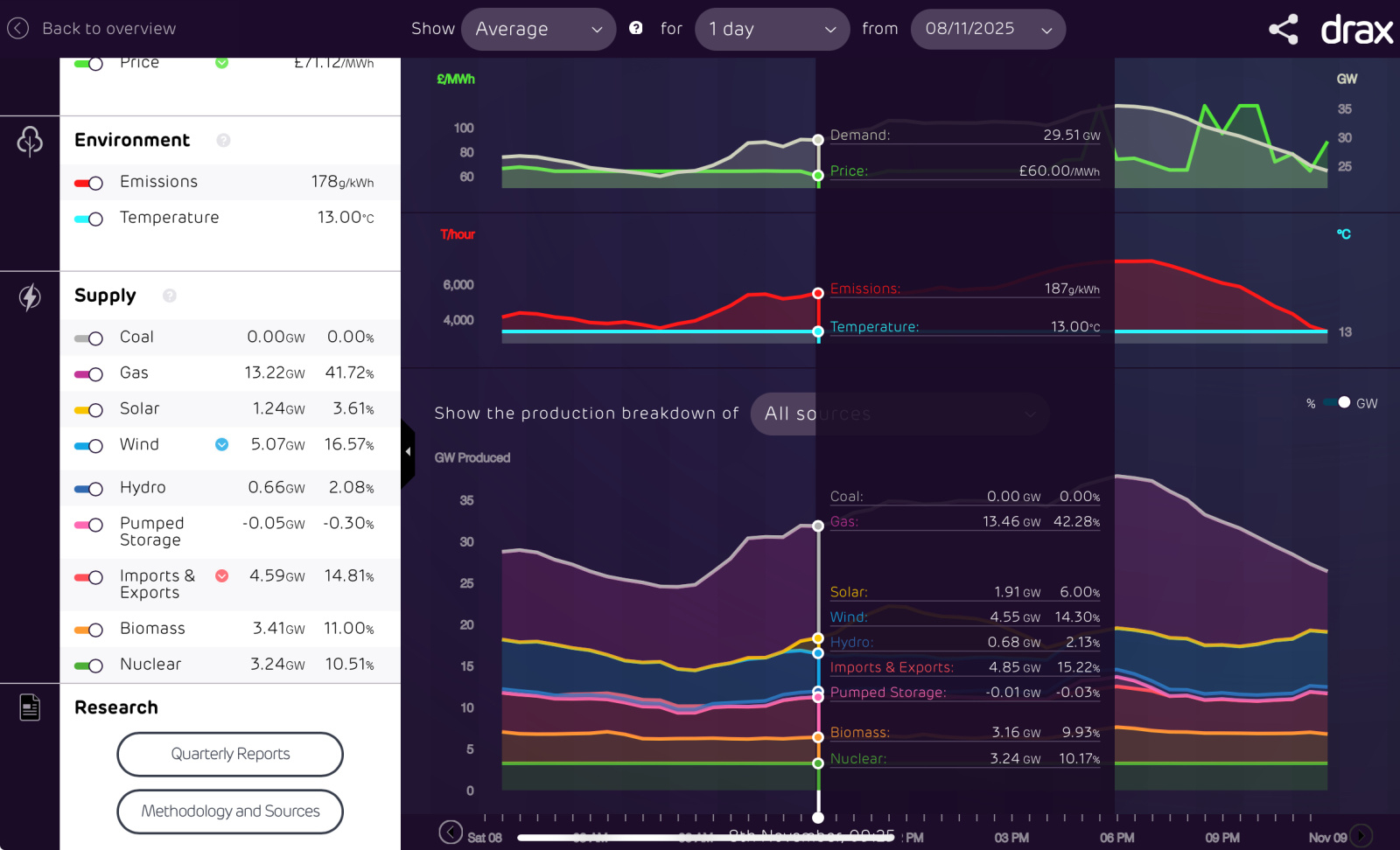
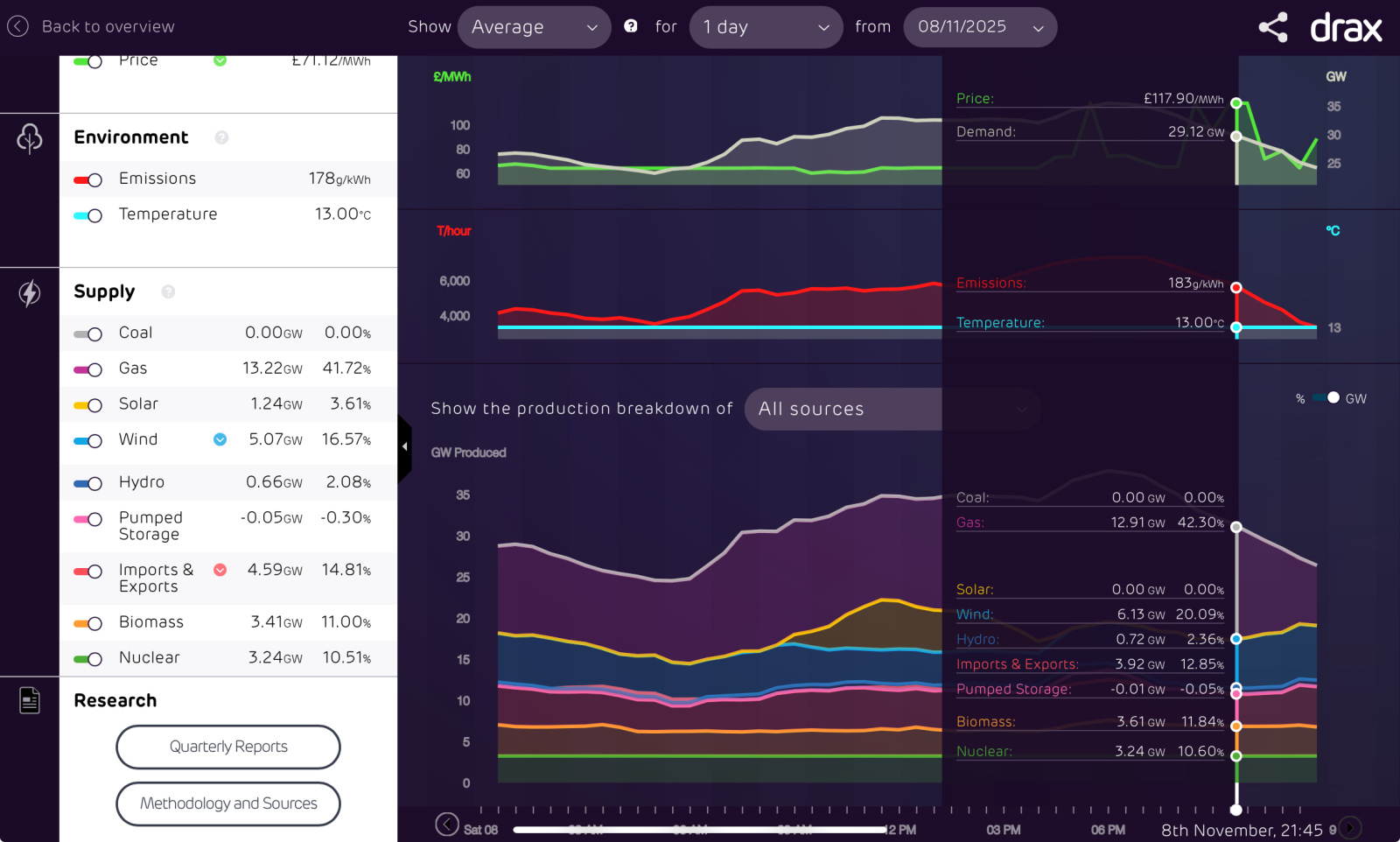 You will see that emissions when the batteries might have been charged were a very similar level to when they might have been discharged, so there would have been no saving compared to generating with gas and in fact because of round trip losses we would consumed more units of energy and hence use more CO2 than were saved in the discharge.You provided a link to NESO but that only highlighted how reactive grid balancing is. It is difficult to plan much more than a day or two ahead and often in the day so this only really confirms what I said about the difficulty of predicting how long CO2 payback might take.
I notice you didn’t comment on my hypothesis that it takes twice as long to cancel out the effect of battery manufacture on the grid as the theoretical payback calculation (of CO2 used less CO2 saved) which is a shame as I was looking forward to explaining that further.Northern Lincolnshire. 7.8 kWp system, (4.2 kWwest facing panels , 3.6 kWeast facing), Solis inverters installed 2018, 5kW SSE facing system (shaded in afternoon) added in 2025 with Tesla PW3 battery, Mitsubishi SRK35ZS-S and SRK20ZS-S Wall Mounted A2A Heat Pumps, ex Nissan Leaf owner.0 -
I was just wondering why battery discharge doesn’t appear in the Drax Electric Insights figures given that we have 6GW operational? Anybody?
UK reaches 6GW/8GWh of operational BESS; nearly 20GWh under construction
Northern Lincolnshire. 7.8 kWp system, (4.2 kWwest facing panels , 3.6 kWeast facing), Solis inverters installed 2018, 5kW SSE facing system (shaded in afternoon) added in 2025 with Tesla PW3 battery, Mitsubishi SRK35ZS-S and SRK20ZS-S Wall Mounted A2A Heat Pumps, ex Nissan Leaf owner.0 -
JKenH said:I was just wondering why battery discharge doesn’t appear in the Drax Electric Insights figures given that we have 6GW operational? Anybody?
UK reaches 6GW/8GWh of operational BESS; nearly 20GWh under construction
The data is not yet available in a way that can easily be consumed and displayed on these websites via Elexon. It may be available soon though:6.4kWp (16 * 400Wp REC Alpha) facing ESE + 5kW Huawei inverter + 10kWh Huawei battery. Vaillant Arotherm Pro 7kW heat pump.2 -
This site indicates battery activity:Somebody posted the site a few months ago so thanks to them.
4.7kwp PV split equally N and S 20° 2016.Givenergy AIO (2024)Seat Mii electric (2021). MG4 Trophy (2024).1.2kw Ripple Kirk Hill. 0.6kw Derril Water.Vaillant aroTHERM plus 5kW ASHP (2025)Gas supply capped (2025)3 -
Thank you.thevilla said:This site indicates battery activity:Somebody posted the site a few months ago so thanks to them.Northern Lincolnshire. 7.8 kWp system, (4.2 kWwest facing panels , 3.6 kWeast facing), Solis inverters installed 2018, 5kW SSE facing system (shaded in afternoon) added in 2025 with Tesla PW3 battery, Mitsubishi SRK35ZS-S and SRK20ZS-S Wall Mounted A2A Heat Pumps, ex Nissan Leaf owner.0 -
thevilla said:This site indicates battery activity:That's really useful, thanks for reminding us!It also includes a "grid stability" page where you can see those MVAr we were discussing a few days ago:N. Hampshire, he/him. Octopus Intelligent Go elec / Fuse gas / Vodafone BB / iD mobile. Kirk Hill Co-op member.Economy 7 cap explainer. Gas vs E7 vs peak elec heating costs, Ecoflow Stream, Best kettle :-)
2.72kWp PV facing SSW installed Jan 2012. 11 x 247w panels, 3.6kw inverter. 37 MWh generated, long-term average 2.6 Os.1










Confirm your email address to Create Threads and Reply

Categories
- All Categories
- 355.7K Banking & Borrowing
- 254.9K Reduce Debt & Boost Income
- 456.1K Spending & Discounts
- 248.3K Work, Benefits & Business
- 605.8K Mortgages, Homes & Bills
- 179K Life & Family
- 263.6K Travel & Transport
- 1.5M Hobbies & Leisure
- 16.1K Discuss & Feedback
- 37.7K Read-Only Boards