We’d like to remind Forumites to please avoid political debate on the Forum.
This is to keep it a safe and useful space for MoneySaving discussions. Threads that are – or become – political in nature may be removed in line with the Forum’s rules. Thank you for your understanding.
📨 Have you signed up to the Forum's new Email Digest yet? Get a selection of trending threads sent straight to your inbox daily, weekly or monthly!
Green, ethical, energy issues in the news
Comments
-
Nah, that's fake news mate. We all know that the grid will collapse at RE penetration levels of
30%40%50%…… and now we have those pesky batts/inverters that can produce artificial inertia …… 😉Mart. Cardiff. 8.72 kWp PV systems (2.12 SSW 4.6 ESE & 2.0 WNW). 28kWh battery storage. Two A2A units for cleaner heating. Two BEV's for cleaner driving.
For general PV advice please see the PV FAQ thread on the Green & Ethical Board.3 -
Latest updates to the Boiler Upgrade Scheme (BUS) have been laid before parliament and come into force on 28th April 2026:
Amongst other changes, Air2Air heat pump systems are now included (£2,500 grant), and the requirement for an EPC has been removed making it easier to be eligible for the grant.
I am a Forum Ambassador and I support the Forum Team on the Benefits & tax credits, Heat pumps and Green & Ethical MoneySaving forums. If you need any help on those boards, do let me know. Please note that Ambassadors are not moderators. Any post you spot in breach of the Forum Rules should be reported via the report button, or by emailing forumteam@moneysavingexpert.com. All views are my own & not the official line of Money Saving Expert.3 -
The most important thing (to me), is that additional electric heating is allowed. I may be reading into that, and also not having had a wet ASHP installed, but it seems to solve the biggest problem. That being, that to get the BUS grant of £7.5k for a wet system the install needs to be 'perfect'.
The cost and complications of meeting all edge cases, is (and again from what I'm reading/seeing/hearing) the biggest hurdle. So some rads may be changed, HP size enlarged, and pipe bores changed, for extreme edge cases, rather than just for 'normal' yearly extremes.
We couldn't get an ASHP at reasonable cost, due to concerns about extreme edge cases, and what I felt was extreme overbuild. But at a rough guess our worst months historically (last 10yrs) had hit ~2,000kWh of gas (inc cooking and DHW). Even allowing for peak days, within those peak months, a single 2kW oil-rad / hot air blower, could handle half of that if necessary.
Then again, folk are used to GCH, which is typically massively overpowered (if run 24/7), so winning them over with something that may need a bit of support (at times), may cause overdramatic concerns till we've adapted our heating thought processes?
Mart. Cardiff. 8.72 kWp PV systems (2.12 SSW 4.6 ESE & 2.0 WNW). 28kWh battery storage. Two A2A units for cleaner heating. Two BEV's for cleaner driving.
For general PV advice please see the PV FAQ thread on the Green & Ethical Board.3 -
I've never hit those levels of gas use: electric cooking and much of my hot water via PV diverter, and a wood burner in the lounge. Last calendar year was just over 2100 in total..
What I have been doing with cheap Agile (when price = significantly<gas) is experimenting with the impact of direct acting electric heating at 1kW or 2kW, and it seems very effective. It would make sense for my prospective A2A to be quite low rated, with log burner for really cold spells which are pretty unknown on the south coast near the sea.
1 -
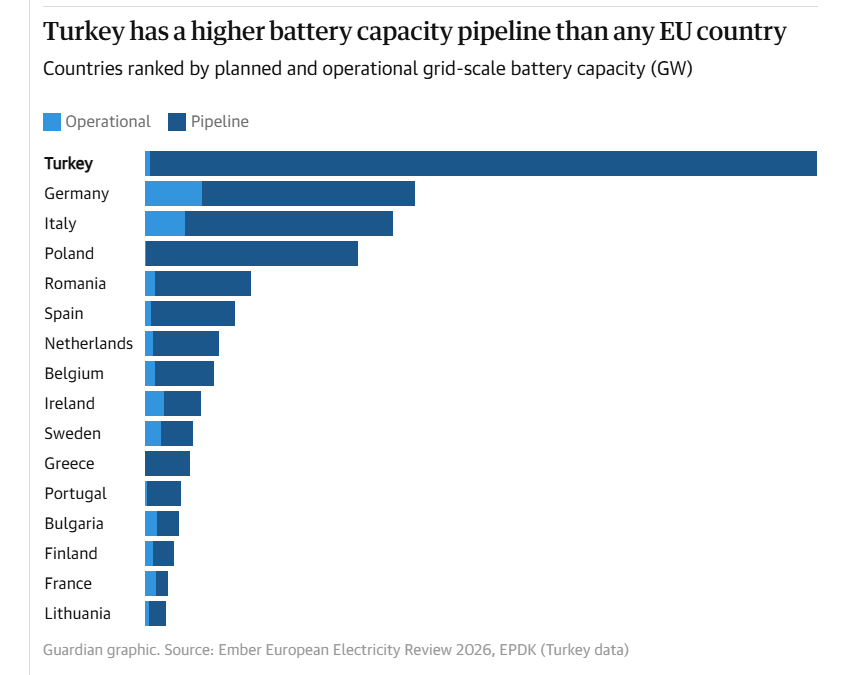
Bit surprised and shocked at the potential* rate of storage deployment in Turkey. Their policy of matching storage to RE deployments, for fast approval, seems like a great idea, especially now that storage costs have tumbled.
*The graph is impressive, but note the difference between operational and pipeline. So we may need to watch for a year or two, to see if the rapid deployment does actually happen at such a vast scale.
Turkey to race ahead of EU on battery storage amid fossil fuel crisisTurkey has given the green light to more batteries to buffer its electricity grid than any EU member state, a report has found, in a further sign of rich countries losing steam in the race to a clean economy.
More than 33GW of battery capacity have been approved in Turkey since 2022, according to the climate thinktank Ember, while the total planned and operational capacity in European frontrunners that started deploying them earlier, such as Germany and Italy, is 12-13GW.
Turkey’s large number of projects is the result of a 2022 mandate that gives preferential grid access to renewables that are paired with an equal amount of storage. Of 221GW of battery storage in submitted applications, Turkey has approved 33GW, equivalent to 83% of its current wind and solar capacity, according to the report. Romania is the only EU country with a greater ratio.
 Mart. Cardiff. 8.72 kWp PV systems (2.12 SSW 4.6 ESE & 2.0 WNW). 28kWh battery storage. Two A2A units for cleaner heating. Two BEV's for cleaner driving.
For general PV advice please see the PV FAQ thread on the Green & Ethical Board.2 -
Where does the UK stand compared with those figures?
Greece and France look disappointing there, although at least France has a decent nuclear base.
0 -
UK is around 7GW on the grid side, with a lot under construction.
I assume/suspect that storage deployment will accelerate now that it's gotten much. much cheaper. In Australia they are deploying battery storage with up to 11.5hr roles already. So it's moved far beyond the SDES (short duration energy storage) role of 1-4hr. [Obviously batts can last longer, but we have to consider the economic role for now.]
And China got bids around $65/kWh all-in for a huge storage project, with some bids in the low $50's. Though those could have been used by companies as a way to 'dump' capacity at cost, in order to improve economies of scale at production
California, in a very short time, has deployed both a huge amount of PV, and the battery capacity needed to absord daytime excess for late afternoon use. PV provides about 80% of mid-day power, and battery capacity has grown from 1.3GW in 2020 to over 17GW today. Batts now cover about 40% of the 7pm peak.
I genuinely meant to stop with the first single line. Doh!
Mart. Cardiff. 8.72 kWp PV systems (2.12 SSW 4.6 ESE & 2.0 WNW). 28kWh battery storage. Two A2A units for cleaner heating. Two BEV's for cleaner driving.
For general PV advice please see the PV FAQ thread on the Green & Ethical Board.5 -
Analysis: Record wind and solar saved UK from gas imports worth £1bn in March 2026 - Carbon Brief
The UK avoided the need for gas imports worth £1bn in March 2026 thanks to record electricity generation from wind and solar, reveals Carbon Brief analysis.
Wind generation hit a new record for the month of March on the island of Great Britain, up 38% year-on-year, while solar nearly matched the output of last year’s exceptionally sunny spring.
Together, wind and solar generated 11 terawatt hours (TWh) of electricity in March 2026, up a combined 28% and setting a new record for the month, as shown in the figure below.
When people complain of solar taking up farmland, it's worth remembering not only is it a relatively small amount (less than that taken up by golf courses) but also gas that would otherwise would be used to generate electricity costs more than the lost crop yields. ie it improves our trade balance because the avoided gas imports are more than the extra crop imports.
Solar install June 2022, Bath
4.8 kW array, Growatt SPH5000 inverter, 1x Seplos V3 battery 15.2 kWh, 1x Seplos V4 battery 16.1 kWh.
SSW roof. ~22° pitch, BISF house. 12 x 400W Hyundai panels. Hyundai Kona 64 kWh EV.6 -
Remember also that some animals (e.g. sheep) could graze in solar fields and there have even been suggestions that having the panels improves the yields of meat.
NE Derbyshire.4kWp S Facing 17.5deg slope (dormer roof).24kWh of Pylontech batteries with Lux controller BEV : Hyundai Ioniq53 -
When people complain of solar taking up farmland, it's worth remembering not only is it a relatively small amount
I know I'm preaching to the choir here, but there's currently more land used to make road fuels than there is for solar farms.
In 2024, 142,000 hectares of the UK were used to grow biofuels. 30% of that was used for road fuels, which is 42,600 hectares.
Also in 2024, the government calculated that the UK's 9.4GW of ground-mounted PV took up 21,200 hectares. That's 55% of the total UK PV capacity at that time, on half the area used for road fuels (the remaining 45% consists of 30% on domestic roofs and 15% commercial property etc.) and about one-seventh of the total area used for biofuels.
At 2.25 hectares per megawatt (calculated in the above report), if the UK expands to 47GW of PV by 2030, and this continues to be 55% ground-mounted, we'll need ~65,000 hectares total - still less than half the area currently used for biofuels.
N. Hampshire, he/him. Octopus Intelligent Go elec / Fuse gas / Vodafone BB / iD mobile. Kirk Hill Co-op member.Economy 7 cap explainer. Gas vs E7 vs peak elec heating costs, Ecoflow Stream, Best kettle :-)
2.72kWp PV facing SSW installed Jan 2012. 11 x 247w panels, 3.6kw inverter. 37 MWh generated, long-term average 2.6 Os.4









Confirm your email address to Create Threads and Reply

Categories
- All Categories
- 355.8K Banking & Borrowing
- 254.9K Reduce Debt & Boost Income
- 456.2K Spending & Discounts
- 248.3K Work, Benefits & Business
- 605.9K Mortgages, Homes & Bills
- 179K Life & Family
- 263.8K Travel & Transport
- 1.5M Hobbies & Leisure
- 16.2K Discuss & Feedback
- 37.7K Read-Only Boards