We’d like to remind Forumites to please avoid political debate on the Forum.
This is to keep it a safe and useful space for MoneySaving discussions. Threads that are – or become – political in nature may be removed in line with the Forum’s rules. Thank you for your understanding.
IMPORTANT: Please make sure your posts do not contain any personally identifiable information (both your own and that of others). When uploading images, please take care that you have redacted all personal information including number plates, reference numbers and QR codes (which may reveal vehicle information when scanned).
📨 Have you signed up to the Forum's new Email Digest yet? Get a selection of trending threads sent straight to your inbox daily, weekly or monthly!
The Forum now has a brand new text editor, adding a bunch of handy features to use when creating posts. Read more in our how-to guide
UKPC - Crawley Leisure Centre parking outside lines
Comments
-
Afraid not.
If you haven't received an evidence pack then there's a good chance they have thrown in the towel. If POPLA award against you and you haven't had a pack then complain like hell to POPLA. It's a waiting game I'm afraid."The darkest places in hell are reserved for those who maintain their neutrality in times of moral crisis." - Dante Alighieri0 -
Hearing date on the 13th or soon thereafter (so two days from now).
No information pack received as of yet. Are there any (enforceable) guidelines that state that if a pre-requisite has not been met that they have defaulted?0 -
MoneyTwister wrote: »Hearing date on the 13th or soon thereafter (so two days from now).
No information pack received as of yet. Are there any (enforceable) guidelines that state that if a pre-requisite has not been met that they have defaulted?
Not as such, but I'd be emailing POPLA on the day before the forecast adjudication date to inform them you've not received the PPC's evidence pack.Please note, we are not a legal advice forum. I personally don't get involved in critiquing court case Defences/Witness Statements, so unable to help on that front. Please don't ask. .
I provide only my personal opinion, it is not a legal opinion, it is simply a personal one. I am not a lawyer.
Give a man a fish, and you feed him for a day; show him how to catch fish, and you feed him for a lifetime.#Private Parking Firms - Killing the High Street0 -
Good idea, not sure if they will receive / process the email on time to take note but can not hurt of course.0
-
MoneyTwister wrote: »Good idea, not sure if they will receive / process the email on time to take note but can not hurt of course.
Make sure you mark your email in CAPS & BOLD to the effect:
FOR THE URGENT ATTENTION OF THE ADJUDICATOR IN CASE NUMBER (your POPLA code) + (your name and address) - DUE FOR DECISION ON (date of adjudication).Please note, we are not a legal advice forum. I personally don't get involved in critiquing court case Defences/Witness Statements, so unable to help on that front. Please don't ask. .
I provide only my personal opinion, it is not a legal opinion, it is simply a personal one. I am not a lawyer.
Give a man a fish, and you feed him for a day; show him how to catch fish, and you feed him for a lifetime.#Private Parking Firms - Killing the High Street0 -
Response received from POPLA regarding the missing evidence pack, they have noted it on the case records and forwarded me the evidence pack they had received. Not sure how relevant this omission is on the outcome of the appeal.
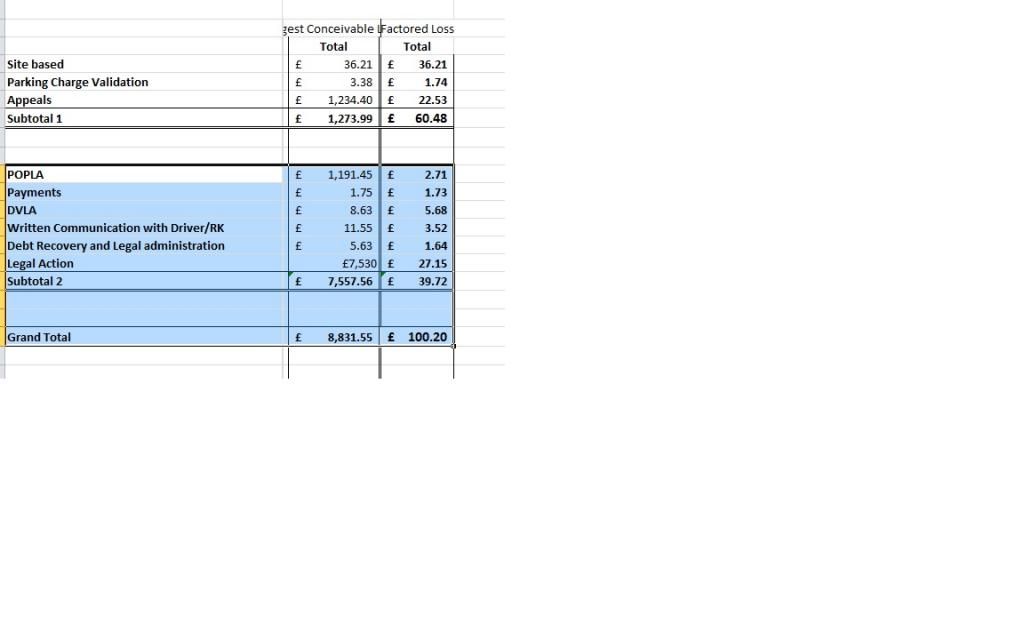
UKPC had a whole load of bla bla about the cost element, and added a cost spreadsheet that "shows" that it costs them £100.
If anyone is interested, I can post their response but not sure if that helps to see what they are arguing and all the law cases they quote on why it should be rejected.0 -
You'll need to rebut their "evidence", particularly their loss statement (which we know is a pack of lies and made-up costs). Would be interesting to see their latest attempt to justify £100 as being their loss at the time the charge was issued (this is important, costs incurred during any subsequent appeal process cannot be included, as these are not losses if someone stumps up the £100 right away).0
-
Formatting off unfortunately, but column 1 is Largest Conceivable Loss, column 2 is factored loss.0
-
 0
0 -
It is confidently argued that the parking charge in question should be fully enforced by the independent
appeals service. UK Parking Control Ltd (UKPC) is entitled by common law to be fully compensated for the
genuine pre-estimate of loss stemming from the appellant’s breach of contract.
The Charge Represents a Genuine Pre-Estimate of Loss
It will come as no surprise to read that the burden of proving that a clause is a penalty clause, not representing
a genuine pre-estimate of loss, lies upon the person who seeks to escape liability under it (Robophone Facilities
Ltd v Blank [1966] 1 WLR 1428, 1446, per Diplock LJ). This sound interpretation of the law has also been endorsed
by both Professor Richard Hooley of Cambridge University and Allen and Overy LLP (2008).
Nevertheless, in order to assist POPLA in resolving this dispute as effectively as possible, UK Parking Control Ltd
has provided a redacted breakdown of the greatest potential loss stemming from the breach of contract.
Since the breached clause provides for liquidated damages, the specific loss caused to UK Parking Control Ltd
for this particular breach is not at issue. Lord Dunedin in Dunlop Pneumatic Tyre Company Co Ltd v New
Garage & Motor Co Ltd [1915] AC 79 explains that quantifying the loss from a single breach in such cases as
these would be ‘impracticable’ and that it would be ‘quite reasonable’ to estimate damage from a single
breach at a single figure. The greatest potential loss for a breach has been provided, since it is certain that
whether liquidated damages represent a penalty or compensation should be assessed in relation to whether
the sum is ‘extravagent and unconscionable by comparison with the greatest loss that could be proved’
(emphasis added) (Clydebank Engineering and Shipbuilding Co Ltd v Don Jose Romas Yzquierdo y Castenda
[1905] AC 6, per Lord Davey and Parking Eye Ltd v Beavis and Wardley [2014] 3JD05152-69, per HHJ Moloney
QC).
It is hoped that the Assessor can appreciate that the provision of a full breakdown would highly prejudice the
commercial interests of UK Parking Control Ltd. However, the redacted version’s heads of costs mirror those
recommended by Mr Recorder Lowe QC in James Paul Mayhook v National Car Parks [2012] 1CM00569, para
66. Further, the full version of the breakdown has been reviewed and commended by Steve Clark (Head of
Operational Services for the British Parking Association) and our lawyers. It is also strongly doubted that a full
breakdown would assist the Assessor any more than the redacted version, since POPLA is understandably illequipped
to cast judgement on each specific cost involved in effective parking management by hundreds of
British Parking Association members.
As aforementioned, the heads of costs chosen in the provided breakdown have been judicially endorsed. The
site-based costs include (but are not limited to) the cost of producing the charge itself with accompanying
weatherproof wallet, which directly relates to the breach. The costs involved in validating the parking charge
include checking that the registration plate matches the vehicle in question, which directly relates to the breach.
The appeals’ costs would obviously not be incurred but for the breach. These costs include the telephone costs
of the call centre, employee costs to review the appeal and legal fees. POPLA costs are also directly attributable
to the breach. They include the preparation of evidence packs, which are completed by employees of different
pay grades and takes time to complete. Payment costs include the bank and employee costs involved in
processing the payment of parking charges issued for breaches. In line with the Protection of Freedoms Act
2012, DVLA costs include requesting from the DVLA the Registered Keeper details of the relevant vehicle, which
was parked in breach of contract. Written communication costs include the cost to produce and send initial
notices to the Driver/Registered Keeper and final notices, which are required to follow up on payments of
charges. If charges remain unpaid, a debt recovery company will be employed to obtain compensation for the
breach on our behalf. Costs involved under this head include employing the debt recovery company’s services
and preparing sufficient information to allow the external company to pursue the debt. Legal action costs
include the cost of preparing cases to take a number of people to court per year. UKPC has started taking more
people to court and anticipate we will continue to take more in the future. As a result, we have sat down with
our lawyers and advisors to try and estimate the likely costs involved in doing so.
It should be noted that for relevant costs an aggregate has been calculated and an average applied, where
costs differ depending on the breach in question. This is well-established practice when calculating certain
costs in determining liquidated damages for breaches. Largest Conceivable Loss is not factored down to take
account of the likeliness that each individual event will occur. It is nevertheless included to heed Lord Davey’s
emphasis on making a comparison between the charge and ‘the greatest loss that could be proved’ (emphasis
added) (Clydebank Engineering and Shipbuilding Co Ltd v Don Jose Romas Yzquierdo y Castenda [1905] AC 6,
per Lord Davey and Parking Eye Ltd v Beavis and Wardley [2014] 3JD05152-69, per HHJ Moloney QC). Factored
Loss is, however, factored to take into account the likelihood of each event occurring. Grand Total of costs has
been split into two subtotals to reflect the typical costs incurred by UKPC when payment of the charge is made
within 14 days of issuance and when payment is made afterwards. As a result, Subtotal 1 reflects the typical
costs incurred for charges which are paid at the discounted rate for early payment, whereas Subtotal 2 reflects
the typical late payment costs.
Many costs, however, have not been included. Court costs would likely be sought to be recovered at court,
which is why it has been omitted under legal action costs. Though it could be argued that including the
following costs is commercially justified, we have taken the view not to, since these costs are incurred
independently of breaches occurring: head office rent rates, wages of employees not directly dealing with
parking enforcement, signage on site, warden training, hiring costs, company insurance, membership to the
ATA, installation of ANPR equipment, installation of pay and display equipment, warning flyers, iWarden
software, employee uniform and employing area managers.
The Predominant Purpose of the Charge
The predominant purpose of this charge is to compensate UK Parking Control Ltd for the predetermined loss
caused by the breach of contract. The provided breakdown of costs firmly evidences this notion. Another major
purpose is to ensure the effective management of parking areas by the operator. It is superfluous to say that
another effect of the charge is to deter parties from breaching the contract. Potentially having to compensate
another for breach of contract would naturally create some deterrent effect.
However, to say that deterrence is the predominant purpose of the charge would be wholly unfounded. Even if
this unsubstantiated assertion were to be entertained, high judicial authority has stated that even this does not
preclude the charge being enforceable. In the recent Court of Appeal case of Talel el Makdessi v Cavendish
Square Holdings [2013] EWCA Civ 1539, Clarke LJ says that despite the predominant purpose of a charge being
to deter, a clause can still be upheld if there is a ‘commercial justification’ for it. Further support for this
approach can be found in the combined wisdom of the EU and Parliament in the Unfair Terms Regulations
1999, which effectively strike a balance between the commercial interests of the receiving party and the fairness
towards the paying party.
The clause in question is unambiguously commercially justified. As aforementioned the charge represents a
genuine pre-estimate of loss and is compensatory in nature. It is also agreed with HHJ Moloney QC that the
supply of parking is a ‘limited and valuable commodity’, thus commercially justified for a clause to deter parties
from breaching the contract. It is further agreed that, in the present context, the deterrence factor is thus an
‘entirely legitimate and acceptable one’, where ‘ordinary principles of compensation for breach have no
application’ Specifically, HHJ Moloney QC was minded to look at the profit margin of Parking Eye Ltd when
deciding the commercial justification of the clause. Though UK Parking Control Ltd will not release its profit
margins for reasons of commercial sensitivity, comparing its figures with that of those revealed by Parking Eye
Ltd, it is certain that the judiciary would accept the level of profitability the company maintains (Parking Eye Ltd v
Beavis and Wardley [2014] 3JD05152-69).
Conclusion
UK Parking Control Ltd urges the Assessor to find in its favour for the solid reasoning which has been provided.
Considering the detailed and thorough response provided by UKPC, it would be appreciated that any finding
against UKPC is accompanied by detailed and thorough reasoning for making such an adverse finding,
supported by judicial authority.0








This discussion has been closed.
Confirm your email address to Create Threads and Reply

Categories
- All Categories
- 354.5K Banking & Borrowing
- 254.4K Reduce Debt & Boost Income
- 455.4K Spending & Discounts
- 247.4K Work, Benefits & Business
- 604.2K Mortgages, Homes & Bills
- 178.5K Life & Family
- 261.7K Travel & Transport
- 1.5M Hobbies & Leisure
- 16.1K Discuss & Feedback
- 37.7K Read-Only Boards