We’d like to remind Forumites to please avoid political debate on the Forum.
This is to keep it a safe and useful space for MoneySaving discussions. Threads that are – or become – political in nature may be removed in line with the Forum’s rules. Thank you for your understanding.
📨 Have you signed up to the Forum's new Email Digest yet? Get a selection of trending threads sent straight to your inbox daily, weekly or monthly!
Solar ... In the news
Comments
-
In a manner of speaking it is very much a forum wide effort. We may disagree on some of the detail, but many return back here to help others in a variety of ways. I have certainly benefitted from this rather unique distribution of community knowledge, and do believe it is what makes this sub-forum a special place.
- 10 x 400w LG Bifacial + 6 x 550W SHARP BiFacial + 2 x 570W SHARP Bifacial + 5kW SolarEdge Inverter + SolarEdge Optimizers. SE London.
- Triple aspect: ENE (2.7 kWp), WSW (3.3 kWp), SSE (2.4 kWp)
- Viessmann 200-W on Advanced Weather Comp. (The most efficient gas boiler sold)Feel free to DM me for help with any form of energy saving! Happy to help!3 -
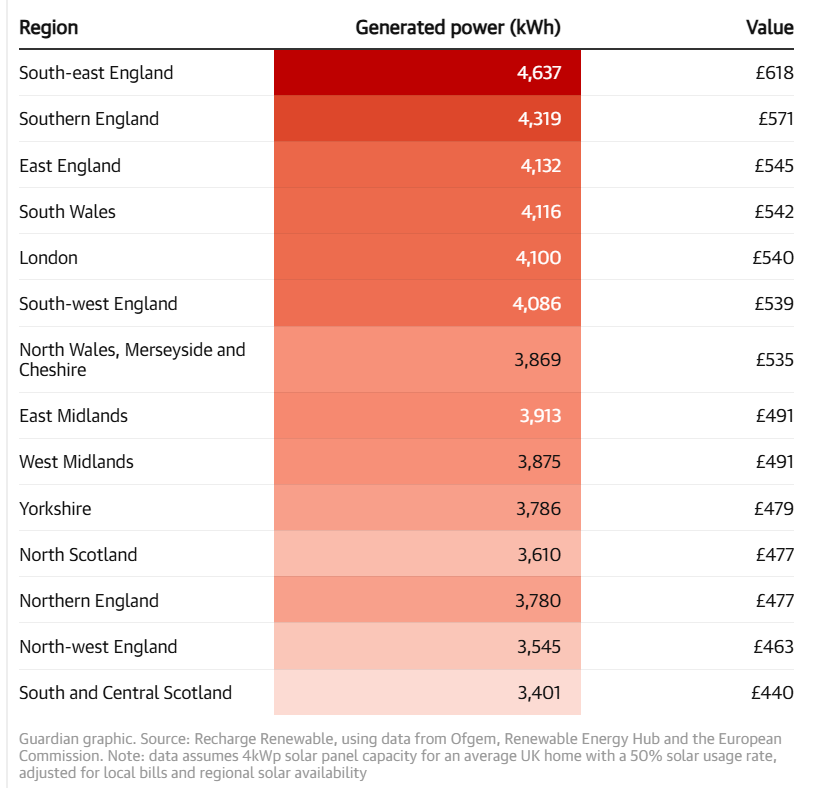
I think this is a good article, looking at potential savings, for a 4kWp south facing system, in different parts of the UK. I'd suggest the size is a bit small these days (as an average), and £7k (for 4kWp) can be beaten, but overall, not bad.
Solar cuts ‘at least £400 from bills in even the cloudiest British areas’
Households in Great Britain’s cloudiest regions could still save more than £400 a year on their energy bills by installing rooftop solar panels, research has found.
Rising wholesale energy prices mean the potential savings from a home solar panel system have climbed in recent years, as the cost of installation has continued to fall, leading to increased demand.
An analysis carried out for the Guardian has found that in areas with the fewest sunny days, solar panels could bring annual savings of about £450 a year on the average household electricity bill. In areas with the brightest skies, this figure could climb to more than £600.
 Mart. Cardiff. 8.72 kWp PV systems (2.12 SSW 4.6 ESE & 2.0 WNW). 28kWh battery storage. Two A2A units for cleaner heating. Two BEV's for cleaner driving.
For general PV advice please see the PV FAQ thread on the Green & Ethical Board.1 -
A couple of thoughts after reading that article:
- While the Energy Saving Trust seems reluctant to drop their £7k indicative price for a 4kWp system, plug-in prices are beginning to show the "true" price of PV. At Octopus's £650 for 800W, for example, 4kW should be closer to £3250.
- Savings of £450-£600 for using half the electricity generated by 4kWp would scale to being £90-120 for a 800Wp plug-in system - or (noting the current discussion on the plug-in thread) maybe £110-£150 if overpanelled to 1kWp.
It's a shame it's now September with only one "good" PV month left in the year.
N. Hampshire, he/him. Octopus Intelligent Go elec / Fuse gas / Vodafone BB / iD mobile. Kirk Hill Co-op member.Economy 7 cap explainer. Gas vs E7 vs peak elec heating costs, Ecoflow Stream, Best kettle :-)
2.72kWp PV facing SSW installed Jan 2012. 11 x 247w panels, 3.6kw inverter. 37 MWh generated, long-term average 2.6 Os.2 -
It got me looking at my savings so far this year. It's difficult to tease out the solar from the battery so I haven't.
I've consumed 3666 kWh since the start of Jan which would have cost £1101 (54.6p/day standing charge, 26.39p/kWh) on the Octopus flat rate tariff but my actual bill after exports is £155 so I've saved £946.
I've generated 3600 kWh, imported almost everything at 8.63p/kWh and exported at 12p/kWh as I'm Octopus Go.
Our monthly consumption has jumped from about 350 kWh to about 750 kWh since I got the EV in June, so I'm expecting the savings to be much bigger from now on.
Solar install June 2022, Bath
4.8 kW array, Growatt SPH5000 inverter, 1x Seplos V3 battery 15.2 kWh, 1x Seplos V4 battery 16.1 kWh.
SSW roof. ~22° pitch, BISF house. 12 x 400W Hyundai panels. Hyundai Kona 64 kWh EV.3 -
I think this comes under solar news. Something that has cropped up in discussions on the G&E board for maybe a decade is the deployment of battery storage at the sub-station level. This would/should/could(?) allow higher export limits for demand side PV. It would also allow the buffering of demand from the transmission network (to the distribution network) to help move more supply side RE at times.
I think this news from Aus, is comparable, at least I'm assuming so.
ARENA marks 100th community battery installed, funds three new projects across Australia
The Australian Renewable Energy Agency (ARENA) has confirmed the installation of the 100th community battery storage system under its Community Batteries Funding Initiative.
The milestone has also seen an additional AU$23.2 million (US$15.1 million) in new funding for three additional projects under Round 2 of the programme.
ARENA is the federal government body tasked with supporting the commercialisation of renewable energy technologies in Australia. The Community Batteries Funding Initiative forms part of the government’s AU$200 million Community Batteries for Household Solar measure, with AU$171 million allocated to ARENA to help test and scale community-scale battery deployment across the country.
Community batteries are typically designed to store surplus rooftop solar generation during the day and discharge it during the evening peak, offering renters, apartment dwellers and other households without their own solar installation a way to access the financial benefits of distributed storage.
Mart. Cardiff. 8.72 kWp PV systems (2.12 SSW 4.6 ESE & 2.0 WNW). 28kWh battery storage. Two A2A units for cleaner heating. Two BEV's for cleaner driving.
For general PV advice please see the PV FAQ thread on the Green & Ethical Board.1 -
I agree it's a great idea, however…
In the UK, local sub-stations are owned and operated by the DNO, and they are prohibited from owning or operating any generating equipment - their remit is for distribution only, not generation and BESS falls under generation.
I am a Forum Ambassador and I support the Forum Team on the Benefits & tax credits, Heat pumps and Green & Ethical MoneySaving forums. If you need any help on those boards, do let me know. Please note that Ambassadors are not moderators. Any post you spot in breach of the Forum Rules should be reported via the report button, or by emailing forumteam@moneysavingexpert.com. All views are my own & not the official line of Money Saving Expert.2 -
Well that's spoilt my day. You could have broken it to me gently Ned. 😉
I wonder if this will change now that distributed storage makes sense, or just lean into storage at the household level instead?
Or could there be an exemption for co-located storage owned and operated by a third party?
Straws and clutching springs to mind.
Mart. Cardiff. 8.72 kWp PV systems (2.12 SSW 4.6 ESE & 2.0 WNW). 28kWh battery storage. Two A2A units for cleaner heating. Two BEV's for cleaner driving.
For general PV advice please see the PV FAQ thread on the Green & Ethical Board.0 -
Considering the noise from the Prime Minister on public ownership on utilities, I would like to see the Government making money available to public sector (especially Hospitals with 24/7 demand) to install batteries. Controlled by say NESO that can decide when to charge/discharge. I would expect that the money spent here would be far better value for the taxpayer against some of the other net zero initiatives. No idea on how good the feasibility of this is.
5.5kWp Solar PV System. South herts, SE facing 12 panels. 6kw inverter, 5 kwh Battery. Apr 2025 install0 -
Indeed, there are lots of potential candidate locations for government funded BESS storage. Hospitals and schools immediately spring to mind. Social housing is another - install solar and BESS on all social/council housing and the occupants benefit by way of reduced bills and the grid benefits by way of reduced (or smoothed) demand.
Unfortunately I've read enough to know I don't understand the problem well enough to know what the solution is, only to know enough that it is a highly complex problem with many moving parts that do not always play well together.
A classic example is co-locating BESS with a solar farm. You'd think this would be a great idea - charge the batteries from excess solar produced during the day and sell it to the grid when it's needed most. But the Grid views both as non-reactive generating capacity, and therefore views it as twice the problem, not a great solution, and both can end up getting taken offline when there are too much renewables on the grid (e.g, see the current issues with Ripple's Derril Water solar farm being taken offline due to grid overload issues - too much non-reactive RE on the grid).
Not dissimilar to how a DNO views you if you have a 5kW solar array and apply to add a 5kW AC-coupled battery system - you now have twice the generation at 10kW in their eyes, and they may refuse permission despite the fact that how you plan to use the system may be beneficial to the grid rather than detrimental (as it has the potential to be detrimental if you decided to export your 5kW battery at the same time your 5kW solar array was at peak generation)
I am a Forum Ambassador and I support the Forum Team on the Benefits & tax credits, Heat pumps and Green & Ethical MoneySaving forums. If you need any help on those boards, do let me know. Please note that Ambassadors are not moderators. Any post you spot in breach of the Forum Rules should be reported via the report button, or by emailing forumteam@moneysavingexpert.com. All views are my own & not the official line of Money Saving Expert.2 -
What about a community substation bess where a group of locals can contribute and then reap the benefits of cheaper peak electricity?
I think....0












Confirm your email address to Create Threads and Reply

Categories
- All Categories
- 355.8K Banking & Borrowing
- 254.9K Reduce Debt & Boost Income
- 456.2K Spending & Discounts
- 248.3K Work, Benefits & Business
- 605.9K Mortgages, Homes & Bills
- 179K Life & Family
- 263.8K Travel & Transport
- 1.5M Hobbies & Leisure
- 16.2K Discuss & Feedback
- 37.7K Read-Only Boards