We’d like to remind Forumites to please avoid political debate on the Forum.
This is to keep it a safe and useful space for MoneySaving discussions. Threads that are – or become – political in nature may be removed in line with the Forum’s rules. Thank you for your understanding.
Debate House Prices
In order to help keep the Forum a useful, safe and friendly place for our users, discussions around non MoneySaving matters are no longer permitted. This includes wider debates about general house prices, the economy and politics. As a result, we have taken the decision to keep this board permanently closed, but it remains viewable for users who may find some useful information in it. Thank you for your understanding.
📨 Have you signed up to the Forum's new Email Digest yet? Get a selection of trending threads sent straight to your inbox daily, weekly or monthly!
The Forum now has a brand new text editor, adding a bunch of handy features to use when creating posts. Read more in our how-to guide
Wikileaks shows peak oil is a reality
Comments
-
Could you show me some factual evidence to support this assumption? If you're going to dispute my figures then you need to back it up.
Well if you knew how to read and interpret your figures you might see my point of view was correct.
http://nextbigfuture.com/2011/04/iea-reports-that-world-oil-supply-rose.htmlSupply includes production of crude oil (including lease condensates), natural gas plant liquids, biofuels, other liquids, and refinery processing gains. World crude oil and liquid fuels consumption grew by an estimated 2.3 million bbl/d in 2010 to a record-high level of 86.7 million bbl/d.
Here's a graph from theoildrum that plots the EIA data referred to on your page. You can see that production of "crude and condensate" (that means "oil") is basically flat in the medium term.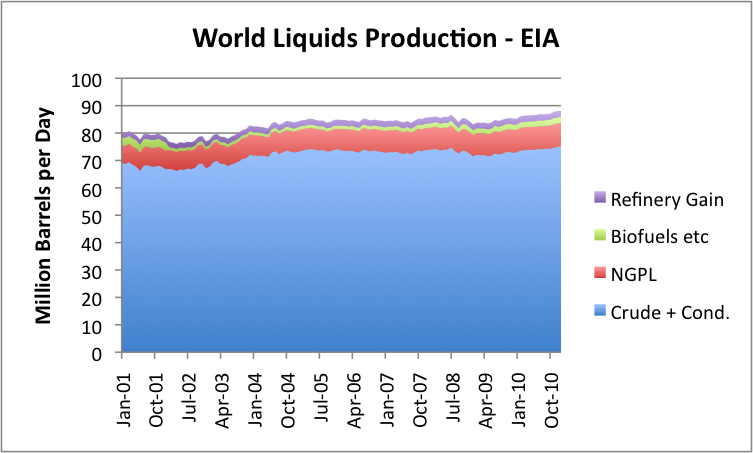
And the IEA report. Search for "peak oil", and you'll find this paragraph:Global oil production [meaning total liquids] reaches 96 mb/d, the balance of 3 mb/d coming from processing gains. Crude oil output reaches an undulating plateau of around 68‐69 mb/d by 2020, but never regains its all‐time peak of 70 mb/d reached in 2006, while production of natural gas liquids (NGLs) and unconventional oil grows strongly.
Given the IEA is predicting production of all liquids to reach 96 mb/d, significantly more than today, perhaps there's no cause for concern. But their previous predictions have proven to be very optimistic and every single one has been revised downward.0




This discussion has been closed.
Confirm your email address to Create Threads and Reply

Categories
- All Categories
- 354.4K Banking & Borrowing
- 254.4K Reduce Debt & Boost Income
- 455.4K Spending & Discounts
- 247.3K Work, Benefits & Business
- 604K Mortgages, Homes & Bills
- 178.4K Life & Family
- 261.5K Travel & Transport
- 1.5M Hobbies & Leisure
- 16K Discuss & Feedback
- 37.7K Read-Only Boards