We’d like to remind Forumites to please avoid political debate on the Forum.
This is to keep it a safe and useful space for MoneySaving discussions. Threads that are – or become – political in nature may be removed in line with the Forum’s rules. Thank you for your understanding.
Debate House Prices
In order to help keep the Forum a useful, safe and friendly place for our users, discussions around non MoneySaving matters are no longer permitted. This includes wider debates about general house prices, the economy and politics. As a result, we have taken the decision to keep this board permanently closed, but it remains viewable for users who may find some useful information in it. Thank you for your understanding.
📨 Have you signed up to the Forum's new Email Digest yet? Get a selection of trending threads sent straight to your inbox daily, weekly or monthly!
The Forum now has a brand new text editor, adding a bunch of handy features to use when creating posts. Read more in our how-to guide
How bad will tax get?
Comments
-
It was bad back then, wasn't it - and you are totally correct in pointing it out.
Here however was what I based my comments on - wrong or right, it is just my opinion.
We know that the Government is hell bent on a borrowing spree, and that the repayment of those borrowings will be through taxation - thus my question - how bad will tax get?
To follow your point about the Wilson Government, here is a graph which shows Public Spending from 1900 to 2011 (it will probably get worse after Darling gets up to speak about the Budget in April)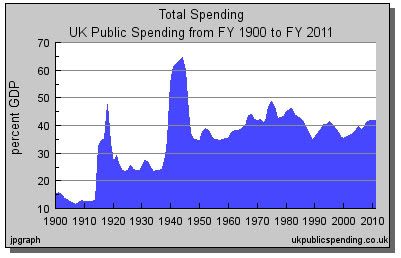
It shows the peak you referred to around Wilson, it also shows the effects of the two world wars - and that we are not at the same levels today as we were at any of those three points - so you are right and I was wrong in how I phrased my comments.
However, and here I am starting in 1966, this is a graph of Public Spending - but also shows the levels of net public borrowings (and yes, in April at the Budget I think this will look worse not better):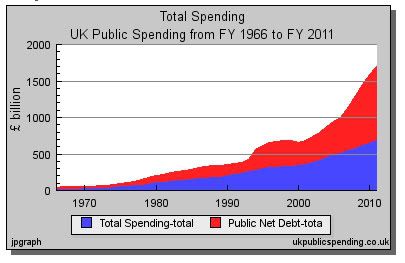
It doesn't look good does it - and interestingly it covers a period of both Conservative and Labour periods in office.
Then how you form an opinion depends on how you see the UK in terms of plus or minus on a load of inter-related factors:
Our growing and ageing population: the levels of personal debt: the reduction in our manufacturing base: the reliance on financial services as a growth factor: our growing dependency on imported fuel: the increase in unemployment: off balance sheet accounting (PFI): etc etc.
I look at these factors and others - and I ask - how bad will tax get?
I am an optimist by nature - but it is hard to be positive that we are in for an easy ride.
*EDIT* The source of those graphs was here:
http://ukpublicspending.co.uk/
Right now they need an "X" Certificate imho ;-)
curious
what public spending really (virtually) zero in 1966?
are these figures adjusted for inflation ?0 -
curious
what public spending really (virtually) zero in 1966?
are these figures adjusted for inflation ?
Answer: No - in both cases.
If you are not familiar with the site from which these graphs are taken , it is worth while visiting, because you can input the "raw" data from which the graphs are established.
For example - 1966 looks like near zero perhaps in the earlier graph, but it wasn't, it is today's levels of public spending in comparison that cause that illusion.Have a look - same chart but starting in 1900: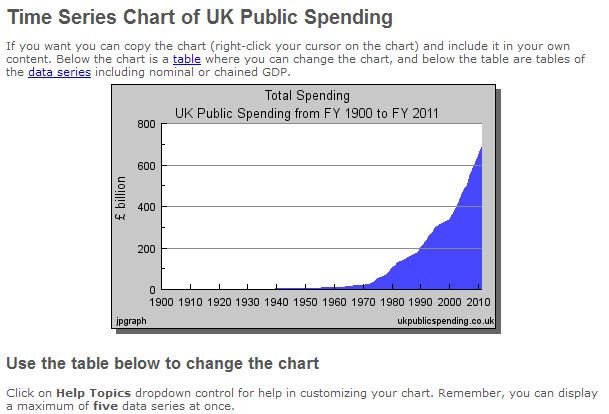 *******************************If you want to see other graphs, or shape how you want the data to look, go to the site - this graph for instance came from here:If many little people, in many little places, do many little things,
they can change the face of the world.
- African proverb -0 -
I have two proposals.
1. A tax on thingy
2. A tax on all foreigners living abroad0 -
PasturesNew wrote: »If only that were the case. If you aren't in a well paid job it's quite likely that those around you who aren't working are a lot better off.
I did some quick calculations the other day that said if I were over 25 and living alone and paid £6/hour and worked just 16 hours/week - after WTC top up I'd be just a couple of quid worse off than if I were working 40 hours - and along with work comes the cost of getting to/from work and so it balanced out pretty much. I'd have an extra 24 hours/week to enjoy myself, catch some sun, shop when food reductions were in the shops etc and have a great life.
All those tax credits shovel money at people... it's a system that was supposed to 'help' some people, but ended up doing the opposite as the system can be "worked"
I'm sure that the system can be worked, however your example is bogus because WTC can only be claimed by a single person over 25 who works for 30 hours or more.
Someone earning £9360 (30 hours per week @ £6 per hour) would get about £16 per week WTC.
I am not sure if this "keeping yourself poor" to make sure you get some benefits really is much of an incentive.
If you really think societys main problems are caused by people working 30 hours a week and getting a small top up then you probably need to get out a bit more.US housing: it's not a bubble
Moneyweek, December 20050 -
From today we will be paying less income tax, we are now in FY 09/10.
I'm getting around an additional £28pm, better than a kick in the teeth 0
0 -
I get just over 40k, doesn't go far as it doesn't make financial sense for the wife to work as she would earn less than the childcare and living in the SE everything is expensive but it is enough for the Chancellor to feel that I can afford to fork out another 347 in National Insurance Tax every year. Of course working in the private sector I have seen no pay rise this year and the value of my pension disappear...I think....0
-
The UK's deficit is about 2.7% more than Chancellor Alistair Darling acknowledged in the pre-Budget report, the Institute for Fiscal Studies says.
The government may have to find £39bn a year by the end of 2015/16, to plug the gap in its finances, the IFS predicted.
To raise the £39bn without raising any taxes, there would need to be a five-year real freeze in total public spending, the IFS says.
Alternatively, if it was raised entirely through tax-raising measures, then families would face an average increase of £1,250 in taxes a year.
Source:
http://news.bbc.co.uk/1/hi/business/7984889.stm
The extent of the UK's budgetary problems are now becoming apparent. Which ever route is taken to rectify the deficit we seem to be in for a stagnated period of growth. As there is also a mountain of consumer debt to be repaid as well.0 -
Personally I think the upper limit on national INS should be abolished why should someone on £50k pay less tax than someone on £40k in % terms0
-
Personally I think the upper limit on national INS should be abolished why should someone on £50k pay less tax than someone on £40k in % terms
Why does %terms matter? It's all about cash-in-hand, or do you think more about spending power in terms of % as well?
Employers consider the additional/reduced tax burdens when setting salaries anyway.0 -
Entirely agree - with the caveat that it should just be quoted as income tax as it is already a total sham that it in some way relates to the unemployment and pension benefits that you might receive.
As posters above have noted however Govts do need to be careful with marginal tax rates as the higher they are the greater are the returns on investment in 'avoidance' and thus we move further down the road of the middle earners paying most of the tax as the top earners avoid paying altogether...Personally I think the upper limit on national INS should be abolished why should someone on £50k pay less tax than someone on £40k in % termsI think....0








This discussion has been closed.
Confirm your email address to Create Threads and Reply

Categories
- All Categories
- 354.1K Banking & Borrowing
- 254.3K Reduce Debt & Boost Income
- 455.3K Spending & Discounts
- 247.1K Work, Benefits & Business
- 603.7K Mortgages, Homes & Bills
- 178.3K Life & Family
- 261.2K Travel & Transport
- 1.5M Hobbies & Leisure
- 16.1K Discuss & Feedback
- 37.7K Read-Only Boards