Ready, steady… save!
You don’t need a chart to join in. Here are 2 ways to record your savings:
1. Cross it off
Pop a chart into your first post. Saved an amount? Cross it out! Read more »
£0.01 £0.02 £0.03
2. Write it down
Skip the chart and add updates to your first post. Read more »
“Another +£3 saved today. Go me!”
Use +£ before each new saving so it counts towards your total.
We’d like to remind Forumites to please avoid political debate on the Forum.
This is to keep it a safe and useful space for MoneySaving discussions. Threads that are – or become – political in nature may be removed in line with the Forum’s rules. Thank you for your understanding.
Capital Gains Tax for a UK non-tax payer


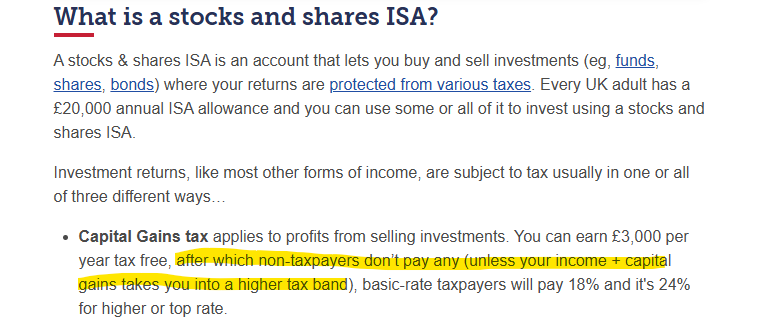
I have found references within MSE and AI on google to the effect that a UK non tax payer would have up to £12,570 total income + capital Gains before having to pay any CGT over and above their £3k personal CG allowance.
i.e. if my pension is £6kpa and my capital gains from selling shares is £4k, both MSE and Google AI say i dont have to pay any CGT on the £1k over my £3k CG allowance because my total income would only be £7k and therefore within the £12,570 income allowance (meaning my tax rate is zero %)
However, in all calculators that i have used, in law firms webpages and on GOV.CO.UK, they show i would have to pay tax at 18%.
which is correct?
Comments
-
Gov.uk is right and if MSE say otherwise they're wrong - which page are you referring to?
1 -
You cannot use the Personal Allowance for capital gains, only the £3,000 Annual Exempt Amount
Income tax and capital gains tax are separate regimes2 -
Yes, not quite sure what they're trying to say there but, as above, income tax allowances can't be used to offset (separate) capital gains tax liabilities.
There is sometimes confusion arising from the fact that CGT is payable at a higher rate if adding gains to income collectively exceeds an income tax threshold, but essentially they are unrelated taxes apart from that…
0 -
thanks, so regardless of whether your total income + capital gains is under your income tax allowance, you would still be taxed at a minimum of 18% which is the basic tax payer rate.
What is confusing is that, if I were a basic income tax payer, and my capital gains were to exceed the limit for basic tax, i would pay split tax on my capital gains (i.e. 18% on tax up to a total income + CG of £50k and then 24% on any remaining capital gains).
but the same doesn't seem to apply to a non-tax payer.
As i understood it, your personal income tax allowance was being referred to merely to ascertain what percentage you should be paying tax on your capital gains.
if income + CG is more than 12.5k but less than 50k then the rate is 18%….if more than 50k then the rate is 24% - but this seems to ignore non tax payers paying at 0%.
If, for example, my pension income was £6.57k and my capital gains was net £7k of my capital gains tax allowance, then (technically) i should be paying only £180 tax (being (6.57+7-12.57) x 18%. but it would appear from the calculators that i am going to have to pay £1,260.00.
doesn't seem "right"….but then we are talking about tax…
0 -
Think of it this way:
Income, whether salary, pension, rent, interest or dividends, has a £12,570 Personal Allowance. Income above that is subject to tax.
Capital gain has a £3,000 Capital Gains Allowance. Capital gain above that is subject to tax.
All income that is subject to tax, and capital gain that is subject to tax, is added together to find a total.
The total under £37,700 is subject to the basic rate; that is 20% for salary and pension, 22% for rent and interest (with the first £1,000 of interest at 0% if your total is under £37,7000, or £500 if over, but not in the additional rate band), 10.75% for dividends, and 18% for capital gain.
Above £37,700, the rates are 40%, 42%, 35.75% and 24% respectively. There are different rates again if you get into the additional rate band.
3 -
basically then, if you have been lucky enough to receive capital gains in excess of your capital gains allowance, the minimum rate will be 18% even if you are a non tax payer.
0 -
Yes, unless you've had the assets wrapped within ISA or pension. Another option is to stage the disposals over multiple tax years so as to limit the gains to your annual exemption each time…
1 -
You are not a non-taxpayer in this context, just as you wouldn't be a non-taxpayer if you received sufficient earnings to use up your personal allowance.
The term non-taxpayer is unhelpful when applied to scenarios where a tax liability exists. You don't have a special status - it is a statement of your current circumstances, which can change.
1









Categories
- All Categories
- 356K Banking & Borrowing
- 255K Reduce Debt & Boost Income
- 456.3K Spending & Discounts
- 248.5K Work, Benefits & Business
- 606.3K Mortgages, Homes & Bills
- 179.1K Life & Family
- 264.1K Travel & Transport
- 1.6M Hobbies & Leisure
- 16.2K Discuss & Feedback
- 37.7K Read-Only Boards