We’d like to remind Forumites to please avoid political debate on the Forum.
This is to keep it a safe and useful space for MoneySaving discussions. Threads that are – or become – political in nature may be removed in line with the Forum’s rules. Thank you for your understanding.
📨 Have you signed up to the Forum's new Email Digest yet? Get a selection of trending threads sent straight to your inbox daily, weekly or monthly!
Lightyear Gilts
Comments
-
Lastly, about documentation - Lightyear only show the price I paid to buy the bond, whereas Freetrade separates the dirty price from the accrued interest. Doesn't make a material difference, but I thought the amount of extra information offered by Freetrade was nice to have.
@fire_in_progress if you are buying in a GIA then accrued interest is a bit more than "nice to have" information. You will need it for your tax return.
0 -
That's correct, of course.
I am speculating that all interest will be listed in the end-of-year statement, which can be used for the tax return.0 -
There isn't a contract note somewhere in the app showing the breakdown? This is basic stuff…
1 -
Yes, I was looking at the trade confirmation note. See below for the relevant snippet.
 0
-
Okay, so that's showing the dirty price. You'll have paid 150 or 151 days accrued interest depending on whether Lightyear settles T+1 or T+2. It's annoying that it isn't broken out, clean + accrued.
I usually submit my tax return on 06/04 so waiting for brokers to get around to telling me things I should've known for certain when I made the trade in an annual tax statement - if it's there… - isn't something I'll put up with. 0
-
I think the problem is the end of year statement will show you the interest you receive but not the accrued interest you paid when you bought (and which you should deduct from the interest received to make sure you pay the right amount of tax). Sometimes it can be a small amount and you may not worry too much about it (eg if you have bought a low coupon gilt) but the coupon on T29 is highish.
2 -
You can calculate the accrued interest yourself, if you know the settlement date. Though I agree it really should be on the contract note.
e.g. if the settlement date is 151 days after the previous coupon payment date, and there are 184 days between the previous coupon payment date and the next one, and the annual coupon is 4%, then the accrued should be:
4% * 1/2 * 151/184 = 1.641304%
(the result is always rounded to 6 decimal places, up or down to the nearest value, and if they're equally near then up)
Then multiply the calculated percentage by the number of units you bought.
1 -
It shows both clean and dirty price.
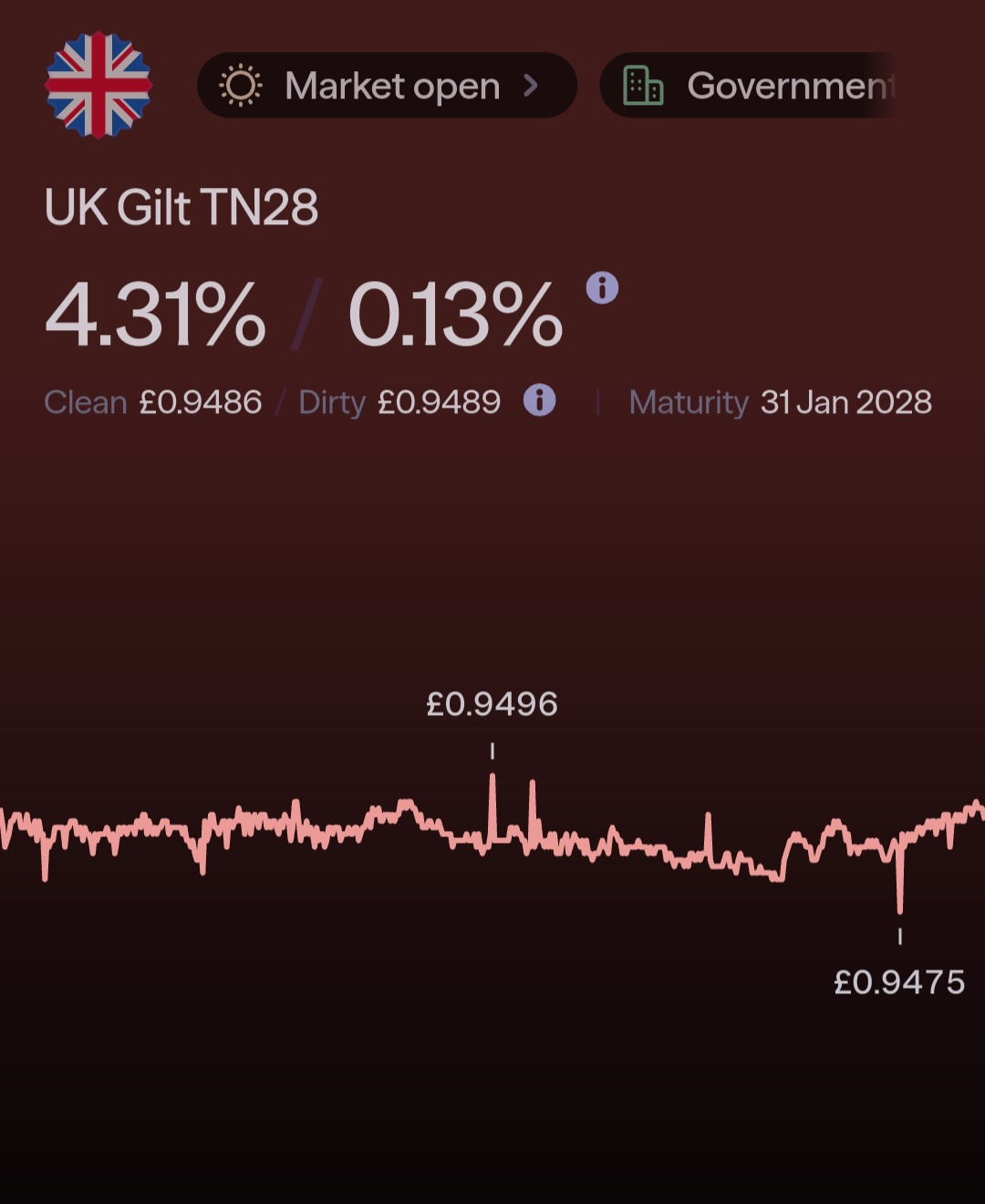
Also if you go into transactions, for each purchase it shows the clean price as well as the dirty price you paid.
They have a lot more info if you look.
1 -
Yes, I see that it's now there in the transaction log, which is extremely useful. Am I losing my marbles or is this a new feature that appeared very recently?
0 -
Sorry, that was incorrect about the rounding. The percentage should be unrounded; and then when you multiply by the number of units bought, you should round to the nearest penny.
See the DMO's classic text, "Formulae for Calculating Gilt Prices from Yields – 4th edition" (at https://www.dmo.gov.uk/publications/gilt-market/formulae-and-examples/ ). 6 decimal places are used in some instances in SECTION TWO: CALCULATION OF DIVIDEND PAYMENTS ON GILTS, but not in SECTION THREE: CALCULATION OF ACCRUED INTEREST.
Not that it will make much difference.
0








Confirm your email address to Create Threads and Reply

Categories
- All Categories
- 355.8K Banking & Borrowing
- 254.9K Reduce Debt & Boost Income
- 456.2K Spending & Discounts
- 248.3K Work, Benefits & Business
- 606K Mortgages, Homes & Bills
- 179K Life & Family
- 263.8K Travel & Transport
- 1.5M Hobbies & Leisure
- 16.2K Discuss & Feedback
- 37.7K Read-Only Boards