We’d like to remind Forumites to please avoid political debate on the Forum.
This is to keep it a safe and useful space for MoneySaving discussions. Threads that are – or become – political in nature may be removed in line with the Forum’s rules. Thank you for your understanding.
Gateway House Piccadilly




Comments
-
I have the exact same claim against me - difference was I remember going in and turning the car around almost immediatley which is backed by the photo evidence showing a momentary stop mid maneuvre. Using the OP's defense + making a few amendments I have come up with the below. For the experienced members here does it look good or are changes needed?
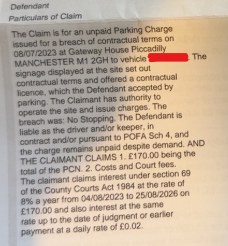
1. The Claimant’s sparse case lacks specificity and does not comply with CPR 16.4, 16PD3 or 16PD7, failing to state all facts necessary for the purpose of formulating a complete cause of action. The added costs/damages are an attempt at double recovery of costs and are not monies shown to have been genuinely owed to, or incurred by, this Claimant. The original Parking Charge ('PC') was £100, yet the Particulars of Claim ('PoC') now describe £170 as being the total of the PCN. The claim therefore includes an artificially enhanced sum which is disputed. Exaggerated claims for impermissible or unexplained sums are good reason for the court to intervene. Whilst the Defendant reserves the right to respond further if details of the alleged contract are provided, the court is invited to strike out the claim using its powers under CPR 3.4.
2. The allegation(s) and heads of cost are vague and liability is denied for the sum claimed, or at all. At the very least, interest should be disallowed or reduced; the substantial delay in bringing proceedings lies with the Claimant. This also makes retrieving material documents, evidence and recollection of incidental details considerably more difficult, which is prejudicial to the Defendant. The Defendant seeks fixed costs pursuant to CPR 27.14 and reserves the right to seek further costs in the event of unreasonable conduct. The Defendant admits that he was the registered keeper and driver of the vehicle on the material date.
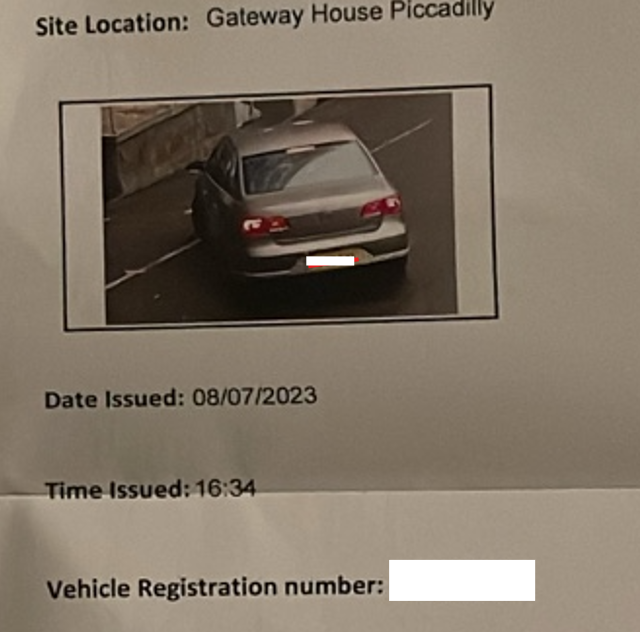
3. The Defendant recalls that the vehicle was being turned around in order to leave the roadway. It is denied that the vehicle was parked or that the single photograph relied upon establishes a voluntary stop in breach of any contractual term. The Claimant's own photograph shows the vehicle positioned at an angle across the roadway, consistent with the Defendant's recollection that the vehicle was captured during a manoeuvre.
Braking and, where necessary, momentarily bringing a vehicle to rest are ordinary and necessary components of safely executing a turning manoeuvre. The Defendant does not now recall every incidental detail of an unremarkable event more than three years ago and does not seek to speculate. The Claimant, who chose to preserve and rely upon surveillance evidence, is put to strict proof by production of the complete contemporaneous photographic and/or video sequence and all associated timestamps, rather than a single selected still.
4. Further, the Defendant believes that the location forms part of, or is connected with, the Manchester Piccadilly railway station estate and was subject to statutory control and/or Railway Byelaws at the material date. If so, it was not classed as 'relevant land' for the purposes of Schedule 4 of the Protection of Freedoms Act 2012 ('POFA') in July 2023.
The Claimant's PoC expressly pleads liability pursuant to POFA Schedule 4. The Claimant is therefore put to strict proof that the precise roadway on which the vehicle was photographed was 'relevant land' for POFA purposes on 8 July 2023, including production of the applicable land boundary, ownership/occupation evidence and any material relied upon to establish that Railway Byelaws or other statutory control did not apply.
The Defendant accepts that he was the driver and therefore does not artificially seek to rely upon an inability to identify the driver. However, insofar as the Claimant expressly relies upon POFA as an alternative basis of liability, that statutory case must be properly made out. The PoC cannot simply cite POFA while leaving the status of the land unproven.
5. The PoC are materially misleading insofar as they rely upon statutory keeper liability without properly pleading or establishing the statutory prerequisites, whilst simultaneously pursuing an artificially enhanced £170 sum. Further, the claim includes disputed additional 'damages' and pre-loaded interest.
Section 69 of the County Courts Act 1984 confers a discretionary power upon the court to award simple interest. The PoC nevertheless assume interest at 8% on the enhanced £170 quantum. The Defendant denies that interest may properly be recovered on a disputed and unexplained additional £70 and invites the court to take account of the Claimant's considerable delay in commencing proceedings. Permitting a claimant to delay proceedings and then obtain additional interest upon an artificially enhanced sum would result in unjust enrichment. The Defendant avers that this aspect of the pleading amounts to an abuse of the court process.
6. It is denied that a term was breached. To form a contract, there must be an offer, acceptance and valuable consideration. The Consumer Rights Act 2015 ('CRA') at s71 mandates a test of fairness by the court and sets a high bar for the transparency and prominence of consumer terms and notices. Paying regard to Schedule 2, s62 and the duties of fair and open dealing/good faith, the Defendant disputes that the Claimant has established that the terms relied upon were sufficiently clear, prominent or fairly communicated. The Claimant is put to strict proof with contemporaneous photographs of the signage as it appeared on 8 July 2023.
Further and in any event, even if a contractual 'No Stopping' term existed, it is denied that the Defendant breached that term merely because the vehicle may have become momentarily stationary as an inherent part of turning around to leave.
The Defendant relies upon the reasoning in Vehicle Control Services Ltd v Ozog [2026] EWCC 12, in which the court rejected the proposition that every physical occasion upon which a vehicle becomes stationary necessarily amounts to a contractual breach of a 'No Stopping' term. The reason and circumstances for the stationary position matter. The Defendant's case is that any momentary stationary position occurred whilst executing a turning manoeuvre in order to leave.
7. DVLA keeper data is only supplied on the basis of appropriate landowner authority. The Claimant, an agent rather than the landowner, is put to strict proof of its standing to sue and of the terms, scope and dates of the landowner agreement, including the contract, updates, schedules and a map of the site boundary set by the landowner, rather than an unverified Google Maps image.
This is particularly important given the Defendant's contention regarding the railway station estate and statutory control. The Claimant is put to strict proof that its authority extended to the precise area where the vehicle was photographed, to the specific alleged 'No Stopping' conduct, and to commencing proceedings in its own name.
8. To impose a PC, as well as establishing a breach, there must be: (i) a legitimate interest extending beyond compensation for loss; and (ii) adequate notice and prominence of the PC and any relevant obligation(s). Neither has been demonstrated.
This PC is fully distinguished from ParkingEye Ltd v Beavis [2015] UKSC 67. That case concerned prominent contractual signage and a motorist who remained parked in a retail car park beyond a permitted period. Here, the Defendant recalls entering the roadway and turning the vehicle around in order to leave. The Claimant's own photograph shows the vehicle angled across the roadway and is consistent with that account.
The Claimant is put to strict proof that a driver entering this roadway had a fair and reasonable opportunity to see, read and comprehend the alleged contractual terms and £100 charge before the conduct now alleged to constitute acceptance and breach occurred.
9. Attention is drawn to paras 98, 100, 193 and 198 of ParkingEye Ltd v Beavis [2015] UKSC 67, and also to ParkingEye Ltd v Somerfield Stores Ltd [2011] EWHC 4023 (QB).
In Somerfield, HHJ Hegarty considered additional administrative sums which increased an underlying parking charge and concluded that the enhanced amount appeared penal in the circumstances. The Defendant avers that the same underlying concern arises here: the Claimant's own PCN identified a £100 parking charge, yet the PoC now state that £170 is 'the total of the PCN'.
The Claimant cannot simply relabel an additional debt recovery or administrative sum as part of the original PCN. It is put to strict proof of the contractual and legal basis upon which the extra £70 is recoverable.
10. The Parking (Code of Practice) Act and subsequent Government work have specifically addressed conduct by private parking operators and debt recovery agents ('DRAs'), including concerns regarding additional debt recovery charges and excessive profit. The Defendant relies upon this material as context supporting careful scrutiny of the additional £70, rather than suggesting that Government policy itself disposes of this claim.
The Claimant must prove that the additional £70 formed part of an enforceable obligation, was fairly and prominently communicated before any alleged contract was entered into, and represents a sum lawfully recoverable from this Defendant.
11. Pursuant to Schedule 4 of POFA, insofar as the Claimant seeks to rely upon statutory keeper liability, recovery is subject to the statutory conditions and limitations. At the material date, land on which parking was subject to statutory control, including railway land subject to applicable Railway Byelaws, was excluded from the definition of relevant land. The 2025 amendment which subsequently brought railway byelaw land within the relevant-land regime did not apply in July 2023.
Accordingly, the Claimant is put to strict proof that the precise land was relevant land and that all requirements relied upon under Schedule 4 were met. Further, POFA does not itself create an entitlement to arbitrary debt recovery fees. Any attempt to recover the additional £70 must have a separate lawful and contractual basis.
12. The Defendant also draws attention to an apparent internal inconsistency in the Claimant's PoC. The Claimant pleads that signage offered contractual terms and a contractual licence which the Defendant 'accepted by parking', whilst simultaneously identifying the alleged breach as 'No Stopping'.
The Defendant denies that he parked. Where an agreement is alleged to have arisen through conduct, Practice Direction 16 paragraph 7.5 requires the conduct relied upon to be specified, including by whom, when and where the relevant acts occurred. The Claimant is therefore put to strict proof of precisely what conduct allegedly constituted acceptance of the alleged contract and what distinct conduct subsequently constituted breach.
13. This claim arose from a single image showing a vehicle momentarily positioned at an angle during what the Defendant recalls was a turning manoeuvre. The Claimant has allowed more than three years to pass and now seeks £277.32 arising from an original £100 PCN.
The Defendant avers that the Claimant must prove, rather than merely assert:
(a) that an enforceable contract was formed;
(b) that adequate notice of the relevant terms was given;
(c) that a voluntary contractual 'stop', rather than a momentary part of a manoeuvre, occurred;
(d) that UKCPS had authority over the precise land;
(e) that the land was relevant land insofar as POFA is relied upon;
(f) that the additional £70 is contractually and legally recoverable; and
(g) that interest is properly payable upon the sums claimed.The Defendant denies that the Claimant has established any entitlement to the sum claimed.
14. The Defendant submits that the artificially enhanced claim and vague PoC have unnecessarily consumed court resources. If the Claimant possessed evidence establishing a genuine prohibited stop, it was and remains in a position to disclose the complete timestamped sequence rather than relying upon a single still image.
The Defendant reserves the right to seek costs pursuant to CPR 27.14, including further costs under CPR 27.14(2)(g) should the court find that the Claimant has behaved unreasonably.
15. For the reasons above, the Defendant denies that any sum is due and respectfully invites the court to dismiss the claim.
1 -
Looks good. Will be discontinued in due course.
2 -
But it needs to be on your own thread, otherwise it can become confusing.
4 -
we've split this into a new thread
Official MSE Forum Team member. Please use the 'report' button to alert us to problem posts, or email forumteam@moneysavingexpert.com4 -
Does the Claimant already know who the driver was?
2 -
That image isn't your car; it's the one from the other thread you posted on.
Please show us the pic they took of your vehicle (cover the VRM). Were you also merely turning round?
PRIVATE 'PCN'? DON'T PAY BUT DON'T IGNORE IT (except N.Ireland).
CLICK at the top or bottom of any page where it says:
Home»Motoring»Parking Tickets Fines & Parking - read the NEWBIES THREAD1 -
If the driver is not known by the Claimant then the defendant should not provide that information - do not admit who was driving.
There is no Keeper liability at this location.
3









Confirm your email address to Create Threads and Reply

Categories
- All Categories
- 355.7K Banking & Borrowing
- 254.9K Reduce Debt & Boost Income
- 456.1K Spending & Discounts
- 248.3K Work, Benefits & Business
- 605.9K Mortgages, Homes & Bills
- 179K Life & Family
- 263.7K Travel & Transport
- 1.5M Hobbies & Leisure
- 16.2K Discuss & Feedback
- 37.7K Read-Only Boards