We’d like to remind Forumites to please avoid political debate on the Forum.
This is to keep it a safe and useful space for MoneySaving discussions. Threads that are – or become – political in nature may be removed in line with the Forum’s rules. Thank you for your understanding.
Investing in bonds?
Comments
-
In my view each investment should be justified by an objective.
That might sound an obvious statement but it's very useful. It got me to work through the objectives of each of my nine bonds/bond funds and I can justify each one. For anyone who buys on the basis of "I don't have any of that one yet", it's fine to have gaps, eg I have no long dated bonds, less than a quarter are intermediate duration, and I know why. I got ChatGPT to assess my portfolio and it called it "a well-thought-out medium-risk retirement portfolio with clearly articulated investment beliefs". Don't you hate sycophants!
0 -
I got ChatGPT to assess my portfolio and it called it "a well-thought-out medium-risk retirement portfolio with clearly articulated investment beliefs".
You must be in deep trouble!
2 -
From my experience,
mostevery time.0 -
Don't you hate sycophants!
Distracting you whilst it harvests your online banking usernames and passwords?
0 -
Thank you for these thoughts.
I had not realised that corporate bonds no longer carry a 'risk premium': I wonder how long that situation will continue. I shall exclude them from consideration.
I don't have any particular investment goal or fixed time when I will need the money, and I have realised that the fear of future losses matters more to me than the hope of future gains, which ought to be the trigger for de-risking.
My plan is not to hold bonds to maturity, but to buy cheap and sell dear, so my main interest is in longer-maturity paper.0 -
Corporate bonds do carry a risk premium - the point is that it's currently relatively narrow. But, unlike equities, the majority of actively managed funds outperform the index funds - whose main holdings, by definition, are the most indebted companies - so you could see whether you like the strategies + historic performance of active funds. For example, I hold Royal London Short Duration Credit and Man Sterling Corporate Bond.
For buying low and selling high long-dated gilts... I wonder whether anyone else ever had that idea and if anything went wrong, eg 50% losses in 2022. You are taking a gamble on interest rates falling, and gambling doesn't align with your objective of not losing money.
1 -
But, unlike equities, the majority of actively managed funds outperform the index funds - whose main holdings, by definition, are the most indebted companies - so you could see whether you like the strategies + historic performance of active funds.
The index funds return the average performance minus costs. If the market weighted average performance of all the active funds outperforms the index after allowing for survivor bias, there must be another class of bond investor that underperforms the average. Who are these investors? You appear to be saying that they are the bond investors who underweight the "most indebted companies" (which may not have the largest debts relative to their ability to pay them off). Is there reliable evidence that these bonds consistently underperform?
0 -
One reason why corporate bond index funds tend to provide lower returns than active funds is that they invest in very safe bonds. Investing successfully in higher risk high return bonds requires research on the finances of the issuing company.
A second important factor is that many corporate bonds are very illiquid. They are generally bought when issued or bought directly from the initial purchaser, perhaps a bank, and then held to maturity. There is no meaningful market after the initial sale. In those circumstances published valuations are calculated by accountants, they are not the result of large numbers of real transactions. Hence it is difficult to see how the rationale behind equity index funds would apply.3 -
One reason why corporate bond index funds tend to provide lower returns than active funds is that they invest in very safe bonds. Investing successfully in higher risk high return bonds requires research on the finances of the issuing company.
Good point. Index funds average A- while actively managed non-high yield funds probably average BBB+/BBB. But the yield difference between A- and BBB is surprisingly small and I don't think accounts for the difference in performance (Trustnet is not loading right now so I can't check this); according to a generally unreliable source (I think you know what I mean):
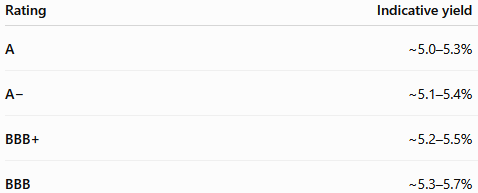
There is more potential to successfully run actively managed bond funds than equity funds. Bonds come down to a binary question: will the company be able to repay its loan? If you can quantify that, you can assess whether a bond's price is undervalued.
EDIT. However, the higher yield of BBB over A- reflects a risk premium. After defaults, A- and BBB should provide about the same return. Hence the difference seems to be down the active management, which generally focuses on the lower quality end of investment grade. You might reply that that thesis could apply in a low default environment but in a high default environment the A-/index funds would win out?
0 -
A typical bond tracker that the OP might like to consider is VAGS:
Vanguard LifeStrategy invests heavily in the OEIC version of this fund. It tracks the Bloomberg Global Aggregate Float Adjusted and Scaled Index. The bonds that it holds are nearly all of investment quality and highly liquid. The average duration is 6 years. If a fund invests in illiquid junk bonds, it has a good prospect of delivering a higher return, provided things go well. If you are using bonds to reduce risk, that is not what you want.
1










Confirm your email address to Create Threads and Reply

Categories
- All Categories
- 355.7K Banking & Borrowing
- 254.9K Reduce Debt & Boost Income
- 456.1K Spending & Discounts
- 248.3K Work, Benefits & Business
- 605.9K Mortgages, Homes & Bills
- 179K Life & Family
- 263.7K Travel & Transport
- 1.5M Hobbies & Leisure
- 16.2K Discuss & Feedback
- 37.7K Read-Only Boards