We’d like to remind Forumites to please avoid political debate on the Forum.
This is to keep it a safe and useful space for MoneySaving discussions. Threads that are – or become – political in nature may be removed in line with the Forum’s rules. Thank you for your understanding.
📨 Have you signed up to the Forum's new Email Digest yet? Get a selection of trending threads sent straight to your inbox daily, weekly or monthly!
Investing SAAS Loan into S&P 500
Comments
-
In my previous comment I'm not saying that I'm going to deliberately sabotage my career for cheap payments, I'm just making a point that the interest doesn't affect the size of the payments I make every month.
0 -
"I do understand a it's a large risk but I do plan on leaving this alone for longer than 10 years, ideally it's for a property when I retire"
So the plan is to buy a property when you retire, which no doubt will be more than 10 years from now.
I would recommend getting your career established, and then start building towards property ownership.
Where would the property potentially be, and how much would a suitable property likely cost at that point in the future?Is the plan to live at home, or in rental accommodation in the meantime?
If you’re intending to own property you could benefit from opening a lifetime ISA (LISA) either cash or stocks to benefit from the tax advantages.
If you’re successful in your future career, the perceived investment gains you’re anticipating from this scheme, will pale into insignificance, compared to the returns you would achieve from maximising contributions to a workplace pension and/or private pension.
You’re contemplating putting yourself in debt when, as you said you don’t need the loan. There could be comparatively little investment return, for a fair amount of risk, considering the possible effects that current world instability might have on the market overall.
Borrowing money to invest is risky at the best of times, and I would say that right now is not, the best of times.
0 -
The interest doesn't affect the size of the payments, but it does affect the length of time you will have to pay them and the total you will repay - unless you earn little enough not to repay in full.
The median UK salary is about £39k, so that is £5,205 above the Plan 4 threshold.
Crudely, £5,205 x 40 x 9% = £18,700
So, if you follow the trajectory of a typical person, earning less than median wage to begin with, but rising above it later in your career, then you can expect to repay at least this much. I've not even made allowances for wage inflation uplifting your monthly payments. That could more than double the nominal amount paid over 30 years.
Edit: here is a properly calculated example, showing salary starting lowish and growing over the first 20 years, and falling back in late career, assuming 2.5% inflation and that the repayment threshold isn't raised with inflation.
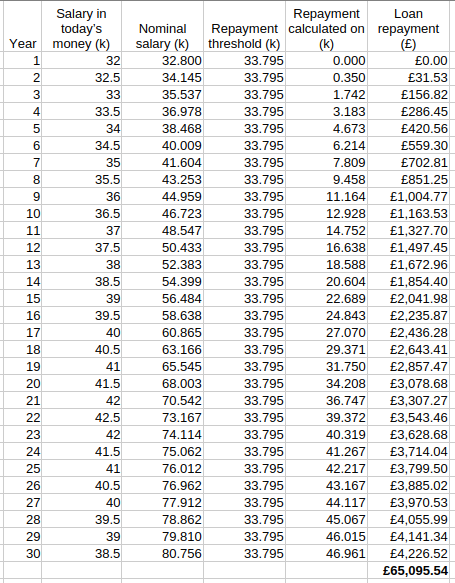
So, as the interest compounds in your loan account, your repayment increases. Probably by a lot more than the interest being added. Even borrowing £34k over a 4 year course, you'd need a lowish income for it not to be repaid in full.
0 -
Regarding your other assumption (7% return), you might find the following helpful:
This has US equities predicted to return 4.2-6.2% per year over a 10 year horizon.
Even at that level you could make money, but it is lower than your assumption. Today you can buy a 10 year gilt that returns 5.4%, or a 10 year index linked gilt that yields RPI+2% - removing much of the risk.
0 -
I'm struggling to see the downside risk. Student loans are designed to create a higher marginal tax rate, they're not loans in any real sense. And the risk self balances, i.e. if you lose your job and your salary you don't pay, so you don't have to liquidate the investments to repay. The "debt" gets cancelled if not paid, so you can let it accumulate without much effect except on take home during working life, which has a knock on on affordability checks.
It is of course possible, and even likely, we'll see an equity slump in the near future, but as you don't need to liquidate investments to cover the student loan repayments you can ride things out. The risk of being completely wiped out in an aggregated fund is fairly low outside of war or pestilence level catastrophic events. I guess you'd be doing this inside an ISA wrapper?
I suppose one downside is that significant savings and investments make you ineligible for some benefits such as universal credit if you needed them. I think I'd rather be in possession of savings and lose benefits in a situation such as illness or longer term unemployment, but it's worth factoring in to considerations.
0 -
I think it is very likely to make money over the long term, but I would challenge whether it is the best use of the capital to make a long term investment in a single country equity index.
If in 3-4 years, OP is renting and saving for a deposit, for example. It might take them a few more years to be in a position to buy their first home, but if this capital is to be used for that purpose then they'll be well advised not to remain invested in the S&P500 in the lead up.
I suppose we recently had the prospect raised of adult children opting to live with their parents for a number of years while investing to maximise their wealth, so that is an option I suppose.
0 -
I don't necessarily disagree with you however there are more things that someone should take into account before doing this.
In the OP's favour is that it's a Plan 4 loan with a repayment term of thirty years rather than a Plan 5 loan with a repayment term of 40 years. Over that period it is highly likely the returns on investing the money would outstrip the repayments made, but there are no guarantees and in certain scenarios the opposite would be true.
Student loan repayments are taken into account in any affordability assessment for credit which may reduce the amount of credit offered, in the case of a mortgage applicaton it will definitely reduce the amount of a mortgage offer.
Additionally, life can throw curve balls. Whilst someone might have a plan for what they will be doing going forward sometimes things out of their control derails that plan. Whilst eligibility for means tested benefits should not influence someone's plans they should be aware what would happen if life decided to throw a curveball their way.
0












Confirm your email address to Create Threads and Reply

Categories
- All Categories
- 355.8K Banking & Borrowing
- 254.9K Reduce Debt & Boost Income
- 456.2K Spending & Discounts
- 248.3K Work, Benefits & Business
- 605.9K Mortgages, Homes & Bills
- 179K Life & Family
- 263.7K Travel & Transport
- 1.5M Hobbies & Leisure
- 16.2K Discuss & Feedback
- 37.7K Read-Only Boards