We’d like to remind Forumites to please avoid political debate on the Forum.
This is to keep it a safe and useful space for MoneySaving discussions. Threads that are – or become – political in nature may be removed in line with the Forum’s rules. Thank you for your understanding.
Advice on this wiring.




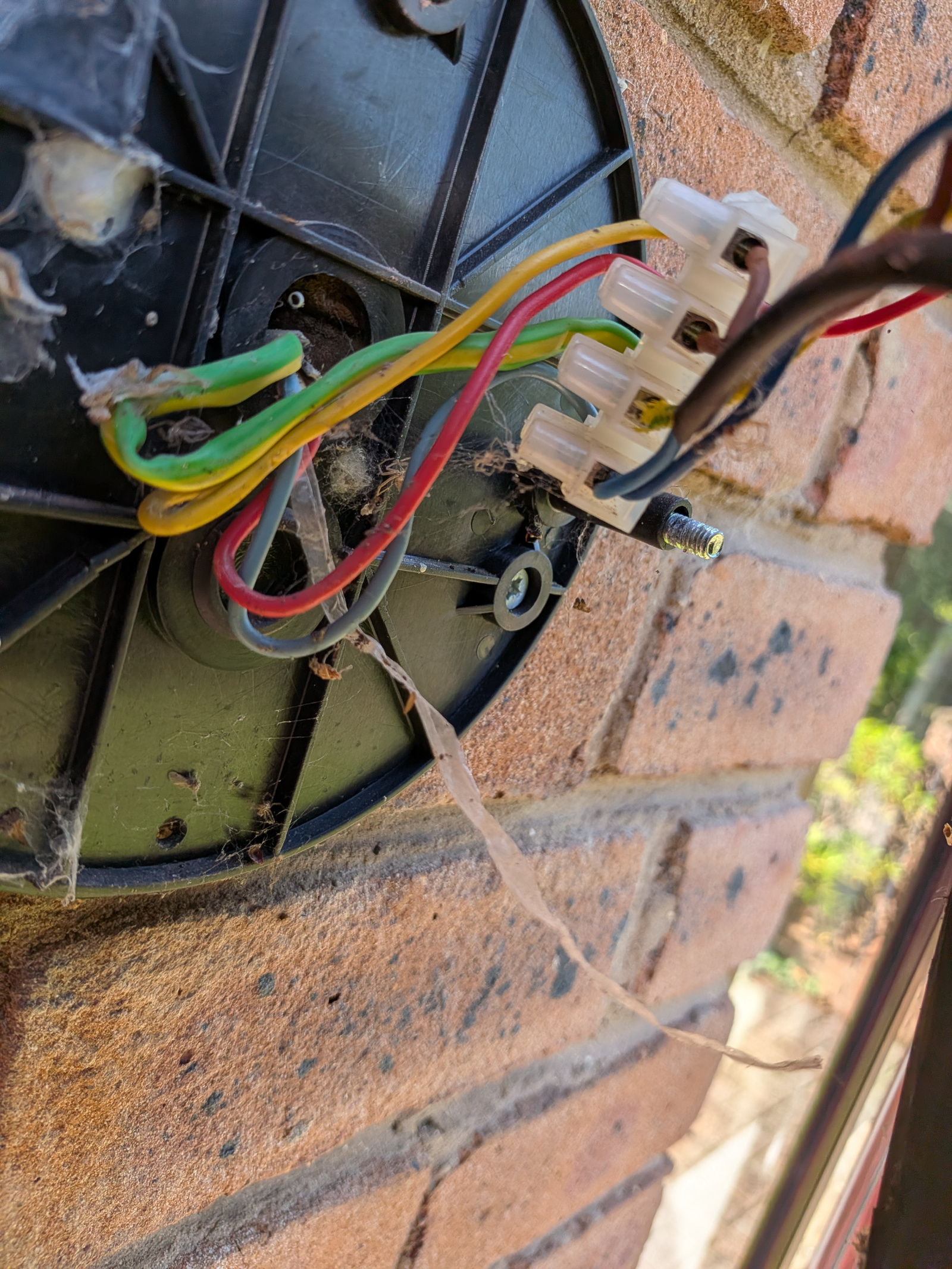
I was planning to remove my outside light and install a light & camera unit. It looked really easy online but I took the light down and I have four cables coming out of my wall, not three.
Can anyone let me know what the extra cable is for and which are live and neutral?
I should probably get an electrician but I can normally manage my own basic wiring but this is something I haven't seen.
Comments
-
I think it can be figured out from that pic, but that wouldn't be sensible. (The 'extra' supply wire will likely be a permanent live to power the PIR, and the other a switched - override - wire to turn the light on manually).
Could you examine that mounting plate, and the inside of the light fitting, to find what the terminal strip connections are, please - most likely it'll be embossed on there somewhere. Also a clearer pic to show the light fitting wire colours. And finally the make of fitting, along with a pic, please.
And trace that supply cable in your house/garage - where is the light switch for that PIR?
0 -
I think it can be figured out from that pic, but that wouldn't be sensible. (The 'extra' supply wire will likely be a permanent live to power the PIR, and the other a switched - override - wire to turn the light on manually).
That would make sense, but unless I'm mistaken someone has put a link (using a brown wire) between the terminal strip connectors for the red and yellow 'supply' wires - which is an odd thing to do as it means both will now be switched or permanent 'lives'. It also possibly creates a dangerous situation if what was meant to be a switched live is now permanently energised from the opposite end to what you'd expect. I would want to know in particular how the other end of the yellow cable is terminated.
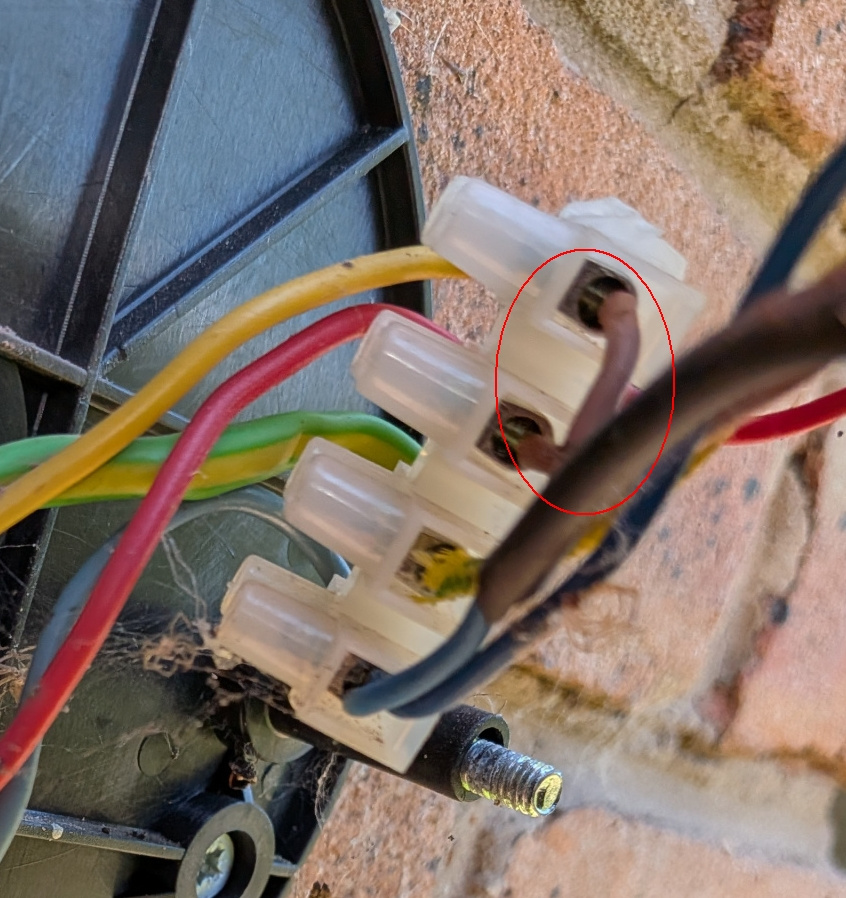
There also appears to be brown sleeving on one of the blue wires, which you might expect to be a neutral if this is a PIR setup. It has the appearance of being done by someone with a bit of electrical knowledge, but not enough to do the job properly.
To be safe, this is one for a qualified electrician to check out.
1 -
Hi
Colours as follows: earth - yellow and green; neutral - blue; red - permanent live and yellow - switched live. If you connect the red and yellow together then that overrides the indoor switch as the light is now permanently powered. I'm guessing that the indoor switch has no effect on the light and it's always 'on' (when PIR activated)?
Assuming that your new light has only L,N,E then Blue to N, Green/Yellow to E and Yellow to L and cap off (a Wago block) the red. Don't just tape it up - it's naff.
It will now operate as a PIR light but you can switch it off completely using the indoor switch.
3 -
I’m not sure that is a bridging wire. Hard to tell from the photo but it looks more like two separate cables on that side (presumably the supply side) as there are two blues (one sleeved) in the end terminal.
A better picture would help.
1 -
I’m not sure that is a bridging wire. Hard to tell from the photo but it looks more like two separate cables on that side (presumably the supply
side) as there are two blues (one sleeved) in the end terminal.Zooming in closer you could be right - there is a slight difference in colour between the ends of the 'link'. Also both ends appear to have some kind of crimp ferrule, which tends to suggest against it being a DIY link.
1 -
Colours as follows: earth - yellow and green; neutral - blue; red - permanent live and yellow - switched live.
OP - bear in mind unless jimi_man installed the light, or popped round today with test gear to check it, then the colours and function listed there are just one of the ways it could be wired up.
None of us can say for sure just by looking at pictures.
Also, unless you are sure what the wires do, connecting them together can be dangerous and/or cause damage.
3 -
Indeed, but I did go off the colours that are coming out of the wall and it's a standard colour scheme for outside lights (from a few years ago obviously as the colours have changed since).
What's going out of the choc box to the light is another matter entirely but I purposely haven't commented on that and isn't really relevant as the new light may have different wiring. People do wiring in different ways but that's up to them, however the basic colours are set. Once you know what the wires coming out of the wall do then that's the key and one can wire up the new light accordingly. The OP is happy doing his own wiring up and was just asking what the colours are.
Outside lights are always more confusing as they are usually 3 core and earth instead of T&E but once you understand what the extra wire does it's not really any different.
0 -
The point is there is no 'set' way of using the colours in old wiring. Yellow didn't mean 'switched live' - if it had a meaning it was usually one of the phases (along with blue and red) in 3-phase wiring. Unlikely the OP's light is 3-phase though.
And sometimes a yellow was used for earthing. (3-core cables with no 'bare' cpc can be found in some homes)
There's also a more fundamental issue that at times when red/blue/yellow cable was in use for domestic installations it wasn't unusual for lighting to be done with a switched neutral rather than switched live. So the assumption the yellow is a switched live is dangerous if it were actually in use as a switched neutral - especially if the OP does as you suggested and connect what might be the permanent live (red) to what could be a switched neutral.
It is never a good idea to assume someone else has followed any kind of colour convention, especially in older installations.
The answer to the OP's question is we could guess what the wires do based on colour, but none of us can know. And guessing when it comes to electrics can be very dangerous.
0 -
Definitely one for an electrician IMO.
I’m quite happy to replace items like for like or do small jobs like adding a spur in a bedroom, but as soon as you find something that you’re not quite sure of you should get a professional in. As @Section62 says, never assume someone else has wired it correctly.
I was replacing some old manky looking metal switches in my son’s house when I found that whoever wired the two way switch in the hall had used twin core instead of three core and was using the bare earth wire as the switched live. It was sleeved in green and yellow too!
1 -
If H143 provides the additional info requested, and if he has some form of reliable tester tobesure, we can almost certainly confirm what the supply wires are. He was seemingly - understandably - thrown by the unusual colours, and the extra wire, that's all.
Of course, only he can confirm his level of practical competence, tho' he says he can do 'basic wiring' which I presume means swapping sockets and switches, that sort of stuff. This is more fiddly as it needs to be mounted on a wall, but is not in itself much more electrically complex.
1




Confirm your email address to Create Threads and Reply

Categories
- All Categories
- 355.8K Banking & Borrowing
- 254.9K Reduce Debt & Boost Income
- 456.1K Spending & Discounts
- 248.3K Work, Benefits & Business
- 605.9K Mortgages, Homes & Bills
- 179K Life & Family
- 263.7K Travel & Transport
- 1.5M Hobbies & Leisure
- 16.2K Discuss & Feedback
- 37.7K Read-Only Boards