We’d like to remind Forumites to please avoid political debate on the Forum.
This is to keep it a safe and useful space for MoneySaving discussions. Threads that are – or become – political in nature may be removed in line with the Forum’s rules. Thank you for your understanding.
IMPORTANT: Please make sure your posts do not contain any personally identifiable information (both your own and that of others). When uploading images, please take care that you have redacted all personal information including number plates, reference numbers and QR codes (which may reveal vehicle information when scanned).
📨 Have you signed up to the Forum's new Email Digest yet? Get a selection of trending threads sent straight to your inbox daily, weekly or monthly!
King Crude Supreme Court Judgement 2025




I've been doing some reading, always dangerous, and wondered if any thought has been given to King Crude Carriers SA v Ridgebury November LLC [2025] UKSC 39 from last November. It's a commercial shipping case about ship sale deposits, so nothing to do with parking on its face, but the point decided is general contract law about when a conditional debt accrues.
On the face of it there's probably nothing especially novel here, but it looks like it would prevent some readings into the contract that generally favour the PPCs, i.e. it constrains the judge's discretion. The Supreme Court held, unanimously, that a conditional debt only accrues if the conditions are actually met on the words as written. The court can't treat an unmet condition as met, can't imply extra requirements in unless strictly necessary, and can't fill gaps by pointing at what the scheme was obviously trying to achieve.
A general defence statement might be something like this:
The parking charge as described on the Claimant's signage is a sum payable only upon the occurrence of specified events, and is therefore a conditional debt. Following King Crude Carriers SA and others v Ridgebury November LLC and others [2025] UKSC 39, a conditional debt accrues only upon the actual satisfaction of each condition precedent, applied according to its terms as written: there is no principle of English law by which an unsatisfied condition may be deemed or treated as fulfilled, the conditions cannot be enlarged or supplemented by implication save where the strict test of necessity is met, and no appeal to the purpose of the scheme or to the alleged conduct of the Defendant can create a debt that has not accrued under the contract's own terms. The Claimant is accordingly put to strict proof, by evidence and not assertion, that each condition precedent to the charge becoming payable was satisfied as a fact. Insofar as the claim is instead advanced as damages for breach of contract, the Claimant is put to proof of the breach, of loss suffered by it, and of mitigation.
Notably the court also held that the maxim about not benefiting from your own wrong can't create a debt by itself: if the condition stated on the sign didn't actually occur, the operator can't get there by arguing the motorist's own error or omission should count as if it had.
This wouldn't apply in all cases since it adds nothing where the breach plainly happened on the signage terms, such as a genuine overstay or straightforward non-payment. It might help for cases where the charge trigger is genuinely in dispute.
If anyone has any thoughts on this I'd be interested to know. Apologies if it's been discussed already and found not to be helpful or if I'm totally misapplying it.
I'm a random person on the internet. I hold no legal qualifications and nothing I say is advice.
Comments
-
I must be tired because that's completely flown over my head, I'm afraid!
@Johnersh what do you think? Useful?
PRIVATE 'PCN'? DON'T PAY BUT DON'T IGNORE IT (except N.Ireland).
CLICK at the top or bottom of any page where it says:
Home»Motoring»Parking Tickets Fines & Parking - read the NEWBIES THREAD2 -
Having read the judgment itself more, the useful part is the debt/damages fork. Operators plead £100 as a sum due under the contract while relying on breach to get there. They can't have both. If it's a debt, they must show the condition accrued on the words as written, and [82] is blunt that a conditional obligation applies according to its terms. If it's damages, they have to prove breach, loss and mitigation, and the penalty rule engages.
"No benefit from your own wrong" is untouched as a defence. At [79] the court notes the buyers' reliance on the clause was purely defensive, and [78] confirms the authorities are about claiming an entitlement, not resisting one. So it still answers an operator leaning on its own failure to reach the trigger.
One caveat, since i think I overstated it before. Deemed fulfilment is normally the motorist's argument, not theirs: the terminal was hidden, the machine was broken, so treat the condition as met. That's now closed. Cooperation survives as a duty [26], but [68] says the remedy for prevention is damages.I'm a random person on the internet. I hold no legal qualifications and nothing I say is advice.
0 -
The more I think about it, the less likely it is a sign will be worded in a way that opens the debt route. The shield still looks useful, though that's really Alghussein rather than anything new, with King Crude at [78] and [79] confirming it survives and that purely defensive reliance is fine. Would appreciate anyone more knowledgeable weighing in.
Edit: I keep flip flopping and it being the small hours isn't helping.
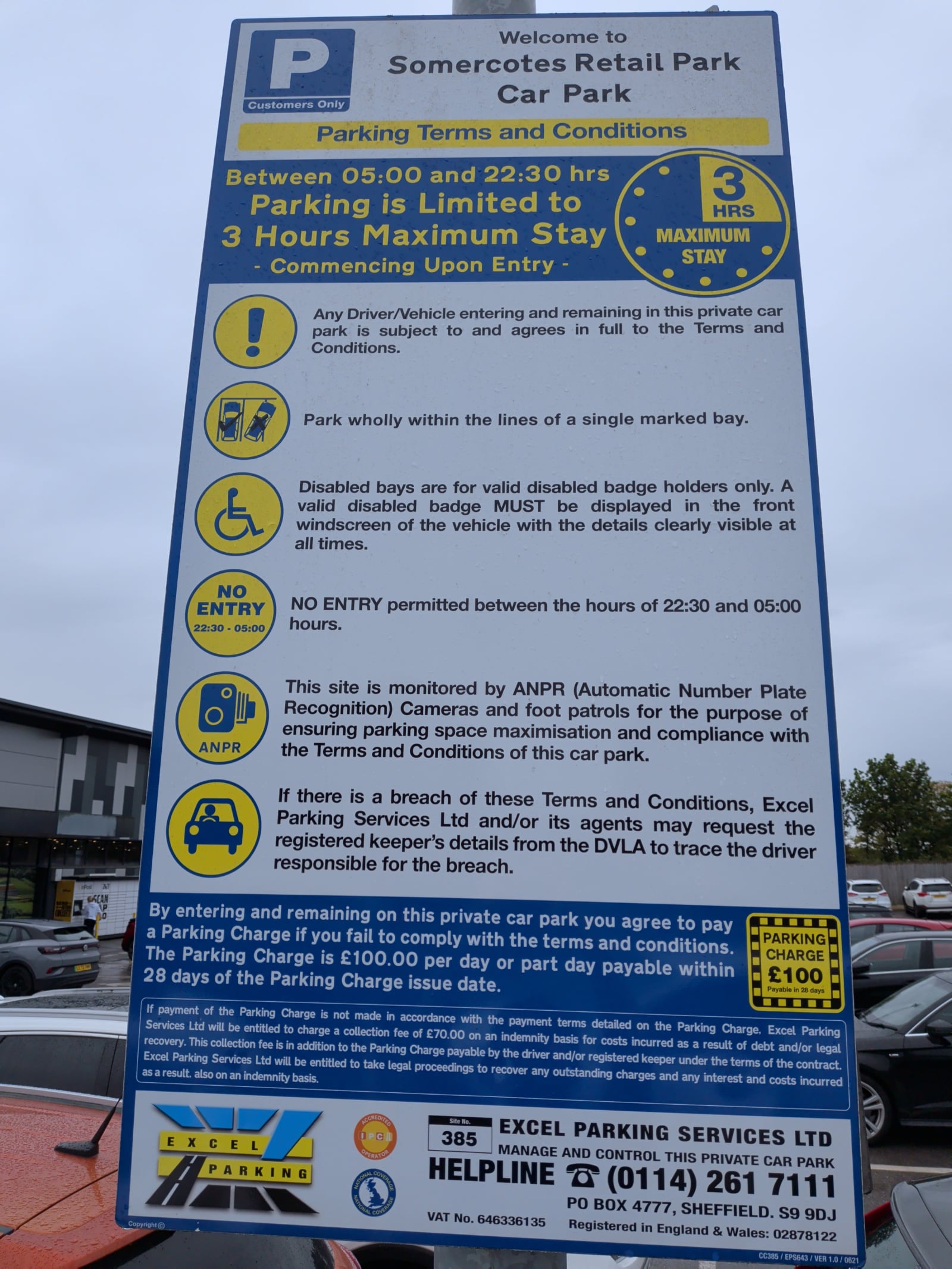
If Excel alleges the vehicle remained on site after 22:30 giving rise to a PCN: the sign prohibits entry between 22:30 and 05:00. It does not prohibit presence or require exit. The claim requires an exit term to be implied. No such term is necessary or obvious, it goes beyond the express provision on the same period, and Excel could have drafted one: Marks and Spencer v BNP Paribas [2015] UKSC 72; King Crude Carriers v Ridgebury November [2025] UKSC 39 at [82], [98] and [122].
So not a new argument. King Crude is a second Supreme Court application of the Marks and Spencer test, specifically rejecting the argument that a scheme's evident purpose can supply a term the words don't contain. It doesn't prevent implied terms, it confirms the bar: necessary or obvious, and not contradicting or extending an express provision on the same subject.
I'm a random person on the internet. I hold no legal qualifications and nothing I say is advice.
1 -
The contract would turn on the interpretation of the word 'stay' and the time of the PCN.
If interpreted simply as 'to remain', then the vehicle plainly needs to have left within 3 hrs of arrival in the charging window. It would still be possible to arrive at 22:29 and remain for 3 hours exiting before 01:28 without breaching any terms (which I suspect is not what the PPC intend).
The sign expressly does not offer parking at all after 22:30 or even permission to use the land, which then begs the question if any term can be performed. If not, that is yes, a trespass, but no, not a breach of any contract (one has not been offered). Even if I'm wrong in that, technically, by the time the driver has entered, parked and read the sign the anpr has already logged the entry and the driver is in breach. That would give rise to the argument that the contract terms are impossible/cannot be complied with.
The largest writing could easily be interpreted to read (I paraphrase) free parking at night outside the specified hours.
Frankly I think citing a commercial shipping case unhelpful in this context in front of a time limited DJ. The arguments on the correct application of the penalty rule (usually misinterpreted by ppcs) and uplifts are of course well rehearsed on this forum.
4






Confirm your email address to Create Threads and Reply

Categories
- All Categories
- 355.8K Banking & Borrowing
- 254.9K Reduce Debt & Boost Income
- 456.2K Spending & Discounts
- 248.3K Work, Benefits & Business
- 605.9K Mortgages, Homes & Bills
- 179K Life & Family
- 263.8K Travel & Transport
- 1.5M Hobbies & Leisure
- 16.2K Discuss & Feedback
- 37.7K Read-Only Boards