We’d like to remind Forumites to please avoid political debate on the Forum.
This is to keep it a safe and useful space for MoneySaving discussions. Threads that are – or become – political in nature may be removed in line with the Forum’s rules. Thank you for your understanding.
Parkingeye PCN - Merlyn Vaz Health Centre
Comments
-
Hi,
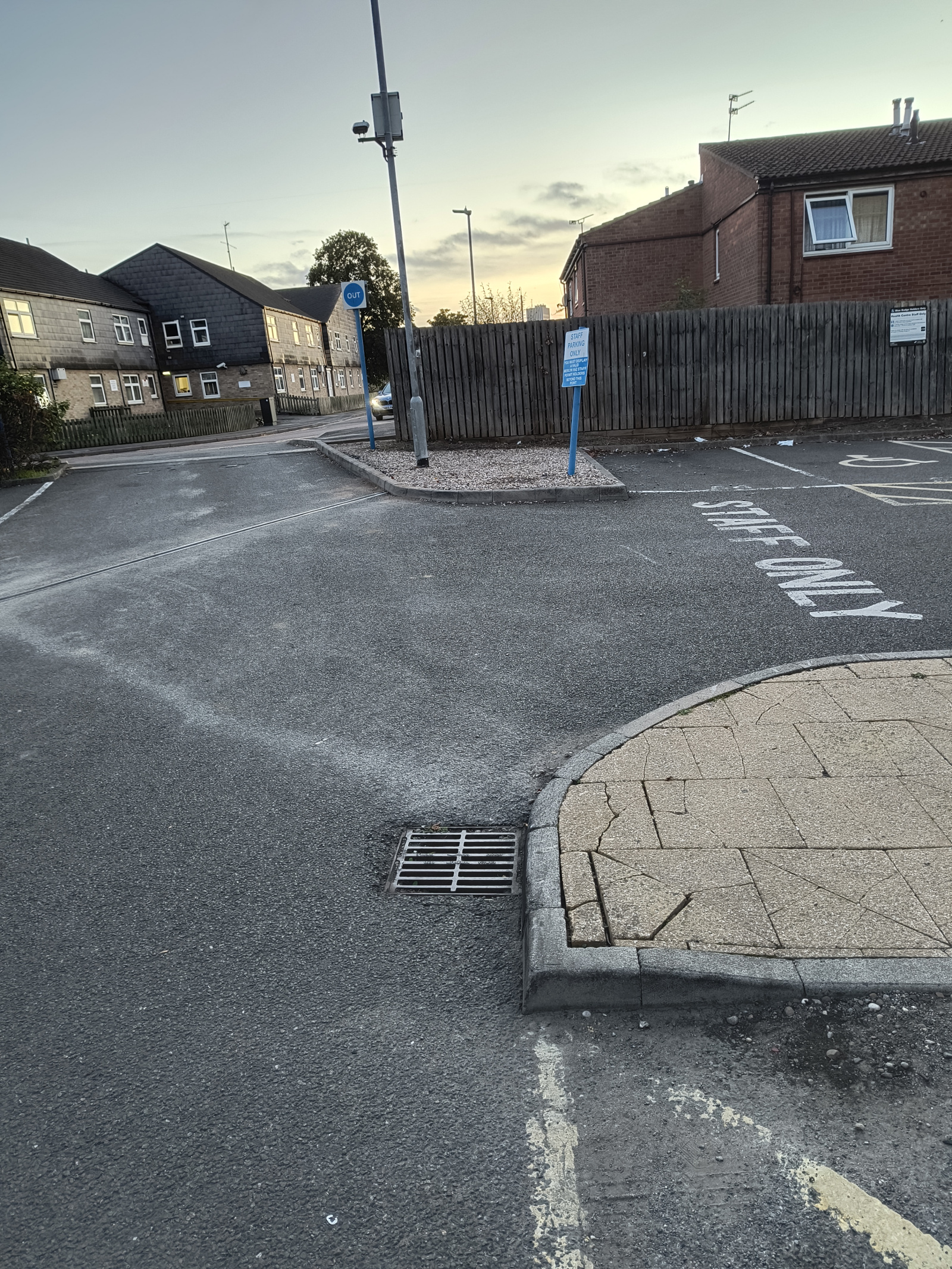
Thanks for your reply. I would say so yes, that the ANPR pictures do not show exactly where the car is or the staff only written on the floor, and the exit is close by. Please see photo below. It does seem like it does take a picture early, in my opinion.
Also, would it be good to mention that the driver did park in the patient car park after leaving the staff car park? I do have proof of an appointment too which I will attach in the POPLA appeal.
Thanks again for your help
1 -
POPLA appeal:
1. No Parking Event Occurred – Failure to Allow Mandatory Consideration Period (BPA Code of Practice Clause 13.1)
The operator’s ANPR records show a total duration on site of only 0 hours 9 minutes. At no point was the vehicle parked, engine turned off, or left unattended in the staff area.
Under Section 13.1 of the British Parking Association (BPA) Code of Practice:
"The driver must have the chance to read the terms and conditions before they enter into the contract with you. If, having had that opportunity, the driver decides not to park but instead leaves the car park, you must provide them with a reasonable consideration period to leave, before the driver can be bound by your terms and conditions."
The vehicle was conveying a registered disabled occupant (Blue Badge attached as Exhibit 4). Upon entry into an unfamiliar and busy dead-end car park, the driver noticed designated disabled bays. Confronted with a confusing environment and attempting to locate legitimate disabled parking for an appointment, the driver approached the bays to inspect the signage.
Upon pulling in close, the driver was met with conflicting boards: a Parkingeye sign mounted on a post directly in front of the bay, and a second, contradictory sign from a different operator (CMS Ltd) mounted immediately alongside on the fence (Exhibit 2). Genuinely confused by the conflicting notices, the driver determined they could not or should not park there, rejected the terms, carefully turned the vehicle around in the narrow layout, and departed. Nine minutes to enter, decipher competing notices, reject the contract, and execute a turn falls squarely within a mandatory consideration period.
2. Subsequent Relocation to Authorised Patient Parking & Valid Appointment Proof
Further proving that the brief 9 minutes was solely an uncompleted consideration and navigational period, the driver immediately exited the staff roadway and parked in the authorised patient car park.
The occupants were legitimate visitors attending a scheduled NHS appointment at the health centre, as evidenced by the NHS appointment text confirmation attached as Exhibit 5. The driver utilised the proper patient facilities for the duration of the visit. The operator cannot claim a staff parking contract was breached when the motorist explicitly rejected the staff terms and parked in the public patient car park instead.
3. Inherent Unreliability of ANPR Camera Timings and Inability to Prove a "Parking" Event
Parkingeye relies solely on Automated Number Plate Recognition (ANPR) camera captures at the boundary.
ANPR Measures Transit, Not Parking: ANPR cameras only record the timestamp of a vehicle crossing an invisible perimeter line at the roadway entrance and exit. They provide zero evidence of parking, bay occupancy, or whether a vehicle was ever stationary.
Lack of Camera Synchronisation and Margin of Error: It is well-established that private parking ANPR systems are susceptible to clock drift, latency issues, and unsynchronised camera clocks between separate entry and exit lenses. In a margin-critical allegation of only 9 minutes, even a minor timing discrepancy of 1–2 minutes significantly distorts the recorded duration.
Failure to Discharge Burden of Proof: The legal burden rests on Parkingeye to prove a contract was agreed to and breached. In the absence of manual patrol evidence, bay photographs, or continuous CCTV footage showing a vehicle parked and vacated, Parkingeye has merely documented a vehicle driving through an access road.
4. Physical Layout, Absence of Barriers, and Defective Visibility of Terms
As shown in Exhibit 1 (Site Layout), there is no physical gate, barrier, or visual distinction separating the health centre approach from this narrow section.
The terms and conditions are printed in small, illegible font that cannot be safely read from the roadway. It was strictly necessary to pull past the painted road marking to inspect the terms. Given that the car park was busy and consists of a narrow, single-lane dead-end with vehicles on either side, navigating safely with a disabled passenger accounted for the brief transit time.
5. Conflicting, Contradictory, and Defective Signage by Competing Operators
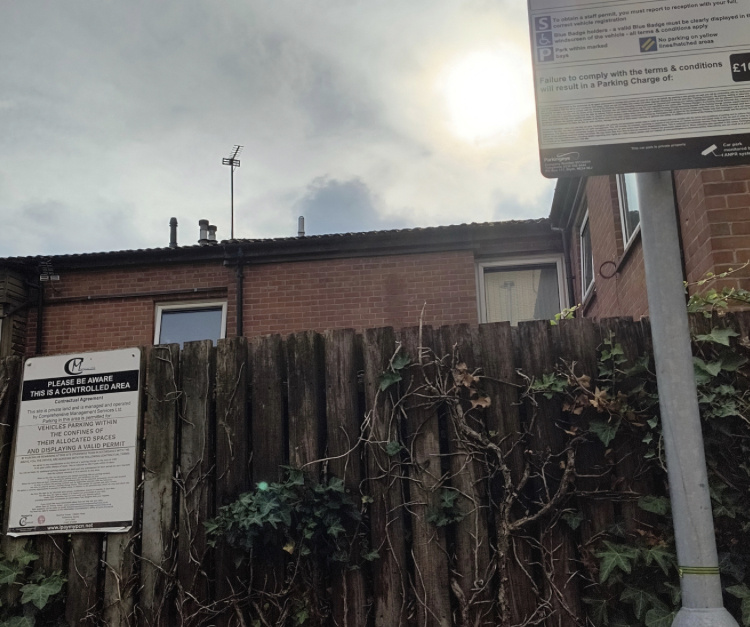
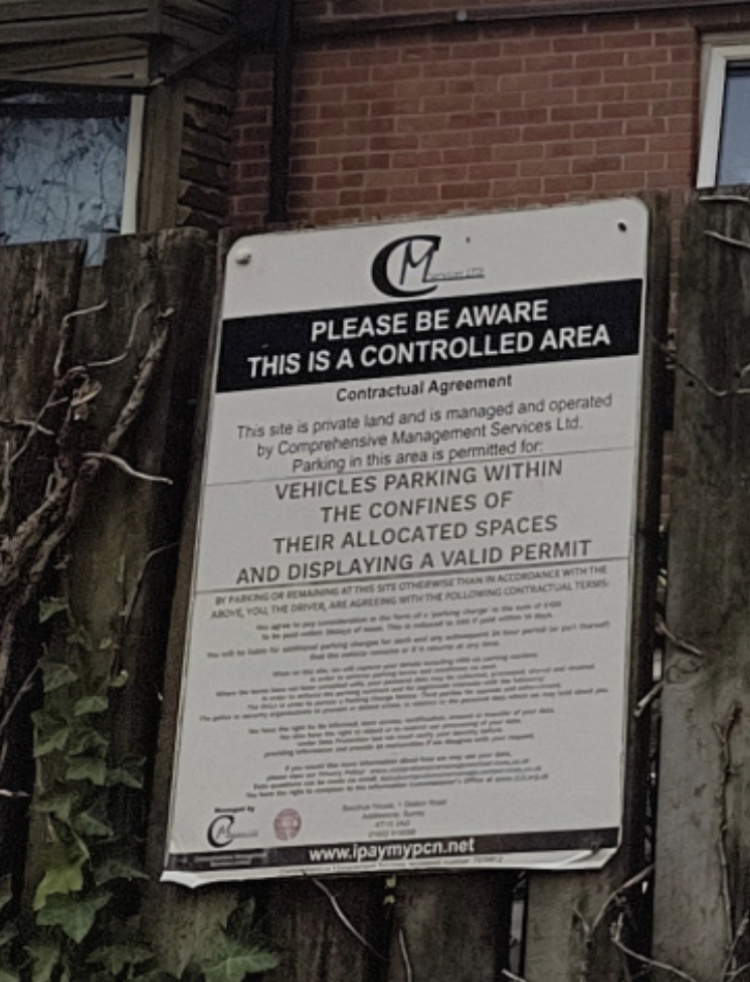
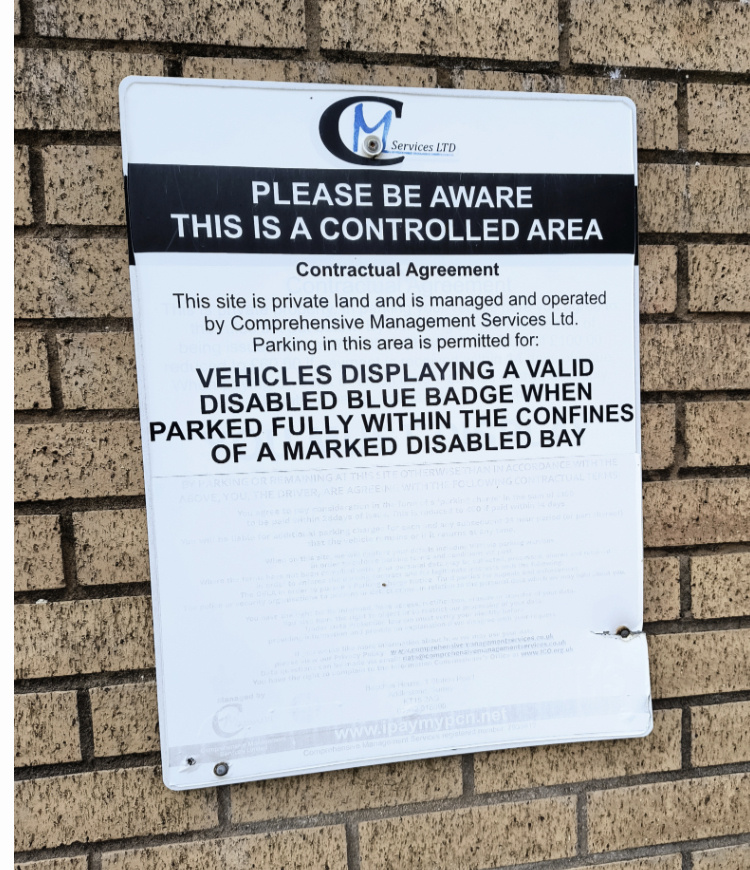
As evidenced in Exhibit 2 (Side-by-Side Photographic Evidence) and Exhibit 3 (CMS Close-Up), the site contains conflicting signage erected by two distinct commercial entities:
Parkingeye Ltd (asserting ANPR terms and conditions)
Comprehensive Management Services Ltd (CMS Ltd) (asserting manual warden/permit terms and conditions)
Both notices are mounted in immediate proximity on the exact same boundary fence.
This dual-operator presence creates severe ambiguity regarding which company manages the land and what rules apply.
The CMS Ltd board fails to make the core charge (£100) prominent, burying it in standard body text, whereas the Parkingeye board sets out entirely different terms.
Under the established legal doctrine of contra proferentem, any ambiguity in contractual terms displayed on private land must be resolved in favour of the consumer. A driver faced with competing notices inherently requires additional time to read, evaluate, and decide to leave.
6. Statutory Failure to Make Reasonable Adjustments (Equality Act 2010, Section 20)
As shown in Exhibit 4 (Blue Badge), an occupant of the vehicle is a registered Blue Badge holder.
Under Section 20 and Section 29 of the Equality Act 2010, service providers and land managers have a strict statutory duty to make reasonable adjustments for persons with disabilities.
Enforcing an inflexible or unreasonable time restriction without regard to disability context constitutes indirect discrimination.
Allowing a brief 9-minute window for a vehicle carrying a disabled occupant to enter a busy site, locate disabled signage, decipher contradictory notices, and safely exit falls squarely within the statutory scope of a reasonable adjustment.
7. Conclusion
The appellant was the Registered Keeper. No contract was formed because the driver utilized a standard consideration period to inspect the terms, rejected them due to conflicting operator notices, and relocated immediately to the authorised patient car park for a scheduled NHS appointment.
The Appellant respectfully requests that POPLA uphold this appeal and direct Parkingeye Ltd to cancel Parking Charge Notice
0 -
I wouldn't admit to 'being in' the staff car park, just say you drove round the entire site - round beside the building - looking for an accessible bay but none of the photos show where the car was. Therefore there is no evidence of time allegedly spent in a staff area. The tarmac shown in the two images could be anywhere on site and it is up to the operator to prove and identify where the car was. It looks like unmarked roadway and the spaces provided on site are mixed: some staff, some patients. You do not accept that the images were captured within a staff area and in fact this looks like the unmarked section leading to the overall site exit.
(Go through the rest of your wording to ensure you only talk about that rogue other company sign in terms of spotting it when you went back in foot to take pictures).
Show us your draft.
PRIVATE 'PCN'? DON'T PAY BUT DON'T IGNORE IT (except N.Ireland).
CLICK at the top or bottom of any page where it says:
Home»Motoring»Parking Tickets Fines & Parking - read the NEWBIES THREAD2 -
Hi,
Thank you for your feedback. This is what I've come up with.
POPLA Appeal Submission
POPLA Verification Code: [Insert your 10-digit Code here]
Parking Operator: Parkingeye Ltd
PCN Reference Number:
Vehicle Registration:
Appealing Party: (Registered Keeper)- Operator’s Own Photographs Fail to Prove Location Within Any Restricted "Staff" Zone
The operator alleges an unauthorised parking event within a restricted "Staff Car Park". However, the operator’s evidence fails to substantiate this claim:
No Evidence of Time Allegedly Spent in a Staff Area: The operator’s photographic evidence merely shows vehicle movement across unmarked roadway. There is zero evidence of time allegedly spent in a staff car park. The vehicle was simply driven around the site, including along the access roads beside the building and perimeter, seeking an available accessible bay for an authorized NHS appointment.
Indeterminate Location on a Mixed-Use Site: The operator’s photographs are tightly cropped around the registration plate and feature solely generic, unmarked tarmac, providing zero contextual evidence of where on the premises the images were captured. The site is a compact, mixed-use facility comprising public patient bays, general circulating access routes, and staff areas. The photographs could have been taken anywhere on site. The operator has failed to provide camera installation schematics, site plans, or wide-angle context shots proving that this specific camera exclusively records entry to a restricted staff zone, rather than vehicles passing along the general access route.
Failure to Prove a Parking Event: ANPR only records transit past a lens, not parking. The operator has produced zero photographic evidence of bay occupancy, an unattended vehicle, or that the vehicle was parked in a bay rather than simply circulating or pausing momentarily to assess signage under the mandatory consideration period. The legal burden rests on Parkingeye to prove both the location and the breach, and they have completely failed to discharge that burden. - Transit, Search for Accessible Bays, and Mandatory Consideration Period (BPA Code Clause 13.1)
The vehicle was conveying a registered disabled occupant (valid Blue Badge attached as Exhibit 4).
The driver entered the site to attend a scheduled NHS medical appointment at the health centre, as confirmed by the official appointment confirmation attached as Exhibit 5. Due to the congested nature of the site and the absence of clear directional demarcation, the driver drove along the access roadway—beside the building and along the perimeter—seeking an available accessible/disabled bay.
Under Section 13.1 of the British Parking Association (BPA) Code of Practice:
"The driver must have the chance to read the terms and conditions before they enter into the contract with you. If, having had that opportunity, the driver decides not to park but instead leaves the car park, you must provide them with a reasonable consideration period to leave, before the driver can be bound by your terms and conditions."
Circulating the site roadway for 9 minutes while seeking an accessible space, and navigating safely with a disabled occupant, falls entirely within an uncompleted transit and consideration period. At no point was any contract formed or breached. - Inherent Unreliability, Camera Placement, and Technical Limitations of ANPR Data
Parkingeye relies entirely on Automated Number Plate Recognition (ANPR) captures:
Boundary Positioning vs. Actual Restrictions: Merlyn Vaz Health Centre is a mixed-use site containing public patient facilities, access routes, and restricted areas. The operator has positioned cameras in a manner that captures vehicles on circulating access roads rather than within specific restricted bays.
Transit vs. Parking: ANPR captures movement past an optical beam, not stationary parking duration. It provides no corroborating evidence of where the vehicle traveled within the curtilage of the premises or whether the vehicle was ever parked.
System Tolerances & Clock Drift: Private parking ANPR systems are susceptible to latency and clock synchronization discrepancies between units. In a margin-critical timeframe of only 9 minutes, minor clock drift distorts the recorded transit time. - Defective Site Governance, Competing Operators, and Illegible Signage Discovered on Foot
Following receipt of this charge, a site inspection on foot revealed that the premises are blighted by contradictory and severely defective signage erected by competing commercial operators:
Parkingeye Ltd (asserting ANPR enforcement)Comprehensive Management Services Ltd (CMS Ltd) (asserting separate contractual terms for disabled motorists and permit holders)As evidenced in Exhibit 2, boards for both companies are erected side-by-side on the exact same boundary fence in immediate proximity.Furthermore, an inspection of the patient car park revealed that CMS Ltd maintains signs specifically governing disabled bays, explicitly inviting "VEHICLES DISPLAYING A VALID DISABLED BLUE BADGE" to park (Exhibit 3). However, the entire contractual terms section beneath is blank, sun-bleached, and completely illegible.This dual-operator presence across the facility creates severe ambiguity as to which company manages which areas, what terms apply, and whether Parkingeye holds exclusive, legitimate landowner authority across the site.Under the established legal principle of contra proferentem, any ambiguity in contractual terms displayed on private land must be resolved against the parking operator. - Statutory Duty to Make Reasonable Adjustments (Equality Act 2010, Section 20)
As shown in Exhibit 4 (Blue Badge), an occupant of the vehicle is a registered disabled person.
Under Section 20 and Section 29 of the Equality Act 2010, service providers and parking operators have a mandatory statutory duty to make reasonable adjustments for disabled motorists.
Applying an arbitrary, automated ANPR timer without regard to the extra time required for a disabled occupant to navigate a congested site and seek an accessible bay constitutes indirect discrimination.
Allowing 9 minutes of circulation time on site roadways to navigate safely falls squarely within the scope of a reasonable adjustment. - Conclusion
The appellant was the Registered Keeper. The operator has failed to prove where the vehicle was located on site, failed to prove that any parking event took place, and failed to honour the mandatory consideration period under BPA Code Section 13.1.
The Appellant respectfully requests that POPLA uphold this appeal and direct Parkingeye Ltd to cancel Parking Charge Notice (Number Here).
Evidence Files to Attach:
Exhibit 1: Site layout photo showing undivided roadway, mixed access, and lack of physical barriers.Exhibit 2: Photo taken on foot showing side-by-side conflicting signs (Parkingeye and CMS Ltd) mounted on the boundary fence.
Exhibit 3: Photo taken on foot in the patient car park showing the CMS Ltd sign regarding disabled bays with completely blank/illegible contractual terms.
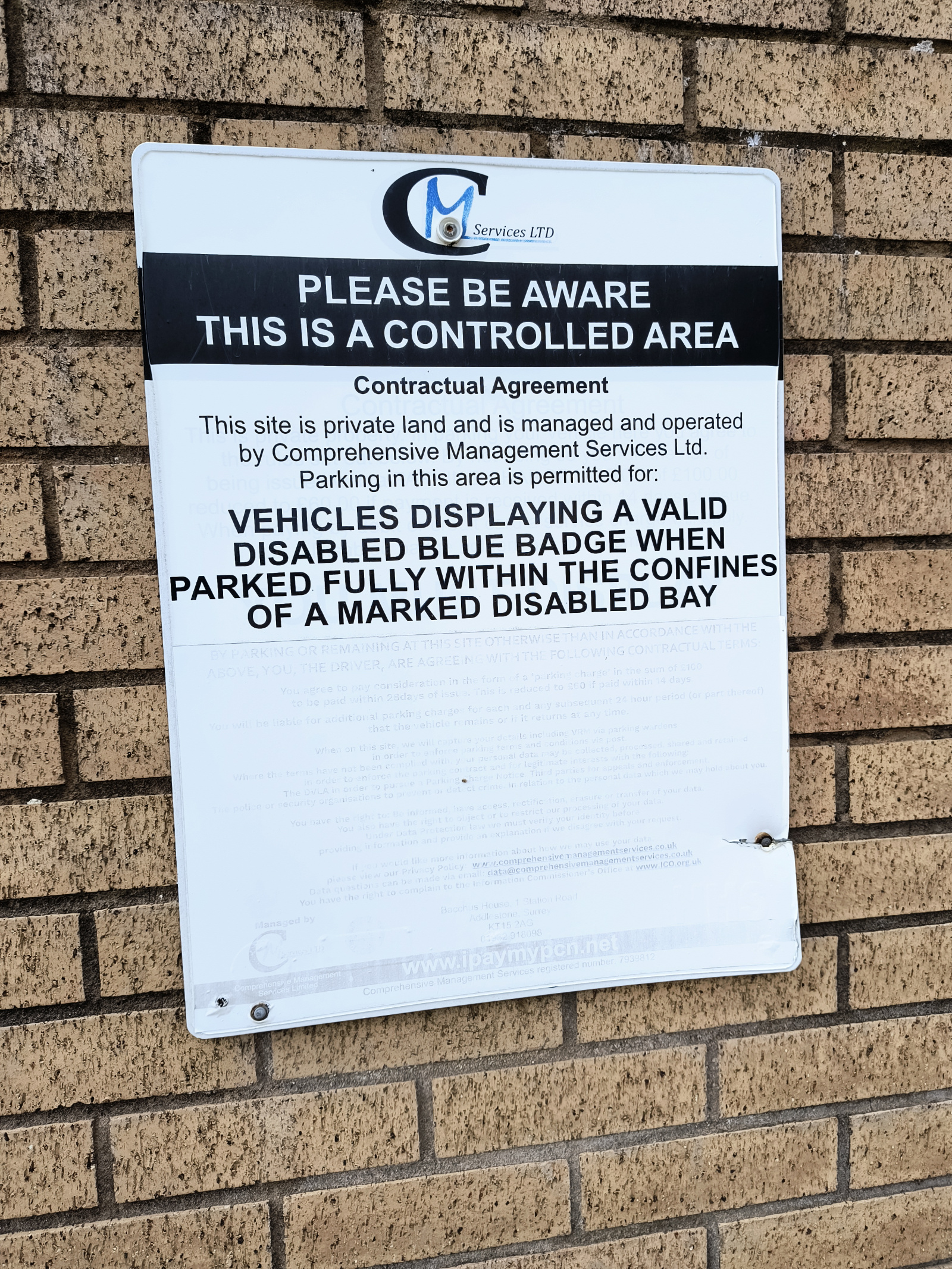
Exhibit 4: Front face of the valid Blue Badge (showing serial number and validity; personal details protected).
I will add this
Exhibit 5: Screenshot of NHS appointment text confirmation (showing date, time, and patient status; medical details redacted).
I will add this
Note: Exhibit 3 is in the patient car park in front of a disabled bay, I thought it was worth adding as it shows there is multiple CMS signs around the car park.
0 - Operator’s Own Photographs Fail to Prove Location Within Any Restricted "Staff" Zone
-
I would go through it & remove the obvious ChatGPT over-complex and strange 'bot' language like 'clock-drift'(?) and American spellings like 'synchronization'.
I'd remove almost every image, especially that first one. Don't give evidence of surface markings - that's helping ParkingEye!
I would also not point out that one of the two CPMS signs is faded. Don't assist them to dismiss it as unimportant.
The point is they are there and highly misleading, which misdirects drivers to think they can either park with a blue badge or a CPMS permit. Those signs are also the first ones a disabled person would see because they are at eye level on a fence and a brick wall.
Add these cropped images and say the car appears to have been shown manoeuvring on the exit roadway near the drain cover:
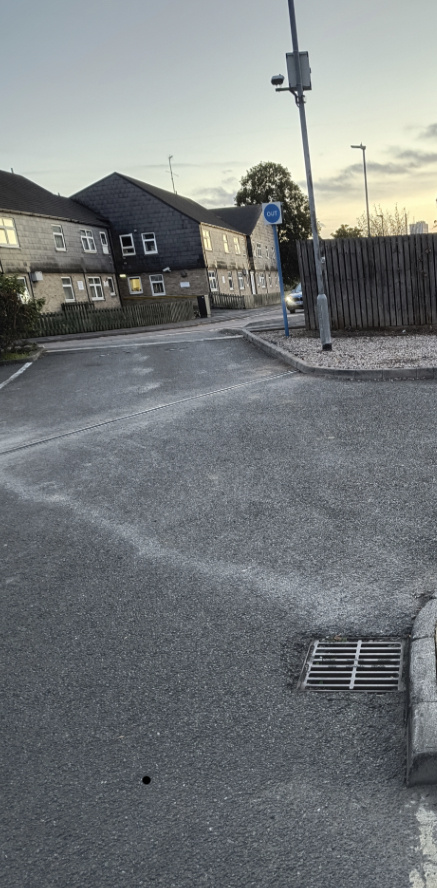
Also finish by putting ParkingEye to strict proof of unredacted landowner authority, as you suspect there is a 10-15 minute consideration period on site and/or a requirement set in the agreement by the surgery to treat disabled users fairly.
(I made that last bit up but it is deliberate fishing to get the landowner authority document).
PRIVATE 'PCN'? DON'T PAY BUT DON'T IGNORE IT (except N.Ireland).
CLICK at the top or bottom of any page where it says:
Home»Motoring»Parking Tickets Fines & Parking - read the NEWBIES THREAD4 -
Thank you very much, I will get to editing
1 -
This is what I have come up with, will be sending the appeal today
1. Operator’s Own Photographs Fail to Prove Location Within Any Restricted "Staff" Zone
The operator alleges an unauthorised parking event within a restricted "Staff Car Park". However, the operator’s evidence fails to substantiate this claim:
No Evidence That the Vehicle Entered the Staff Car Park: The operator’s photographic evidence shows the vehicle travelling through a section of the roadway. The evidence provided does not establish that the vehicle entered the staff car park.
Indeterminate Location on a Mixed-Use Site: The operator’s photographs are tightly cropped around the registration plate and show only a limited view of the surrounding area, providing little indication of where on the premises the images were captured. The site is a mixed-use facility comprising public patient bays, general access routes, and staff areas. The operator has failed to provide camera installation plans, site plans, or wider-angle photographs showing that the vehicle was photographed within the alleged restricted staff area, rather than on a general access route.
Failure to Prove a Parking Event: The ANPR photographs show the vehicle passing the camera, but do not show where the vehicle travelled or whether it was parked within the alleged restricted area. The operator has not provided photographic evidence showing the vehicle parked in a bay or left unattended. The burden is on ParkingEye to prove both the location and the alleged breach, and the evidence provided does not do so.
2. Circulating the Site, Search for an Accessible Bay, and Reasonable Consideration Period (BPA Code Clause 13.1)
A valid Blue Badge was held by a disabled person using the vehicle, which is attached as Exhibit 4.
The vehicle entered the site in connection with a scheduled NHS medical appointment at the health centre, as confirmed by the appointment confirmation attached as Exhibit 5. Due to the congestion on site, with other vehicles and pedestrians, the vehicle had to be manoeuvred carefully while looking for an available accessible bay and travelled along the access roadway, including beside the building and around the perimeter.
Under Section 13.1 of the British Parking Association (BPA) Code of Practice:
“The driver must have the chance to read the terms and conditions before they enter into the contract with you. If, having had that opportunity, the driver decides not to park but instead leaves the car park, you must provide them with a reasonable consideration period to leave, before the driver can be bound by your terms and conditions.”
A period of 9 minutes and 6 seconds should be considered reasonable in the circumstances. The vehicle was occupied by a disabled person with a valid Blue Badge, and the site was busy with other vehicles and pedestrians, requiring careful navigation while looking for an accessible bay. The evidence does not establish that a parking contract was formed or that a breach occurred during this period.
3. Limitations of the ANPR Evidence, Camera Placement, and Site Management
ParkingEye relies on Automated Number Plate Recognition (ANPR) captures to establish the timing and duration of the alleged parking event.
Boundary Positioning vs. Actual Restrictions: Merlyn Vaz Health Centre is a mixed-use site containing public patient facilities, access routes and restricted areas. The ANPR images do not establish where the vehicle travelled within the site or whether it was ever parked within the specific restricted area alleged by the operator.
Vehicle Movement vs. Parking: The ANPR photographs allegedly show the vehicle at the camera locations at the recorded times, but do not show where the vehicle travelled within the site or where any alleged parking took place. They also do not show the vehicle parked in a specific bay or restricted area. There is no supporting photographic evidence showing where the alleged parking event occurred.
Site Management and Maintenance: The site contains signage relating to both ParkingEye and CMS, with the signage not clearly establishing which operator's terms and restrictions apply. The continued presence of competing operator signage creates genuine uncertainty as to which parking terms govern the site.
The presence of conflicting parking arrangements raises legitimate concerns about the standard of site management and maintenance. In these circumstances, where ParkingEye relies on ANPR timestamps to establish an alleged period of only 9 minutes and 6 seconds, the accuracy and maintenance of the ANPR system are also relevant. ParkingEye should therefore be able to demonstrate that the relevant ANPR equipment was properly maintained, accurately recording the relevant times, and operating correctly on the date in question.
4. Defective Site Governance, Competing Operators
The site contains multiple pieces of conflicting contractual signage from two separate parking operators:
ParkingEye Ltd, displaying signage relating to its ANPR parking enforcement; and
Comprehensive Management Services Ltd (CMS Ltd), whose signage states that the site is “managed and operated” by CMS and sets out its own contractual parking terms.
As evidenced in Exhibit 2, signs belonging to both companies are displayed side-by-side on the same boundary fence and in close proximity to one another.
Furthermore, CMS Ltd signage is also present specifically governing parking by disabled Blue Badge holders. The sign states that the site is “managed and operated by Comprehensive Management Services Ltd” and that parking is permitted for “vehicles displaying a valid disabled blue badge when parked fully within the confines of a marked disabled bay.”
The presence of two different operators' contractual signage creates clear ambiguity as to which operator's terms apply to the site, which areas each operator controls, and which restrictions motorists are expected to follow. The signage itself does not clearly identify which operator has authority over the relevant area.
The issue is particularly significant because both operators' signage purports to establish contractual parking arrangements, yet the signage provides no clear explanation of how the two sets of terms are intended to operate alongside one another. A motorist should not be required to determine which of two competing operators' contractual terms governs the area, which restrictions apply, or which terms take priority before knowing what parking conditions they are expected to follow.
This is also relevant to the standard of site management and maintenance. The continued presence of competing contractual signage raises legitimate concerns about how the parking arrangements are being managed and maintained.
Consumer Rights Act 2015: The Consumer Rights Act 2015 applies to consumer notices, including notices intended to communicate rights or obligations to consumers. Section 68 requires written consumer terms and notices to be transparent, meaning they must be expressed in plain and intelligible language and, where written, be legible. Section 69 further provides that where a term in a consumer contract or consumer notice could have different meanings, the meaning most favourable to the consumer is to prevail.
In circumstances where two different operators display competing contractual signage at the same site without clearly explaining which operator's terms apply to which areas, the resulting ambiguity should not operate to the detriment of the motorist. Where the signage is capable of creating more than one reasonable interpretation as to which operator's terms apply, the interpretation most favourable to the consumer should prevail.
In addition to this, the BPA single code of practice, Under 3.1.6, NOTE 2: If there is more than one sign, all should be consistent with regards to typeface style, size and weight, colour and layout. This is not the case here.
5. Statutory Duty to Make Reasonable Adjustments (Equality Act 2010, Sections 20 and 29)
As shown in Exhibit 4 (Blue Badge), a valid Blue Badge was held by a disabled person using the vehicle.
Under Sections 20 and 29 of the Equality Act 2010, service providers are subject to a statutory duty to make reasonable adjustments where a provision, criterion or practice places a disabled person at a substantial disadvantage compared with persons who are not disabled. The duty includes taking reasonable steps to avoid that disadvantage.
In this case, applying a fixed ANPR-based parking period without allowing for the additional time that may reasonably be required by a disabled person to navigate a busy site safely and locate an accessible parking bay risks placing that person at a substantial disadvantage.
The circumstances are particularly relevant here. The vehicle was on site for only 9 minutes and 6 seconds, during which time it was necessary to navigate a busy site with other vehicles and pedestrians while looking for an accessible bay. Allowing reasonable additional time in those circumstances would be a straightforward and proportionate adjustment, rather than treating the ANPR time limit as an absolute measure regardless of disability-related needs.
The 9 minutes and 6 seconds recorded by ParkingEye's ANPR system should therefore be considered in the context of the reasonable adjustment required for a disabled person using the site, rather than treated as an automatic breach solely because the ANPR system recorded that period.
Furthermore, in the BPA single code of practice, under accessible parking, commentary on clause 4, the BPA notes:
“people with other disabilities might reasonably need longer consideration period and grace periods, more time to access payment machinery, and other ways to pay where payment is required. Recognition of these obligations is important in the consideration of appeals.”
6. ParkingEye's Authority to Operate and Enforce
Given the presence of contractual signage from both ParkingEye Ltd and Comprehensive Management Services Ltd at the site, ParkingEye is put to strict proof of its authority to operate and enforce parking restrictions in the specific area relied upon for this Parking Charge Notice.
ParkingEye should provide the relevant landowner agreement or other evidence establishing its authority to operate and enforce parking restrictions at the site, including the extent of the area covered and the terms governing its enforcement authority.
The Appellant also requests that ParkingEye provide the relevant contractual provisions governing the operation of the site, including any provisions relating to consideration or grace periods, disabled users, reasonable adjustments, or any other requirements imposed by the landowner concerning the treatment of motorists using the site.
This is particularly relevant given the presence of competing contractual signage from two separate parking operators and the uncertainty as to which operator has authority over the relevant area. It is also relevant to the circumstances of this case, where the vehicle was on site for only 9 minutes and 6 seconds and a disabled person was using the vehicle.
7. Conclusion
The Appellant is the Registered Keeper. ParkingEye has failed to provide sufficient evidence to establish where the vehicle was located on site, that a parking event took place, or that the circumstances of the 9 minutes and 6 seconds recorded by ParkingEye’s ANPR system amounted to a breach of the applicable terms.
The appeal also raises significant concerns regarding the competing contractual signage from ParkingEye and CMS, the lack of clarity as to which operator's terms apply to the relevant area, the reasonable consideration period, and ParkingEye's obligations to make reasonable adjustments for a disabled person using the site.
For these reasons, the Appellant respectfully requests that POPLA uphold this appeal and direct ParkingEye Ltd to cancel Parking Charge Notice (number here)
I will be adding the photos mentioned before (thank you very much for that)
I have also contacted my local MP regarding this so let's see what happens.
Once again, thank you for all your help, it is very much appreciated.
2 -
All good except I really would use these words. If you say you think the site consideration period is 10/15 minutes they have to prove otherwise!
"finish by putting ParkingEye to strict proof of unredacted landowner authority, as you suspect there is a 10-15 minute consideration period on site and/or a requirement set in the agreement by the surgery to treat disabled users fairly."
PRIVATE 'PCN'? DON'T PAY BUT DON'T IGNORE IT (except N.Ireland).
CLICK at the top or bottom of any page where it says:
Home»Motoring»Parking Tickets Fines & Parking - read the NEWBIES THREAD3 -
UPDATE: parkingeye emailed this morning to cancel the PCN as a "goodwill gesture". Very kind of them.
Once again, thank you very much for all your help, especially as the registered keeper just wanted to pay.
I will still follow up with my local MP to raise all the issues about parkingeye.
6 -
I would also suggest that strong complaint is made to the CMA , with your evidence, about this sorry saga
Coupon-mad has posted the details numerous times on here, with email addresses
5







Confirm your email address to Create Threads and Reply

Categories
- All Categories
- 355.7K Banking & Borrowing
- 254.9K Reduce Debt & Boost Income
- 456.1K Spending & Discounts
- 248.3K Work, Benefits & Business
- 605.9K Mortgages, Homes & Bills
- 179K Life & Family
- 263.7K Travel & Transport
- 1.5M Hobbies & Leisure
- 16.2K Discuss & Feedback
- 37.7K Read-Only Boards