We’d like to remind Forumites to please avoid political debate on the Forum.
This is to keep it a safe and useful space for MoneySaving discussions. Threads that are – or become – political in nature may be removed in line with the Forum’s rules. Thank you for your understanding.
The impact of inflation - yikes!
Comments
-
how best to illustrate it though? continue a cashflow real / nominal conversion spreadsheet during retirement? If you’re tracking and controlling your costs reasonably to minimise personal inflation then I would think the main thing is trackign your pot growth relative to where you started from - eg 4% rule you can do a fairly simple nominal withdrawl of your inflation adjusted income as a percentage of your nominal pot value to see if you’re within whatever bounds you think reasonable - is that enough?
0 -
It is a good question - given we are most able to think in terms of 'today's money' perhaps back adjust historic data into today's prices? This would hopefully also tend to keep expenditure flat rather than appearing to be on a risng trend?
I think....0 -
The more awareness that is put on the importance of factoring inflation into current modelling the better in my view.
In two discussions with friends recently, one is just about to take a level-annuity and I reminded them to consider diminishing purchasing powers and the other who seemed quite happy with the value of their annual DB estimate but was overlooking the fact that it was some 13-14 years away.
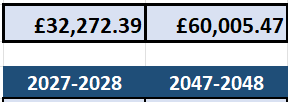
From my own number crunching when modelling an annual expenditure estimate for 2027-2028 it comes in at £32,272, project that forward to 2047-2048 it is £60,005 (different rates of inflation on different lines of the forecast)
If anyone does a State Pension + Other Pension sum and comes to say £35,000 and thinks they are sorted, this is where inflation will bite, although SP increases will help a bit.
Yikes indeed!
1 -
This is not really anything to worry about (at least not without further information).
As far as I understand, It’s quite typical and normal for the nominal balance of a retirees savings to go up in the years after retirement, but then start going down after a couple of decades, but the real terms value is already going down.
For most of us the objective is not to maintain our capital intact, it is to avoid running out of money before we die.
1 -
Interesting supposition with regard to the statement ' for most of us the objective is not to maintain our capital intact'.
I wonder to what extent that really is indicative of the mindset of the majority of contributors to this forum.
Certainly without the comfort blanket of a good index linked DB pension ( which I certainly dont have), eroding income generating capital would be potentially perilous.
1 -
I have a spreadsheet where I am going to track the current pot value vs the original pot value at retirement with an additional column which is the original amount subject to CPI. By subtracting the cumulative drawdown I can then work out the CPI adjusted rate of return/withdrawal rate.
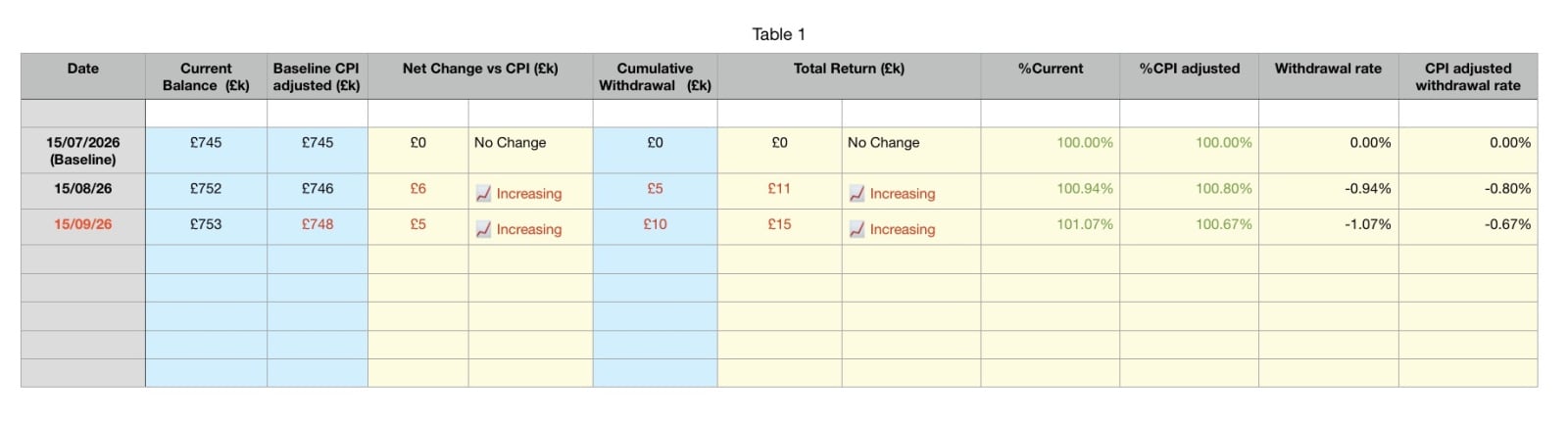
The CPI figures are always going to lag a bit due to the delay in the ONS publishing. I will probably just accept the lag whilst tracking monthly but could always do a full annual reconciliation once the respective figures are published..
3 -
It's not a case of one being higher or lower than the other - they measure different things. CPIH includes owner-occupier housing costs (mortgage payments, but also council tax, maintenance costs etc) whereas CPI doesn't. At a time when housing costs are rising more slowly than general inflation (as they have been of late) CPIH will be lower than CPI; when housing costs are rising quickly CPIH will be higher.
Since 1988 CPI has risen by 179% and CPIH has risen by 187% so in the long term it's been pretty much a wash.
RPI also includes housing costs, but the main reason it tends to be higher than either because it uses an arithmetic mean rather than a geometric mean to aggregate the different products whose prices it measures - the arithmetic mean tends to apply more weight to outliers. ie If a small number of products increase in price by a large amount while everything else doesn't go up much, it will have more impact on RPI than CPI. Which is fair enough since if one or two things go up hugely in price people ted to stop buying so much of those things, especially if they're discretionary spending, which limits the impact on "cost of living".
4 -
For myself inflation has been counteracted by…
Changing jobs for more money
Maxing salary sacrifice to boost pension/pay less tax/ni
Pay myself first
Use less energy
No longer buy pretty much anything
Got rid of the EV as everything within walking distance now
Permanent WFH
Second job with DB a short walk along the road for more security [100% of net salary pensioned to DC]
No subscriptions
Sold/dumped all the crap around the house.
Thanks to fiscal drag I've changed ISA investments to income oriented.
No mortgage/debt/finance.
Probably a lot more :)
2 -
I think that is the thinking of some, but I've watched many videos, podcasts etc by certified financial advisers and I don't recall hearing any of them say that you should aim to retain the value of your pot in real terms (or even in nominal terms) throughout retirement (unless your actual stated retirement goal is to leave a big pension behind when you die).
0 -
balancing act though. even if you’re comfortable allowing it to burn down, in early retirement you’ll be nervous watching it and likely want it to be stable during SORR window. And even letting it drop you’ll want that to be slow as it has to last a long time including with inflation and drawdown. So effectively I’d say perhaps in the first 10 years you’ll want at least nominal level balance or close to it (considering general volatility making a snapshot not representative of any longer trend)
1














Confirm your email address to Create Threads and Reply

Categories
- All Categories
- 355.6K Banking & Borrowing
- 254.8K Reduce Debt & Boost Income
- 456.1K Spending & Discounts
- 248.2K Work, Benefits & Business
- 605.7K Mortgages, Homes & Bills
- 179K Life & Family
- 263.5K Travel & Transport
- 1.5M Hobbies & Leisure
- 16.1K Discuss & Feedback
- 37.7K Read-Only Boards