We’d like to remind Forumites to please avoid political debate on the Forum.
This is to keep it a safe and useful space for MoneySaving discussions. Threads that are – or become – political in nature may be removed in line with the Forum’s rules. Thank you for your understanding.
Octopus Energy tariff complications


Hi.
I'm new to the forum and I have some thoughts/comments on Octopus tariffs.
I've been a fan of Greg Jackson's company and a user of Octopus at homes in both Cambridge and Cornwall over some years. We have an air source heat pump at one location, PV panels and ESS batteries at both locations and have just installed EV chargers (at both) in advance of the arrival of an EV.
Unfortunately, I think Octopus are in danger of misleading customers over the savings that can be achieved using their Intelligent Go tariffs. They suggest you can make significant savings on your EV charging costs, but they fail to take account of your other equipment and related costs and earnings.
Admittedly, the situation is complicated when you have an array of equipment, some of which uses electrical energy more or less continuously (especially heat pumps during winter months), some of which generates electrical energy at varying times and in varying amounts over the year. However, Octopus don't make it at all easy to do a sensible calculation of costs (including both import and export) using the various tariffs.
Given that Octopus have made a great thing about their Kraken software/platform, it seems surprising to me that they haven't provided at simple tool allowing one to download energy import and export data, add future scenarios and compare different tariffs accordingly.
The situation isn't helped at all by the fact that there are such huge numbers of both import and export tariffs (including geographical differences) with little consistency over standard daytime, peak and saving rate times. Since Octopus must use something like Kraken to calculate what its rates are and at what times, etc. why on earth can't they help the customer by providing a suitable system to allow true comparisons to be made?
Perhaps we should be putting these questions to Greg. Eh?
Thanks and regards.
Comments
-
Welcome to the forum!
it seems surprising to me that they haven't provided at simple tool allowing one to download energy import and export data …
Your 30-minute data should be available to download from your Octopus account.
… add future scenarios and compare different tariffs accordingly.
Now it gets complicated. For example on IOG the time that you use your power for EV charging is controlled by Octopus, not by you. Historical data on what time of day you use electricity is of little value if most of it has only been used at any particular time because that's when Octopus's algorithm chose to use it; you could ask for exactly the same charging in the future and Octopus will use different times.
Perhaps we should be putting these questions to Greg. Eh?
Or perhaps you're looking for simple solutions to complicated problems, where past usage patterns aren't as helpful as they would be with fixed-ToU tariffs.
N. Hampshire, he/him. Octopus Intelligent Go elec / Fuse gas / Vodafone BB / iD mobile. Kirk Hill Co-op member.Economy 7 cap explainer. Gas vs E7 vs peak elec heating costs, Ecoflow Stream, Best kettle :-)
2.72kWp PV facing SSW installed Jan 2012. 11 x 247w panels, 3.6kw inverter. 37 MWh generated, long-term average 2.6 Os.2 -
I'm not sure you can ever make that sort of comparison easy or anything close to accurate as the way you behave in response to the times and prices of the tariff will vary, so just using historical data doesn't really work.
The mileage you do in the EV will impact on tariff choice as will the temperature you set for the heat-pump to maintain for the home as will the temperature outside the home over winter…
The size of your home batteries and the amount of energy you use and when during the day you use it all play a part as well.
The size of your PV array and the amount it can produce each month is also a big factor.
You are going to have to do most of the work yourself as even the best tools can only go so far in deciding how your timing of your use might change if you were willing to change your behaviour to match the changes between tariffs…
In reality though you are probably only going to need to look at two import tariffs, Intelligent Octopus Go (as long as your EV or charger are compatible) and Cosy for possible winter use if you only have a small home battery, but EV mileage is a significant factor as well…
0 -
I think Octopus are in danger of misleading customers over the savings that can be achieved using their Intelligent Go tariffs. They suggest you can make significant savings on your EV charging costs, but they fail to take account of your other equipment and related costs and earnings.
Solar can be exported at more than the off peak rate on IOG.
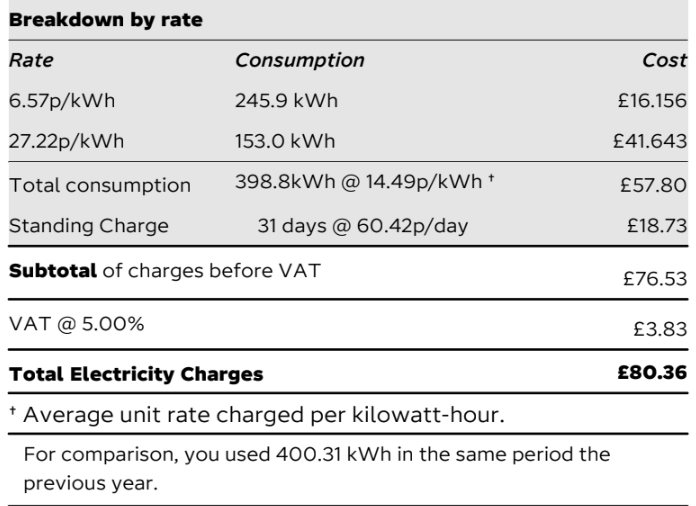
2 EV's 1 does 9K the other 4K a year. Notice average kWh cost 14,49 kWh, way under any variable tariff you could find. Thanks to daytime charging slots @ off peak rate.
IOG, no solar or batteries, gas heating (not required at moment). just for water heating S/C is more than gas usage.
 Life in the slow lane1
 -
There's plenty external tools that pool your usage data from Octopus and conpare across various tarrifs:
But the problem itself is too complex, you cant conpare apples with oranges. You can compare fixed tarrif with another fixed tarrif but thats about it. You cant even compare standard capped one as its price changes every 3 months, going more into ToU tarrifs they changes even every 30mins. Then seasonal consumption, high usage in winter low in summer.
Also pattern shifitng, many years ago when i was on E7 i would do washing overnight - now on Cosy + Solar my cheapest time is between 13-16 so i do most of my electric errons then - so depending on behaviour, each of them can be cheaper.
Then also when you add EV, HeatPump, Battery, Solar.. this gets really tricky. No tool could give you the answer.. and each tarrif could be cheapest if you adapt to it - fixed rate + solar - charge car during sunny days, E7/EV tarrif - do all at night.. Find out what uses the most in summer/ winter and see what would work cheapest for you - once you selected your one - compare that with competition.
0 -
Thanks everyone.
I recognised the complexity of the problem as I said, but I just thought that it was worth airing the subject. I have considered all the various things you've mentioned already, but I thought that someone might have considered how to do a real comparison. Obviously you can't predict future uses accurately, but you ought to be able to take past use and then do a comparison across the different tariffs without having to create a complex spreadsheet calculation engine.
Having the half hourly data over an extended period of time (as provided from the Octopus portal) is all very well, but over a period of a year this results in a spreadsheet with 48x365 rows which isn't exactly easy to manage. Although this doesn't break the Excel limit, it does make it an enormous task to work with.
Anyway, thanks again for contributions.
0 -
Obviously you can't predict future uses accurately, but you ought to be
able to take past use and then do a comparison across the different
tariffs without having to create a complex spreadsheet calculation
engine.You can, just use the link posted earlier in this thread, but it is not really a useful comparison.
If you want a more helpful approach split the problem into two halves, broadly summer and winter as the best tariff will often not be the same.
Then you just need to consider the cheapest way to get through a typical day rather than trying to examine it all HH by HH.
For me, with a large battery and an EV I am going to get through a winter day with the cheapest import I can get overnight to charge the battery and then aim to not use grid power for the rest of the time so an EV tariff with enough cheap overnight hours fits the bill.
Over summer you can factor in the export potential and the SEG rate to see if there is a better option given you size of solar array, and ability to time-shift with the battery.
For me it does work out to be the same EV tariff but I have a relatively small array.
0 -
Many thanks MWT. The Agile Buddy has developed quite a lot since I last saw it, so I'll have a look at that. I hope I can factor in export too as the summer months (with the ASHP only heating water) allow me to build up quite a lot of credit!
Cheers.
0






Confirm your email address to Create Threads and Reply

Categories
- All Categories
- 355.7K Banking & Borrowing
- 254.9K Reduce Debt & Boost Income
- 456.1K Spending & Discounts
- 248.3K Work, Benefits & Business
- 605.8K Mortgages, Homes & Bills
- 179K Life & Family
- 263.6K Travel & Transport
- 1.5M Hobbies & Leisure
- 16.2K Discuss & Feedback
- 37.7K Read-Only Boards