We’d like to remind Forumites to please avoid political debate on the Forum.
This is to keep it a safe and useful space for MoneySaving discussions. Threads that are – or become – political in nature may be removed in line with the Forum’s rules. Thank you for your understanding.
IMPORTANT: Please make sure your posts do not contain any personally identifiable information (both your own and that of others). When uploading images, please take care that you have redacted all personal information including number plates, reference numbers and QR codes (which may reveal vehicle information when scanned).
📨 Have you signed up to the Forum's new Email Digest yet? Get a selection of trending threads sent straight to your inbox daily, weekly or monthly!
POPLA appeal - P4Parking PCN during unloading at residential development



Hi everyone,
Apologies for the length of the post.
I'm now at the POPLA stage after my keeper appeal was rejected.
I've spent the last few weeks reading the NEWBIES thread, BPA CoP, and Jopson v Homeguard ruling, but before I submit my POPLA appeal I'd really appreciate a sense check.
Background
The PCN was issued by P4Parking for "Parked in a No Parking Zone."
The vehicle is a commercial courier van making a genuine pre-booked delivery of a bulky household appliance to a resident of a modern tower block development.
The stop lasted around 10 minutes before leaving immediately for the next scheduled delivery.
I can evidence this with:
- Proof of Delivery;
- delivery photograph;
- live GPS tracking;
- job timestamps;
- dashcam recording from a different day showing the layout of the road that the driver took;
- operator photographs.
So there is no dispute that this was a genuine commercial delivery rather than someone leaving a vehicle.
The management company's explanation
Following my complaint to the landowner, the management company informed me that delivery drivers are expected to obtain a temporary permit from the concierge before unloading.
This surprised me because nothing on the route suggested that such a requirement existed.
I therefore revisited the development, photographed every relevant sign and recorded the entire route from the entrance to the delivery location.
I also emailed the management company asking:
- where this requirement is displayed;
- whether there is any publicly available guidance;
- where the direction to the concierge is signed;
- how a first-time visiting delivery driver is expected to know this requirement.
Nearly three weeks later, I have received no reply.
Signage/road layout
This is where I think the case becomes unusual.
The development contains:
- double red route style road markings on entry;
- these then change into cul-de-sac with single red route style markings immediately after some parking laybys for 'Visitors only';
- part of the development is fenced off, with construction of new blocks taking place; these are most of the parking bays on site according to Google Maps footage;
- Exactly where the single red line is, there is a permanent sign stating:
Visitors & Deliveries
7am-7pm →
7pm-7am ←
and another one with 'No Parking at Any Time'
This is also where the driver stopped to unload.
What really caught my attention is that they appear to have deliberately used double and single red route markings throughout the estate.
On the public highway, single red route markings have an established meaning.
Double red means no stopping. Single red means stopping restrictions apply only during the hours shown on accompanying signs.
Here, the sign adjacent to the single red line does not explain any stopping restriction. Instead, it is a directional sign specifically referring to Visitors & Deliveries with different directions depending on the time of day.
As a first-time delivery driver, I would naturally interpret that sign as directing deliveries during the relevant hours, not as indicating that deliveries are prohibited unless I had first visited an unidentified concierge to obtain a permit.
To me, the directional sign actually reinforces the impression that deliveries are expected and catered for within the development.
In both the P4Parking evidence photos and dashcam footage on different days, there were other vehicles parked at the same spot making deliveries.
Concierge permit requirement was not communicated to visiting motorists
Only after submitting my initial appeal did I learn, through correspondence with the landowner/management company, that delivery drivers are expected to obtain a temporary permit from the concierge before unloading.
This alleged requirement was not mentioned anywhere on the signage relied upon by P4Parking, nor was it explained in the Parking Charge Notice. It first emerged only after I contacted the landowner to understand how a first-time visiting delivery driver was expected to comply.
Following receipt of that information, I revisited the development and carried out a comprehensive survey of the site. I photographed every relevant sign and recorded the complete approach route from the site entrance to the delivery location from a driver's perspective.
My findings were clear.
The first prominent sign encountered after turning left towards the residential buildings states "Deliveries Only." Shortly afterwards, the driver encounters the estate's permanent wayfinding sign directing "Visitors & Deliveries" towards the apartment blocks. These signs naturally lead a first-time visiting courier towards the delivery destination and reinforce the impression that deliveries are expected and accommodated within the development.
However, despite surveying the entire route, I was unable to identify any sign that informs a first-time visiting delivery driver:
- that a concierge service exists;
- where the concierge is located;
- that delivery drivers must report there before unloading;
- that a temporary permit must first be obtained;
- how such a permit is obtained; or
- that failure to complete this procedure may result in a Parking Charge Notice.
This omission is particularly significant because, in its rejection letter, P4Parking repeatedly states that:
"It is the duty of the driver to read the signage placed on the development."
and
"As a motorist it is your responsibility to read the warning notices on the development..."
I do not dispute that proposition. However, it necessarily follows that the relevant contractual terms must actually be communicated by the signage.
The Private Parking Sector Code of Practice reflects this principle.
Paragraph 3.1.1 requires an entrance sign informing drivers whether parking is permitted subject to terms and conditions or prohibited.
Paragraph 3.1.2 requires the entrance sign to make clear that terms and conditions apply to accessing or parking on the site and to be positioned with regard to the expected speed and direction of approaching vehicles.
Furthermore, paragraph 3.1.2, Note 4 states:
"Where the terms and conditions require the driver to do something off site, such as input their vehicle registration mark inside a pub or restaurant, the sign should make clear how this is to be done."
That guidance is directly applicable here.
The operator and landowner now contend that, before making a delivery, a driver must first locate the concierge and obtain a temporary permit. That is precisely the type of additional off-site action contemplated by Note 4. Yet the signage contains no reference whatsoever to the concierge, no directions to its location, and no explanation of the alleged permit procedure.
Instead, the signage positively directs deliveries towards the residential buildings.
To me, that seems odd. If obtaining a concierge permit is genuinely a condition of making deliveries, I'd have expected the estate's own 'Deliveries Only' and 'Visitors & Deliveries' signs to mention it.
Jopson v Homeguard
The allegation is:
Parked in a No Parking Zone.
The vehicle was unloading a bulky item to a resident on the 11th floor before immediately leaving for the next delivery.
Paragraph 21 of Jopson v Homeguard 2016 appears directly applicable.
Whether a car is parked, or simply stopped, or left for a moment while unloading, or (to take an example discussed in argument) accompanying a frail person inside, must be a question of fact or degree. I think in the end this was agreed. A milkman leaving his float to carry bottles to the flat would not be “parked”. Nor would a postman delivering letters, a wine merchant delivering a case of wine, and nor, I am satisfied, a retailer’s van, or indeed the appellant, unloading an awkward piece of furniture. Any other approach would leave life in the block of flats close to unworkable, a consideration which those instructing Miss Fenwick seemed reluctant to accept. I am quite satisfied, and I find as a fact, that while the appellant’s car had been stationary for more than a minute and without its driver for the same period (whatever precisely it was), while she carried in her desk, it was not “parked”. Accordingly, for that reason too, the appellant was not liable to the charge stipulated in the respondent’s notice.
HHJ Harris KC therefore drew a clear distinction between parking and temporarily stopping to unload goods at residential premises. The judgment recognises that deliveries are an ordinary and necessary incident of residential life and that treating every stationary vehicle as "parked" would make the normal operation of a block of flats "close to unworkable".
By contrast, the Private Parking Sector Code of Practice adopts, for the purposes of the Code, a definition of "parked" that includes any vehicle that is stationary other than in the course of driving. Whilst I acknowledge that this definition applies only for the purposes of the Code, it should not displace the ordinary meaning of "parked" recognised by HHJ Harris in Jopson, particularly where the allegation itself is that the vehicle was "Parked in a No Parking Zone."
The estate itself also appears to recognise that deliveries are an ordinary incident of residential life by installing permanent Visitors & Deliveries wayfinding signs.
If deliveries are expected, why is the alleged concierge permit procedure not communicated on those signs?
Reliance on undisclosed evidence
The rejection letter states that my appeal was considered not only against my submissions and the photographs taken by the warden, but also against:
"...all additional 3rd party information available to us..."
The operator neither identifies nor discloses what this "additional 3rd party information" comprises, despite expressly stating that it formed part of the evidence relied upon in rejecting my appeal.
This omission is significant.
The management company has subsequently informed me that delivery drivers are expected to obtain a temporary permit from the concierge before unloading. However, the operator has never produced any evidence demonstrating:
- where this alleged requirement is communicated to first-time visiting delivery drivers;
- that such a procedure forms part of the contractual terms displayed on site;
- that the concierge permit process is publicly available to visiting motorists;
- or that the driver could reasonably have become aware of this requirement before entering into the alleged contract.
Instead, the rejection simply repeats the generic assertion that motorists must comply with the signage, whilst failing to identify any sign that communicates the alleged concierge permit requirement.
If the operator intends to rely upon internal instructions, information supplied by the management company, or any other third-party material to establish the existence of this contractual obligation, fairness requires that such evidence be disclosed. It cannot rely upon undisclosed material whilst simultaneously asserting that the driver was contractually bound by terms that were never communicated on the signage.
The operator has therefore failed to explain how a first-time visiting delivery driver, acting reasonably and following the on-site wayfinding signs, could have become aware of a mandatory concierge permit procedure before stopping to complete a genuine delivery.
My questions
- Does this sound like the right approach for POPLA?
- Is the concierge permit issue stronger than the red route/signage argument?
- Has anyone argued successfully that using Highway Code-style road markings together with private contractual restrictions creates ambiguity rather than adequate notice?
- Am I overlooking any stronger arguments?
Many thanks in advance.
Comments
-
Don't rush to try POPLA. You have a month so let's discuss this.
The PCN was issued by P4Parking for"Parked in a No Parking Zone."The vehicle is a commercial courier van making a genuine pre-booked delivery of a bulky household appliance to a resident of a modern tower block development.Why hasn't the resident complained to the managing agent to cancel it?
Was the NTK addressed to a company?
Please show both sides of that PCN with your data, the vehicle reg and all refs/QR codes covered, but all dates and times showing.
PRIVATE 'PCN'? DON'T PAY BUT DON'T IGNORE IT (except N.Ireland).
CLICK at the top or bottom of any page where it says:
Home»Motoring»Parking Tickets Fines & Parking - read the NEWBIES THREAD2 -
I have until 16/7/2026 to appeal to POPLA.
Please show both sides of that PCN with your data, the vehicle reg and all refs/QR codes covered, but all dates and times showing.
The NTK letter seems like the template that is pinned in the forum, as a complaint with the POFA requirements.
Why hasn't the resident complained to the managing agent to cancel it?
I haven't contacted the resident. Complaint to the management company myself. Firstly received a brush-off message to appeal to P4Parking. When the appeal was rejected, I received a message along the lines of 'I forwarded this to the managing agent for clarification' or something in those lines. I'd prefer to avoid involving my customers with disputes like that.
Was the NTK addressed to a company?
It's a sole trader business. The van is registered to a person, not an LTD entity.
I can attach the appeal rejection letter, but wasn't sure if it's too much for whoever might scroll this thread for intel, since the letter has handwritten paragraphs amongst other template parts.
AI Summary of the appeal rejection letter is as follows:
The operator rejected the appeal on the basis that the vehicle was "Parked in a No Parking Zone" and that P4Parking is authorised by the landowner to enforce the site's parking regulations. It asserts that motorists entering private land enter into a contractual agreement to comply with the displayed terms and conditions.
The rejection does not engage with the individual grounds raised in the appeal. Instead, it relies almost entirely on general statements that:
- it is the driver's responsibility to read and comply with the signage;
- the signs clearly state that unauthorised parking or parking outside the site's regulations will result in a Parking Charge;
- the warning notices in the area state "NO PARKING AT ANY TIME"; and
- the patrol officer acted correctly in accordance with the landowner's instructions.
The operator further states that it considered not only the appeal and the warden's photographs, but also "all additional 3rd party information available to us." However, the rejection does not identify what that information is, whether it formed part of the decision-making process, or provide any opportunity for the appellant to understand or challenge it.
Beyond these generic assertions, the rejection contains no explanation as to why the specific issues raised in the appeal were rejected, no analysis of the circumstances, and no reference to any evidence beyond the photographs attached to the letter. Instead, it concludes that the Parking Charge was issued correctly and advises that any further challenge must now be made to POPLA.
Issues mentioned in the initial appeal, on top of the template from the forum, were that the vehicle was on site for approximately 10 minutes while completing the delivery of white goods to one of the flats in the development.
0 -
All your points are valid - for a court claim.
At Popla, kangaroos become involved. Are there signs? Is there a landowner agreement? Were there hatchings on the ground?
Tick. Tick. Tick.
Appeal rejected.
Nothing to lose though and they sometimes withdraw before Popla get they paws on it.3 -
Dates / times have been covered over.
You can also reveal the location.
2 -
Infringement happened on 8/7/2026. NTK is dated 10/7/2026. I received it on the 14th and revisited the site on the 22nd of July.
The location is a new flat development at Royal Arsenal, London.All your points are valid - for a court claim.
What's the difference?
At Popla, kangaroos become involved. Are there signs? Is there a landowner agreement? Were there hatchings on the ground?
From what I understood from the BPA CoP, the sole fact that there are signs in place is not a determinative argument in favour or against. Signs have to follow specific characteristics.
If there is landowner agreement that allows a permit for deliveries, this should be clearly communicated to visiting drivers; otherwise, simply stating 'Permit holders only' won't be effective. One of the signs on site (on the parking layby bay) says 'Visitors parking only; Vehicles must display valid visitor permit'. I doubt that this would refer to a moped delivery driver dropping takeaway from local McDonald's or, as in the picture, an Ocado driver. My reasoning follows common sense and the judgement from the Jopson v Homeguard ruling, but as you guys keep saying, this industry is the Wild West, and I am aware of it, as my wife got fined as an NHS worker attending an elderly resident once (this was revoked at the POPLA stage).
What I plan to do is - as advised, prepare a comprehensive 'review of the site' showing that what they are expecting vs communicating is not what they should. As advised, create a long, boring appeal.
1 -
All your points are valid - for a court claim.@sh44ggy
"What's the difference?"Judges make proper decisions based on the law, liability and fairness/prominence of terms, plus case law like Jopson.
POPLA…don't.
Anyway what an amateurish piece of paper!
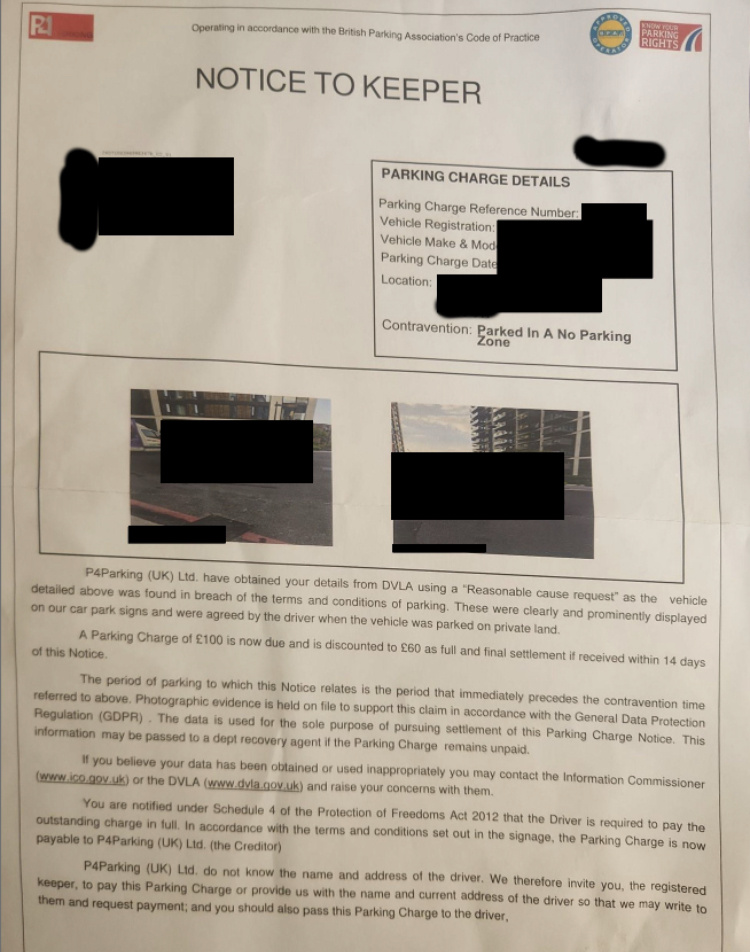
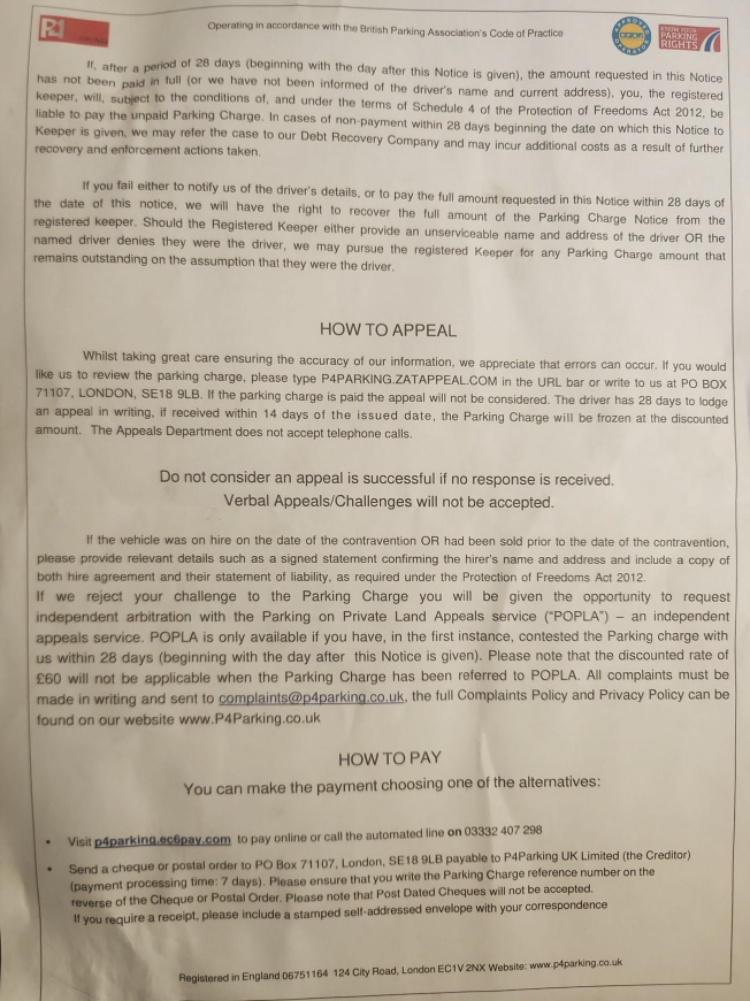 PRIVATE 'PCN'? DON'T PAY BUT DON'T IGNORE IT (except N.Ireland).
CLICK at the top or bottom of any page where it says:
Home»Motoring»Parking Tickets Fines & Parking - read the NEWBIES THREAD2 -
their “deliveries this way” sign is like Wile E Coyote putting up a sign saying bird seed, it’s a trap.
Like the road runner you will escape this ;)
Always remember to abide by Space Corps Directive 39436175880932/B:
'All nations attending the conference are only allocated one parking space.'
247advice dot uk has more information and guidance on dealing with this Outrageous Scam.4 -
Out of curiosity, if a keeper has not identified the driver, is there any way to rely on the driver's recollection of events without effectively identifying them?
For example, if the driver says they spoke to the parking attendant, who allegedly confirmed that no PCN would be issued because it was a genuine delivery, but a PCN was later received.
Had the attendant indicated that a PCN would be issued, the driver says they would have asked for the attendant's details and immediately preserved the dashcam footage. Instead, believing the matter had been resolved, the footage was overwritten in the normal course of use.
Obviously a signed witness statement would identify the driver, which defeats the purpose of keeping the driver's identity undisclosed. So is there any procedural way of relying on that evidence, or is it effectively unusable unless the driver is identified?
0 -
"
Onlyaftersubmitting my initial appeal did I learn, through correspondence with the landowner/management company, that delivery drivers are expected to obtain a temporary permit from the concierge before unloading.This alleged requirement was not mentioned anywhere on the signage relied upon by P4Parking, nor was it explained in the Parking Charge Notice. It first emerged only after I contacted the landowner to understand how a first-time visiting delivery driver was expected to comply.Following receipt of that information, I revisited the development and carried out a comprehensive survey of the site. I photographed every relevant sign and recorded the complete approach route from the site entrance to the delivery location from a driver's perspective.My findings were clear.Thefirst prominent signencountered after turning left towards the residential buildings states"Deliveries Only."Shortly afterwards, the driver encounters the estate's permanent wayfinding sign directing"Visitors & Deliveries"towards the apartment blocks. These signs naturally lead a first-time visiting courier towards the delivery destination and reinforce the impression that deliveries are expected and accommodated within the development.However, despite surveying the entire route, I was unable to identify any sign that informs a first-time visiting delivery driver:that a concierge service exists;where the concierge is located;that delivery drivers must report there before unloading;that a temporary permit must first be obtained;how such a permit is obtained; orthat failure to complete this procedure may result in a Parking Charge Notice."the driver says they spoke to the parking attendant, who allegedly confirmed that no PCN would be issued because it was a genuine delivery, but a PCN was later received."
This is why the statutory Code needs to say that windscreen PCNs MUST be issued on the spot in cases where a 'warden' on foot is there.
Taking sneaky pics to upload to the parking firm back office, whilst lying to the driver that "no PCN will be issued" then later posting a PCN, is a typical scam seen all too often.
P4Parking need reporting to the CMA for this entrapment.
Read the CMA's Open letter to the parking sector last month (Google it, you'll see) and read other threads about people reporting parking firms for rogue conduct. You can do the same.
Issuing later PCNs by post when they could & should have been affixed to the windscreen after a fair observation period) encourages poor practice and all too often lulls the driver into a false sense of security … and often leads to multiple PCNs.
It is also unjustified DVLA data harvesting and unnecessary pursuit of a third party (the registered keeper, which in 30% of cases is a Lease/Hire firm who will just pay up, charging the hirer who is then denied their right to appeal) rather than issuing a timely 'consumer notice' to the driver like local authorities have to in car parks.
Getting DVLA data and issuing postal PCNs should be last resort, not first resort. So says the ICO in the surveillance camera guidance AND they said the same thing to the DCLG in 2015 when the current private parking reform was first mooted:
PRIVATE 'PCN'? DON'T PAY BUT DON'T IGNORE IT (except N.Ireland).
CLICK at the top or bottom of any page where it says:
Home»Motoring»Parking Tickets Fines & Parking - read the NEWBIES THREAD4 -
Obviously a signed witness statement would identify the driver, which defeats the purpose of keeping the driver's identity undisclosed. So is there any procedural way of relying on that evidence, or is it effectively unusable unless the driver is identified?Of course not! Just say "the driver will not be named but reports that …"
DEFINITELY talk about the warden lying to the driver then taking sneaky photos to deliberately generate a late notice by post. Also state the family will be showing their evidence of entrapment to the CMA this month because the signage is extremely poor, invites deliveries, doesn't warn about the need to 'register' with the concierge and the warden lied to the driver AND failed to affix a PCN to the windscreen, which would have been a timely consumer notice.
Please can you show us the sign inviting deliveries? I'd like to see it.
PRIVATE 'PCN'? DON'T PAY BUT DON'T IGNORE IT (except N.Ireland).
CLICK at the top or bottom of any page where it says:
Home»Motoring»Parking Tickets Fines & Parking - read the NEWBIES THREAD4









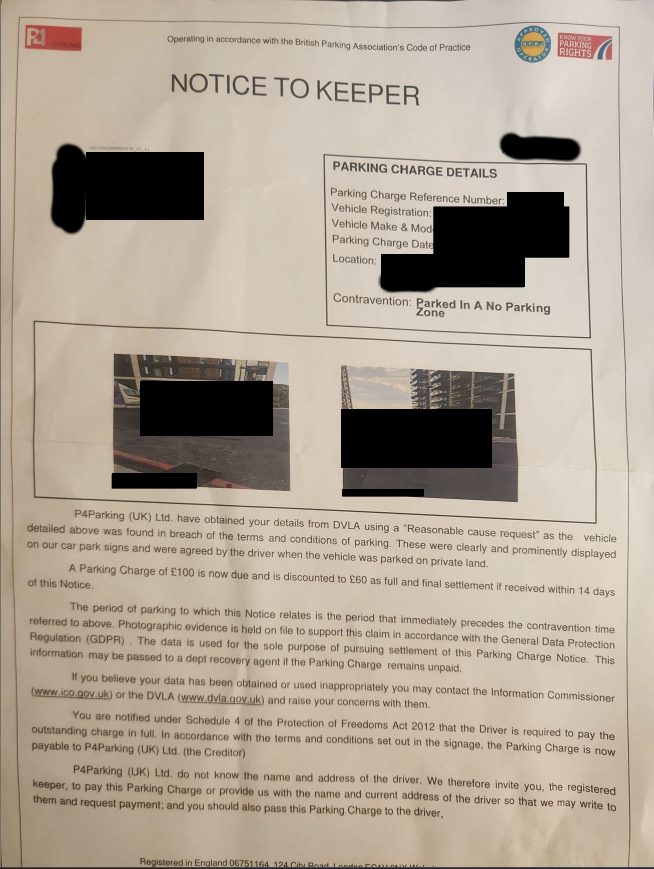
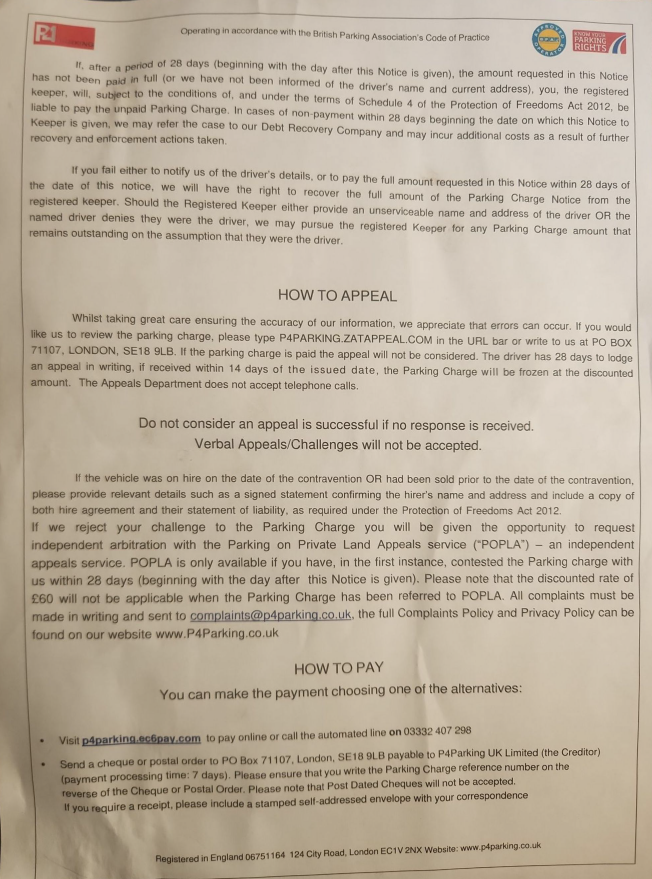
Confirm your email address to Create Threads and Reply

Categories
- All Categories
- 355.8K Banking & Borrowing
- 254.9K Reduce Debt & Boost Income
- 456.2K Spending & Discounts
- 248.3K Work, Benefits & Business
- 605.9K Mortgages, Homes & Bills
- 179K Life & Family
- 263.7K Travel & Transport
- 1.5M Hobbies & Leisure
- 16.2K Discuss & Feedback
- 37.7K Read-Only Boards