We’d like to remind Forumites to please avoid political debate on the Forum.
This is to keep it a safe and useful space for MoneySaving discussions. Threads that are – or become – political in nature may be removed in line with the Forum’s rules. Thank you for your understanding.
CEL court claim - defence due 29 July - landowner requested leniency but was denied


Hi all, I’ve read the Newbies thread and the CEL thread. Defence due 29 July — fairly confident in what we have but would welcome a review, particularly on two specific points.
The basics:
• Claimant: Civil Enforcement Limited
• Site: Leagrave Road, Luton
• Date of incident: August 2025
• Registered keeper: defendant (my wife)
• Driver: not admitted at any stage in any formal correspondence
• Overstay: approximately 25 minutes after paying for one hour via RingGo
Appeal history:
• Internal appeal submitted in keeper’s name — rejected
• POPLA appeal submitted and rejected
• Letter Before Action received and responded to — driver not admitted, POFA compliance challenged
• Acknowledgement of service filed
• Defence due 29 July
Background
After receiving the court claim we contacted the landowner directly to explain the circumstances. The landowner was sympathetic and contacted CEL on our behalf requesting goodwill cancellation or reduction to the original PCN amount.
CEL responded to the landowner in writing. In that response they made two statements which are demonstrably inaccurate:
1. That “the driver was sent at least 5 letters regarding their PCN” — in fact all correspondence was sent to the registered keeper only. The driver’s identity has never been established or admitted at any stage in any formal correspondence.
2. That the recipient “had the opportunity to appeal and dispute their PCN within 28 days of the date of issue, but they failed to do so” — in fact a formal internal appeal was submitted and rejected, followed by a full POPLA appeal. Both are fully evidenced.
These inaccurate statements were made directly in response to the landowner’s goodwill request and had the effect of frustrating it. We have this correspondence in writing and intend to include it in our evidence bundle.
Important question on driver identity
In our letter to the landowner, written on behalf of my wife as registered keeper, we described the circumstances of the overstay including that the occupants of the vehicle were delayed returning. We did not explicitly identify who was driving but we did reference that a pregnant woman was among the occupants. CEL now have this letter via the landowner’s forwarded correspondence.
We never formally identified the driver in any appeal or legal correspondence. However given CEL can see we were present at the scene, we’d welcome expert views on whether the “driver not admitted” position remains tenable and how robust it is at this stage.
Proposed defence:
1. The Defendant denies that the Claimant is entitled to the relief claimed, or to any relief at all.
2. It is admitted that the Defendant was the registered keeper of the vehicle. It is not admitted that the Defendant was the driver on the material date, and the Claimant is put to strict proof of the identity of the driver or, alternatively, of full compliance with the requirements of Schedule 4 of the Protection of Freedoms Act 2012 in order to establish keeper liability.
3. It is admitted that payment for parking was made via the RingGo system. The dispute concerns an alleged overstay following the expiry of the paid parking session, not an allegation that no payment was made.
4. The Defendant denies that the Claimant has proved any breach of contract. The Claimant relies solely upon ANPR images recording the vehicle entering and leaving the site. Such images do not establish the actual period during which the vehicle was parked and do not account for the time reasonably spent entering, parking, loading, boarding or exiting the site.
5. The Particulars of Claim are sparse and fail to set out sufficient facts to establish a cause of action, including the contractual terms allegedly breached or how the sum claimed has been calculated. The Defendant reserves the right to expand upon this Defence following disclosure of the Claimant’s evidence.
6. The Defendant puts the Claimant to strict proof of a contemporaneous and currently valid landowner agreement conferring authority upon Civil Enforcement Limited to issue parking charges and commence proceedings at the material site. The Defendant notes that the Confirmation of Authority disclosed in the Claimant’s POPLA evidence pack is dated June 2017 and puts the Claimant to strict proof that this document remains valid and in force.
7. The Claimant has added sums in excess of the original parking charge. The Defendant denies
My specific questions:
1. Is the defence appropriate to file as drafted?
2. Given the landowner correspondence described above, is the “driver not admitted” position still robust?
3. Is paragraph 8 on CEL’s inaccurate statements appropriately worded?
4. Is the 2017 authority document point in paragraph 6 worth keeping?
5. Any other points missed?
Many thanks in advance.
Comments
-
I would suggest that the defendant sticks to the 10 paragraph template defence in announcements near the top of the forum, especially if the alleged breach was pleaded in the POC
Adapt paragraphs 2 & 3 only, to suit, ensuring that the POC is refuted
No exhibits or documents are included in the defence submission ( using MCOL. )
Post a redacted picture of the POC from the lower left of the claim form below after hiding the VRM details first
5 -
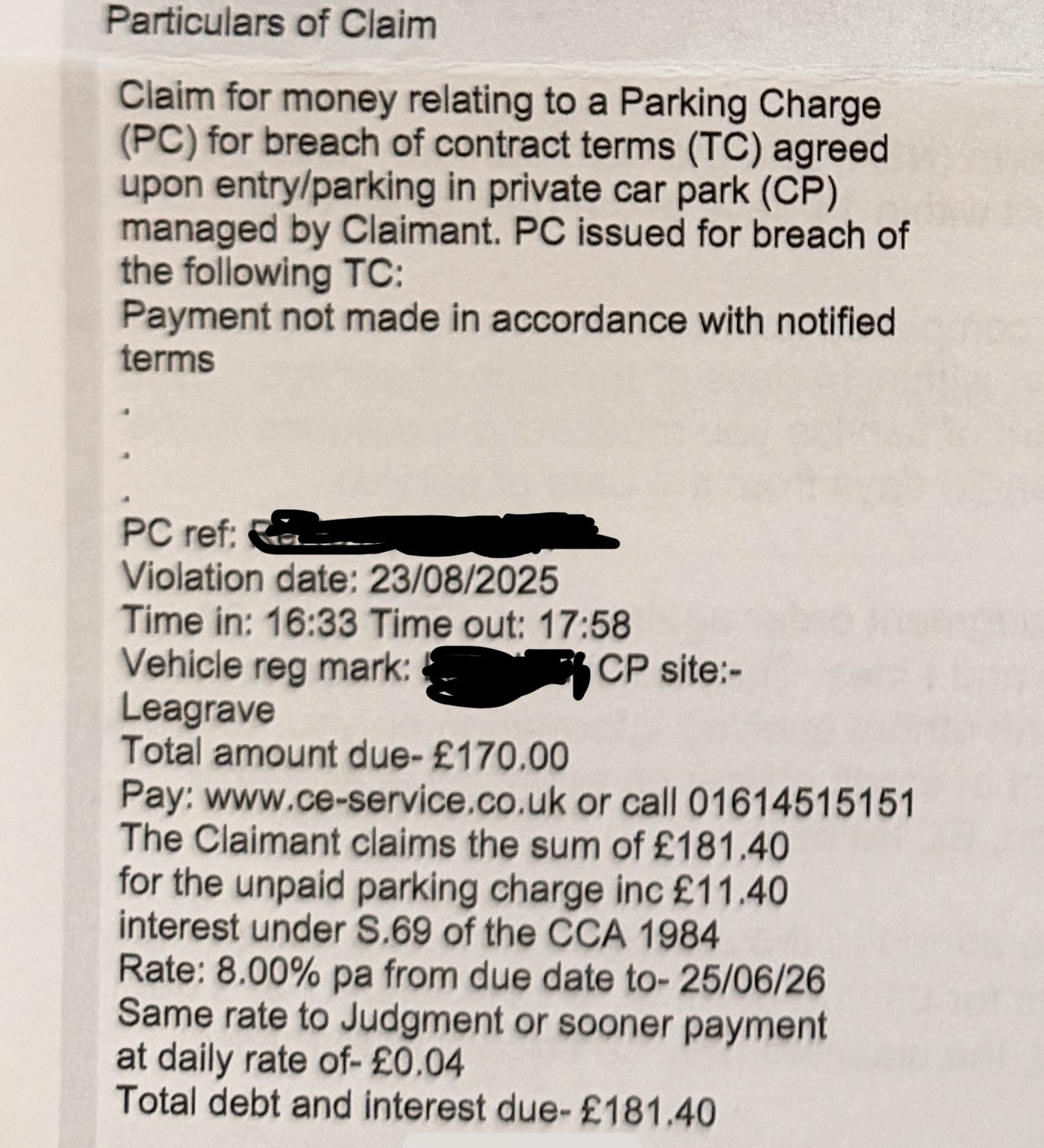
Hi, thank you for the advice to use the standard template and adapt paragraphs 2 and 3 only.
POC attached above.
the updated version includes an 11th point should this be included?
adapted 2 and 3 below:2. The allegation is denied. The Defendant admits being the registered keeper of the vehicle. Payment was made via RingGo for a one hour parking session on the date in question. The dispute concerns an alleged overstay only — it is not alleged that no payment was made.
3. The Defendant is unable to confirm who was driving on the material date and no evidence has been produced to establish this. There can be no keeper liability in this case. Research has proved that this Claimant has never used the provisions of Schedule 4 of the POFA 2012 and they know, or should know, that they cannot hold registered keepers
I have three specific questions before filing.
Paragraph 3 and POFA
The template states “Research has proved that this Claimant has never used the provisions of Schedule 4 of the POFA 2012 and they know, or should know, that they cannot hold registered keepers liable.”
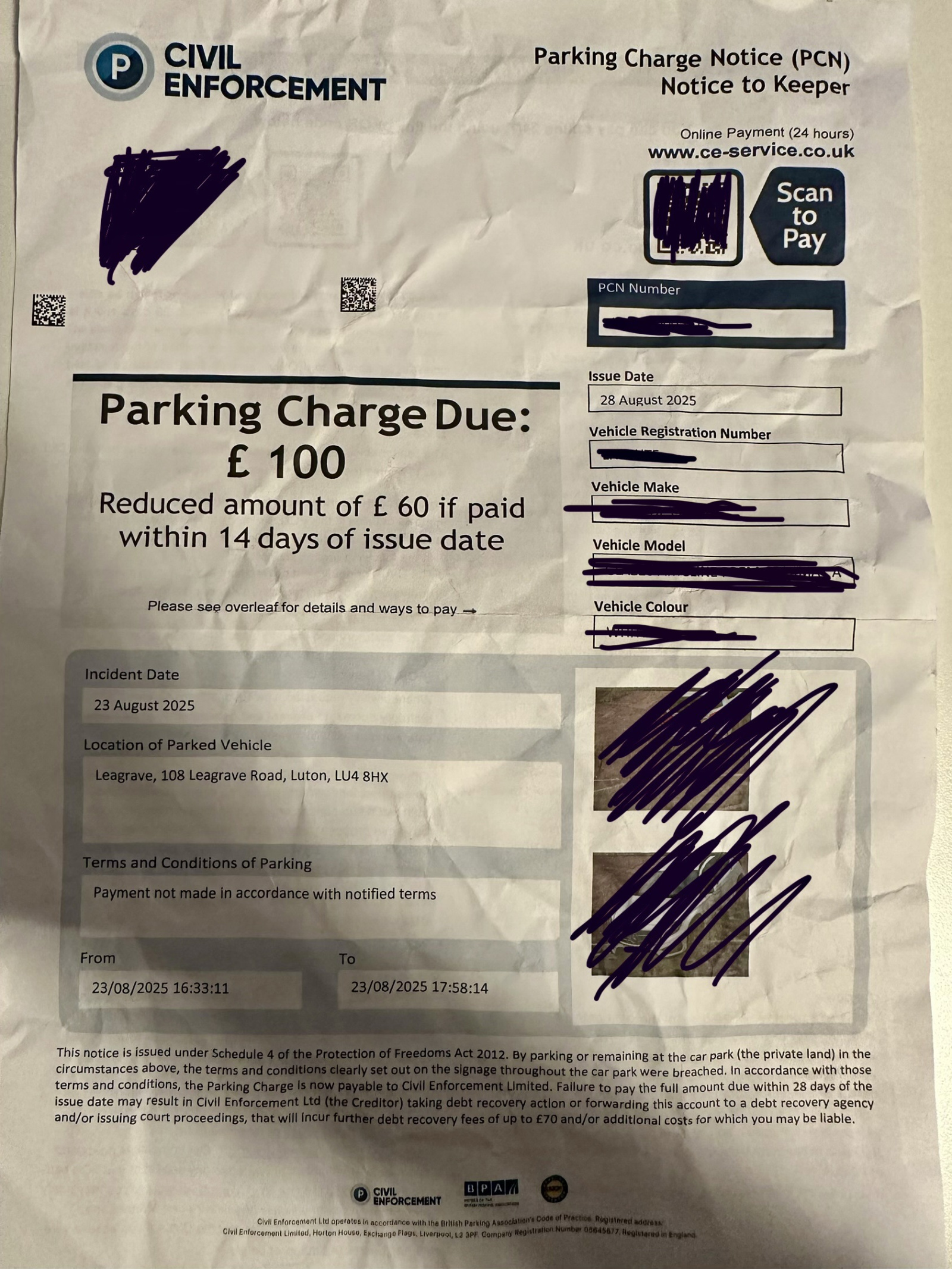
However in our case the NTK was issued on 28 August 2025, just 5 days after the incident on 23 August 2025 — which appears to be within the 14 day window required by Schedule 4. Does this assertion still apply to CEL specifically, or does it need amending given the NTK timing? We don’t want to make a claim in the defence that CEL can easily disprove.
Paragraph 5 and valuable consideration
The template states there was an absence of valuable consideration. In our case payment was made via RingGo for one hour — so consideration was clearly present for that period. Does this line still apply in the context of the overstay period specifically, or does it need adapting given that payment was made?
Paragraph 10 and POFA maximum sum
The template states the claim exceeds the maximum recoverable sum under Schedule 4 POFA. As noted above the NTK appears to have been issued within the required timeframe. Does paragraph 10 still apply if CEL appear to have complied with the POFA timing requirements, or does it only work if there was a procedural failure?
Any guidance on these three points before we file would be hugely appreciated.
0 -
Your paragraph 3 is incorrect , Your POC clearly states the following statement
Payment not made in accordance with notified terms
The actual advertised terms are not stated
The POC says nothing about insufficient payment, or an overstay
Refute the POC, Refute the allegation in the POC, not your perception of the claims
4 -
Thank you so much for your advice. I have redrafted below:
1. The Claimant’s sparse case lacks specificity and does not comply with CPR 16.4, 16PD3 or 16PD7, failing to ‘state all facts necessary for the purpose of formulating a complete cause of action’. Further, the Claimant has improperly added a false ‘fee’ or damages to the original Parking Charge (PC). This sum is not legally recoverable and constitutes an attempt at double recovery, which is unreasonable conduct under CPR 27.14(2)(g). The binding Supreme Court judgment in ParkingEye Ltd v Beavis [2015] UKSC 67 held that an £85 parking charge more than covered all the ‘costs of enforcement’ which HHJ Moloney had listed as the pre-action work of a DVLA look-up and a simple automated letter chain, including a LBC. The same heads of cost cannot lawfully be counted twice and interest should also be disallowed. Exaggerated claims for impermissible sums are good reason for judges to intervene and the court is invited to strike out the claim using its powers under CPR 3.4.
2. The allegation(s) are vague and liability is denied for the sum claimed, or at all. The delay in bringing proceedings lies with the Claimant, making retrieving material evidence difficult, which is highly prejudicial. The Defendant has little knowledge of events, save as set out below and to admit that they were the registered keeper and not the driver, and puts the Claimant to strict proof that the Notice to Keeper was issued in full compliance with Schedule 4 of the Protection of Freedoms Act 2012.
3. With regards to the POC in question, two recent persuasive appeal judgments in Civil Enforcement Limited v Chan (Ref. E7GM9W44) and Car Park Management Service Ltd v Akande (Ref. K0DP5J30) would indicate the POC fails to comply with Civil Procedure Rule 16.4(1)(e) and Practice Direction Part 16.7.5. On the 15th August 2023, in the Chan case, HHJ Murch held: ‘the particulars of the claim as filed and served did not set out the conduct which amounted to the breach in reliance upon which the claimant would be able to bring a claim for breach of contract’. The same is true in this case and the Defendant trusts that the Court should strike out the extant claim, using its powers pursuant to CPR 3.4. The second recent persuasive appeal judgment also held that typical private parking case POC (like this) fail to comply with Part 16. On the 10 May 2024, in CPMS v Akande, HHJ Evans held: ‘Particulars of Claim have to set out the basic facts upon which a party relies in order to prove his or her claim’.
4. It is neither admitted nor denied that a term was breached but to form a contract, there must be an offer, acceptance, and valuable consideration (absent in this case). The Consumer Rights Act 2015 (s71) mandates a ‘test of fairness’ duty on Courts and sets a high bar for prominence of terms and ‘consumer notices’. Paying regard to Sch2 (examples 6, 10, 14 & 18), also s62 and the duties of fair, open dealing/good faith, the Defendant notes that this Claimant reportedly uses unclear (unfair) terms/notices. On the limited information given, this case looks no different. The Claimant is put to strict proof with contemporaneous photographs.
5. DVLA keeper data is only supplied on the basis of prior written landowner authority. The Claimant (an agent) is put to strict proof of their standing to sue and the terms, scope and dates of the landowner agreement, including the contract, updates, schedules and a map of the site boundary set by the landowner (not an unverified Google Maps aerial view).
6. To impose a PC, as well as a breach, there must be: (i) a strong ‘legitimate interest’ extending beyond compensation for loss, and (ii) ‘adequate notice’ (prominence) of the PC and any relevant obligation(s). None of which have been demonstrated. This PC is a penalty arising as a result of a ‘concealed pitfall or trap’, poor signs and covert surveillance, thus it is fully distinguished from Beavis.
7. Attention is drawn to: (i) paras 98, 100, 193, 198 of Beavis (an £85 PC covered all costs and generated a huge profit shared with the landowner); the court should also read paragraph 3.4 of the original judgment by HHJ Moloney in Beavis, confirming what that authority means by ‘costs of the operation’, and (ii) the binding judgment in ParkingEye v Somerfield Stores ChD [2011] EWHC 4023(QB) which remains unaffected by Beavis and stands as the only parking case law that references costs abuse. HHJ Hegarty held in paras 419-428 (his judgment later ratified by the CoA) that ‘costs’ inflating a £75 PC (already increased from £37.50) to £135 were disproportionate to the very minor cost of a letter-chain and ‘would appear to be penal’. The court should note that HHJ Moloney referenced this case in Beavis.
8. The Parking (Code of Practice) Act will curb rogue conduct by operators and debt recovery agents (DRAs). The Government launched a Public Consultation likely to herald a ban on double recovery ‘fees’, which the relevant 2022 Minister called ‘extorting money from motorists’. Both the previous and present Governments found that the high profits may be indicative of firms having too much control ‘indicating that there is a market failure’.
9. Pursuant to Sch4 of the Protection of Freedoms Act 2012 (‘POFA’) the claim exceeds the maximum sum and is unrecoverable: see Explanatory Note 221: ‘The creditor may not make a claim against the keeper … for more than the amount of the unpaid parking related charges as they stood when the notice to the driver was issued (para 4(5))’. There is no keeper liability for added false fees and the POFA specifically states that ‘double recovery’ is not allowed if a creditor uses any other remedy.
10. The Defendant seeks fixed costs (CPR 27.14) and a finding of unreasonable conduct and further costs (CPR 46.5). Parking cases now make up a third of all small claims which has overburdened HMCTS, causing the most CCJs of all sectors yet almost invariably discontinuing defended cases before hearings, which indicates a deliberate business model of systemic abuse and makes Claimants liable for costs (r.38.6(1)). Whilst this does not ‘normally’ apply to the small claims track (r.38.6(3)) the White Book has this annotation: ‘Note that the normal rule as to costs does not apply if a claimant in a case allocated to the small claims track serves a notice of discontinuance although it might be contended that costs should be awarded if a party has behaved unreasonably (r.27.14(2)(dg))’.
Is this good to go?
0 -
Presumably you have only altered paragraphs 2. & 3. ?
Paragraph 2 looks OK to me, a good and reasonable ending
Your paragraph 3 above is now a Chan and Akande defence paragraph, I am unsure if it applies or not so will leave it to other comments or replies
Perhaps draft an alternative paragraph 3, as you did earlier, just in case you cannot use the standard Chan and Akande paragraph ? Then it would be which one is best. ? ( based on the POC. )
2 -
I changed the initial draft to bring it in line with the defence template.
The POC states ‘payment not made in accordance with notified terms’ but does not specify what the terms were, how they were communicated or what specific conduct breached them. Is this not exactly the kind of vague CEL pleading that Chan and Akande address? Or does this wording constitute a sufficiently specified breach to take it outside Chan and Akande?
0 -
To be fair you could use Chan & Akande because "
Payment not made in accordance with notified terms"…doesn't specify what term was breached. And 'Leagrave' doesn't cut it in terms of identifying the private land location.
I would suggest you:
- swap round the order of paras 8 and 9 (I might do this when editing the Template Defence soon!) and
- remove "The delay in bringing proceedings lies with the Claimant, making retrieving material evidence difficult, which is highly prejudicial" because they have not delayed. A claim brought within a year is quick!
- remove the short phrase "and debt recovery agents (DRAs)" later in the template, because CEL don't use them, and
- why not change paragraph 10 completely to this, which introduces the CMA's view about fair & open dealing - TELL ME IF THIS FITS ON MCOL INSTEAD OF THE USUAL PARA 10 ABOUT COSTS, THAT YOU CAN SAVE TILL LATER:
10. It is worth the judge noting that, In July 2026, the UK consumer protection law Regulator - the Competition and Markets Authority ('the CMA') - has weighed in. The CMA has just published open letters to the parking industry and government on what they believe are actions that potentially breach consumer law:
Open letter to private parking operators
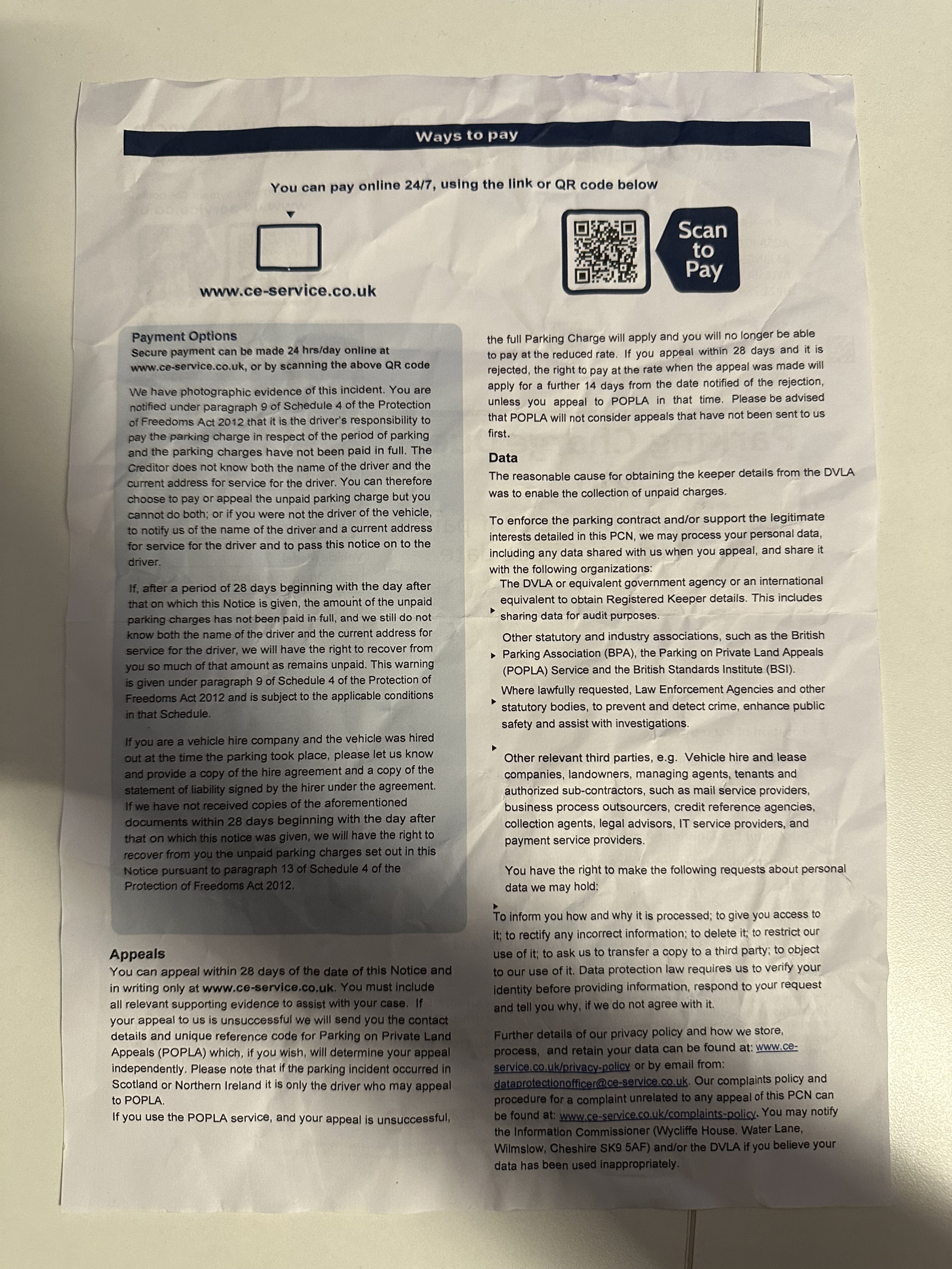
10.1. Paragraph 28 requires Operators to ensure that all substantive correspondence sent to consumers directs them to the Private Parking Sector Single Code of Practice ('the CoP') in order to allow consumers to make better informed decisions on whether to pay, ignore or dispute a PCN. 'Substantive correspondence' includes the Notice to Keeper ('NTK') which in the extant case, fails to direct the consumer to the CoP. The CMA consider that this is a failure to provide material information, ref: section 227(2) of the Digital Markets, Competition and Consumers Act 2024.
10.1.2. The same criticism - a failure to provide material information - can also be made of the NTK's failure to describe the circumstances in which the requirement to pay the parking charges arose. This is equally true of the woeful POC, which fails to particularise the alleged breach or the term, and nor does it properly identify the private land location.
10.2. With the CMA's Open Letter in mind, the Defendant avers that there is a lack of good faith in this Claimant (led by a solicitor and legal team) continuing to churn out boilerplate POC followed (as ever) by a premature, prolix Witness Statement, which this Defendant will not be intimidated by. This is the same Claimant as in CEL v Chan, and they appear to believe they are above the law and above HHJ Murch. Exaggerated claims for impermissible sums and template statements of case which fail to comply with Part 16 are good reasons for judges to intervene and the court is invited to strike out the claim using its powers under CPR 3.4.
PRIVATE 'PCN'? DON'T PAY BUT DON'T IGNORE IT (except N.Ireland).
CLICK at the top or bottom of any page where it says:
Home»Motoring»Parking Tickets Fines & Parking - read the NEWBIES THREAD5 -
Thank you for the suggested changes — have incorporated all four:
• Removed the delay sentence from paragraph 2
• Kept Chan and Akande in paragraph 3
• Removed “and debt recovery agents (DRAs)” from paragraph 8
• Swapped paragraphs 8 and 9
• Replaced old paragraph 10 with the new CMA paragraph
Testing the line count at 75 characters wide it comes in at 119 lines — right on the edge of the 122 limit.
Two questions before filing:
1. Is 119 lines at 75 characters wide safe enough or is it too close to the MCOL limit? Should the old costs paragraph (CPR 27.14 / r.38.6) be removed entirely to give more breathing room, or is it worth keeping given it’s only 3 lines under the limit?
2. Can you confirm the NTK in this case does indeed fail to direct the consumer to the Code of Practice as required by paragraph 28? We want to make sure paragraph 10.1 is accurate before filing.
blob:https://forums.moneysavingexpert.com/bca828f5-2f38-40ae-80db-e5ede31804d8
blob:https://forums.moneysavingexpert.com/7bd4ff2f-3678-40bb-acf4-06be9ff47c33Thank you.
0 -
-
Yes and yes. it's all good.
PRIVATE 'PCN'? DON'T PAY BUT DON'T IGNORE IT (except N.Ireland).
CLICK at the top or bottom of any page where it says:
Home»Motoring»Parking Tickets Fines & Parking - read the NEWBIES THREAD2




Confirm your email address to Create Threads and Reply

Categories
- All Categories
- 355.5K Banking & Borrowing
- 254.8K Reduce Debt & Boost Income
- 456.1K Spending & Discounts
- 248.1K Work, Benefits & Business
- 605.6K Mortgages, Homes & Bills
- 179K Life & Family
- 263.4K Travel & Transport
- 1.5M Hobbies & Leisure
- 16.1K Discuss & Feedback
- 37.7K Read-Only Boards