We’d like to remind Forumites to please avoid political debate on the Forum.
This is to keep it a safe and useful space for MoneySaving discussions. Threads that are – or become – political in nature may be removed in line with the Forum’s rules. Thank you for your understanding.
Where to put my cash to get a decent return
Comments
-
This site does the calculations for you, look at the last column, yield to maturity: www.dividenddata.co.uk/uk-gilts-prices-yields.py
I don't think a 3 year gilt / ILG is attractive enough personally. The good ones are longer duration. You would be looking at around 4.3% or RPI+0.7%, which isn't great.
The only other competitive option I can think of with low enough risk for a 3 year timeframe would be a "mixed MMF" ultra-short bond fund, e.g. Royal London Short Term Fixed Income Enhanced, which would probably compete with the top savings accounts with little effort, but you'd want to hold that on a fixed fee investment platform to avoid losing some of the returns to a platform fee. Even then, the hope would be close to 5% with the base rate where it is now.
1 -
How much money we're talking?
RLSTMM is the same as interests from tax point of view outside ISA.
You say you used already this year CGT, but also mentioned you used the next year? Is that something that you plan to sell next tax year?
Then what about 2028 allowance and 2029 allowance? Buy some funds in GIA and don't sell till then.
CGT in your case is really only 18% so if from £10k you get 10% return CGT would be just £180 meaning you still get 8.2%..
0 -
I have give the wrong information in my earlier post.
Yes, the asset I have sold will be in April 2026/2027 tax year. If I have not other asset to sell, I will start to sell S&S and buy back as S&S ISA (only to change them into tax free status)
Good idea about GIAs with a 3 year time frame, is it doable?
0 -
Is the difference between Royal London Short Term Fixed Income Enhanced and Royal London Short Term money market fund, that the 'enhanced' has slight more fluctuations but aims to
outperform standard money market yields? in 3 years time, I will be withdrawing a portion of this money year by year. I have also got a separate pot of Cash ISA, would it be better to use my cash ISA or you cash to buy this enhanced fund? As I am also looking to buy OEIC or ETFs and hold for 10 years and I know the tax return will not be straight forward so trying to work out the options. I will leave the gilts for now.0 -
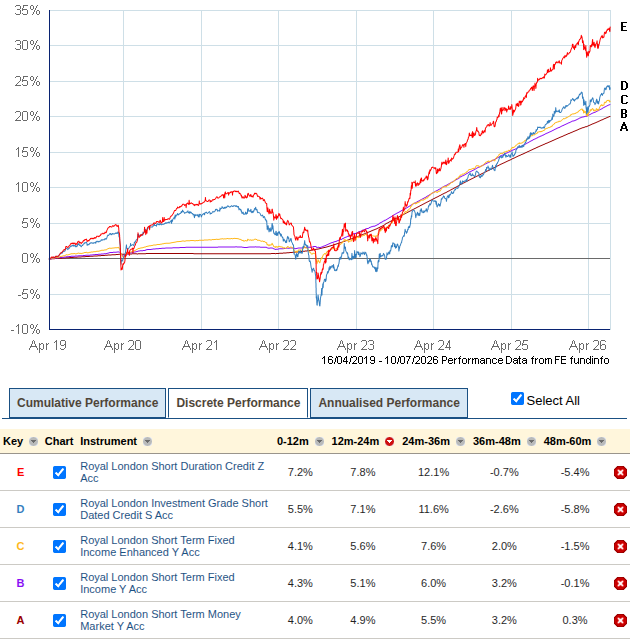
The Enhanced fund (Fund C in yellow below) contains some short-dated corporate bonds, which are the main driver of its outperformance, but these are only about 30% of the fund and so they don't tend to drag the fund down much during bad times. There is also a non-enhanced version (Fund B) which uses covered bonds for a smoother ride.
You can see the spectrum in the chart below. The table covering each of the last ~3 years is the more relevant data, since before 2023 we had near-zero interest rates and a very different economic situation. In the last 12 months, we've had the Iran crisis, which has had an impact on corporate bonds, so you can see the effect on each of the funds vs the year before.
Hopefully this shows the impact of going from the "pure" MMF to the two "mixed" funds. If you just have investment grade corporate bonds (fund D) or high yield corporate bonds (fund E), then it is a much wilder ride.
If you are holding funds outside of your ISA, then OEICs are better than ETFs from a tax reporting perspective because they distribute all of their income, so you can trust your platform's consolidated tax certificate (or simply add up your received dividends if you go for Inc units instead of Acc)
2 -
Yes, you are only subject to tax when you sell above excess, receive dividends above excess.. if you just keep an equity heavy fund with low dividends for many many years then it's all tax free. Then once you ready you can start selling every year within your CGT limits.
1 -
@masonic nice chart, the short duration credit still invests in decently rated corporate bonds with UK banks, infrastructure products etc. also as they're shortdated with big names they're within my safe limit :)
There's another one to your collection:
This one goes for a lot of junk bonds and is the highest risk (4/7).
And just to add - these are seen as Interests from tax point of view - even if you don't sell within a tax year you will need to pay tax on any interests earned (reinvested in ACC)
0 -
Yes, I have held Extra Yield in the past, but I'd say that one is pushing the limit of what's appropriate for a 3 year horizon, as it has more duration risk as well as credit risk. I tend to favour the Investment Trust NCYF for junk bonds, and there was a great buying opportunity in the start of the pandemic due to it moving to a huge discount briefly:
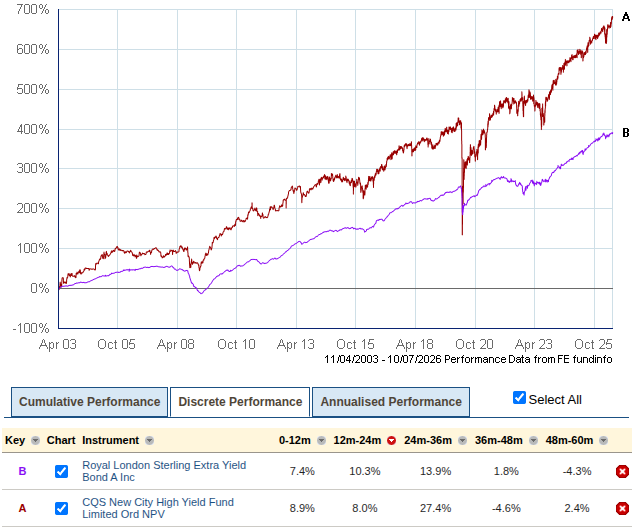
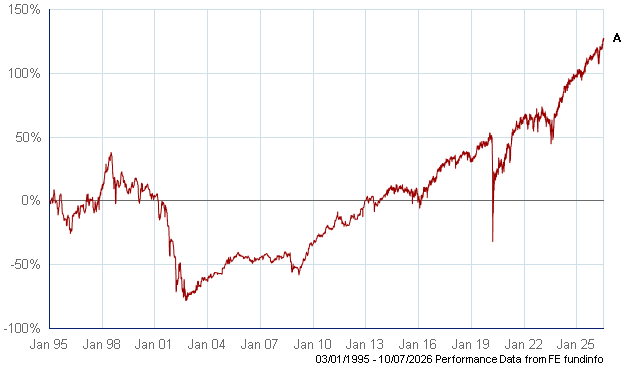
But these are not funds to mess around with. We don't have the historical data for the RL one during the dotcom crash, but NCYF fell a lot more than it did during the 2008 GFC. The July 1995 peak to November 2002 trough was -82% and the recovery to previous high took 20 years!
 2
-
So, what do you reckon is the right balance between the two?
0 -
Musk's X Money offers a 6% return and comes with FDIC insurance of up to $10 million.
-1











Confirm your email address to Create Threads and Reply

Categories
- All Categories
- 355.8K Banking & Borrowing
- 254.9K Reduce Debt & Boost Income
- 456.1K Spending & Discounts
- 248.3K Work, Benefits & Business
- 605.9K Mortgages, Homes & Bills
- 179K Life & Family
- 263.7K Travel & Transport
- 1.5M Hobbies & Leisure
- 16.2K Discuss & Feedback
- 37.7K Read-Only Boards