We’d like to remind Forumites to please avoid political debate on the Forum.
This is to keep it a safe and useful space for MoneySaving discussions. Threads that are – or become – political in nature may be removed in line with the Forum’s rules. Thank you for your understanding.
📨 Have you signed up to the Forum's new Email Digest yet? Get a selection of trending threads sent straight to your inbox daily, weekly or monthly!
Picking a world tracking ETF
Comments
-
Risk adjusted return depends on two variables: return and standard deviation measured over some arbitrary period of time. This metric, however, gives no consideration to structural risk management. Take the example of three funds from Peter Martin and Byron McCann's 1989 book The Investor's Guide to Fidelity Funds:
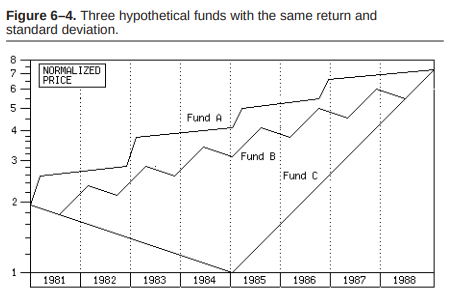
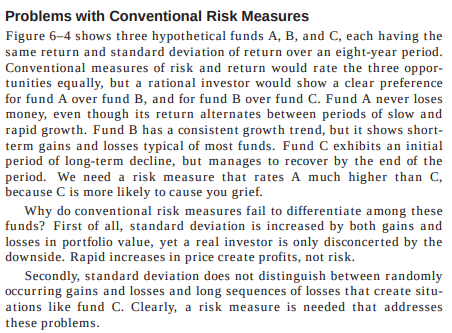
Mathematically, you are correct that whether an investor hold a fixed amount of capital in fund A, B, or C over 8 years, the path doesn't matter as they get the same end result. But if that investor is in drawdown, or has a different time horizon, then the path clearly matters.
It is entirely rational for an investor to seek a smoother ride than the market may provide, and dilution with cash or bonds is certainly not established to be the only or best way to to reduce those tail risks while preserving as much of the median return of the portfolio as possible. In reality, the investor will generally have to give up some returns in exchange for the downside protection, contrary to the thought experiment above.
As the global index concentrates under momentum flows of capital, the index fund inches closer from behaving like Fund B to behaving like Fund C, and it is rational for an investor to take action to counter that, even if it costs them something in terms of their overall return. When the All-World index quietly concentrates a fifth of its entire weight into just seven US technology companies, a passive tracker is no longer a neutral, diversified baseline. The market is making a high-conviction bet on a single sector narrative. Intentionally stepping away from that concentration to protect what you've already accumulated isn't irrational.
When the objective switches from standard deviation (volatility) to a drawdown constraint, standard Modern Portfolio Theory breaks down. One needs to look to things like historical back-testing and Monte Carlo analysis to understand how various portfolios would fare under different economic conditions. These tests cannot predict the future, but if a portfolio doesn't perform very well under a set of realistic, historically proven, test conditions, it is unlikely to fare any better when it comes into contact with future conditions. In such analysis, simple equity:bond portfolios do not fare particularly well.
Ultimately, because the future is unknowable, there is no single, universally rational choice or perfect asset allocation template. Every design involves trade-offs. However, it is irrational to ignore these issues, or to assume that a market-cap-weighted index automatically solves them for you, given the market is only optimising to maximise conventional risk-adjusted return (where Funds A-C are equivalent). For an investor managing real-world liabilities and a finite timeline, the truest form of rationality is understanding your specific vulnerabilities and deliberately engineering a portfolio to defend against them.
4 -
Whatever are you talking about? Or is it a quotation? Would the images provide a clue if they displayed?
0 -
Images should be fixed now.
0 -
Basically it is nonsense. Why should we believe that the market calculates risk and return over the last 8 years? Why should we believe that the market assesses risk by volatility alone? More to the point the simplest volatility model assumes geometric Brownian motion. The path taken is entirely a matter of chance. "As the global index concentrates under momentum flows of capital…" That is nonsense. Fresh capital allocated to market weighted trackers is allocated in exactly the same way as existing capital. Active investors determine the prices, not passive investors.
Nobel laureate William Sharpe famously coined the decumulation phase of retirement "the nastiest, hardest problem in finance" due to the complexities of inflation, fluctuating market returns, and life expectancy. He proposed his Lockbox Drawdown Strategy, but I do not expect that it converts base metal into gold. Thankfully, I have secure pension income.
0 -
The 8-year timeline wasn't a claim about how the market operates - it was a simple thought experiment from the authors to demonstrate standard deviation treats short-term noise and prolonged, structural destruction of capital exactly the same. You stated that the market opimises for risk-adjusted return (and I agree with you about that). Risk adjusted return is dependent on those two variables alone.
Today's global index is unarguably concentrated in US mega-tech (yes, that is driven by active momentum investors, not passive investors), and the US weighting in general is beginning to become problematic. History has taught us that during extreme market events, while equities can all fall together initially, different sectors and regions fare very differently as the situation evolves. Because it is impossible to predict which sectors will be hit hardest by a future shock, it is a matter of basic prudence not to place massive bets on a single narrative, even if the current market consensus heavily favours it. Intentionally capping a concentration isn't trying to beat the market, it is managing a structural point of failure.
But for you, you are managing surplus capital, so you can afford to take sequencing risk and prolonged drawdowns out of the equation and focus entirely upon returns, and the market very effectively optimises that for you.
That doesn't mean those of us managing decumulation of required capital are irrational for putting in place risk mitigation measures we need, but you don't.
5 -
The simple random walk model works very well. (Geometric Brownian motion.) It forms the basis of options pricing. It is statistically very accurate with a few tweaks. The distribution of stock prices is not perfectly log-normal. The corrections (volatility smile) allow for "fat tails". The same pricing model works for all securities. If you look at past history it may appear that one security jiggles up and down, whereas another security trends, but that is just the result of chance. (The model also includes an underlying long term growth, which cancels out when calculating option prices.) If you think the model is wrong, you can bet against it on the options market.
Momentum investors do chase up the price of rising stocks, but they are not the only investors in the market. Others will be looking at the fundamentals. If they believe that the price has gone too high, they will sell or short the stock. Momentum investors will then chase the stock down. That is what creates the volatility.
The US is an enormous country (or perhaps more accurately 52 countries joined together). It has an enormous economy, rivalled only by the EU and China. In the US, a larger proportion of the economy is is in the form of publicly traded stocks than elsewhere. There is also a wider range of traded stocks than elsewhere. US companies are generally more profitable and grow more rapidly than elsewhere. The US is better placed to weather external shocks than most other countries. The tech giants are currently high risk, high return, but the same is not true for all the US market. It includes just about every type of stock.
The world's stock markets have been growing strongly for a very long time without any major set backs. That will not last forever. We do not know when or where the storm will break. I would not want to be too exposed when it does.
I have been wondering whether I should do something to reduce my UK bias, which is questionable for the reasons that I have outlined. Interestingly the total return of VUKG and VWRP have been almost identical of the last five years. The FTSE 100 had spurt of outperformance, but has not done very well over the past year. Over five years it has been even Stephens. I had faith, but not many would have predicted that. Nobody knows what will happen over the next five years. Small tweaks to my portfolio do not actually matter. I will probably do nothing as usual.
0 -
Well, thanks for your question OP..I’m sure everything is a lot clearer to you now 😂
8 -
Here are two articles from Vanguard countering the view that the global equity market is too concentrated in the US and the Magnificent 7:
If you want something to worry about, I suggest the Middle East. By the new year, the continuing oil supply shortage will be having very serious effects. I would not be sanguine about Russia either. The people who are worrying about the US market may have their fears misplaced.
The global equity market may well overpriced. It will crash one day; but I do not know when, and I do not know what will trigger the crash. Market crashes occur periodically, and we need to be prepared for them. Markets usually recover fairly quickly, but that does not always happen.
0 -
The Middle East oil situation, and that of Russia, are exactly why I wouldn't want a heavy UK bias, too much exposure to continental Europe, or over-concentration in companies trying to hyperscale energy-intensive datacentres. I completely agree with your previous point: "We do not know when or where the storm will break. I would not want to be too exposed when it does". Adapting asset allocations to mitigate various different vulnerabilities is all part of being prepared.
The largest part of that was converting a substantial portion of my equities to ILG, as I had no need to take substantial risk above the inflation+2% I could get with relative safety. But retaining the long-standing upper limits I've had within equities provides me with additional comfort.
0 -
I did sell some FTSE 100 (about 1.2% of my portfolio) in my ISA and added the proceeds to my VAGS holding. FTSE 100 is up on the week, but that is Sod's Law. UK is now 10.1% of my portfolio. The UK's prospects are not great, but that is in the price. Equities are now 63.9% of my portfolio.
0








Confirm your email address to Create Threads and Reply

Categories
- All Categories
- 355.8K Banking & Borrowing
- 254.9K Reduce Debt & Boost Income
- 456.2K Spending & Discounts
- 248.4K Work, Benefits & Business
- 606K Mortgages, Homes & Bills
- 179K Life & Family
- 263.8K Travel & Transport
- 1.5M Hobbies & Leisure
- 16.2K Discuss & Feedback
- 37.7K Read-Only Boards