We’d like to remind Forumites to please avoid political debate on the Forum.
This is to keep it a safe and useful space for MoneySaving discussions. Threads that are – or become – political in nature may be removed in line with the Forum’s rules. Thank you for your understanding.
where can I position my curtain pole above the patio door [sorted]





Hi 👋
Sorted: here
I'd like to put up a curtain pole that's as high as possible and as wide as possible, to elevate the room and make the door appear bigger than it is.
I'm unsure what I need to think about before drilling, I know for internal walls I should look for the studs. This is an external wall for a 2009 build (ETA, no extension). It is 3m long. The sensor in the left corner is wireless, and will be moved.
Weight-wise, I'm looking for blackout thermal curtains, so they will be rather heavy and very long!
Is there anything I need to note, or limitations to my ambition to cover most of the wall?
This is what it looks like
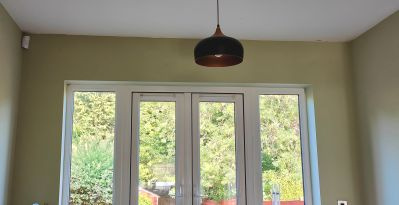
I'll touch up the ceiling paint before the new curtains are put up.
Thank you
Comments
-
For an exterior (usually masonry) wall, you will need to use a masonry drill bit and wall plugs. You won't have studs in the exterior wall, but you likely have a lintel directly above the door frame. To be safe I'd suggest leaving at least a 20cm gap between the top of the recess and where you drill.
Know what you don't2 -
Do you know if the wall is traditional build brick/block cavity wall, or brick/ timber frame?
1 -
thank you so much
no, I'm afraid I don't, I'm just guessing my way given the age of the house.
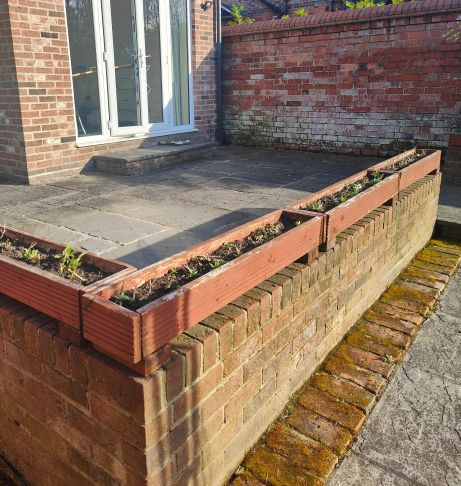
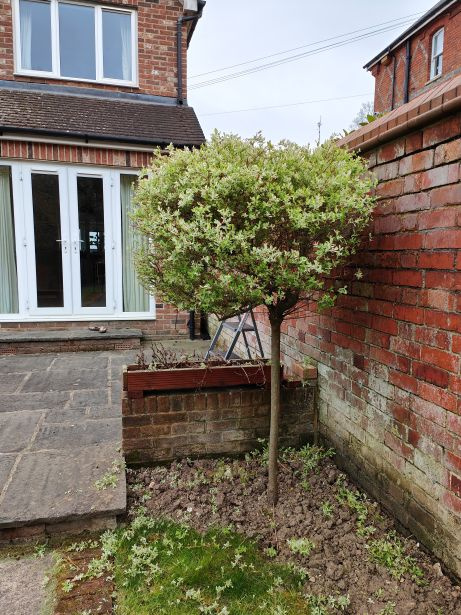
This is a photo I took of the patio before; it shows part of the door and the wall around it. The retaining wall is much older.
 I'm FTB, not an expert, all my comments are from personal experience and not a professional advice.Mortgage debt start date 11/2024 = 175k (5.19%)... Q1/2026 = PAID (3.94%)0
 -
If it's an extension, then the chances are it a block inner skin. If they are Thermalite blocks they will be really easy to drill, so it's worth using a slightly smaller drill bit as being very soft blocks it's easy to make the hole a bit too large for the plug. If you ever get really stuck getting the holes where you need them in walls, an option is to fix a piece of timber full length over the top and then use wood screws to fix to the timber.
1 -
If it is a brick/block wall, a good chance that there will be a Catnic type lintel in there. Yes, a masonry drill will through brick & block (if set to hammer action), but once it hits steel, things get a little more interesting. A twist drill for steel could well be needed, but once it hits brick/block/cement, the cutting edge will be trashed.
If drilling in to Thermalite type blocks, go in deep with a slightly smaller drill. Hammer the wall plugs in so that they are 10-12mm below the surface of the plaster. Fix the brackets with longer (and possibly slightly larger) screws. Should it be brick behind the plaster, still hammer the plugs 10-12mm below the surface. That way, when the plugs expand, they will be gripping something solid and not the plaster.
Should it be timber (possibly SIP construction), wood screws should be all that is needed. Using a stud finder to locate the studs may help, or it could just be a case of pot luck.
Any language construct that forces such insanity in this case should be abandoned without regrets. –
Erik Aronesty, 2014
Treasure the moments that you have. Savour them for as long as you can for they will never come back again.2 -
If it is a brick/block wall, a good chance that there will be a Catnic type lintel in there. Yes, a masonry drill will through brick & block (if set to hammer action), but once it hits steel, things get a little more interesting. A twist drill for steel could well be needed, but once it hits brick/block/cement, the cutting edge will be trashed.
That's why I said to leave a gap from the top of the recess, to avoid drilling into the lintel.
Know what you don't1 -
Have a read1 -
Right, it is not an extension; it's all built like that. Does that change what it could be?
I'm FTB, not an expert, all my comments are from personal experience and not a professional advice.Mortgage debt start date 11/2024 = 175k (5.19%)... Q1/2026 = PAID (3.94%)0 -
It could be timber frame. Tap on the wall and see if it sounds hollow. If it feels solid all over it probably blockwork. If it sounds hollow it could be timber frame, but it could also be block with dot and dab plasterboard over the top. For dot and dab there are special fixings that don't pull the boards in when you tighten up the screws.
1 -
Thank you all, much appreciated. I'll assume it is brick and block for now, and get on the ladder later today and see what's going on. I'm also assuming that I can drill anywhere near the corners far from the door.
The screws I've got with the new pole are 3cm in length (x3 per cylinder wall bracket), the ones from the previous curtains were 4cm (2x per wall bracket & slightly bigger diameter). Would the 3cm long enough?
Thank you, will come in very handy when I get the courage to drill the wall 🙈
I'm FTB, not an expert, all my comments are from personal experience and not a professional advice.Mortgage debt start date 11/2024 = 175k (5.19%)... Q1/2026 = PAID (3.94%)0










Confirm your email address to Create Threads and Reply

Categories
- All Categories
- 355.4K Banking & Borrowing
- 254.8K Reduce Debt & Boost Income
- 456K Spending & Discounts
- 248.1K Work, Benefits & Business
- 605.4K Mortgages, Homes & Bills
- 178.9K Life & Family
- 263.2K Travel & Transport
- 1.5M Hobbies & Leisure
- 16.1K Discuss & Feedback
- 37.7K Read-Only Boards