We’d like to remind Forumites to please avoid political debate on the Forum.
This is to keep it a safe and useful space for MoneySaving discussions. Threads that are – or become – political in nature may be removed in line with the Forum’s rules. Thank you for your understanding.
📨 Have you signed up to the Forum's new Email Digest yet? Get a selection of trending threads sent straight to your inbox daily, weekly or monthly!
Have consumer rights been ended by Chinese online retailers ?
Comments
-
In the case of these international sites, what constitutes "activities directed to UK consumers" and therefore UK consumer rights applying?
I have visited the sites in the past but never purchased. I have always be rather cautious of what, if anything, would eventually arrive.
My FiL thinks these sites are brilliant because of how cheap everything is. He also takes the view that it doesn't matter if the item that arrives is actually complete tat because you saved so much, if some items go straight in the bin, or don't last as long as you expect, so what? (I have not challenged him about just buying what you need and paying "full UK" price versus the savings on these sites and then accepting a certain amount is useless.)
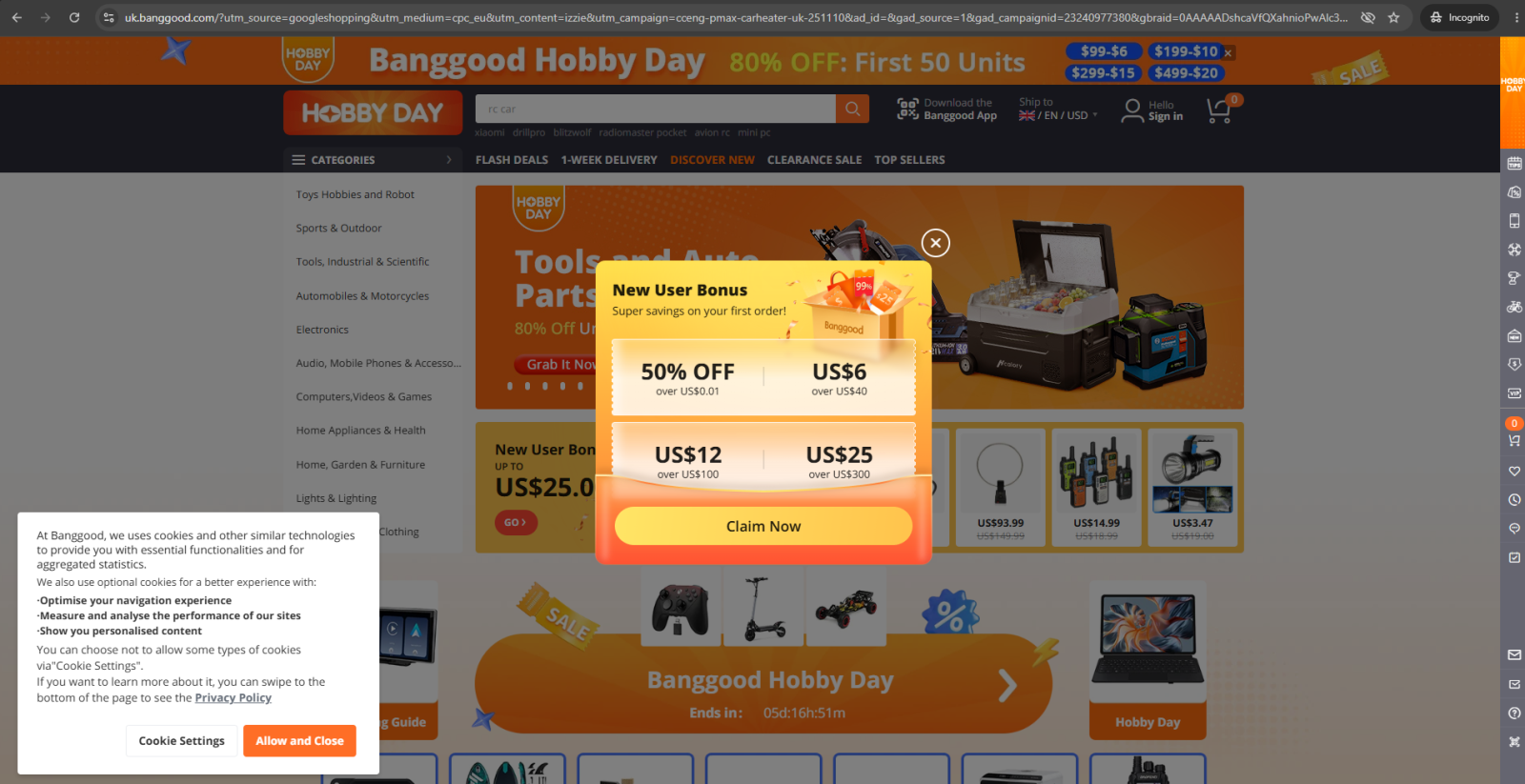
Anyway, I visited one of the sites mentioned by the OP, and note it is the uk. prefix for the site address so, presumably, the part most intended for a customer in the UK. I would not, however, think that this site is really "directed to UK consumers" - particularly the pricing for everything being in US$. Just having a drop down for "shipping to UK" does not really make the site "directed at UK consumers" in my opinion.
In fact, the site listing everything and expressly clear that the currency is US$ seems to reinforce the international status of the site. Even if the site was directed at consumers in USA, then the US$ might just be presented as $ (as a consumer in USA on a site directed at US consumers would default to expecting US$ as opposed to AU$ or whatever). Similarly, when I visit a typical UK site, the price is only displayed in £, not GP£ or EG£, as the default expectation for a trader "directed to UK consumers" is GB£ and the "GB" part of that can be silent.
I might very well form the opinion that the sites the OP has referenced are not offering "activities directed to UK consumers" but that the sites are offering products to a global market place, including UK.
 3
-
So full disclosure as I'm guessing someone will at some point ask, the relevant law is Rome I Regulation, which was retained law post-Brexit and converted into UK law, now known as UK Rome I (Link to Regulation). Article 6(1) concerns consumers and cross-border transactions which I paraphrased as directing activities towards UK consumers.
There is no set criteria as to whether an overseas business is directing their activities to the UK but what is clear is that a consumer in the UK merely accessing an overseas website is not enough. There has to be a clear intention to market or offer goods/services to that country, but need not be the only country.
Indicators, that a court might consider an overseas business as directing their activities towards the UK can be one or more of the following:
- Offering English as a translation language on the website other than the language/currency used in that country.
- The ability to purchase goods and services in GBP currency.
- Paying for targeted adverts towards UK customers
- Mentioning on their website that they have UK suppliers, distributors, resellers etc.
- Offering to deliver to the UK from the country of the overseas business or through a partner based in the UK.
- Using a UK specific domain such as .uk or .co.uk
- Telephone numbers with an international code
- Having an established presence in the UK such as warehouses and/or promoting the same.
The decision for a court will be, is it apparent from the website that they are promoting, offering or directing their goods or services to the UK.
Looking at the Temu website:
- They offer different language translations, one of which is English.
- They offer GBP as a currency for purchase
- The web address suggests this part of their site is specific to UK customers. This is further reinforced by the fact the website's title page (in the browser tab) says "Temu United Kingdom".
- The company details link lists Whaleco UK Limited with company number 14476358. That would suggest that Temu is using a dedicated company in the UK to service it's customers.
The last point sort of defeats the former points I made, but this is why it's important to check the website and T&Cs to understand who you are contracting with.
As for Banggood, similar points to Temu can be made, although checking their T&Cs shows you are contracting with what appears to be a Chinese company, but they refer to a dedicated UK site (uk.banggood.com), and in their "about me" page shows that they have been shipping to the UK at least since 2019 but probably earlier. Further down their page, their "Our Footprint" section seems to list a number of countries including the UK, which is another indicator of directing activities.
I could go on about more points for these websites but I'm sure you get the gist. At the end of the day, it's a balance of probabilities so the more evidence you can show that suggests the overseas business is directing their activities towards the UK, the more likely you are to convince a court.
P.s. Your point about having a drop down menu for change of currency is the very example that was given in an EU court case as being an indicator of a company directing their activities towards a specific country.
1 -
P.s. Your point about having a drop down menu for change of currency is the very example that was given in an EU court case as being an indicator of a company directing their activities towards a specific country.
Well, that's an interesting observation as I was making that point for exactly the opposite argument. I don't have any legal training. My my point was really that, even with the "ship to UK" selected, the currency remained US$ so clearly an international site. The esteemed lawyers in the court case seem to interpret that differently if I have understood what you said correctly.
0 -
Well, that's an interesting observation as I was making that point for exactly the opposite argument.
It is perfectly possible to use the foreign currency point as an argument to positively support a retailer's case rather than a negative. Although the language of the legislation talks about directing activities, it really comes down to whether there is an intention by the overseas company to target consumers in a particular country.
Here's some examples where the overseas company can explain away the use of foreign currency or English language, to argue that they do not direct their activities towards consumers in a particular country:
- English is being used as a neutral language, not as a targeting tool since English is the default language for international trade.
- The foreign currency is simply the company's local trading currency where that currency is routinely used for domestic purchases. This could be the case where you have a large population of immigrants living in that country.
- The currency and language may be for informational purposes only. An example could be a local hotel that publishes information on their website for tourists to understand when they come to this country to book accommodation on an in-person basis.
- English language or currency may have derived from the use of a standard template as part of a platform used by the company. Wordpress, Shopify etc. all have standard templates and it could have simply been a mistake or error that it was not updated or corrected.
- Even though the currency is foreign and language is in English, the website still restricts deliveries to that country only. Requiring local billing addresses, local contact details only and referring to domestic returns could be used as evidence that there was no intention to target consumers outside the country where the company is based.
Currency and language on it's own is usually not going to be enough which is why its an indicating factor but not determinative.
1 -
In the case of s.75 claims, those rights have been established since 2007 in the OFT v Lloyds Bank case which confirmed purchases apply to foreign transactions.
That is because s75 covers breach of contract &/or misrepresentation. So is against retailers T/C
You re implying that people still have UK consumer rights against these oversea's companies.
How do you enforce it? Which is the important part?
Life in the slow lane0 -
Is that a question directed to me or someone else?
0 -
At you 👍
Meant to add your name in
Life in the slow lane0 -
AIUI, S75 for foreign transaction would be as per the contract for that purchase and consumer rights under the area of jurisdiction.
The grey area seems to be a foreign business stating foreign jurisdiction applies but having presented to the consumer via website procurement as being a UK business subject to UK jurisdiction
1 -
Same point stands. .co.uk can be used by anyone. As we know many non UK sites used a uk city name in their name.
How do you enforce UK consumer rights.
Life in the slow lane0 -
If the question is strictly, how do you enforce your rights, I explained some of those ways you can do that in my initial post back on the first page.
Consumer rights laws won't police and protect every single issue that crops up and it certainly can't always keep up with societal changes in behaviour on we or where we purchase goods or services. In my opinion there must be some level of self-education by consumers to ensure they do reasonable due diligence before making any commitments, much in the same we scammers are out there to steal your money.
All too often people seem to purchase things from websites or social media oblivious to who they are paying, where the goods are coming from and where the company is located. Then they expect to be reimbursed if something goes wrong. It is a simple a case of learning from your mistakes, which we have all made in our lives.
0








Confirm your email address to Create Threads and Reply

Categories
- All Categories
- 355.8K Banking & Borrowing
- 254.9K Reduce Debt & Boost Income
- 456.2K Spending & Discounts
- 248.3K Work, Benefits & Business
- 606K Mortgages, Homes & Bills
- 179K Life & Family
- 263.8K Travel & Transport
- 1.5M Hobbies & Leisure
- 16.2K Discuss & Feedback
- 37.7K Read-Only Boards