We’d like to remind Forumites to please avoid political debate on the Forum.
This is to keep it a safe and useful space for MoneySaving discussions. Threads that are – or become – political in nature may be removed in line with the Forum’s rules. Thank you for your understanding.
Buy now vs buy in a few years?



Good Afternoon Everyone,
I have a question regarding whether I should buy now or rent for a bit longer to save more money and increase my deposit. So I have just seen that Santander do 2% deposit mortgages currently, and with that I would be able to buy a house in the latter part of this year. But I am wondering whether it would be more beneficial to save for a few more years to increase my deposit percentage or if I should go ahead and look to buy asap? For context rent is currently £1100 a month
Comments
-
That is a question only you can answer Im afraid. You need to do what is best for you.
Do you meet the criteria for the 2% deposit mortgage? Very low/no deposit mortgages often have very strict lending criteria.
0 -
There's usually some gimmick to these low-LTV products. From a brief look at this, it seems it has a "minimum £10,000 deposit". This means you'll be putting down more than 2% as a deposit, unless the first house you are planning to buy is valued at half a million pounds.
It's also worth remembering if you're cutting it this thin, that you will need more than just the deposit to buy the house. Conveyancing you will want to budget at least a grand for, plus maybe £500 for a survey, and then you want some money after you move in, else you risk eating and sleeping on the floor for the first few months. Many suggest having another £5k at least on top of the deposit.
What are you currently doing with your savings? Are you putting them in a LISA? If you're achieving a similar or better rate on your savings while renting, then I don't see the problem waiting a bit longer till you're in a better financial position. Plus I wouldn't be keen to buy in the current market - lots of properties round my way sat still for many months. I think the problem is prices surged a few years ago, but then unfortunately so did mortgage rates limiting buyers, but many sellers expectations are still stuck on the prices of yesterday and are slow are unwilling to accept reality. Of course, that's not all sellers.
You haven't really given any detail for us to provide an informed opinion. You mention your rent, but not the area you live/are looking to buy, nor your income or potential budget. £1100 would be expensive for the north east, but cheap for London.
Know what you don't0 -
What's your income and how much deposit do you have now?
1 -
Most people who leave the property market for a period or join it later expected find prices only go one way (except in exceptional times)
Advice in general get on the property ladder as soon as you can.
2 -
While I might have historically agreed with your sentiment, I think it's important to consider this in context.
Inflation is usually positive (that is the BoE's goal),meaning most things go up in price over time. The conclusion shouldn't be that everyone should buy everything now because it'll likely cost more in the future.
Why this mantra is often applied to house prices in particular, is because over the last few decades, house prices have tended to significantly outpace inflation (even despite a steep decline during the financial crisis). It is only in the last few years that this trend has finally started to reverse, as buyer demand has decreased due to high inflation and world events causing a surge in mortgage rates. A little chart below to illustrate my point. As I mentioned in my earlier comment, this has caused a lot of stagnation in my local property market, as todays sellers are still holding out for yesterdays prices. In terms of (unrealised) returns, someone who held their money in a simple global index fund rather than in property equity would have generally achieved a much greater paper profit over the past 5 years.
It is also not realistic or sensible in my opinion to expect house prices in the future to always continue the previous trend of increasing by more than inflation. It does not take an economist to realise this is not sustainable over the long term, you need a buyer at the other end of the transaction. Personally I think the only reason it happened to begin with was that houses were originally priced based on one working person in the household, while the partner usually stayed at home and looked after the kids. In modern day society, it's more normal for both adults in the household to work, which I believe has led to house prices becoming based on two working adult incomes instead of one (and you can see this in earnings to house price multiples over the past few decades).
Sorry a lot of text to effectively say - I personally wouldn't bank on house prices outpacing inflation over the long term, and so long as the OP is saving their money sensibly (e.g. in a LISA), then I don't see any urgency to buy a house.
Never did I think I would sound like a HPC guy…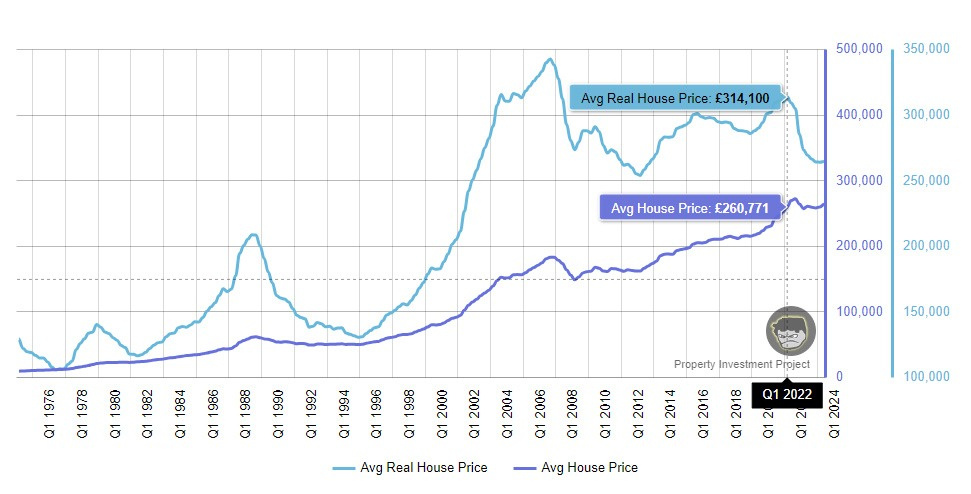 Know what you don't2
 -
Hi, thanks for your help I really appreciate it, but for a bit of a better understanding of what our situation is, combined pre tax salary of £85,000. And we are renting in Cardiff and are planning to stay in Cardiff with a budget of £300,000-350,000. We are currently both paying into LISA’s and I am maxing mine out every year but I am only in my second year of paying in as I only got a well paid job 18 months ago. In regards to costs after moving in, our current house is rented unfurnished so we have enough furniture to fill a 2 bedroom house and quite frankly anything we need above that isn’t a priority. But yes I appreciate that there will be extra costs on top of deposit and as we are in Wales we will also be required to pay stamp duty. We currently have more than the £10,000 minimum in savings but have stuff planned for later in the year which will mean that savings won’t increase as much as in normal circumstances.
0 -
I see what you mean but......
For those not on the property ladder surely the rent going to waste each month verses a repayment mortgage changes the figures somewhat.
Yes there will be some that can earn big wages, live at home and invest but for most people you need your own property.
So as an example £1300 rent (below average for the UK I believe). Even taking an interest rate fix of 5% and a short term of 25 years that's £220,000 they can borrow on a repayment basis for under £1300 a month and after 5 years they will have paid £25,000 of the mortgage back.
I guess what I am saying is that for most people where is the £25k that they know own of that property shown in your example above?
House prices don't have to out pace inflation if people are going from wasting money to actually owning more and more of their property each year with a repayment mortgage.
I am hoping I haven't got this terribly wrong lol
1 -
OP, in many parts of the country the market is subdued to say the least, not everywhere of course. Now is a good time to buy, but that's not to say that next year might not be a better time to buy, or a worse time to buy. Personally, I would say you need to get the figures worked out for yourself. Low deposit mortgages tend to cost more, but if it saves you money, might still be worth while getting in now. Your rented property will never make you any money, but then you have less liability as well.
On a £300k purchase in Wales your transaction tax will be about £4.5k. I'd budget £10k all in for solicitors, surveys, moving company, tax, and miscellaneous costs etc.
0 -
But this is a different point to the one which I responded to (that one should buy a house because house prices go up).
Don't get me wrong, I'm a strong advocate for people buying their own houses, I think it's pretty much essential for later life, it won't take much to get me to agree on this point.
On the new point that owning a house builds equity whereas renting does not, it really depends on the specific scenario.
If you have a scenario where the hypothetical mortgage payments and rent payments are the same, then it's probably a no brainer. If you have a scenario where the mortgage is less than rent, it's even more of a no-brainer. If however you have a scenario where rent would be less than the equivalent mortgage payment, it is not so obvious. You would then need to work out if you could earn more elsewhere - investments have generally outpaced property over the last few years, but it would also be likely if you combined a decent savings rate with the LISA bonus.
According to local indices, my house price has an annualised increase of around ~5% over the past 5 years. On the other hand, my investment have a XIRR of ~15% over the same period. The government adding a bonus to LISA's mean that someone can achieve 25% in one of those accounts, without considering investment or interest.
I guess what I am saying is that for most people where is the £25k that they know own of that property shown in your example above?
As OP has now provided their own numbers, we can be more specific:
OP currently pays rent of £1,100 p/m.
OP wants to buy a house worth £300k-£350k, let's say £325k. The thread is about putting down the minimum £10k deposit, so let's assume they take out a mortgage of £315k (which works with their income).
Mortgage rate for the 98% LTV product is 5.6%, meaning a monthly mortgage payment of £1,809 (over a 30 year term). In 5 years OP would have paid about £23k off the balance. Now consider they carried on renting, putting the difference between their rent and their hypothetical mortgage (£709) into a LISA instead. Before any interest we can see that would be £42.5k in a savings account. Including interest (ignoring the promotional rates, Tembo pays 3.8% per year) that's another ~£5k. You would also have another £5k in government bonus, giving you £52.5k. This is 2.3x more than you would have paid off the mortgage. This would then be reduced by any house price growth.
This equation has usually been very one-sided because interest rates have historically been very low (so mortgages were cheap and savings didn't return much) and because you had the added benefit of house prices increasing by more than inflation. As I mentioned earlier, I don't think it's sensible to build your plan on this happening over the long term.
My point isn't to prove renting > buying, I would disagree with that. It was, as I mentioned earlier, to show it's not a problem or the end of the world if OP wants to rent a little bit longer to save up a bigger deposit (hopefully also enabling them to get a lower mortgage rate). Things are more nuanced than just buying as much and as quickly as possible.
Know what you don't1 -
Thanks for running those figures that are specific to this poster @Exodi and yep with their small deposit, expected house they are willing to accept price wise it may make sense for them to continue renting it at least considering what's more important to them.
I wonder how much the property they are renting now at £1100 pcm would be to buy as another example.
0














Confirm your email address to Create Threads and Reply

Categories
- All Categories
- 355.7K Banking & Borrowing
- 254.9K Reduce Debt & Boost Income
- 456.1K Spending & Discounts
- 248.3K Work, Benefits & Business
- 605.8K Mortgages, Homes & Bills
- 179K Life & Family
- 263.6K Travel & Transport
- 1.5M Hobbies & Leisure
- 16.2K Discuss & Feedback
- 37.7K Read-Only Boards