We’d like to remind Forumites to please avoid political debate on the Forum.
This is to keep it a safe and useful space for MoneySaving discussions. Threads that are – or become – political in nature may be removed in line with the Forum’s rules. Thank you for your understanding.
Warning about a new ANPR TOLL on Warburton Bridge over Manchester Ship Canal managed by Excel
Comments
-
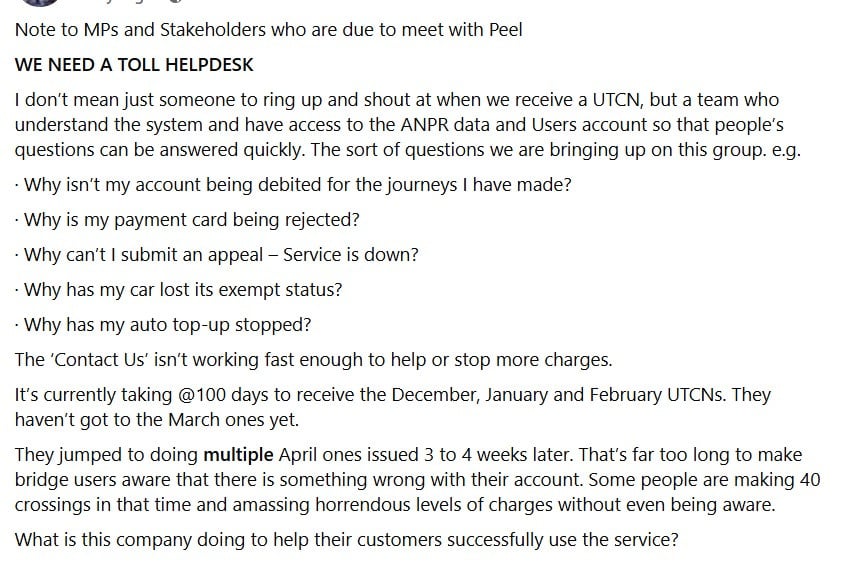
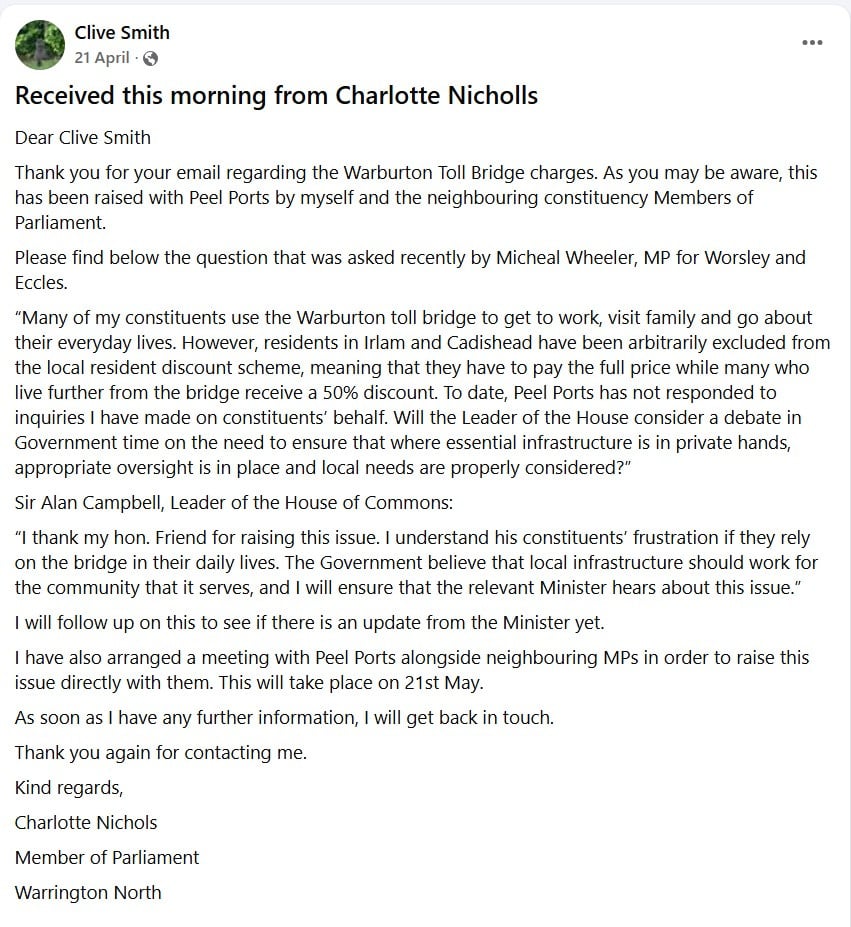
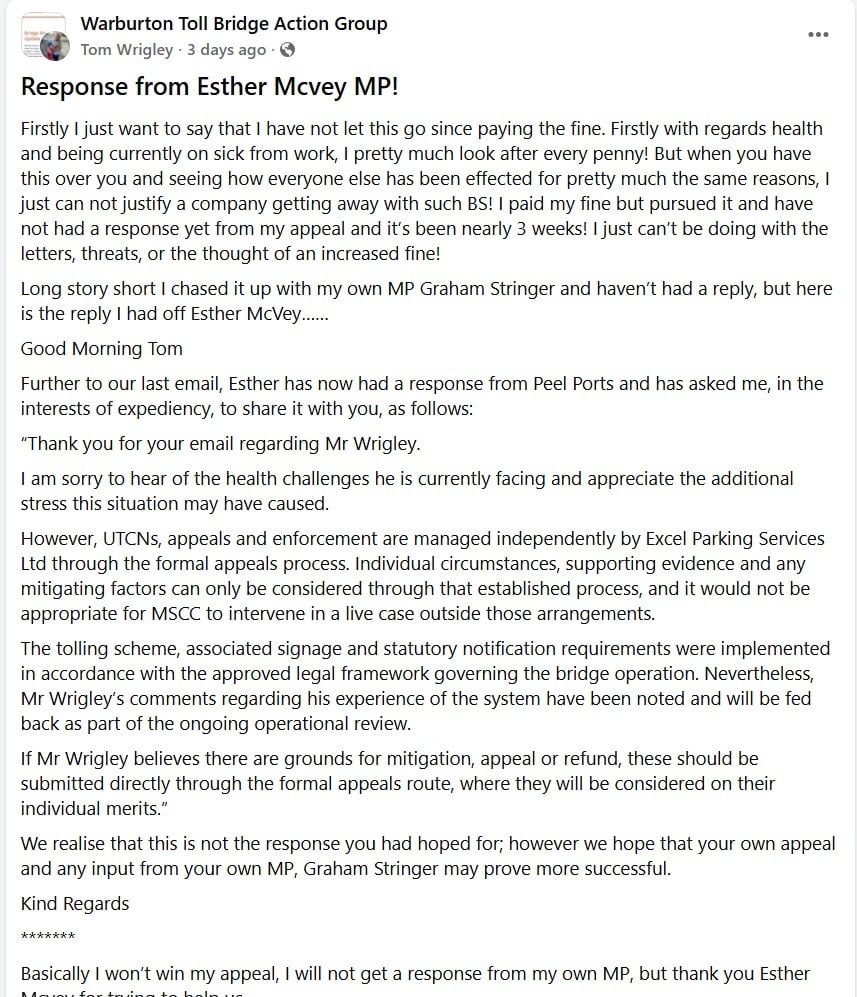
Finally the reaction from local MPs. Yes, they have all objected to the rise in the Toll fee and the impact on the communities either side of the bridge. The not very accurate postcode lottery for people to get discounted 50p crossings. However, they don't seem to be aware of the problems. In fact, reading some of their responses to constituents its sounds like they are simply advising them to pay up before the charge escalates. I've made my own suggestion to be pushed up at the meeting. Provide the people with a means of easily sorting out problems. Peel push complainants to Excel, Excel push them back to Peel again. Problems that the MPs don't seem to be considering. BTW the meeting scheduled for 21 May was postponed.
 2
2 -
This is a slippery slope.
You should never park on a slippery slope ……….. I'll get me coat!
0 -
It's a pity they don't abide by their own byelaws ( 25) and the 'relevant date'
1 -
" I remember when it was 2p return".
Not relevant, but being of certain age, I remember when it was 1d each way with a pushbike, I think 6d for a car. It was manned with a barrier/gate.
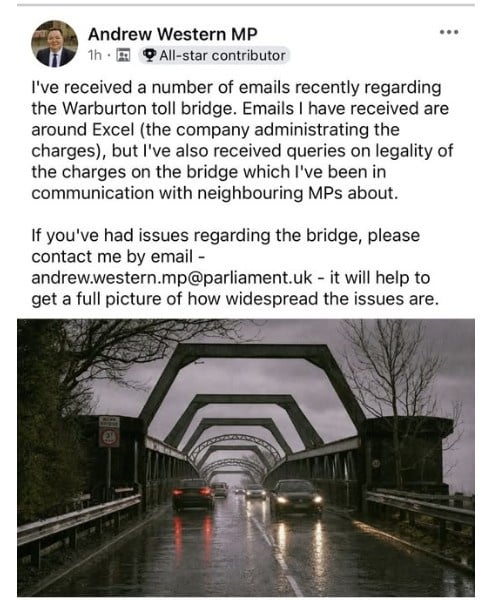
Looks like things have changed. I was always under the impression that the then toll was for the old bridge spanning the River Irwell, not the cantilever bridge over the MSC (shown in the rainy picture).
0 -
Yes, J63320, That's it. Many people have asked who or where is WarburtonTollBridge not even a domain extension. If you are not a local, who would recall which bridge you just drove over.
1 -
That’s exactly my thoughts . If Proserve / Duff can’t get access to dvla data - how are Peel/ Excel getting this access ? No ATA to regulate the use of KADOE which is required - Also there are no access to independent arbitration to try and resolve disputes.
3 -
There seems to be a relationship[ wbetween Peel group and PPCs.
As for getting their hands of RK data and the KADOE contract - Excel also seem to have a nice side line with moving traffic "charge" notices be that airport land and with this bridge, if there is a crackdown on car parks, then i fully expect to see a move to other things such as this, and more.
The DVLA were slow when it came to proserve holding people to ransome with duff charges I would expect them to be even more sluggish when it comes to a well known PPC
From the Plain Language Commission:
"The BPA has surely become one of the most socially dangerous organisations in the UK"3 -
In my view, the real issue with the Warburton Toll Bridge UTCN scheme is not whether a £1 toll can lawfully be charged. The more serious question is whether the much larger Unpaid Toll Charge Notice is being imposed and pursued through a lawful statutory enforcement process.
The byelaws create a mechanism by which a toll is payable for passage over the bridge, and they also set out escalating unpaid toll charges of £30, £60 and £100 in addition to the original toll. On its face, that gives the undertaker a route to claim that a charge has arisen where a toll remains unpaid. However, that is not the end of the matter. The lawfulness of any UTCN depends on whether the enforcement process being used is actually the process authorised by the statutory scheme.
The difficulty is Article 13 of the Rixton and Warburton Bridge Order 2024. That provision appears to apply the Transport Act 2000 road user charging enforcement framework to the bridge, as if the tolls and charges were charges payable under a road user charging scheme. If that is right, then there is an obvious question: why is this being operated through a homemade UTCN process administered by Excel, rather than through the statutory road user charging penalty charge regime?
That matters because the Transport Act road user charging framework is not just about creating penalties. It also brings with it procedural safeguards. Those safeguards include proper prescribed notices, a formal representations process, statutory appeal grounds, access to independent adjudication, and rules dealing with situations such as hire vehicles. Those safeguards exist for a reason. If an operator is going to use ANPR to impose escalating penalties for non-payment of a road user charge, motorists should not be left with only an internal appeal to the same enforcement contractor that issued the notice.
That is where this scheme starts to look legally dubious. The UTCN appears to demand payment of a penalty-like sum, but without the normal statutory enforcement structure that one would expect if the charge is treated as a road user charging penalty. There is no independent adjudication route. There is no apparent statutory representations process. There is no clear transfer mechanism for hire, lease, courtesy car or company vehicle cases. There is no obvious procedural safeguard for someone who was not the registered keeper but was the actual user of the vehicle and the person with the evidence.
The hire and lease vehicle problem is particularly stark. The notice says only the registered keeper can appeal unless written authority is supplied. That may be administratively convenient for Excel, but it is plainly unfair in practice. The registered keeper may be a lease company or hire company with no knowledge of the crossing and no incentive to investigate anything. It may simply pay the charge and recharge the hirer, often with an additional admin fee. Meanwhile, the person who actually used the bridge, attempted payment, held an account, had an exemption issue, or experienced a system failure may have no effective right to challenge the UTCN directly.
That is not a minor inconvenience. It is a structural defect in the appeal process. A lawful enforcement scheme should not impose escalating financial liability while denying the person with the relevant evidence any direct and effective appeal route. If the statutory road user charging framework applies, that problem becomes even more serious, because that framework contains safeguards precisely to prevent this kind of one-sided enforcement.
The internal-only appeal process is another major weakness. Excel appears to be issuing the notices, controlling the appeal process, deciding the appeal, and then threatening debt recovery if the appeal is rejected or ignored. That is not independent scrutiny. It is the enforcement contractor marking its own homework. For a statutory charging regime involving ANPR, keeper data, delayed notices and escalating charges, that is an unsatisfactory and arguably unlawful substitute for the proper statutory process.
The court point would be straightforward. Excel and the undertaker cannot have it both ways. If the £30, £60 or £100 UTCN is in substance a penalty charge for failure to pay a road user charge, then the court should ask why the statutory Transport Act enforcement regime has not been followed. If, on the other hand, they say the UTCN is not a penalty charge under that framework, then they must explain exactly what legal creature it is, why it is recoverable as a civil debt, and how their own UTCN process lawfully bypasses the safeguards that appear to be incorporated by the Order.
That does not mean every motorist can simply ignore the £1 toll. The toll itself may well be lawfully payable. But the enforceability of the much larger UTCN is a different issue. The lawfulness of that charge depends on proper statutory authority, proper procedure, proper notice, a fair opportunity to challenge, and proof that the person pursued is liable.
My opinion is that the scheme is vulnerable because it appears to graft a private debt recovery model onto a statutory toll regime, while avoiding the statutory safeguards that should accompany road user charging enforcement. That is the point I would expect to be tested if Excel or the undertaker ever tries to pursue these UTCNs through the civil courts.
5 -
There could also be some issues round how excell are obtaining registered keeper data from the DVLA for the purposes of so called enforcement, an issue that came to a head with Proserve enforcement at Ransomes business park.
This little venture between Peel group and Excel has the potential to open up a whole can of worms
From the Plain Language Commission:
"The BPA has surely become one of the most socially dangerous organisations in the UK"4 -
Yes, I think that is a very important point.
DVLA “reasonable cause” is not a free-for-all. A company cannot simply obtain registered keeper data because it says money is owed. It must use the correct route, for the correct purpose, and only where it has proper authority to do so.
Excel’s normal electronic DVLA access is through its KADOE contract, which is tied to private parking enforcement, ATA membership and parking-related data requests. This is not a parking charge. It is a statutory toll/Unpaid Toll Charge scheme. So if Excel is obtaining keeper data through its ordinary parking KADOE route, that raises a very serious question about whether the data has been requested and processed outside the scope of that access.
If Excel is not using KADOE, then the likely alternative would be a V888/2A “reasonable cause” request. But that is effectively a manual route. It requires a company to submit a request identifying the reason for needing keeper data, supported by the relevant basis for the request. That is very different from the fast electronic KADOE system and would be far more cumbersome if Excel is issuing Warburton UTCNs in bulk.
That leaves three possibilities. Either Excel is using KADOE, which would be highly questionable because this is not a parking event; or Excel is using V888/2A, in which case there should be a manual reasonable-cause audit trail for each request; or there is some bespoke DVLA arrangement for this toll scheme, in which case Excel or Peel/MSCC should be able to identify it.
That is why this has the potential to open a can of worms. The question is not simply whether keeper data could ever be obtained for an unpaid toll. It probably could. The real question is how Excel obtained it, what reason was given to DVLA, what route was used, and what authority Excel had to request it for this particular statutory toll scheme.
A DVLA SAR should expose who requested the data, when, through what channel, and for what stated reason. If it shows that Excel used a parking-related KADOE request for a non-parking toll enforcement scheme, that would be a serious DVLA, data protection and authority issue.
5















Confirm your email address to Create Threads and Reply

Categories
- All Categories
- 354.6K Banking & Borrowing
- 254.5K Reduce Debt & Boost Income
- 455.5K Spending & Discounts
- 247.5K Work, Benefits & Business
- 604.4K Mortgages, Homes & Bills
- 178.6K Life & Family
- 262K Travel & Transport
- 1.5M Hobbies & Leisure
- 16.1K Discuss & Feedback
- 37.7K Read-Only Boards