We’d like to remind Forumites to please avoid political debate on the Forum.
This is to keep it a safe and useful space for MoneySaving discussions. Threads that are – or become – political in nature may be removed in line with the Forum’s rules. Thank you for your understanding.
Not quite understanding the Fuse fix




Before I moved to Fuse I was with Octopus. When I was on a fixed deal with Octopus my monthly bill was the same each month. I paid a set amount & over the course I ended up building credit.
Same with Shell when I was with them before Octopus.
When it came time to lock in on a deal again, Fuse were the fit for me - so I selected their fixed tariff.
Thing is, what I've been getting billed each month has been yo-yoing around all over the place. April £139.30, May £112.03.
Why isn't it just a set amount with Fuse's fix like I had with Octopus' fix?
🤐🤐🤐
Comments
-
A fixed tariff doesn’t usually mean a fixed monthly bill.
It means the unit rates and standing charges are fixed for the length of the deal. So each kWh costs the same, but your bill still changes depending on how much gas/electric you used that month.
With Octopus/Shell, it sounds like you were on a fixed monthly Direct Debit arrangement. You paid the same amount each month, then built up credit in summer and used it in winter.
Fuse may be billing you closer to actual monthly usage, or using a variable monthly DD, so April and May will differ.
So, in plain terms:
Fixed tariff = fixed prices
Fixed Direct Debit = fixed monthly paymentYou probably had both with Octopus, but with Fuse you may only have the first. Check whether your Fuse payment method is “fixed monthly Direct Debit” or “pay for what you use”.
1 -
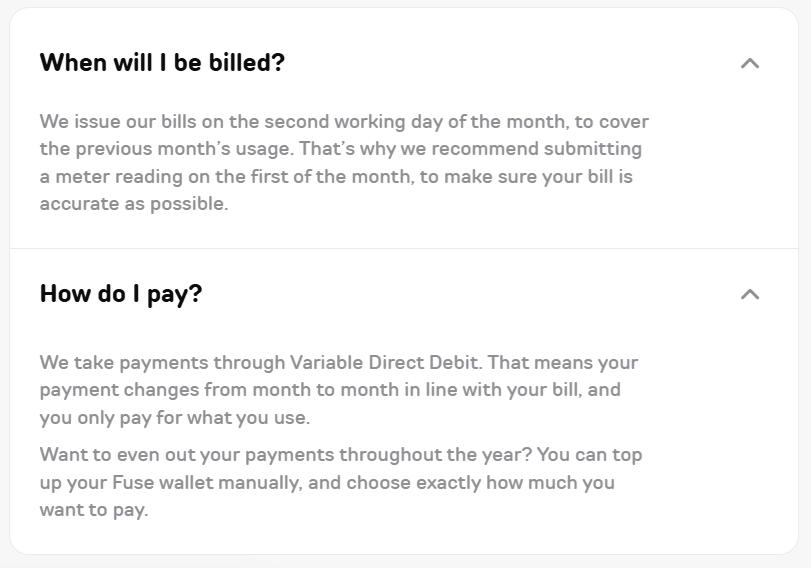
IIRC Fuse only offer monthly variable direct debit as a payment option. You pay each month for the amount of energy you've used since your last bill.
If you don't want this, you'll have to pick a different supplier.
N. Hampshire, he/him. Octopus Intelligent Go elec / Fuse gas / Vodafone BB / iD mobile. Kirk Hill Co-op member.Economy 7 cap explainer. Gas vs E7 vs peak elec heating costs, Ecoflow Stream, Best kettle :-)
2.72kWp PV facing SSW installed Jan 2012. 11 x 247w panels, 3.6kw inverter. 37 MWh generated, long-term average 2.6 Os.3 -
-
Its nothing to do with a fixed term plan - the same issue would occur on variable - it is the payment method.
You were on an annualised DD plan before - so paying an estimate - normally in simplest terms an average - so estimated annual cost / 12.
Its good for smoothing out summer lows and winter heating highs - but many people dont like it now most suppliers run in a constant credit cycle - so hold on to some of their cash.
For folk who can budget - for those with savings - and those who dont like suppliers holding credit - many - but not all suppliers offer - and Fuse as above only offer - an alternative - called various names - but forms of MVDD (Monthly Variable direct debit).
You pay for exactly what you use - so for bills including heating - often much higher in winter / much lower in summer.
Not so good for people - like those on low fixed incomes - who might actually be far better suited to the annualised plan.
Ive got expensive electric heating - and even as a lower then Ofgem median annual user - I'd have to budget for over three times the energy bills in winter vs summer (last winters highest / last month - near 3.5 times) if went MVDD. Someone with far cheaper gas heating - maybe only double.
Although many suggest - that arguably if folk were to switch to / started on MVDD in say April - and were disciplined enough to save the excess amount (annual average - billed amount) - they too could have the cash available in savings to meet winter bills when they fall due.
0 -
Monthly variable direct debit shouldn't affect budgeting, especially when starting at this time of year. Open an instant access savings account with your main bank and set up a regular transfer with the amount you paid previously on monthly fixed direct debit. Then when you get your monthly bill email, move the money to be taken to your current account.
2 -
Or, as I do, make manual payments so you control how much credit they have and when those payments go out.
Darren
Xbigman's guide to a happy life.
Eat properly
Sleep properly
Save some money1 -
@Xbigman wrote:
… make manual payments so you control how much credit they have and when those payments go out.
… at considerable extra expense. For the typical household on a Standard Variable Tariff, the annual cost paying by Direct Debit is £1641. If you'd rather make manual payments when the bill turns up, the cost would be £1772. Is this level of control worth £11 extra on the monthly bill?
I'm not being lazy ... I'm just in energy-saving mode.
If you're asked to post a photo of your meter Meter Configuration Tables v2.0.xlsx2 -
I think they were just suggesting making manual payments whilst being on MVDD so the payment times and amounts remain under your own control.
0 -
Not sure what you are on about. Fuse will accept additional payments at any time, it wont impact the unit rate you pay. I always settle up on the 30th of the month manually (and usually pay a little bit more in over the summer), when they produce the bill on the 2nd I am in credit and no DD is taken.
1 -
Yeah I get that it's the rate that's fixed & at the end of the day you pay for what's used.
I just had the view I did based on the past experience I'd had. I haven't experienced it 'the Fuse way' until now.
Not that it's a problem, like some seem to think I'm saying it is, it's just something I didn't understand as to why for the reason I've just given.
Thanks for explaining it though.
🤐🤐🤐
0







Confirm your email address to Create Threads and Reply

Categories
- All Categories
- 355.7K Banking & Borrowing
- 254.9K Reduce Debt & Boost Income
- 456.1K Spending & Discounts
- 248.3K Work, Benefits & Business
- 605.8K Mortgages, Homes & Bills
- 179K Life & Family
- 263.6K Travel & Transport
- 1.5M Hobbies & Leisure
- 16.2K Discuss & Feedback
- 37.7K Read-Only Boards