We’d like to remind Forumites to please avoid political debate on the Forum.
This is to keep it a safe and useful space for MoneySaving discussions. Threads that are – or become – political in nature may be removed in line with the Forum’s rules. Thank you for your understanding.
IMPORTANT: Please make sure your posts do not contain any personally identifiable information (both your own and that of others). When uploading images, please take care that you have redacted all personal information including number plates, reference numbers and QR codes (which may reveal vehicle information when scanned).
📨 Have you signed up to the Forum's new Email Digest yet? Get a selection of trending threads sent straight to your inbox daily, weekly or monthly!
Private Parking Solutions - Hounslow PCN
Comments
-
The original NtK is not PoFA compliant as it does not contain the information required by Schedule 4 Paragraph 9(2)(b).
I would always make no keeper liability the number one point but you'll need to lead the Assessor by the nose to the non-compliance.
2 -
Thank you all.
0 -
This is what they have submitted:
Dear POPLA Assessor, The Parking Charge has been issued correctly and in accordance with the terms and conditions of parking displayed on the signage at the site. The signage is clearly visible, positioned throughout the private land, and provides motorists with clear information regarding the restrictions that apply. The signage clearly states “do not park here unless you agree with the terms and conditions displayed”, making drivers aware that by choosing to park on this private land they are agreeing to comply with the displayed contractual terms. The Parking Charge has been issued in accordance with all regulations. The terms and conditions sign clearly states “No Parking At Any Time”. The signage further confirms that this is private land, strictly no parking, waiting or loading at any time, and that unauthorised parking will result in the issue of a £100 Parking Charge. The Parking Charge has therefore been issued correctly for the reason: Parking in No Parking area. The vehicle registration XXXX was recorded parked at Zone A+B, Matisse Road, Hounslow, TW3 1AA on 29/04/2026. The photographic evidence confirms the vehicle was parked within the restricted area where the displayed terms and conditions apply. The first and last photographs of the parking event have been uploaded and include timestamps confirming the observation period. The vehicle was recorded on site from 15:00:12 until 15:04:02, and further evidence was recorded at 15:05:13 confirming the nearby terms and conditions signage. The driver had sufficient time to read and understand the terms and conditions of the car park. The appellant states that the vehicle was present for less than five minutes and refers to a consideration period. The operator does not dispute the duration; however, the evidence confirms the vehicle was parked in an area where the displayed terms state “No Parking At Any Time”. The driver was provided with sufficient time to read and understand the terms and conditions displayed on site. The photographic evidence confirms the vehicle remained parked within the restricted area, resulting in a breach of the clearly displayed parking terms. The appellant states that the signage is not prominent, clear, or legible and that the boundaries of the site are unclear. The operator does not accept this statement. The site map provided clearly identifies the managed area and the locations of the installed signage, including the entrance sign/signs and terms and conditions signs. The signs are positioned to make drivers aware that they are entering private land and that parking is controlled by the displayed terms and conditions. The appellant’s statement regarding unclear boundaries is not accepted. The operator has provided the site map confirming the exact area managed by Private Parking Solutions (London) Ltd under agreement with the landowner. The photographic evidence of the vehicle at the time of the breach confirms the vehicle was parked within the controlled area where the terms and conditions apply. The appellant states there was no signage facing the driver and that the signage was difficult to locate. The operator’s evidence demonstrates that signage is installed throughout the site, including signs close to the location where the vehicle was parked. It is the driver’s responsibility when entering private land to review and comply with the terms and conditions displayed. The appellant states that no contract was formed due to the wording of the signage. The appellant’s claim that no contract can be formed due to “prohibitive signage” is incorrect and based on a selective reading of the signage. The sign must be read as a whole, and it clearly states, “By parking on this land you contractually agree to pay the displayed charge,” which establishes a contractual agreement. The wording does not create a prohibition alone but sets out the conditions of use of the land and the consequences of non-compliance. By entering and remaining on site, the driver accepted these terms, and having been on site for a sufficient period, had ample opportunity to read and understand them. The Parking Charge is therefore issued for breach of clearly communicated contractual terms, not trespass, and is valid and enforceable. The appellant refers to the Parking Charge not being compliant with Schedule 4 Paragraph 9(2)(b) of the Protection of Freedoms Act 2012. The operator does not accept this statement. The Parking Charge issued clearly informs the keeper that the vehicle was parked on private land in a manner whereby the driver became liable for a parking charge, confirms the date, time, location, reason for issue, the amount outstanding, and advises that the charge remains unpaid. The required information was provided to the registered keeper. The appellant questions landowner authority. The operator has provided the contract between Private Parking Solutions (London) Ltd and the landowner confirming authority to manage the site, install signage, issue Parking Charges for breaches of the advertised terms and conditions, and enforce the parking restrictions in place. The appellant has provided one evidence document containing images and comments regarding the site layout and signage. These images do not invalidate the Parking Charge. The operator’s own evidence includes the site map, landowner agreement, signage evidence, and photographs taken at the time of the parking event showing the vehicle parked within the controlled area. The operator has supplied the contract between Private Parking Solutions (London) Ltd and the landowner, the site map showing the exact position of the entrance sign/signs and terms and conditions signs, a copy of the terms and conditions sign, a copy of the Parking Charge, the appeal rejection letter, and photographs of the vehicle at the moment of breach including the installed adjacent signage. The evidence confirms that the vehicle was parked on private land where the terms and conditions clearly state “No Parking At Any Time”. The driver remained parked on site despite the clearly displayed restrictions and therefore accepted the contractual terms displayed. The Parking Charge was issued correctly and in accordance with the terms and conditions of parking. We request that this appeal is refused.
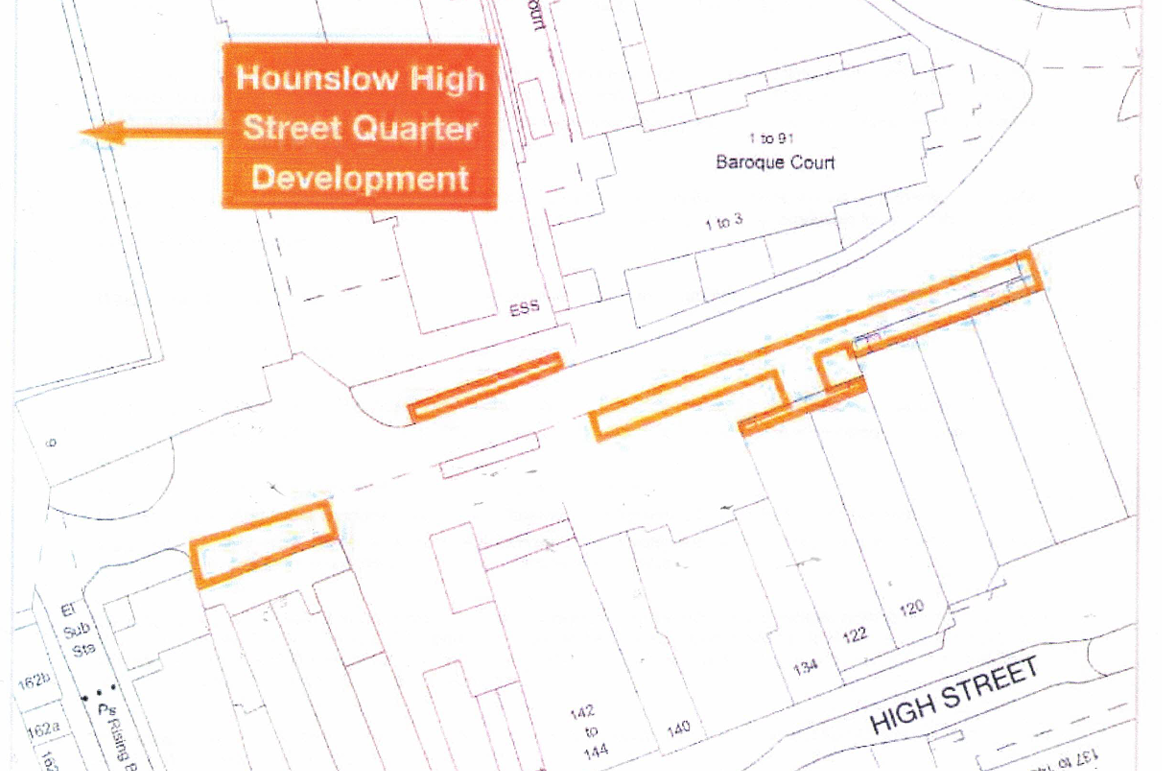
Site map submitted by them:
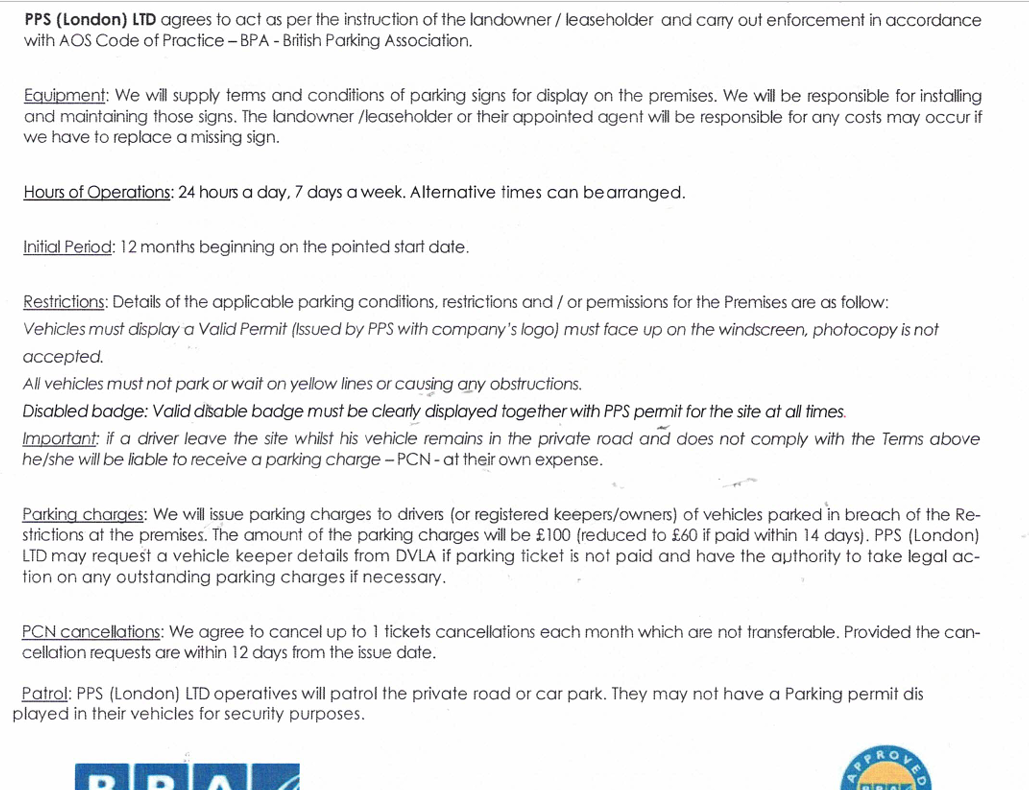
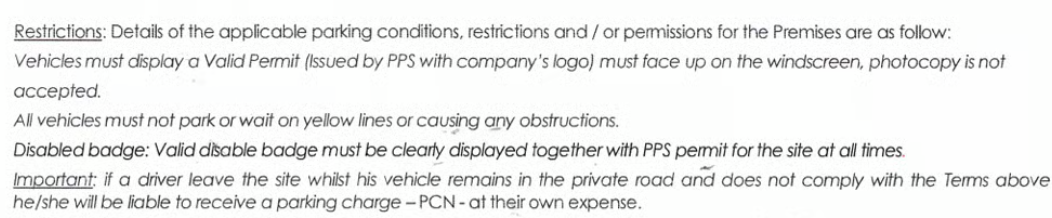
It also says PCN will be issued if driver leaves the site: (What if the driver was in the vehicle?)
 0
0 -
Is there anything I need to add to it please?
0 -
Are you at the stage where they are asking for your comments on the Parking Operator's evidence?
1 -
You can add a sarcastic comment.
"The Appellant notes that a site plan has been submitted, but the parking company does not deem it necessary to mark the boundary on the tarmac in reality. As the Appellant does not possess the gift of telepathy and couldn't see the site plan of this imaginary "controlled area", they fail to see how an unmarked mish mash of tarmac and public highway meets the obligations of the parking company to make any restrictions clear and enable a valid contract to be formed. Simply "not accepting" the fact whilst submitting zero evidence to back up any counter-argument is a tacit acceptance."
2 -
I can come up with some comments on the non-PoFA issues.
The sentence required by 9(2)(b) simply isn't present. Nor is the sentence and invitation required by 9(2)(e).
I agree with above - and a long the same line of thinking - stating that the sentence is present does not make it magically appear!
1 -
yes they are asking me to provide.
0 -
Comments on operator evidence regarding PoFA compliance.
In my appeal I pointed out that the operators NtK was not compliant with the requirements of PoFA Schedule 4 Paragraph 9(2) and, as such, keeper liability cannot occur in a scenario where the driver is not known to the Parking Operator.
The operator has attempted to rebut the non compliance.
Unfortunately they do not quote (verbatim) the sentence from their NtK which they feel satisfies the requirements of 9(2)(b).
In their evidence they state, "The appellant refers to the Parking Charge not being compliant with Schedule 4 Paragraph 9(2)(b) of the Protection of Freedoms Act 2012. The operator does not accept this statement. The Parking Charge issued clearly informs the keeper that the vehicle was parked on private land in a manner whereby the driver became liable for a parking charge, confirms the date, time, location, reason for issue, the amount outstanding, and advises that the charge remains unpaid."
9(2)(b) specifies the following;
The notice MUST inform the keeper that the driver is required to pay parking charges in respect of the specified period of parking and that the parking charges have not been paid in full.
The statute therefore sets out two simple requirements of the sentence in question - i. That the driver is required to pay the charges, and; ii. That the parking charges have not been paid in full.
Whilst I accept that it could be argued that the notice meets the first requirement of the sentence (although the wording varies drastically from the statute and does not refer to the 'specified period of time'), the notice definitely does not specify the requirements of the second element of the sentence, namely; that the parking charges have not been paid in full.
Compliance with 9(2)(b) can be achieved with the following paragraph (or very similar);
"You are notified under PoFA Schedule 4 Paragraph 9(2)(b) that the driver is required to pay parking charges in respect of the specified period of parking and that the parking charges have not been paid in full"
If the POPLA Assessor feels that the notice does contain a sentence which specifies that 'the parking charges have not been paid in full' then I would ask that the Assessor specifically quote this sentence (verbatim) in their appeal finding so that I can be confident that my point is being correctly considered.
Further to the non-PoFA compliant Ntk;
The NtK fails to set out the requirements of Schedule 4 Paragraph 9(2)(e).
9(2)(e) specifies the following;
The notice MUST STATE state that the creditor does not know both the name of the driver and a current address for service for the driver and invite the keeper—
(i)to pay the unpaid parking charges; or
(ii)if the keeper was not the driver of the vehicle, to notify the creditor of the name of the driver and a current address for service for the driver and to pass the notice on to the driver;
The legislation therefore requires the sentence of mandatory wording immediately followed by the setting out of a two limbed invitation to the keeper with the conditions of that invitation determined by sub-paragraph 9(2)(e)(i) and 9(2)(e)(ii) with the two limbs separated by the word 'or' thus giving the keeper the clear two limbed invitation which the legislation requires.
In this instance the paragraph relating to 9(2)(e) is completely missing.
There is no mandatory wording which the legislation specifies that the notice "must state" and there is no two limbed invitation to the keeper set out in the format which the legislation demands.
Compliance with 9(2)(e) can be achieved with the following paragraph (or very similar);
"You are notified under PoFA Schedule 4 Paragraph 9(2)(e) that the creditor does not know both the name of the driver and a current address for service for the driver - the keeper is therefore invited to (i)to pay the unpaid parking charges; or (ii)if the keeper was not the driver of the vehicle, to notify the creditor of the name of the driver and a current address for service for the driver and to pass the notice on to the driver"
This paragraph is also missing from the operators NtK.
Compliance with 9(2)(e) cannot be met in any other way than the setting out of the wording followed by the two limbed choice.
Once again, if the POPLA Assessor feels that the required paragraph is present, then please set out (verbatim) the wording of that paragraph / two limbed choice (separated by the conjunctive adverb 'or') taken directly from the NtK in order that I can be confident that my points are being correctly considered.
(Do not confuse the requirements of 9(2)(f) with those with 9(2)(e) as these are completely separate requirements.)
2






Confirm your email address to Create Threads and Reply

Categories
- All Categories
- 355.8K Banking & Borrowing
- 254.9K Reduce Debt & Boost Income
- 456.2K Spending & Discounts
- 248.3K Work, Benefits & Business
- 605.9K Mortgages, Homes & Bills
- 179K Life & Family
- 263.7K Travel & Transport
- 1.5M Hobbies & Leisure
- 16.2K Discuss & Feedback
- 37.7K Read-Only Boards