We’d like to remind Forumites to please avoid political debate on the Forum.
This is to keep it a safe and useful space for MoneySaving discussions. Threads that are – or become – political in nature may be removed in line with the Forum’s rules. Thank you for your understanding.
📨 Have you signed up to the Forum's new Email Digest yet? Get a selection of trending threads sent straight to your inbox daily, weekly or monthly!
Water Hammer dilemma - particularly regarding costs



Having read a few threads on this topic, I can see this is a common and frustrating issue. I am in a rental, the lady below me owns her flat. Almost every watery thing causes water hammer. Very bad from the shower in particular and I hear it from washing machine, but kitchen taps by washing machine also cause some noise. Toilet seems fine.
Washing machine was replaced a few years ago and I can now hear the water fill stop in my bathroom pipes, which I don't think I ever heard with the prior one. Not sure how both the washing machine and bathroom/shower pipes would both cause noise suddenly though.
Water pressure was reduced last week by plumber and I feel for me it took the edge off a bit in the kitchen taps, but downstairs there is still very bad pipe juddering from shower being turned off.
There have been at least 2 replacements of the shower cartridge (a Bristan) since I moved in almost 8 years ago. Either the water wouldn't stop running at all from the shower, or the temperature control goes wonky. Plumber told me to only have the handle turned for low pressure, last time he replaced it, so turning it from 6 o'clock to about 4 o'clock, whereas previously I'd turned it from 6 'clock up to 2 o'clock because no-one had told me the shower and the pressure aren't a good match or something - was very confused by what he said tbh!
I am fearful that the water hammer suggests a shower valve replacement is needed but am wondering if the fact that it has needed a couple of replacements/repairs already suggests a more complex issue? Or poor suitability. Is there a better option for a shower than keep replacing the same model, perhaps? My landlady is despairing at sudden costs because her own home is in the middle of unplanned massive repairs so having Googled best solutions, I am trying to figure out the cheapest fixes to discuss with her.
I'd happily switch to a shower hose attached to the bath mixer tap but it is currently too big and oval for any options of push on shower hose to work. So then I wondered if replacing the bath tap was a cheaper option so a shower could be fitted direct to that instead, the side panel of the bath would need removing first to access the taps though.
Another Google suggestion is to drain the whole water system and see if that helps which sounds expensive and I am not sure that would work, (she says with zero plumbing knowledge!).
I know an arrestor could fairly easily be fitted to the washing machine, my main concern is the shower needing one too. The tiling behind it was fully redone just a couple of years ago (unexpectedly) at a high cost, would they need to pull off tiles to fit an arrestor or is it done under the bath? The whole building here has also had major renovations over the past 6-12 months so any additional costs are going to be difficult for my landlady right now, so I'm hoping for an affordable solution.
Is doing the shower valve a good option? Which is more likely to solve the shower water hammer best?
If anyone with plumbing experience could advise on likely plumbing costs for different fixes, it would help me discuss things with my landlady and hopefully keep costs down? Downstairs neighbour is being very understanding and I am trying to work round her sleeping/working schedule to minimise noise, but it's not ideal for either of us.
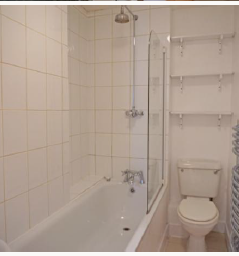
Photo of current shower attached. Huge thanks in advance for anyone who has experienced and fixed this, or with plumbing know-how :-)
Comments
-
Hi PH25.
That's a lot of detail! Which seems to have missed the most important bits 😁
Can you clarify - is the hammer being caused by your appliances in your flat, or from the flat below? Or both?
What kind of heating system/boiler do you have?
Where is the incoming mains to your flat - where do you run if a pipe bursts?
How did the plumber 'reduce the water pressure' in your flat?
Ta.
0 -
lol, sorry. Yes all noise come from my flat only.
Plumber went onto the communal landing and adjusted pressure from there, so I am guessing that's the mains supply to my flat?
Gas central heating with an Ideal brand Logic+ C24 combi boiler.
In terms of me running if a pipe burst, I guess it's where he went in the communal hallway. I've only ever turned the water off under the taps in the kitchen before :-)
1 -
First things first - you need to locate the incoming mains supply to your flat! If it ain't under the sink, then it's likely in that communal landing (cupboard)?
Please find that first thing tomoz, and report back, ideally with a pic.
I suspect that what the plumber did was tweak down the mains stopcock, so reducing the 'flow', and not the pressure. What - exactly - did you notice after he'd done this? Exactly.
What is your water pressure like? Ie, the 'force' with which water comes out the taps? When you stand in front of the kitchen sink and turn the cold on full, does it splash you? Does it look and feel like a powerful jet? If you tried to put your thumb over the spout, would you just end up very wet?
I am hoping that you simply have excess pressure, the most common cause of 'hammer' and 'shock', and the solution would be to add a Pressure Reducing Valve to the incoming mains, just beyond the stopcock - this will reduce the pressure to whatever is needed, but not flow. If necessary, a shock arrestor could also be fitted there. All simple and cheap to do.
(And this would really be for your LL to sort, as it is causing a nuisance to you and others, and is also likely damaging to various valves and bits in the flat. It shouldn't be ignored.)
0 -
Interesting - flow versus pressure. That makes sense as the kitchen tap was quite forceful before and after the adjustment it was tamer. Still good flow, but certainly less power/spray. There does seem to be a noticeable difference also if taps are turned off slowly, rather than shut off to fully close swiftly - ie less noise with a gradual turn down.
One thing plumber said was that all new boilers he fits nowadays have some kind of arrestor fitted at the same time. Mine doesn't, it was installed new in 2018, new washing machine installed 2022, Hisense, WFPV6012EM
picture of cupboard pipes, I'm 9
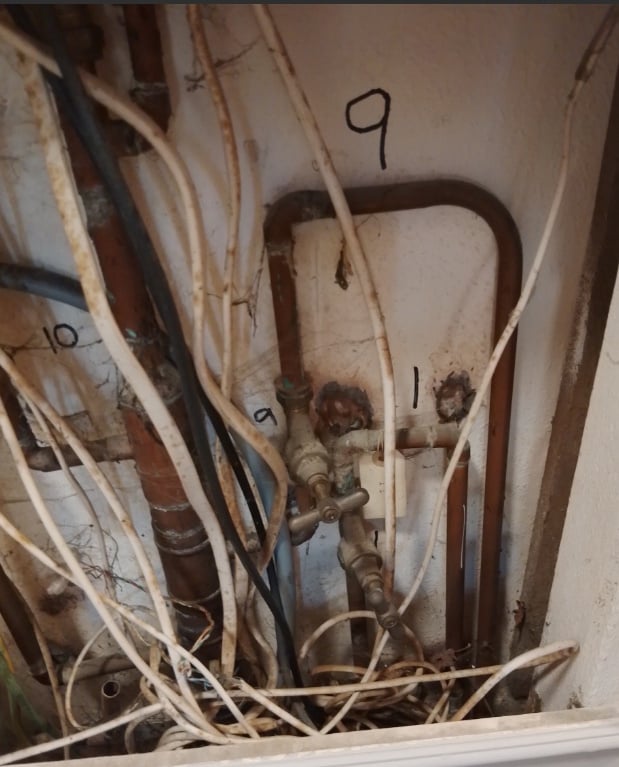
Thanks for your thoughts, landlady is due to visit this evening so this is all helpful info she can take back to the plumbers. His initial suggestion after altering mains, was that if noise still persisted, a handyman could sort it out, no need for a plumber?
1 -
Pressure and flow are very different, but are connected. It is exactly like voltage (pressure) and amps (flow) in electricity; double one and it doubles the other.
Clearly all your 'plumber' did was to turn down the stopcock to partially close it - he added a 'resistor'. That can certainly help the symptoms, but it is not a solution.
What he has done is reduce 'flow'. The 'standing' (no flow, no open taps) pressure in your flat remained unchanged from this; the pressure in the pipes, either side of that stopcock, is identically high. It has to be - they are joined via that stopcock.
However, the way it has 'helped' is by restricting the flow through to the flat, so when you do open a tap, the pressure on the flat side drops away more, as it cannot be resupplied by the mains as quickly as it was before. So, as soon as a tap is opened, the pressure will then drop. But, it'll go right back to full pressure once the tap is closed.
This 'fix' will become an issue as soon as you open more than one tap/toilet/shower/washing machine at a time - the reduced flow just won't be available to supply them all. This basically means that using any other water in the flat will more strongly affect, say, having a shower - you will really notice it. And, because the standing pressure has not actually been reduced, the stress on the pipework and valves remains.
What you actually want is all that lovely 'flow' as before, but at a reduced pressure. That is exactly what a PRV does. And they cost around £35.
Your pipework layout is ideal - fitting it will be a doddle just after the stopcock.
That should be enough, but there remains the option of adding a shock arrester too, just after the PRV, if needed.
Your 'plumber' is not impressive. Not only did he not address the issue correctly, but to suggest it's a handyman task is bewildering.
Perhaps he thinks it's down to a loose pipe that has too much movement in it, but even that is a plumber's job to sort.
Anyhoo, you ideally don't want that guy back.
1 -
Thanks so much for the explanation. To say he was less than interested is an understatement. I mentioned the noise from the washing machine shortly after it was installed, he said old buildings have noisy pipes…. here we are 4 years later…
I am hoping I can persuade my landlady to get a new plumber as this one has not been great on a number of issues. Will be a difficult chat though as guy before was really unreliable and I think she feels she's found someone reliable. Interestingly, since the last post, I had the washing machine running and I didn't get banging pipes, and I checked with my neighbour below who said no noise! She's out for a bit, then I'm going to retest the shower which was truly awful in terms of juddering pipe noise in her flat when turned off.
Is replacing the shower valve (if it ends up just being the shower that now causes noise in her flat) worth doing ahead of the prv, instead of, or at the same time, again cost is a key factor here. The shower has been a pain and a half as originally mentioned.
Thankfully, it's just me, so usually just one watery thing in play at a time. He did at least get me to run the shower and kitchen taps after the adjustment to check he hadn't knocked things out of whack, so that's one silver lining :-)
1 -
Depending on just how high your water pressure is - and the guy obviously didn't measure this - it can cause excess wear on valves and fittings, including ceramic quarter-turn types found in showers and taps. So, there's a chance the pressure contributed to your shower's early demise.
I would expect your LL to add a PRV regardless, if even for their own protection. I presume she is also replacing the shower valve? (It is her responsibility).
Tell her that excess pressure will reduce the life of her taps, valves, and fittings...
0 -
Thanks. Am seeing her tonight to discuss. I wonder if that's why the shower has always been a nightmare?
Fingers crossed we can find a cost-effective fix for the valve and PRV.
Wish me luck.
Thank you so much for your time and help on this. It's not been a fun experience as I am caught in the middle of the owner downstairs and my landlady :-) Both of who are decent people but are coming at the issue from opposite ends obviously.
1 -
Good luck!
It is possible that the high pressure caused shower valve issues. These, and also quarter-turn taps that have ceramic valves, rely to some degree on water pressure to keep them sealed - the pressure pushes the two ceramic surfaces together. In a home with excessively high pressure, you can find taps to be more stiff to operate, so the wear on these discs will be considerably greater.
What were the symptoms of the failing shower?
Regardless of cause (unless you damaged it…) the shower is the responsibility of the LL.
0 -
Is your LL also the LL of the flat below? It's really up to that tenant to also complain, as it's clearly causing a 'nuisance'. Read your deeds (or ask her to) - there will almost certainly be a clause about not annoying other leaseholders and occupiers.
0


Confirm your email address to Create Threads and Reply

Categories
- All Categories
- 355.8K Banking & Borrowing
- 254.9K Reduce Debt & Boost Income
- 456.2K Spending & Discounts
- 248.3K Work, Benefits & Business
- 606K Mortgages, Homes & Bills
- 179K Life & Family
- 263.8K Travel & Transport
- 1.5M Hobbies & Leisure
- 16.2K Discuss & Feedback
- 37.7K Read-Only Boards