We’d like to remind Forumites to please avoid political debate on the Forum.
This is to keep it a safe and useful space for MoneySaving discussions. Threads that are – or become – political in nature may be removed in line with the Forum’s rules. Thank you for your understanding.
📨 Have you signed up to the Forum's new Email Digest yet? Get a selection of trending threads sent straight to your inbox daily, weekly or monthly!
Outside Tap Leaking Help!
Comments
-
They often need two washers as the threaded collar part tends to hit the underside of the tap preventing it being tightened fully.
Signature on holiday for two weeks0 -
As the OPs question has been answered, I will hijack the thread for my own question, as my outside tap looks identical to the one in the OPs picture.
I also thought it leaked from the same place, but recently realised after using a new fitting, it is actually the tap leaking from where the spindle enters the tap. Is this an easy fix? The tap has probably been there at least 40 years. Or would it be best to replace it altogether?
0 -
On the back of this thread, went out with another rubber washer. The existing one in the connector looks to be a white plastic whilst the spare is a softer rubber. Left the white one in and added the black one on top. No more leaks.
The same fix should work for @MOPI
Any language construct that forces such insanity in this case should be abandoned without regrets. –
Erik Aronesty, 2014
Treasure the moments that you have. Savour them for as long as you can for they will never come back again.2 -
Always worth a fix.
This (yellow arrow) is the 'gland nut', and the 'gland' is a washer of some description underneath it, through which the spindle passes, and which should provide a watertight seal.
The actual gland could (likely is) rubber, but used to be 'flax' and grease or similar. The idea is, when you tighten that gland nut, it squishes the gland more flat, which in turn presses it more firmly around the spindle to make it watertight. But, as the tap is used and the spindle is turned, it'll wear the seal. That gland nut is not designed to be fully tightened down, but just enough to perform the task of sealing the gland around the spindle. Ie, you stop tightening when the drips stop.
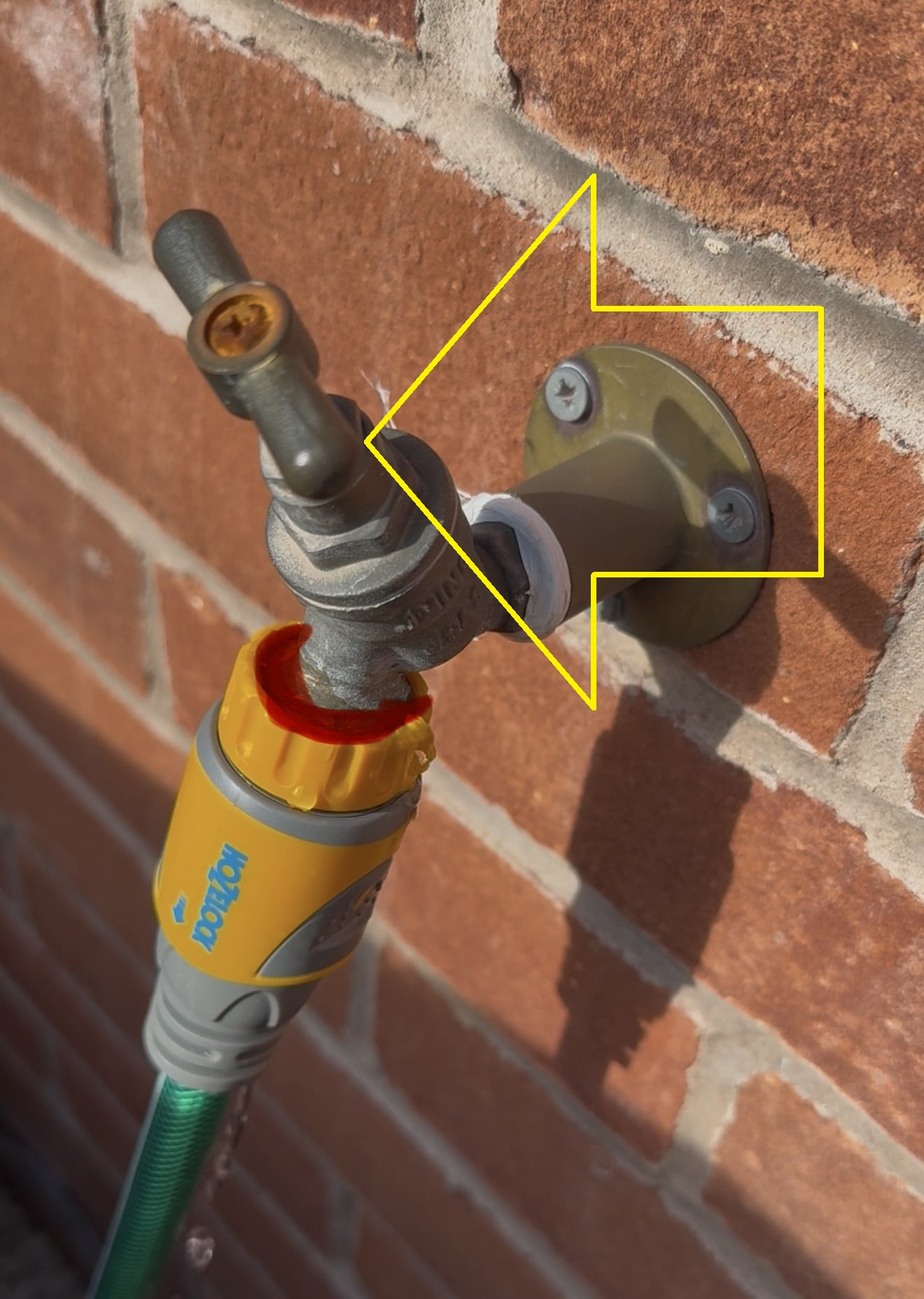
Solution? It could be as simple as a light tightening of that gland nut - literally a fraction-turn clockwise.
Better would be to first apply a good spray of silicone lube - let it run down that spindle, and then open and close the tap a few times to lube the spindle. Then tighten the gland nut a teeny bit as before - just enough to stop the drips.
Better still would be to undo that gland nut fully and slide it up to the handle (remove the handle if it helps access) - no, water will not spray out 'cos the tap is closed. Clean the exposed spindle as far as possible, and add a good smear of sili grease right down in there, before refitting the nut until it 'bottoms' on the gland, then opening and closing the tap a few times to get that lube down the side of the gland. Then tighten the gland nut just enough to stop the drip as before. (Also sili-grease the nut's thread.)
If the gland washer is actually too worn or damaged so won't stop dripping, it can be replaced, but you'd need to be able to prise the old one out. (Remember, the tap won't drip as long as it's turned off).
There are other ways to tackle it, tho'. Eg, lightly wrap a good number of turns of PTFE tape around the spindle, and push it down inside to land on the old gland, ideally also add a good dollop of sili grease too, and then refit the nut.
Or, go old-school, and use natural string! Again, add a good smear of sili grease, give a few wraps around the spindle, and push it down, and tighten the nut just enough as before.
0 -
If you don't want to get water everywhere while working the spindle to lubricate the gland, an outside tap should have a stoptap somewhere close by (usually indoors) on the supply pipe. Close that first!
N. Hampshire, he/him. Octopus Intelligent Go elec / Fuse gas / Vodafone BB / iD mobile. Kirk Hill Co-op member.Economy 7 cap explainer. Gas vs E7 vs peak elec heating costs, Ecoflow Stream, Best kettle :-)
2.72kWp PV facing SSW installed Jan 2012. 11 x 247w panels, 3.6kw inverter. 37 MWh generated, long-term average 2.6 Os.1 -
Thanks, will give it a go at the weekend.
1 -
Yes it has, but I couldn't move it last time I tried. Luckily it is not the main stoptap for the rest of the house ( which does move) . Plus the one in the driveway can be shut off as it is part of a relatively newly installed water meter. Anyway will give it another go .
1 -
Good point. And it would also remove the water pressure from the tap, so allowing the lubricating to be more effective.
But, as long as the tap is turned off, then nothing should come out around that spindle. Even with the gland nut fully removed, nothing should come out as long as the tap is 'off'. Pretty sure… 💧
1 -
Unless you've got all the materials already (e.g. silicone grease) you might find it cheaper to buy a new tap rather than the materials needed for a repair.
And after 40 years there is a good chance the spindle itself is worn, which means all the silicone grease in the world is only going to be a temporary fix.
If replacement of the whole tap looks easy enough then I'd probably treat myself to a new one - sometimes the money saving option isn't a repair.
1 -
Loctite PTFE 55 pipe sealing cord is top for this job.
2










Confirm your email address to Create Threads and Reply

Categories
- All Categories
- 355.8K Banking & Borrowing
- 254.9K Reduce Debt & Boost Income
- 456.2K Spending & Discounts
- 248.3K Work, Benefits & Business
- 606K Mortgages, Homes & Bills
- 179K Life & Family
- 263.8K Travel & Transport
- 1.5M Hobbies & Leisure
- 16.2K Discuss & Feedback
- 37.7K Read-Only Boards