We’d like to remind Forumites to please avoid political debate on the Forum.
This is to keep it a safe and useful space for MoneySaving discussions. Threads that are – or become – political in nature may be removed in line with the Forum’s rules. Thank you for your understanding.
Communal problem -v- access




I know the devil is in the detail therefore I should read my lease but in general is there any overarching principles or general ways things work where there is a problem with a communal part of the freehold building but access to fix and repair it can only be done via one flat?
Have a leak, may be communal soil pipe, freeholder has said if thats the leak then its for them to fix but has been silent on what it means for our fully tiled bathroom, especially if the same tiles cannot be sourced to replace the ones broken to gain access
Comments
-
The repair would be carried out by the freeholder but I believe that you would need to claim on your contents insurance for internal redecoration including tiling.
This would be the same if a leak from the flat above caused staining to your ceiling
1 -
I doubt that your lease would contain any terms on such a specific issue.
Is the freeholder / management company making a buildings insurance claim for this - under "trace and access" cover?
(And the pipe won't be 'communally owned', it's probably owned by the freeholder.)
But I guess more generally…
- The freeholder needs to repair their pipe
- If the freeholder needs to damage your bathroom wall and tiles to gain access to their pipe, they need to make good the damage afterwards (either using Service Charge funds, or using funds from an insurance claim).
But the issue of matching tiles being unavailable is probably less clear - i.e. should the freeholder pay for retiling the whole bathroom?
If an insurance claim is involved, the insurer might have specific terms in their policy about 'matching sets' etc, which would determine whether or not they would pay for the whole bathroom to be retiled. (But just because full retiling isn't covered by insurance, it doesn't necessarily mean the freeholder isn't liable to cover the cost.)
But the additional consideration for the freeholder is if they agree to cover the cost of full retiling (and it isn't covered by insurance), the money must come from Service Charge funds, and other leaseholders can challenge that at a tribunal. So I suspect most freeholders would not want the hassle of a tribunal case, and face the risk of losing the case. So they might want to refuse to pay on that basis.
I guess you could try to persuade the freeholder to go to tribunal before they agree to retile the whole bathroom, to get a ruling on whether or not the cost can come from the Service Charge funds. But the freeholder probably won't be keen on that much hassle, and it's likely to be 6 months or more before they can get a tribunal hearing.
0 -
gwynlas said
The repair would be carried out by the freeholder but I believe that you would need to claim on your contents insurance for internal redecoration including tiling.
This would be the same if a leak from the flat above caused staining to your ceiling
Paintwork, plaster and tiles are not contents, they are part of the building, so they won't be covered by contents insurance.
Similarly, a stained ceiling wouldn't be covered by contents insurance - depending on what caused it, it might be covered by buildings insurance. (With flats, the buildings insurance is often arranged by the freeholder.)
Except that some contents policies cover 'tenant's improvements' to the building. So if the OP replaced the original standard tiles with fancy, expensive ones…
… there might be a situation where the freeholder pays the cost of replacing standard tiles, and the OP's contents insurance pays the difference in costs for fancy expensive tiles.
But that might be influenced by other factors like "Did the OP get consent from the freeholder for alterations - including installing fancy expensive tiles?"
0 -
Whilst its unknown if the problem is with out connection to the shared soil stack or the soil stack itself the freeholder is saying we should claim off their insurance and therefore we would pay the £1,000 excess and the situation be reassessed if the T&A finds its a communal problem.
Its not abundantly clear at what point it goes from mine to ours but we'll cross that bridge when it comes to it
0 -
MyRealNameToo said
… if the T&A finds its a communal problem.
You talk about a "communal problem". Can you clarify, do you mean that…
- 1) Your lease literally says that the shared part of the soil pipe is the joint responsibility of all the leaseholders?
Or
- 2) Your lease says that the shared part of the soil pipe is the responsibility of the freeholder - and you're making the point that the freeholder will charge all the leaseholders via the service charge? (So it's really the freeholder's problem.)
Option 1 would be very unusual. Option 2 is much more typical.
MyRealNameToo said
Its not abundantly clear at what point it goes from mine to ours but we'll cross that bridge when it comes to it
Leases normally make that very clear.
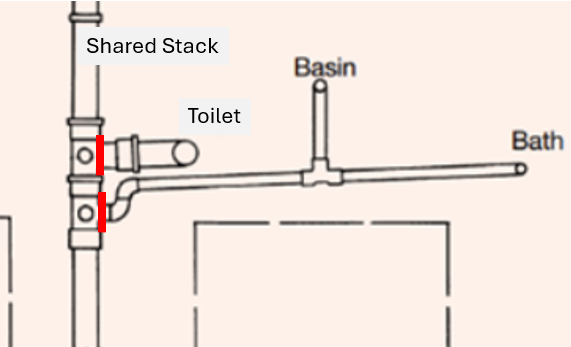
Typically, sections of pipework that are exclusively used by one flat are the responsibility of the leaseholder, and sections of pipework that are used by more than one flat are the responsibility of the freeholder. (But double-check that in your lease.)
So in this example picture, the shared stack would be the freeholder's responsibility, and everything to the right of the red lines would be the leaseholder's responsibility.
 0
0 -
Thanks for the clarification, going by what the estate manager said, rather than having dug out the lease… normally ok at reading legal documents but leases are archaic (or US style) in both the use of language and how they are laid out.
My question is really on the nuances, your red line divides the single piece T into two… I get that if my pipe has become disconnected with the T its my problem, I get that if the communal stack has become disconnected its a freeholder/shared problem. What if the T itself has some how failed?
Personally I question if it is a shared stack, as I mention there are three soil stacks coming out at the same place and whilst its crazy to have put three seperate stacks rather than a communal one there is no logical explanation for the other two. Their people say it's shared and basically denied the existence of the other two so not in my interests to argue against them.
0 -
MyRealNameToo said
Thanks for the clarification, going by what the estate manager said, rather than having dug out the lease…
OK - well I would be 95% certain that the lease says freeholder is responsible for the shared stack.
And the estate manager was using 'sloppy language' to explain that the freeholder would use service charge funds for any repairs to the shared stack, and…
- The service charge fund bank account contains money contributed by all leaseholders
- If there is enough 'spare money' in the service charge fund bank account for the stack repairs (or pay the insurance excess), the freeholder will use that
- If there is not enough 'spare money' in the fund bank account, the freeholder will send out service charge demands to the leaseholders, telling them to pay more money
MyRealNameToo said
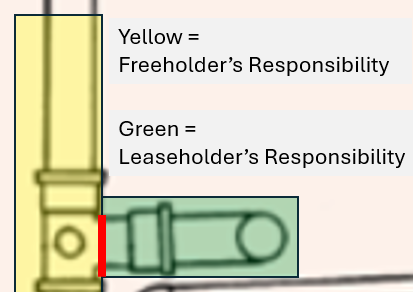
My question is really on the nuances, your red line divides the single piece T into two… I get that if my pipe has become disconnected with the T its my problem, I get that if the communal stack has become disconnected its a freeholder/shared problem. What if the T itself has some how failed?
I guess you mean… What if the leak is precisely under the red line? It's unlikely, but then maybe you would have some arguments. Maybe the solution would be to say the cost is split 50/50 between leaseholder and freeholder (and the freeholder's 50% would come from service charge funds).
 0
0


Confirm your email address to Create Threads and Reply

Categories
- All Categories
- 355.7K Banking & Borrowing
- 254.9K Reduce Debt & Boost Income
- 456.1K Spending & Discounts
- 248.3K Work, Benefits & Business
- 605.8K Mortgages, Homes & Bills
- 179K Life & Family
- 263.6K Travel & Transport
- 1.5M Hobbies & Leisure
- 16.2K Discuss & Feedback
- 37.7K Read-Only Boards