We’d like to remind Forumites to please avoid political debate on the Forum.
This is to keep it a safe and useful space for MoneySaving discussions. Threads that are – or become – political in nature may be removed in line with the Forum’s rules. Thank you for your understanding.
How are people actually calculating their home base load?



I’ve been looking into plug-in solar recently, but before jumping in I want to properly understand my base load and how much I could realistically offset.
What I’m trying to figure out is what methods or apps people are using to calculate their base load accurately. I’m aware it’s basically your constant usage like fridge, router, standby devices etc, but I’m not sure what the best way is to measure it in practice.I’ve got a smart meter, but the data hasn’t been the most reliable so far, so I’m wondering if there are better tools, apps, or even manual methods people recommend.
For those who’ve done this, how did you calculate your base load, and did it actually help you decide whether solar was worth it?
Comments
-
Assuming by base load you mean the things that are just always on in the background, so not including things that are actively used (TVs, cooking etc). The simplest way is to look at your half-hourly usage from your smart meter overnight when only background usage should be in play.
In what way is your smart meter data "not reliable". If that is the case, I'd be more worried about being billed correctly than what your base load is.
If you're with Octopus, the free Oct-Aid app provides a base load figure.
3 -
Obviously base load varies throughout the day as devices switch in and out automatically. I'm home most days, tv on, fridge, freezer, hot tub, cooking lunch, boiling kettle etc. Base load average using my smart meter home readout is around 400watts per hour. I already have solar installed and any solar not being used in the home goes to heat my domestic hot water, then if there is anything left it gets sold/exported to the grid.
1 -
Yeah, by base load I mean your overnight baseline usage — the stuff that’s always on even when you’re asleep and not actively using anything.
That usually includes things like:
- Fridge/freezer cycling
- Router/WiFi
- Standby devices (TV, consoles, etc.)
- Possibly a boiler, aquarium pumps, or security systems
This is actually the most useful number for solar, because it tells you the minimum energy you’ll always consume
0 -
If you have a smart meter, you should be getting a breakdown in your bill of the 30 min segments.
Our Octopus statement also has
Total consumption
6.51 kWh
Off peak consumption
0.92 kWh (£0.06)
Peak consumption
5.59 kWh (£1.48)Life in the slow lane0 -
Use an app like Bright which can breakdown your usage by the 30 min intervals. You can download the data from their web site glowmarket as a csv as well.
4.8kWp 12x400W Longhi 9.6 kWh battery Giv-hy 5.0 Inverter, WSW facing Essex . Aint no sunshine ☀️ Octopus gas fixed 5.07 + Octopus Intelligent Flux leccy
CEC Email energyclub@moneysavingexpert.com1 -
The simplest way is to look at your half-hourly usage from your smart meter overnight when only background usage should be in play.
This is how I judge my base load, by looking at my half-hourly smart meter readings for the middle of the night (although, if I'm awake early or late enough, I can get the same info by looking at my IHD, or from my Octopus Home Mini via the app).
If I pay enough attention I can even tell when the fridge and freezer are running.
For example the lowest 30-minute use last night was 0.05kWh, which means my base load is double that & 0.1kW, or 100 watts.
N. Hampshire, he/him. Octopus Intelligent Go elec / Fuse gas / Vodafone BB / iD mobile. Kirk Hill Co-op member.Economy 7 cap explainer. Gas vs E7 vs peak elec heating costs, Ecoflow Stream, Best kettle :-)
2.72kWp PV facing SSW installed Jan 2012. 11 x 247w panels, 3.6kw inverter. 37 MWh generated, long-term average 2.6 Os.0 -
Does your IHD work - if not some meters will give you a live input power /or hourly equivalent energy reading on LCD panel readout.
If your taking kWh from a supplier portal, app or bright etc per 1/2 hour - remember to double it for the actual average power in that period.
When I left home for several days last autumn (I leave heating on low in colder months so its not a true background reading for more recent trips) - including two c6-8W leds bulbs for "security" on timers for evenings - I used just 0.8-0.9 kWh / day over several days - an average of just 35W (the internet router would have been off then as well, but FF whilst active unused).
So maybe my normal daytime empty average more like 50W - a tiny fraction of the 800W panel capacity when operating at rated.
My friend has outside fish pond and acquariums - his daytime lows more like 250W (was 400W with 2 old pumps - now only has one modern in pond). Plug in Solar would be good for him - and he has outdoor sockets already.
Of course if in and in summer in evenings etc when solar will still have decent I suspect output if not rated - it could save far more.
My heavy use is HW tank and heating on a separate restricted feed from meter - not sure I could really justify £500-600 fitted including special outdoor socket etc as it wouldn't really impact those big cost items.
Beware of leaving too much - especially older kit on standby 24/7 - I don't leave anything on standby when go out or to bed - as that adds around 10-15W for my TV/associated kit (my old LCD alone added 15W if left fast wake mode on - including its wireless) - say c20W for my desktop PC kit.
I'd probably be using c1kWh (oops missed the h) more if left both and router on at mains 24 hrs a day when empty cf figure above.
0 -
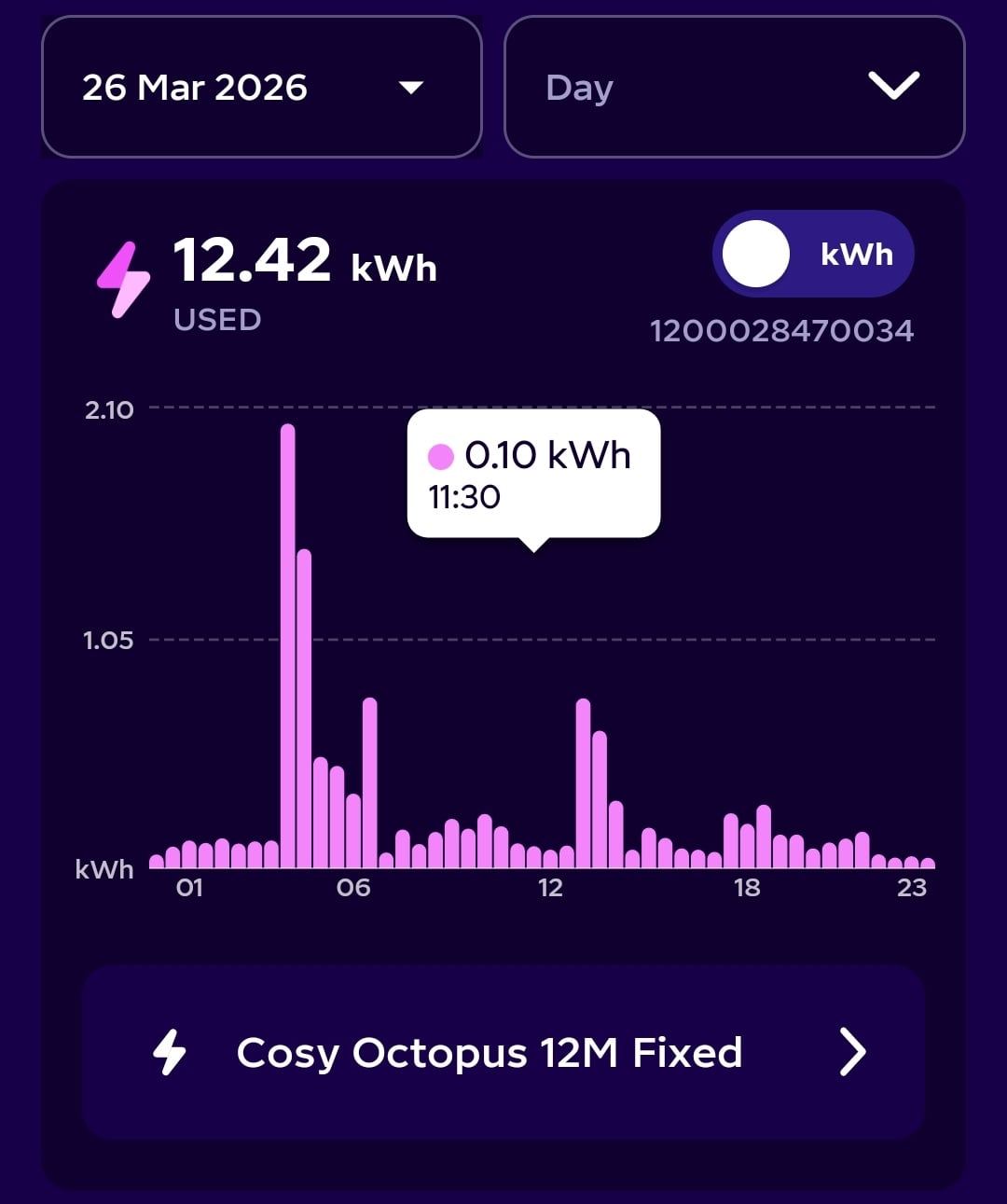
Just look at your daily usage chart, double your minimal usage (assuming it's in 30 mins slot). My one is roughly 200W. Also if you after plug in solar, focus more on daily Mo-Fri 9-17 rather than night etc.
 0
0 -
I guess if your property is empty all day then that might be a useful figure to know. If you or someone is at home or work from home you will be using more so the figure won't be useful. I understand the payback with plug in solar is lengthy but you might consider it for environmental reasons.
1 -
I would be more concerned about other forms of load. I have solar & my biggest issue is the power shower. It uses 8.5kWh but the most the battery can put out is about 4kWh so unless the solar is doing 4.5 then it is coming from the grid Then there is the kettle!
If you are only usiing 50-100watts during the night then that should not be a problem.
1






Confirm your email address to Create Threads and Reply

Categories
- All Categories
- 355.7K Banking & Borrowing
- 254.9K Reduce Debt & Boost Income
- 456.1K Spending & Discounts
- 248.3K Work, Benefits & Business
- 605.9K Mortgages, Homes & Bills
- 179K Life & Family
- 263.7K Travel & Transport
- 1.5M Hobbies & Leisure
- 16.2K Discuss & Feedback
- 37.7K Read-Only Boards