We’d like to remind Forumites to please avoid political debate on the Forum.
This is to keep it a safe and useful space for MoneySaving discussions. Threads that are – or become – political in nature may be removed in line with the Forum’s rules. Thank you for your understanding.
📨 Have you signed up to the Forum's new Email Digest yet? Get a selection of trending threads sent straight to your inbox daily, weekly or monthly!
Newbie - sole exectutor of parent's complex(ish) estate
Comments
-
Hi all
Thank you for the quick replies and helpful info. I am starting to feel like this is do-able, particularly the chattels valuation. I guess I was questioning in my own mind the contrast between £700k+ invested and living in a relatively simple manner albeit one cluttered by stuff purchased for a few pence or pounds and whether a low contents valuation would be questioned by HMRC alongside an estate of ~1.5M
To give some more context to the estate
- defined cash amounts left to 6 named individuals
- I am the beneficiary for the residual estate
- Additional nil-rate band is applicable so IHT threshold is 500k
- Stocks and shares are all held in ISAs so CGT is not a concernThe two tricky areas are going to be:
1. Gifting: in addition to regular monthly gifting to me, there were multiple ad hoc larger amounts particularly over the past 3-4 years - these can be reconciled against a significant excess in income Vs expenditure but there are a couple of examples on bank statements of “£x incoming from broker account and immediately £x paid to me” - these look like gifts from capital so should be declared as such to avoid issues down the road I guess?
2. Tax treatment of the residence: it was a rental property post-purchase until my parent then wound up the letting and used it as their residence for the past 3 years so there would have be a capital gain on the uplift between purchase and the point at which it ceased being a business asset and became the primary residence had it been sold before death; I do not know how this is handled within the estate so professional opinion needed
One other question which has come up from starting to draft the gifting numbers - tax returns from previous 7 years are useful for income and tax paid. What do I do about a tax return for the tax year ending April 2026? Will HMRC send me a summary or will I have to try to file a posthumous return?
Note to us all - when saving documents on the computer, it really helps one’s nearest and dearest if things are filed in obvious-sounding folders and are given names more descriptive than “document 1” 🙄 Thank goodness for the search feature in Windows Explorer!
1 -
Couple of tax points:
The residence - all pre death taxable gains have been erased on death. However since IHT is in point you will need to obtain a professional RICS 'Red Book' valuation in case HMRC choose to challenge the valuation ( for whatever reason).
As regards annual HMRC tax compliance your father would have had to submit annual self assessment tax returns. Did he do it himself or did he have an accountant? If he handled this DIY, then you now have the executor obligation to complete his return to date of death. If you have no experience at all of completing such tax returns you may require professional assistance from a tax accountant, especially in handling the foreign taxed dividends arising in the investment portfolio.
Similarly, with a £700k investment portfolio , there will be estate income tax and possibly capital gains tax payable by the estate over the course of the administration period. Again this may necessitate completion of a formal estate tax returns SA900, which is a learning curve separate and distinct from the process of completing personal tax returns.
In dealing with complex estates the devil is very much in the detail, much of which you may not have ever encountered. For example, if you do not distribute fixed sum legacies within a year of death, the legatees are entitled to statutory interest payable thereon ( a charge to estate residue).
In the circumstances you might benefit from investing in an executor's administration guidance manual, if you are intent on handling the whole matter with minimal professional help.
3 -
Stocks and shares are all held in ISAs so CGT is not a concern
That makes things easier.
The two tricky areas are going to be:
1. Gifting:in addition to regular monthly gifting to me, there were multiple ad hoc larger amounts particularly over the past 3-4 years - these can be reconciled against a significant excess in income Vs expenditure but there are a couple of examples on bank statements of “£x incoming from broker account and immediately £x paid to me” - these look like gifts from capital so should be declared as such to avoid issues down the road I guess?HMRC have some discretion of what they accept as gifts from excess income, and there are some grey areas. It seems to be up to the Executor to provide proof and they may well examine that closely. So yes 'tricky' .
2 -
2. Tax treatment of the residence: it was a rental property post-purchase until my parent then wound up the letting and used it as their residence for the past 3 years so there would have be a capital gain on the uplift between purchase and the point at which it ceased being a business asset and became the primary residence had it been sold before death; I do not know how this is handled within the estate so professional opinion needed
AIUI, no CGT for asset still owned at death
1 -
2. Capital Gains is extinguished on death, so my understanding is that you would just use the value of the property for IHT purposes
I’m a Forum Ambassador and I support the Forum Team on the Pension, Debt Free Wanabee, and Over 50 Money Saving boards. If you need any help on these boards, do let me know. Please note that Ambassadors are not moderators. Any posts you spot in breach of the Forum Rules should be reported via the Report button, or by e-mailing forumteam@moneysavingexpert.com. All views are my own and not the official line of MoneySavingExpert.2 -
Clearly there are some complications, but given fixed sum legacies and the residual to you alone, it is a good deal simpler than it might have been. It means you do not need to lose sleep over the value of the chattels!
Signature removed for peace of mind1 -
I've just been through the same process on a DIY estate worth around 1.7 with 2 properties and foreign bonds.
You can absolutely do this yourself if you have some financial savvy about you. The only professional help I'm getting is from an accountant as there are 2 personal returns to do and there will be 2 estate returns as well including capital gains and top slicing relief on the personal return. I obtained probate in 4 months myself which is far quicker than a solicitor would in those circumstances and I'm now in the administrative period. All fixed legacies have been paid and just trying to sell the properties and get the tax returns done before residual distribution. It's daunting at first but I've actually weirdly got a lot of satisfaction by doing it myself and not having to pay and also chase a solicitor.
The help and guidance on this forum is invaluable, and the knowledge base is great so go for it
2 -
Thanks, Poseidon1
Helpful to know about tax treatment for the property - RICS valuation should be straightforward.Re annual tax return: this was previously done by an accountant who retired earlier this year. I could do it myself as it's probably not much more complex than my own tax return but under the circumstances it may be better for professional continuity and finding someone to do this…But there should be no foreign taxed dividends as the investments are all ISA-wrapped.
My understanding was that investments in an ISA would benefit from continued protection Vs income and CGT tax for up to 3 years and 1 day after the death…am I mis-reading the "If you die" section of the gov.uk page?
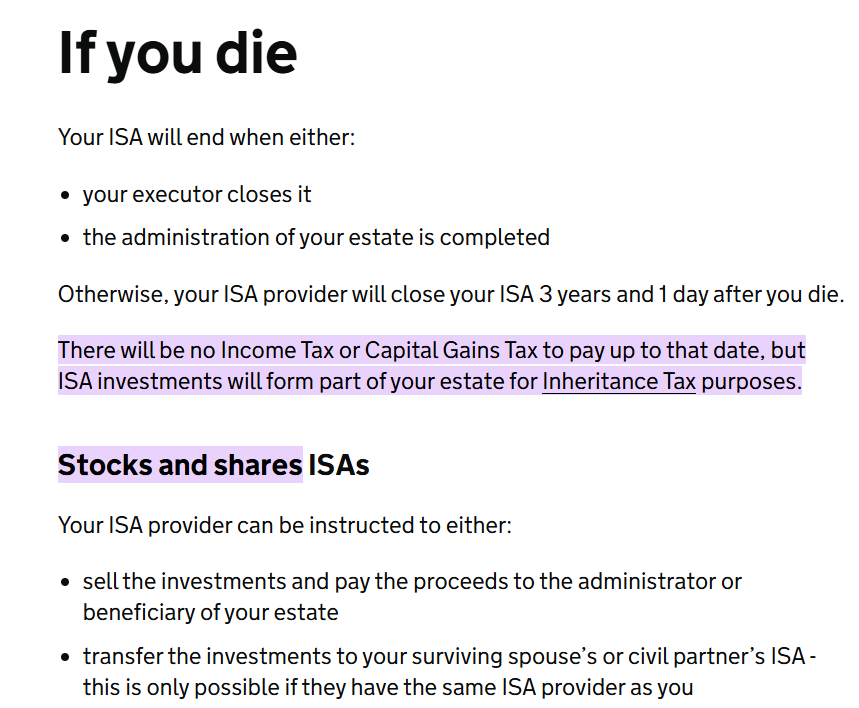
Fully recognise your comment about the devil being in the detail, of which I have no prior knowledge. I am keen to do what I can myself, but not deluding myself that I am capable of things about which I know nothing and cannot learn quickly. I will get a copy of a guidance manual as it will certainly help.
0 -
My understanding was that investments in an ISA would benefit from continued protection Vs income and CGT tax for up to 3 years and 1 day after the death…am I mis-reading the "If you die" section of the gov.uk page?
That is correct AIUI.
Although of course hopefully the adminstration of the estate will be closed off a lot quicker than three years.
1 -
Re: - Is there anything I can do about potentially significant market fluctuations in the stocks/shares between value at date of death (assuming this is what is declared to HMRC) and value at sale - could be more…or less?
If you sell shares within 12 months (of death) at a lower value than at date of death, you can reclaim any IHT paid on the difference using form IHT35.
https://www.gov.uk/government/publications/inheritance-tax-claim-for-relief-loss-on-sale-of-shares-iht35
1















Confirm your email address to Create Threads and Reply

Categories
- All Categories
- 355.8K Banking & Borrowing
- 254.9K Reduce Debt & Boost Income
- 456.2K Spending & Discounts
- 248.3K Work, Benefits & Business
- 606K Mortgages, Homes & Bills
- 179K Life & Family
- 263.8K Travel & Transport
- 1.5M Hobbies & Leisure
- 16.2K Discuss & Feedback
- 37.7K Read-Only Boards