We’d like to remind Forumites to please avoid political debate on the Forum.
This is to keep it a safe and useful space for MoneySaving discussions. Threads that are – or become – political in nature may be removed in line with the Forum’s rules. Thank you for your understanding.
Should I Delay Buying Gilt Ladder
Comments
-
It maybe because many years ago the published gilt price was the dirty one. Gilts issued at that time continue to be priced at the dirty value even after later gilts were changed to clean pricing.
2 -
I suspect that's maybe because there's an expectation of an inflation spike short term. In which case the market thinks -0.232% is a price worth paying. I'm no expert on gilts though - it just seems like a logical explanation.
0 -
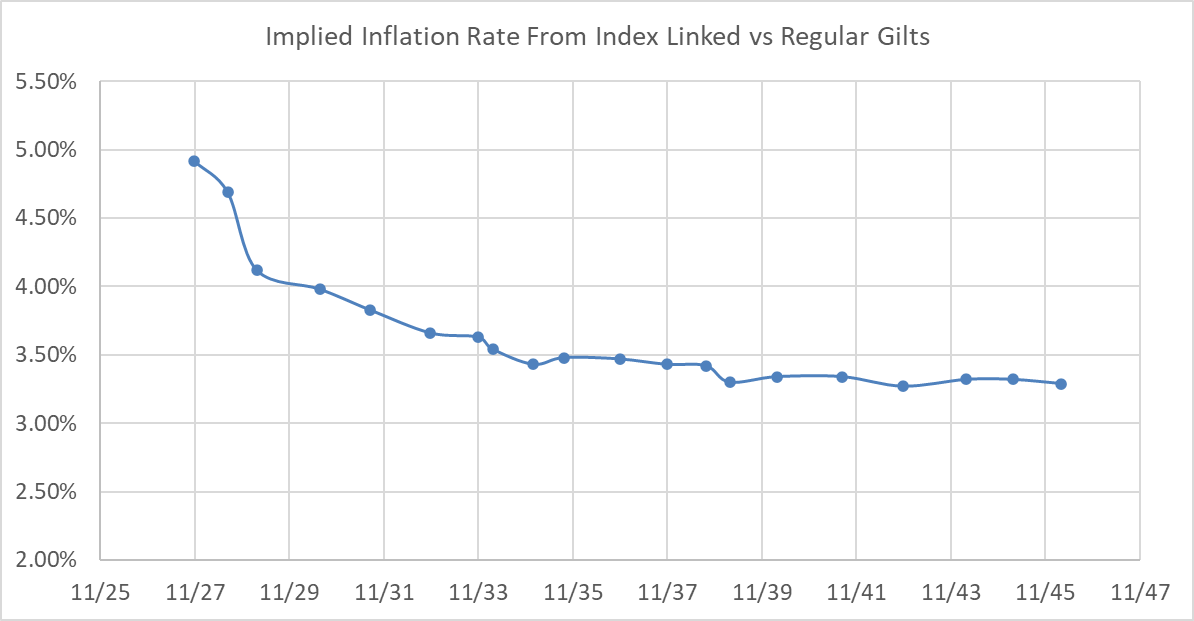
Well I think you are right - at least the page I look at says the implied RPI Growth for T28 is 4.67%. Longer dated ones tend to start with a 3.
0 -
Here is a quick plot of implied inflation, made by comparing conventional vs index linked gilts using today's prices.
You should never think about buying a certain number of IL Gilts because the dirty prices (the price you pay) are all over the place. Instead, think about investing a certain amount of money. Then everything cancels out and makes sense, and the returns are exactly as they should be. I went through a worked example in a post last November. Take a look at it here:
Two gilts, T2IL and T30I belong to an older class of gilt which lags inflation by 8 months (modern gilts lag by 3 mths). They are always quoted as a dirty price.
0 -
For the same yield, the one priced at over 100 will have a higher coupon than the one priced below 100. To take two examples (prices from giltsyield.com)
TR31 (coupon 0.125%, price 96.95), coupon/price ratio is 0.129%
T32 (coupon 1.25%, price 101.34), coupon/price ratio is 1.233%
In other words, the coupon component of the the cashflow is higher with T32 than with TR31 (although note that the yields to maturity are not quite the same in this example)
In the second example (note neither is priced at more than 100, but the first is close enough to provide an illustration),
T38 (coupon 1.75, price 97.92) the coupon/price ratio is 1.787
TG39 (coupon 0.125, price 78.09), the coupon/price ratio is 0.160
So, those priced above 100 will provide higher cashflow before maturity but less at maturity and vice versa.
0












Confirm your email address to Create Threads and Reply

Categories
- All Categories
- 354.6K Banking & Borrowing
- 254.5K Reduce Debt & Boost Income
- 455.5K Spending & Discounts
- 247.5K Work, Benefits & Business
- 604.4K Mortgages, Homes & Bills
- 178.6K Life & Family
- 262K Travel & Transport
- 1.5M Hobbies & Leisure
- 16.1K Discuss & Feedback
- 37.7K Read-Only Boards