We’d like to remind Forumites to please avoid political debate on the Forum.
This is to keep it a safe and useful space for MoneySaving discussions. Threads that are – or become – political in nature may be removed in line with the Forum’s rules. Thank you for your understanding.
OVO Direct Debit Increase
Comments
-
After trying to get this resolved for the last 18 months, I just can't be bothered anymore. Monthly variable direct debit suits me better as I change supplier every November and April so I now never have to wait for delayed final bills and £400+ credit refunds.
2 -
Oh, I see. In which case no point raising a complaint.
1 -
There's a lot of muddle in this thread, so let's try and clarify. I can only speak to electricity, since gas hasn't yet been invented where I live:
- OVO have changed their minimum DD policy two or three times in the past couple of years. The changes aren't exposed in the Core Terms and Conditions, but they are covered in a help article the core terms refer to. Sadly, there's a lack of precision which doesn't make interpreting the rules any easier for customers or indeed support staff.
- It hasn't been explained why 'credit for 1 month's payment' should remain in the account at 31 March, although common sense would suggest that this is the point where a typical DD customer's account balance is at its lowest at the end of the heating season. A properly regulated balance would then normally vary between '1 month's credit' at 31 March and '7½ weeks' credit' at 30 September, as the heating season begins.
- The DD amount is calculated from the account's Future Annual Consumption (FAC) figure, which for a mature account* will equate to the consumption for the preceding 365 days. The annual cost is calculated according to the current tariff, plus the cost of any upgrades and VAT. Each month's cost is then worked out using a standard seasonal variation (this has, for example, December's usage as 10.8% of the year's total, while June accounts for 6.3%). There is no prediction based on expected climatic conditions or possible future tariff changes. The figure for costs for the remainder of the period is adjusted by the current balance on the account.
- This figure is then inflated by '1 month's payment' to find what the DD has to be to end up with that extra buffer at 31 March.
The buffer is simply calculated as 1/12 of the projected annual cost, now excluding amounts for upgrades. It is not affected by the size of the current DD amount, nor by the 'recommended' DD amount however different that may be from the current figure. - If the required DD seems to be much higher than the customer feels is reasonable, the cause is usually an inaccurate FAC.
IMO, having a credit balance big enough to cover one or two months' usage seems eminently reasonable, to prevent a slide into debt should something prevent a DD from being paid. This isn't what generates unacceptably high customer credit balances; they result from customers' inattention to the state of their account.
- A 'mature' account is one where at least a year has passed since it was opened and since the meter was installed. During the first year, the FAC will be affected by the national database's estimate of what it might be (the 'EAC'). In my experience, this estimate often bears little relation to the customer's actual consumption.
I'm not being lazy ... I'm just in energy-saving mode.
If you're asked to post a photo of your meter Meter Configuration Tables v2.0.xlsx2 -
I always ask for any credit balance at 1st April to be refunded. One supplier said that you need to leave the equivalent of two month's DD between October and March, and one month's DD between April and September. That's why I stopped asking for the credit in March and left it till April.
0 -
@luci wrote:
I always ask for any credit balance at 1st April to be refunded.
This will of course depend on what date the monthly DD is taken. The balance will be greatest if the DD is taken on the 28th, least if it's taken on the 1st. It may be worth pointing out that the DD recommended on any particular date will be correspondingly less or more.
I'm not being lazy ... I'm just in energy-saving mode.
If you're asked to post a photo of your meter Meter Configuration Tables v2.0.xlsx0 -
I should have said April rather than 1st April. I have always had my DDs taken on the 1st of the month. I switched to Outfox in November and they take the DD on the 11th, which I have never bothered changing. Because I switched in November, rather than my usual March, I haven't built up any spare credit. I'm actually surprised that they haven't increased my DD, as I'm usually in debit before my DD goes in.
0 -
@luci wrote:
I'm usually in debit before my DD goes in.
You realize that that's a contravention of OVO's Core Terms, don't you?
I'm not being lazy ... I'm just in energy-saving mode.
If you're asked to post a photo of your meter Meter Configuration Tables v2.0.xlsx0 -
I'm not with Ovo, but assume most suppliers will have a similar clause.
At my statement date, I am in debit. Once the DD is taken, I am in credit until the next statement. I have never been in debit with any previous supplier due to joining them in March and building up a credit balance. It's due to switching just before the highest bills and usage of the year that I am in debit at some point during the month, based on my average DD across 12 months.
1 -
I'm also not currently supplied by Ovo, but I do like to check out suppliers terms & conditions, especially when it is suggested something unusual is hidden within.
I did take a brief look at Ovo t&cs, but didn't identify the term(s) being alluded to. Perhaps I missed them?
Could someone let me know which term(s) in particular were being spoken about please?
Meanwhile, there is one supplier that currently only accepts payment in full every month, so presumably all their customers (over 200,000 at the last count) have an account in debit for the 3 working days between bill production and payment/dd collection.
I think I remember there is at least one other supplier (I forget who) who does say the customers account must not be allowed to fall into debt (or was it debit? there is a difference), but I don't think anyone takes too much notice if an account is only temporarily in a debit situation until it is cleared/put back into credit by the next payment/dd collection (before a subsequent bill is created). Afterall, if a customer's account was seen to be in debt /debit and the supplier was concerned, what would be the first reasonable thing the supplier would do?
The meters are presumably known as credit meters for good reason.
1 -
@[Deleted User] wrote:
I did take a brief look at Ovo t&cs, but didn't identify the term(s) being alluded to. Perhaps I missed them? Could someone let me know which term(s) in particular were being spoken about please?
It's § 7.11:
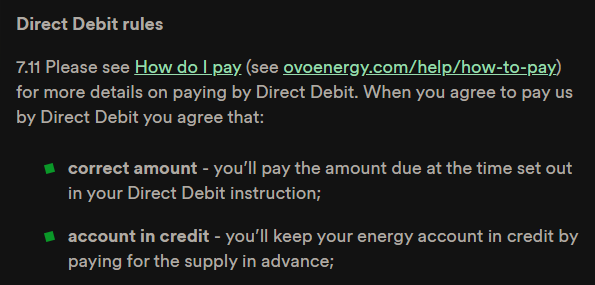
[The link I gave should have opened the page to the right spot with the relevant text highlighted. Not every browser supports this feature - sorry!]I'm not being lazy ... I'm just in energy-saving mode.
If you're asked to post a photo of your meter Meter Configuration Tables v2.0.xlsx1





![[Deleted User]](https://us-noi.v-cdn.net/6031891/uploads/defaultavatar/nFA7H6UNOO0N5.jpg)


Confirm your email address to Create Threads and Reply

Categories
- All Categories
- 355.7K Banking & Borrowing
- 254.9K Reduce Debt & Boost Income
- 456.1K Spending & Discounts
- 248.3K Work, Benefits & Business
- 605.9K Mortgages, Homes & Bills
- 179K Life & Family
- 263.6K Travel & Transport
- 1.5M Hobbies & Leisure
- 16.2K Discuss & Feedback
- 37.7K Read-Only Boards